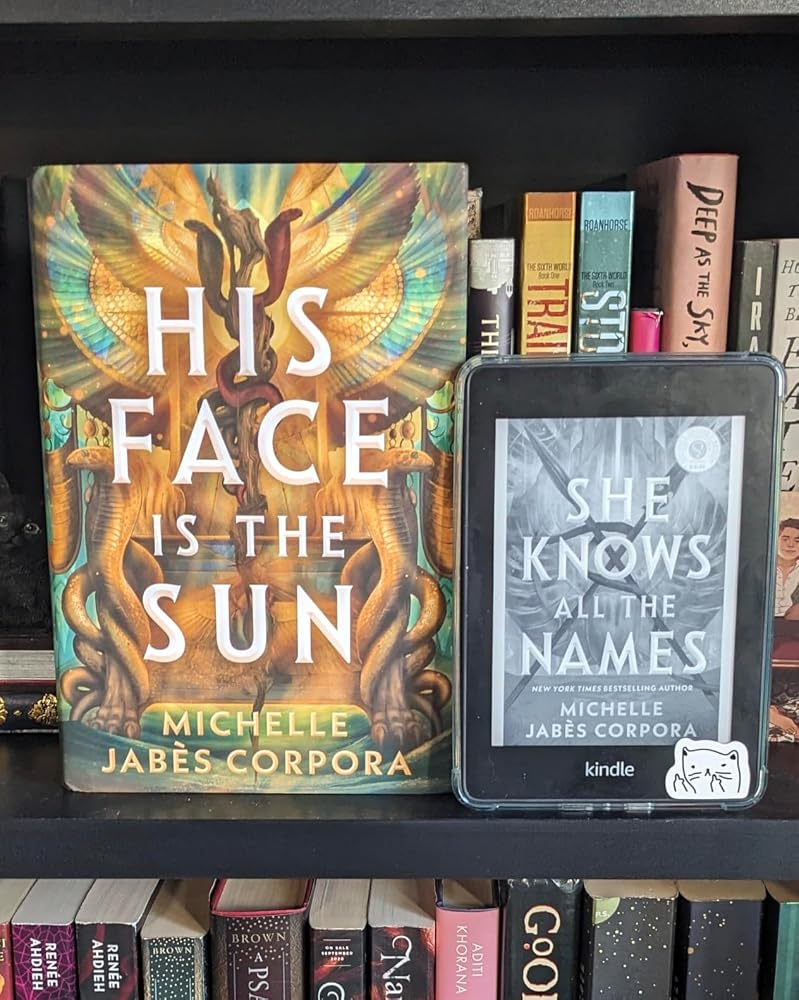
His Face Is the Sun
by Michelle Jabès Corpora
)
Shop All Audiobooks
*When you open this audiobook on Libro.fm, be sure to select Aveson as your bookstore so that your purchase supports local literacy programs and tree‑planting.
Couldn't load pickup availability
An Instant New York Times Bestseller!
A dying throne. A dark prophecy. Four strangers whose destiny will determine the fate of the kingdom.
In the golden heat of Khetara, rebellion smolders and ancient gods stir. As whispers of the pharaoh's illness spread, a long-forgotten oracle begins to awaken--binding a princess, a priestess, a rebel, and a thief to the fate of an empire.
His Face Is the Sun is the start of a sweeping YA fantasy trilogy inspired by Ancient Egypt. Perfect for readers who devour the lush worlds of Leigh Bardugo, the mythic depth of Roshani Chokshi, and the high-stakes emotion of Sabaa Tahir.
The kingdom is cracking, and four lives are about to collide:
Sita, a princess who uncovers a betrayal powerful enough to destroy the royal court.
Neff, a young priestess burdened by divine visions that predict devastating destruction.
Rae, a farmer's daughter sharpened by injustice and poised to tear down her oppressors.
Karim, a tomb robber whose discovery in the desert awakens an ancient enemy.
Drawn together by unseen forces, these chosen four must decide what they're willing to sacrifice when power demands blood.
Share
Book Details
ISBN:
9781464290480
EAN:
9781464290480
Binding:
Hardcover
Pages:
528
Authors:
Michelle Jabès Corpora
Publisher:
Sourcebooks Fire

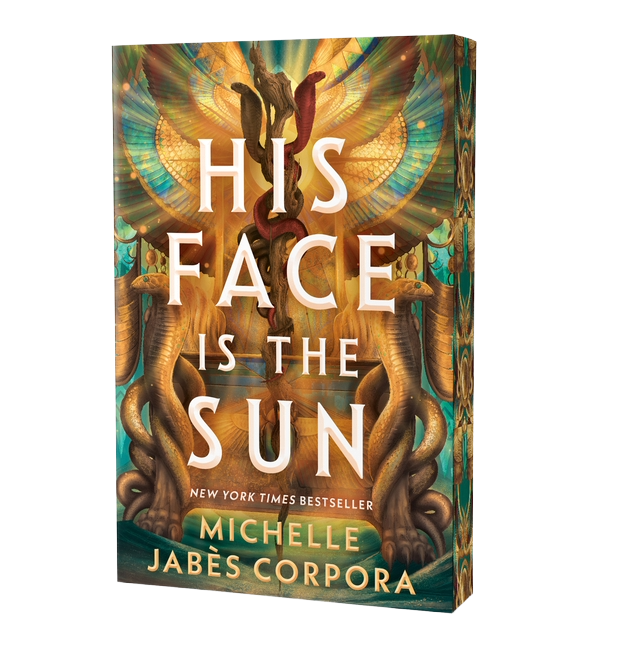
I picked this book up because of the edges and because I love Egyptian mythology. It was so good! I can't wait for the second one.
I have yet to read it but it is a beautiful book
I genuinely think this has something to appeal to everyone from romantasy-enjoyers to fans of adventure and intrigue, to people who just enjoy retellings. Obviously this is not a retelling, but in my opinion its faithfulness to the setting should put it in the same general category given how much liberty some retellings take with their originary material.I love Jabès Corpora's writing style and think it works perfectly for an intrigue-adventure-romance-mystery fantasy. The amount of research and faithful adaptation of Egyptian history is phenomenal. She uses actual Egyptian - I think it's Middle Egyptian but I could be wrong - and there are a bunch of little things here and there that give this series a leg up over a lot of Egyptian-inspired fantasy.One of my favorite things is the way she uses prophecy as foreshadowing. It isn't subtle foreshadowing, but it allows for in-story mystery. The meaning of the prophecies are pretty clear based on the information the readers have, but the characters don't have that information. We're operating in a world where prophecy and magic are taken at face value as metaphysical parts of reality rather than a separate supernatural force, and I think that reminder that ancient Egyptians were operating within a different axiomatic perspective is important.With Book 2 coming out in a month now is the time to jump on this!
I did not expect to like this book as much as I did! I'm always looking for a good book inspired by ancient Egypt (and am often disappointed), so when this one not only met but exceeded my expectations, I was so happy. I loved the author's writing style, and the world-building was well done and immersive. I've seen this marketed as a romantasy (which it isn't, even if there are some romance elements), and I'm honestly glad it didn't turn out that way because I think it would have taken away from the story, which was super intriguing.My only real issue with the book was the multiple POVs. It took me a while to get into the book because the author kept jumping from POV to POV, and I definitely liked some of the MC's more than others, so I'd find myself bored with some chapters. I'm generally not into multiple POVs, especially in the first book, so part of it is just personal preference.Overall, this was a fantastic book, and I will be picking up the sequel! If you are looking for a fantasy with historical elements and political intrigue, I highly recommend it!
If you’re a fan of fantasy and ancient Egyptian historical fiction, you’ll want to add His Face Is the Sun by Michelle Jabes Corpora to your reading list. While not set in ancient Egypt, the novel’s fictional setting of Khetara bears a powerful resemblance to the actual land of the pharaohs. The similarities are so close, and Jabes Corpora incorporates ancient Egyptian-style culture so well that it’s easy to forget Khetara and Egypt aren’t the same.The story revolves around four main characters whose fates are linked through an ancient prophecy. There’s Sitamun, the pharaoh’s teenage daughter, one of a set of triplets born to the chief royal wife. On the other end of the social spectrum, twelve-year-old commoner Nefermaat seeks the gods’ advice about a recurring nightmare and finds herself whisked away from her parents to become a temple priestess. In another village, farmer’s daughter Raetawy embraces rebellion when royal officials oppress her village.Desert dweller/tomb robber Karim unwittingly awakens a long-dead king whose reign has been erased from history. To escape the restless dead, Karim embarks on a quest that brings him into contact with Raetawy, Nefermaat, and finally Sitamun. The prophecy known as The Oracle of the Lamb seems to link the four of them. Together, they will have to save Khetara from multiple evils—both living and dead.His Face Is the Sun provides no resolution to Khetara’s troubles. It is clearly the first in a series that weaves aspects from different time periods of ancient Egypt together into an original story. Readers familiar with Egyptian history and mythology will recognize funerary elements from the pyramid age, echoes of the heretic pharaoh Akhenaten’s story, "Tale of the Birth of the Three Kings” from the Westcar Papyrus, and “The Oracle of the Lamb” from the Roman period.Creating a fictional, Egyptianesque world freed the author from having to follow a specific historical plot. On the downside, the fictional Khetara felt so much like ancient Egypt, that I had to continually remind myself that the setting wasn’t Egypt, which I found jarring. For someone not as familiar with the source material, this might not be a problem.Another quibble I have with the novel is the tomb-robber-being-chased-by-a-dead-man trope. There is a strong movement in Egyptology today to stop viewing the dead as monsters and humanize them instead—for example, saying “mummified remains” instead of “mummy.” The idea of “The Mummy” is tied to colonialism and views ancient Egyptians as objects rather than people. The ancient Egyptians themselves feared ghosts rather than physically reanimated bodies. I feel the story could have worked just as well with an angry spirit pursuing Karim instead of a horror-film type mummy.Despite this reservation, I recommend His Face Is the Sun. The main characters are well-rounded and undergo significant change before the story ends.
)