

On Earth We're Briefly Gorgeous
 )
 )
Couldn't load pickup availability
A New York Times bestseller - Nominated for the National Book Award for Fiction - Ocean Vuong's debut novel is a shattering portrait of a family, a first love, and the redemptive power of storytelling
New York Times Readers Pick: 100 Best Books of the 21st Century
"A lyrical work of self-discovery that's shockingly intimate and insistently universal...Not so much briefly gorgeous as permanently stunning." --Ron Charles, The Washington Post
"This is one of the best novels I've ever read...Ocean Vuong is a master. This book a masterpiece."--Tommy Orange, author of There There and Wandering Stars
On Earth We're Briefly Gorgeous is a letter from a son to a mother who cannot read. Written when the speaker, Little Dog, is in his late twenties, the letter unearths a family's history that began before he was born -- a history whose epicenter is rooted in Vietnam -- and serves as a doorway into parts of his life his mother has never known, all of it leading to an unforgettable revelation. At once a witness to the fraught yet undeniable love between a single mother and her son, it is also a brutally honest exploration of race, class, and masculinity. Asking questions central to our American moment, immersed as we are in addiction, violence, and trauma, but undergirded by compassion and tenderness, On Earth We're Briefly Gorgeous is as much about the power of telling one's own story as it is about the obliterating silence of not being heard.
With stunning urgency and grace, Ocean Vuong writes of people caught between disparate worlds, and asks how we heal and rescue one another without forsaking who we are. The question of how to survive, and how to make of it a kind of joy, powers the most important debut novel of many years.
Named a Best Book of the Year by:
GQ, Kirkus Reviews, Booklist, Library Journal, TIME, Esquire, The Washington Post, Apple, Good Housekeeping, The New Yorker, The New York Public Library, Elle.com, The Guardian, The A.V. Club, NPR, Lithub, Entertainment Weekly, Vogue.com, The San Francisco Chronicle, Mother Jones, Vanity Fair, The Wall Street Journal Magazine, and more!
Book Details
- ISBN
- 9780525562047
- Binding
- Paperback
- Authors
- Ocean Vuong
- Publisher
- Penguin Press
- Published Date
- June 1, 2021
- Language
- English
- Pages
- 256
- Physical Info
- 0.8 in H x 7.7 in L x 5 in W (0.45 lb)
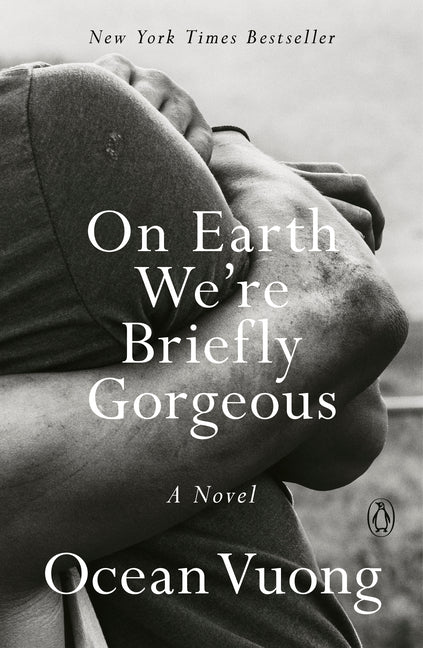
Arrived with a dirty and torn cover.


This was a great and quick read. In total it took me 5 hours to complete this book.This story is a story of an immigrant living and retelling the stories of the immigrants before him such as his mom and grandma.Beautifully written. Loved the portrayal of color. In the beginning of the book, the narrator describes colors to inanimate objects/feelings. As he grows older, other people begin to see him as his own skin color, hence they began to project their understanding of color on to him. Suddenly, color no longer describes an object/feeling but it becomes a weapon that divides people. Color becomes a tool that allows him to be put into a box before ever having the opportunity to give others a chance to know him. Color becomes his identity, as well as the identity of everyone around him. It’s also interesting how trauma affects not only those who lived through traumatic experiences, but also their children who will end up growing up with that trauma.The book has many themes including:• Race• Growing up as an American• Growing up with different cultural identities• Self Identity/Self Discovery• Generational Trauma• Inherited Trauma•Post war affects• Growing up bi racial• Complex parental relationships• Immigrants•Immigrants (due to war)•LGBTThings I disliked:Children having sex:Although the narrator is telling his story, and he is going back in time. I felt highly uncomfortable with the explicit scenes of minors having sex. There was no need to describe certain parts of the body as he did. Simply because of the fact that they were minors when this physical relationship happened. He could have easily mentioned how he felt instead of drawing explicit pictures for his audience.Neutral comment:Parts the story seemed messy, however I personally liked it and I understood it because that’s how my brain works. Making footnotes of footnotes. At the same time, it made sense for the story to be “messy” as he’s writing a letter to his mother. It’s not going to be neat. When you write a letter to your loved ones, many times you’re reminiscing about the old times, and so one memory will turn into another into another into another, and so it gives off the authentic vibes of a letter to someone close to you. You want them to remember the scene that you were at.As many have mentioned, this book isn’t for everyone.Overall, I rate this book 8.0279/10It’s a great book, easy to read, and it brought me out of my reading hiatus!

I love the book but the book itself is very hard to hold when reading. Worst material picked for hard cover.
Timely delivery ‘& book is in good condition
This is a challenging book. Descriptions of Vietnam and the culture during and subsequent to the war are vivid. Vuong’s unsparing yet sensitive portrayals of his sexual awakenings are compelling; he also deftly illustrates both Vietnamese and American class politics. The narrative alternates between subjective and objective voice as well as recollections and imaginings. Occasional lyrical and imagistic passages are rewarding. However, despite the symbolic intent of several graphic descriptions of actual cultural practices that torture animals and human violence, I found certain instances intolerable.
Amazing book! The deeply personal story of a son and his single mother and their plight as immigrants. Raw and Honest. The author, Ocean Vuong, is an amazing storyteller who writes from his heart.
Love this guy. His use of words - original and powerful. Images that sear into your brain I am not a poetry follower as a rule.
One of the most beautiful books I have ever read. It is exquisitely written and deeply personal. I had to read it in small bits, taking my time to digest it---had I not, I think it might have done me in. Rarely has a book pierced my soul as this has.
As I sometimes do, rather starting at page one and proceeding, I dove in here and there to sample before committing. Unfortunately the first thing I read was an account of men eating the brains of a live monkey, having paid to do so to improve their sexual potency. The louder the monkey screams, the better. Next a girl runs away from abuse, but her mother will not take her in. And finally women abasing themselves for a better tip. The depth with which he explores these experiences is excruciating. No thanks.
Such a moving story, verdant, alive. Mr. Vuong captures the essence of the power of words on a page as he takes you along this journey of love, oppression, heartache and love again. One of the finest books I've read in a long time.
Ocean Vuong'a poetic and profound writing leaves a lasting impression. His insights into humanity as a whole, and the working class immigrant experience in particular, make this book incredibly relevant to our time. Read this book.
I was intrigued and found your books on Amazon. This book is very passionate, at times confusing but always as honest and humble as the author can be. I prize honesty and humility as much as I do integrity. I gained a little more understanding of Vietnamese culture. A little.
This novel is deeply personal, written by an extremely sensitive man. I heard Vuong being interviewed by the NYT and I was so taken with his emotion that I wanted to read the book.Alas, this novel is not for me. Although its themes of war, immigration, coming of age, and death are very compelling and well written, there was graphic gay sex and many obscene words that, to my mind, do not make this book recommendable or to be lauded.Also, the storyline is not linear and with no division of different times and places, I was confused which made the book difficult to understand. Plus, the similes just don’t make sense although I realize that this narrative is more like poetry.Actually, the last 25 pages are the best.For the reasons listed above, I had to give this book only 3 stars.
This book is exquisite. The eb and flow of Oceans writing is deeply stirring and truly "gorgeous". Yes, he is a poet. Expresses like a poet, the world reverberates for him as with the greatest poets. His story is woven through this book in its semi-autobiographical form. It is intense. It is heartbreakingly painfully and also utterly beautiful. Like James Baldwin- a great soul and a one in a million writer. It is a true classic.
The author’s free form memories of his childhood in Hartford, CT written to express the emotional trauma are not presented in chronological order. As his ma (Rose) and Grandma Lan were Vietnamese refugees with their own trauma of war, all are trying to fit into American life. Ocean has to navigate American society for his ma who cannot read English and whose only job opportunities are at clock factory and then in the nail salon. Some role reversal here and the ma’s fatigue and PTSD affect her relationship with her son so he doesn’t get the unconditional love he needs and sometimes endures abuse. Eventually he finds one teen who sees him and accepts him for who he is. Through this friendship with Trevor, also a child of an American vet damaged by his experiences in the war, he explores his own masculinity impacted by no father figure in his life other than an abusive father who was sent to jail. What pulls the reader into this memoir is the beautiful poetic writing and metaphors. Seeing how children born of parents who only knew war in their youth are impacted is eye opening. Interesting cultural references on dealing with death. Being gay is dealt with from the perspective of someone who slowly becomes his true self and the vulnerability is beautifully captured in these words, “To be gorgeous, you must first be seen, but to be seen allows you to be hunted.”
On Earth We’re Briefly Gorgeous is letter from a son to a mother. Our main character, Little dog, writes a letter to his illiterate mother who immigrated to from Vietnam. Little dog explores many themes exploration in this letter such as love, identity, trauma, war, and masculinity. The exploration of these themes shown in the letter make up the person little dog is today.I liked the novel a lot because it was very realistic and resonated with me personally. I like the approach on structure Little dog took when writing this letter to his mother. Sometimes it starts off with “Dear Ma,” other times it starts with a memory, or it would just be poetry. The inclusion of these different writing structures added another layer to the experience of reading this novel. I also like all the metaphors the speaker used to describe the complexities of his relationships with other people. I think the speaker does a neat job of using the combination of language and structure to convey his message. However, I do feel at times it does feel disconnected. Sometimes the speaker’s memories don’t correspond to the earlier or the later memory, so they get lost in translation. But when the memories do correspond to one another using the intended language the speaker uses really shine.Overall, I would recommend this book to anyone who regularly reads since it would be a hard book to digest if you aren’t an avid reader.
In April 2022, the book discussion group at the LGBT Center in NYC was in almost universal agreement about this poetic memoir-novel, with only some minor disagreement about whether this is a four-and-a-half-star or full-five-star work.Everyone was wild about the brilliant and colorfully impressionistic writing - completely over the top. Bob compared the writing to the complexity of a millefleur paperweight. While I'm a sucker for this sort of literary folderol, a few of us thought that it might be too poetic at times, and that a bit ugly language might be better to describe the Vietnamese war or some of Little Dog's abuse.We talked about the animal metaphors: the taxidermied deer in the rest area, the trapped monkey, the caged veal calves, the Monarch butterflies that fly in one direction (only the children return), the buffalo who fall off the cliff (search for David Wojanrowicz's buffalo image) and, of course, Little Dog, himself."On Earth..." presents the truly poor, the working impoverished. It also shows Vietnam and the war from the point of the invaded Vietnamese, and shows Little Dog as a true outsider: "Keep your head down. Stay invisible. You're already Vietnamese." Racism is common. Little Dog's boyfriend Trevor is also from an impoverished and alcohol-addled broken home (literally, a falling apart trailer). The intergenerational trauma extends across all the families in the novel. Heterosexuality gets a bad rap, too; there are no intact straight families to be found.This is not a coming out story. Little Dog and Trevor find each other and explore their sexuality. When Little Dog tells his mother that he's gay, she accepts it as she accepts so many other things she doesn't understand.All the humor is midnight dark: the women at the nail salon, one with the dead horse and the other with one leg; the taxidermied deer in the rest area; and Lan's dentures after she dies.Facts are dropped into the novel, both about the Oxy epidemic of overdoses and the multi-racial outsider hero Tiger Woods. It reminds us that these stories are real.The novel is built on the themes of escape, memory, and language. It is full of floating fragments, perhaps too many fragments at times, too jumpy, too overlapping and spiral without enough story, and overly metaphoric at times, but beautiful and authentic, all at the same time.
The pain of the Vietnam War left splinters all across the globe—at the scale of bothwar-torn countries and broken households. In the novel On Earth We’re Briefly Gorgeous, poet Ocean Vuong details the years of physical abuse endured from a mother suffering from post-traumatic stress disorder after fleeing her homeland and the intense guerilla warfare associated with it. The United State’s involvement in the Vietnam War comes a result of a vain attempt to ‘contain’ communism within Southeast Asia. Vietnam was torn into two separate entities; one of which supported the Soviet cause and the other backed by the military giant that is the United States. Vuong beautifully illustrates the racialized and politicized distributions of ‘controlled’ space and power over nature, while also including the achingly painful caveat of war time abuse and the devastating effects of the struggle for materialistic control of land.One of the most powerful aspects of this piece of work is its showcase of the intersectionality between race, gender, and power. In Part 1, Vuong details the story of his grandmother, a young Vietnamese woman who flees an arranged marriage and is sexually assaulted by an American soldier, producing a ‘white-passing’ child. The woman, self-named to be Lan, is approached by two American soldiers on the street, both of which are noticeably intoxicated and carrying massive M-16s. Lan urinates on herself, standing “on the life-sized period of her own sentence, alive” thanks to the paleness of her daughter. This memory from Vuong’s grandmother is striking as it points back to an argument made by researcher Donna Haraway regarding feminist political ecology. The earth, with an “independent sense of humor, is its own active subject in the propagation of gender and social norms. Lan’s ability as a woman to reproduce protected her from imminent death, pointing to an argument made by feminist poltical ecologist Sharlene Mollett which describes that as humans, we are historically entered into heavily racialized and sexualized relationships, so there is no way to properly separate these traits as completely isolated from the other. The binary hierarchy that existed within this confrontation was ultimately created by the differing characteristics that nature and culture have created to categorize men and women into separate social classes, with regard to race as well.Vuong also successfully illustrates the lack of fairly paid domestic labor done by women of color. His mother, Rose, works in a nail salon where the violent, noxious fumes worked to develop asthma in the young lungs of the employee’s children. The ability of this environment, glamorized by the lure of the ‘American dream,’ to cause extreme bodily harm is not reflected within the American economy. The deeply ingrained, patriarchal ideal of success does not include labor that is seen as undesirable. Silvia Federici, an influential socialist feminist thinker, argues that this ignorance points to an even larger flaw in the way our workforce is structured, and how capitalism takes advantage of our nation’s most vulnerable. Vuong shares aninteresting perspective on this by stating that he hates and loves his mother’s battered hands for what they can never be. Even the child of an immigrant, conditioned by abuse to respect andfear his mother, is ashamed of her occupation. Compared to similar accounts of families chasing the ‘American dream,’ the rawness of Vuong’s emotions makes his entire sentiment even more powerful, as he appeals to each side.Later in the story, Vuong grapples with his sexuality and an opioid addiction, conditioned to believe both are evil. This novel is special in many ways, but its strong, emotional tone helps the reader to connect even deeper to the barriers an immigrant family faces, even if they have no experience with the subject. Early on in the story, we learn that Rose, Vuong’s mother, is illiterate. This open letter of resentment, pride, and love that he feels towards his mother will never be received by her, as she cannot conceptualize the act of reading and writing. The notion that Vuong is writing this as a way to reinforce his ownership over the experiences he has endured continues to impress his audience as a second generation, queer man of color taking his own power in a society that systemically does not grant him any.
Reading the reviews of this book here, I found a fascinating snapshot of who we are: richly feeling and yet constrained, open and still closed in mind and heart, welcoming and resolutely petty, loving but spiteful. The book itself was, for me, incandescent, soaring to great heights, and crushing, dragging me as reader to terrible depths. In the balance, the book is a paean to beauty in all its forms--and beauty takes shapes that pierce the spirit with both pain and joy. Regarding literary sensibility, for me there are strains of Proust in the seemingly involuntary function of memory. Another reviewer related this to Whitman and I can absolutely understand why. The references to Barthes, Duchamp, etcetera are part of my regular lexicon of references (given my own work) so Vuong's literary allusions felt natural to me, though I could imagine others growing discontent with the exposure to the unfamiliar--when they don't wish to be sidetracked by new ideas. For me that was always a joy in reading a well-read writer (e.g., Eco or Borges). Vuong loves language with a passion; that is obvious. His ardor sings. The tune is a sometimes a dithyramb, often an elegy, occasionally a hymn, and at times a heartbreaking lament. If I were to offer a criticism of faults, there were a few moments of uneveness of quality in parts II and III. But these seemed exceedingly minor to me in the context of the total work.The book is not for everyone. I write that in manner similar to saying that Joyce isn't for everyone. Readers who claim the book is bad because they couldn't understand it, because Vuong doesn't follow a straight line or leave a clear thread in the labyrinth for them to follow are claiming a rather pedestrian criterion for a universal judgment. By that measure, "Finnegans Wake" is a crime against humanity! Here's a thought: "I don't like this sort of writing" is a very different statement from "this is bad writing." The former is wholly understandable and might just be a matter of individual taste. The latter is a declaration of critical finality, the rightful domain of consensus and posterity. And to those who recoiled in homophobic disgust, I beg you to try opening yourself up to the world as others live it. I'm a straight white male, so I share neither the same sexual desires nor experiences of America (or world) as the author, but allowing myself to empathize with the characters Vuong writes only makes the scope of human understanding that much broader for me. To feel like some agenda is being pushed upon one here is less a reflection on author, publisher, or reviewers than upon one's own defense mechanisms and inability to momentarily leave a world that only affirms only a dominant narrative that reflects one's own experiences. The abuse of the narrator and other figures, the violence against animals: these things are horrific and abject, yes. But they are also a part of life. As part of life they are subjects of poetic reflection; life is not all happy songs and roses, why should art be? I remember someone complaining that Goya's "Disasters" were so horrific as to render his art bad, or not art at all. Most of us would find that idea risible, but I see the sentiment repeated here. Turning our backs on brutality is to give it access to us unchecked and unexamined. The violence in "On Earth," never felt gratuitous to me nor aestheticized for the sake of glorifying violence or excusing it. Rather, it seemed to me that Vuong explored the ambivalences of our brutality, our ability to be loving, caring monsters, beautiful and horribly flawed. Anyhow, I loved the book and recommend it if you are looking for a read that with at once enthrall and challenge you. I read it in one sitting, so I can say that Vuong captured something profound and compelling for me, personally. I honestly find it hard to believe how young he is; there is a wealth of experience and reflection here that is seemingly beyond his years. I look forward to his future endeavors.
This book is marketed as a debut novel by a rising and increasingly acclaimed poet, Ocean Vuong. But that’s a little misleading. It is a stream of consciousness memoir written in very poetic terms.Some of the writing is fantastic: “It was everything I hid from, everything that made me want to be a sun, the only thing I knew that had no shadow.” Or, “Because the sunset, like survival, exists only on the verge of its own disappearing.” The stuff of poets. Great poets, actually.Some of the writing, however, was, well, not so fantastic: “And there, on the kitchen table, beside the gallon of milk on its side, the liquid coming down in white strings like a tablecloth in a nightmare…” Trying too hard on that one, I think.The themes of the book are pretty standard fare. The horror of war. (Vietnam) The sometimes horror of being an immigrant in the US. And coming out as a gay immigrant that doesn’t look like the people around him. Oh, and there is some parental abuse.I don’t agree with the reviewers who felt that the abuse and the sexuality deserve trigger warnings, however. I’m not much for trigger warnings to begin with but I thought the treatment of both subjects was really quite tame in this day and age. You can see much more graphic treatment on prime time television.I do agree with the reviewers, however, who felt that the author failed to plow any new ground. All of these themes have been explored rather exhaustively and a “highly anticipated debut novel,” as the publicity promised, should offer some new and unique insight. And this book, for me at least, didn't.I did give it a four, however, but not because I strongly recommend you run out and buy it. I gave it a four because I want to give the author enough confidence to write another one. I dare say he has “great novelist” in him somewhere. And I truly hope he finds it. As readers, we will all benefit.

