

All the Light We Cannot See
 )
 )
Couldn't load pickup availability
*NOW A NETFLIX LIMITED SERIES--from producer and director Shawn Levy (Stranger Things) starring Mark Ruffalo, Hugh Laurie, and newcomer Aria Mia Loberti*
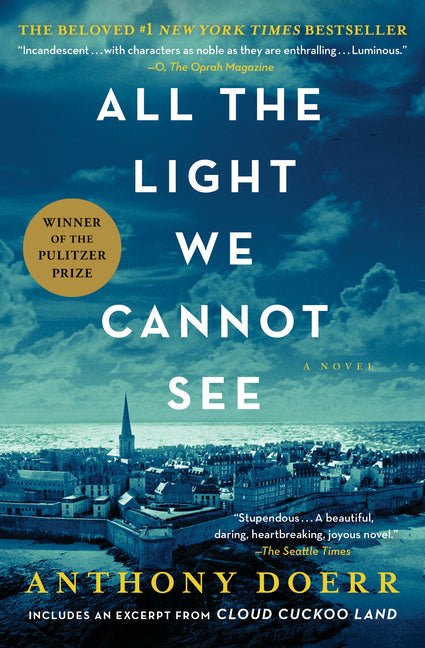
Winner of the Pulitzer Prize and National Book Award finalist, the beloved instant New York Times bestseller and New York Times Book Review Top 10 Book about a blind French girl and a German boy whose paths collide in occupied France as both try to survive the devastation of World War II.
Marie-Laure lives with her father in Paris near the Museum of Natural History where he works as the master of its thousands of locks. When she is six, Marie-Laure goes blind and her father builds a perfect miniature of their neighborhood so she can memorize it by touch and navigate her way home. When she is twelve, the Nazis occupy Paris, and father and daughter flee to the walled citadel of Saint-Malo, where Marie-Laure's reclusive great uncle lives in a tall house by the sea. With them they carry what might be the museum's most valuable and dangerous jewel.
In a mining town in Germany, the orphan Werner grows up with his younger sister, enchanted by a crude radio they find. Werner becomes an expert at building and fixing these crucial new instruments, a talent that wins him a place at a brutal academy for Hitler Youth, then a special assignment to track the Resistance. More and more aware of the human cost of his intelligence, Werner travels through the heart of the war and, finally, into Saint-Malo, where his story and Marie-Laure's converge.
Doerr's "stunning sense of physical detail and gorgeous metaphors" (San Francisco Chronicle) are dazzling. Deftly interweaving the lives of Marie-Laure and Werner, he illuminates the ways, against all odds, people try to be good to one another. Ten years in the writing, All the Light We Cannot See is a magnificent, deeply moving novel from a writer "whose sentences never fail to thrill" (Los Angeles Times).
Book Details
- ISBN
- 1476746583
- Binding
- Hardcover
- Authors
- Anthony Doerr
- Publisher
- Scribner Book Company
- Published Date
- May 6, 2014
- Language
- English
- Pages
- 544
- Physical Info
- 1.7 in H x 9.25 in L x 6.4 in W (1.6 lb)

Being the recipient of the 2015 Pulitzer Prize for Fiction, my expectations for 'All the Light we Cannot See' were extremely high. With all things considered, I feel confident in saying that the critical acclaim was warranted and deserved in this case. Despite two minor annoyances, which I cover at the end, 'All the Light we Cannot See' is a phenomenally written, percipient, and remarkable example of sound literature.Author Anthony Doerr tells the story of how 18 years old Werner, a geeky, crafty, and thoughtful engineering prodigy in Germany, meets 16 years old Marie-Laure, a sweet, astute, and affable blind French girl during the siege of Saint-Malo in 1944. WWII, with all its stentorian and fervid trappings of war is the backdrop to Werner and Marie-Laure's fateful encounter. Written in short but vividly described, intricately woven chapters, the backstory of how they are brought together is told over the course of ten years starting in 1944 and flashing back as far as 1934. Through alternating timelines from both their perspectives, they meet and thereafter, the aftermath and implications of the encounter is written about up until the year 2014.Several pages into the novel, I knew I had a special literary piece in my hands. Werner and Marie-Laure are easy to fall in love with as Doerr writes them in a way that is honest and open. They are both multi-faceted in their strengths and their vulnerabilities, without either one playing a victim. Or at least, I never saw either one as a victim. I also appreciated that foibles, frailty, and other unsavory personality traits are depicted for both, allowing them to be alive with authenticity. I never want to read about characters who are too perfect and give the sun, the moon, and the stars all of the time. In the case of this novel, the two main protagonists are realistic for their time and for the circumstances they find themselves in. Joining Werner and Marie-Laure is a dynamic, and at times unfortunate mix of supporting characters who collectively illuminate the radiance and light of when humanity is good and kind. Juxtaposed, others in the mix depict the ugly darkness of when humanity resorts to selfishness and evil. Though they are fictional, we should all be so lucky as to encounter characters like Frederick, Madame Manec, Frau Elena, and Dr. Geffard, and hope the world breeds less of Dr. Hauptmann, Bastian, and Reinhold von Rumpel.'All the Light we Cannot See' has many lessons to impart on the reader, with one of the most profound being the titular Light that we must all see. The novel soundly shows us how those who are blind in the literal sense, can see more than those who have the ability to gaze as far as their eyes will carry. Additionally, the novel allows the reader to see for themselves how people whose visions are symbolically foggy, can still find goodness of heart and lightness of mind in unlikely places, and in the unlikeliest of people. Thought-provokingly, Doerr weaves for the reader how darkness creeps and consumes those who choose to be figuratively blind and who later become disillusioned by their own rancor, malevolence, and enmity. In the heart of strong-willed characters, we see how love, patience, understanding and empathy become the key that open and illuminate the path into light.I very much enjoyed this read, and surprisingly, the short chapters were not an annoyance as can sometimes be when the author is not skilled enough to execute them. Doerr is skilled and in the case of 'All the Light we Cannot See,' he, in what was in many instances only a page and a half, or even only half a page, has written cohesive chapters that are richly dense, brimming with cerebral atmosphere that envelopes the reader at the turn of every page. In this regard, I could see Marie-Laure's loneliness, and Werner's moral conflict. I felt the fear and uncertainty in Jutta, Daniel LeBlanc, and Etienne's reticence. I could taste the saltiness in the breeze that wafted over Saint-Malo, while also I could smell the acrid, grey, and gritty skies of Zollverein. Each time a character was famished due to scant war rations, I tasted the sweetness of the cool water they drank and I could taste the crust and crumb of the loaf of bread they tore apart. These are not things easy to achieve in books. Doerr however has done so fantastically.It goes without saying that there is plenty beauty and radiance to be found in 'All the Light we Cannot See.' Some of it emanates directly from the characters, while other times, it comes from the reader's own willingness to be open-minded. Taking that into mind, there were only two minor concerns I had with the novel. First being that when the author went into descriptive details of radio repair and engineering principles, my eyes would on occasion glaze over a bit since neither subject matter are strengths of mine. Nevertheless, as a curious reader, I know that it was necessary for me and other readers to know Werner's technica...
good mystery
Great book
A book everyone should read at least once in their lifetime
I was disappointed reading this book. It was tedious to read and slow moving. The saving grace was that the chapters were short.
The second world war through the eyes, metaphorically, of a French girl and a German boy. I didn't want the story to end. Real and magical at the same time.
There have been many books I’ve liked. Some I wanted to re-read at some point. But after finishing “All the Light We Cannot See”, i just started it all over again!!
All the Light We Cannot See is a breathtaking novel—emotionally rich, beautifully written, and deeply moving. Anthony Doerr masterfully weaves together the lives of Marie-Laure and Werner in a way that’s both intimate and epic. Every scene pulses with quiet tension and humanity, and the prose is nothing short of stunning.One small but meaningful detail that really stood out to me was the inclusion of the “Eins, zwei, Polizei, drei, vier, Offizier” nursery rhyme. It’s one I grew up with, and seeing it woven into the story made the experience feel even more personal.It’s no wonder they turned this book into a mini-series—the layered storytelling, vivid imagery, and emotional depth were practically made for the screen. Still, nothing quite compares to the experience of reading it. This is a story that stays with you, long after the final page. Five stars, without hesitation.
Great reimagination of potential history. I fell in love with many of the characters and had hope for many others.
This book was truly incredible. I have to say that it's very well written, and I loved the characters. The characters are really complex, and you get to see all sides of them. You really feel for them, which is what a good book is all about, in my opinion.I didn’t like “All the Light We Cannot See” at first. It was very hard to follow. I downloaded the audiobook to this book, and that helped. The narrator gave all of the characters unique voices, and I had no problem following the story anymore.I became captivated by the story of the main characters, a blind French girl and the smart German boy. I was enthralled with the stories of Marie-Laure and Werner and how their lives intersected together. The book has beautiful language and descriptions, and the characters are well-developed. You can tell that the author spent some hours researching the events of Saint-Malo. And, even though it's long, the story's pacing really helps keep you reading (or listening) until the end. I think this book shows how deeply the author understands the human spirit. It's a beautiful story that takes you to places you've never been before, or maybe, to places you have been to but never really understood.“All the Light We Cannot See” is stunning and is a beautiful story that carries you to places you've never been. It is a novel full of amazingly strong characters, hero's and heroin's, old and young, that made up the resistance in France, and even some from Germany that only tried to survive.This is a must read (or listen to). I was completely immersed in the story, and I think you will be too.
The characters seem real and we feel empathy for them. It's really more philosophical than plot driven. Sad that war is so painful and still with us.
When we try to erase our history by banning books, there is something seriously wrong, in my opinion. For me, it didn't take this book or the thousands of others I've read, to know what early Americans did to the Indigenous people who occupied most of America from early times... It didn't take this book for me to know what happened during WWII and how people were being treated by the Nazi Regime... What a book does for me is to allow me to either reaffirm what I have seen or studied... Or, to read of different opinions that may help me better understand my neighbors...If you enjoy historical novels, this book is a must-read. Perhaps you have already read it or know about the movie (several videos provided here for information...) Whether or not I later see the movie, I am thankful that I read the book first. There is so much in this book that needs to be considered--to remember. My guess is that the magic cannot possibly be demonstrated in a movie... And, it appears that the relationship between the two teens might be emphasized in the movie. Indeed, I was shocked, after reading the book description and videos, that their meeting did not take place until very late in the book! My anticipation had been stoked so much so that I kept waiting for that meeting!I wasn't necessarily disappointed that the emphasis was on these two people, but I believe the hype was misleading. On the other hand, readers will be immediately caught up in what happened when the Germans (BTW I am of German descent on both sides of my parents.) It was important for me to read this particular book. I have read many about the Holocaust, and at least one set in Poland. Having this book set in France gave me new information that I may not have ever known. You see, my father worked in the mines and was killed before I was born. My mother was left a widow with four children...It was in France, in the Walled citadel of Saint Malo, that this book was set. And, why was it taken over? Because there was a mine there and soon the residents of the town were being forced to work in that mine while being treated cruelly and with little food. Certainly the book brought me an awareness that if my family had not come to America, my father might have been in one of the mines in Europe that were being confiscated by Hitler in order to control the world that he planned to conquer!We meet Werner and his sister as they listen to the radio... Werner has found an old one that was not working and he had figured out how to fix it... Soon he was learning more and more, self-taught, as people heard of his ability to fix things that were electronic... As I am writing, I realize, for the first time, that the Frenchman that was broadcasting could be the very man that was related to Marie-Laure and to whose home they went when they were forced to leave their home... As I said, the book is long and so much can be discovered about that awful time period--war!Fortunately for Warner, his expertise was soon recognized so that instead of, when he was older, going to the front lines somewhere, he was sent to a school and then on, using his skills with radios to move around in search of illegal (as defined by Hitler) transmissions that were being used by, for instance, those in the small town of Saint Malo...I am not sure how much actual research supported this novel, but I was totally captured by the people living there and what they did when confronted with German soldiers who immediately took over the Mayor's residence. For he and the town residents, in one way or another displayed only disdain for what they were being forced to do. Yes, there was murder of local people. The book moves back and forth between the lives of the teen girl and boy. The girl had become blind and lived with her father, but when they had to leave their home, they hoped to find peace with a relative. By the time they got there, it was already too late. The Germans had taken over Saint Malo. Soon after Marie-Laure and her father arrived, her father was called back and nobody knew whether he had been killed or was captured and held, possibly tortured.A deadly subplot was the fact that Hitler had assigned one man to supervise the taking of all riches found in conquered areas so that they could create one big magnificent facility to display the booty of their conquests! And we follow this man in his travels as he carries out his orders, but, in doing so, became very ill and he became obsessed in finding one particular jewel that was said that anybody who owned it could not die. His search was intense and, finally, he had made his way to the location where Marie-Laure was staying... There we find the one scene in the entire book where Marie-Laure meets Werner... And she was not alone...I was fascinated with the father's skillful attention to his daughter's new disability and his creating a small scale version of his entire town (and later) another where they had moved, to allow his daughter to become ...
I find this review a bit difficult to write because honestly, I don’t know where to start! All the Light We Cannot See is like no other book that I’ve read before. On its surface, this book is about a young German boy with a talent for fixing radios and a blind French girl who possesses a curiosity and courage way beyond her years – both thrown helplessly into a world torn apart by war and devastation and the impact this has on their lives. But this book is so much more than that! It is about survival, love, courage, family, friendship, etc but on a deeper level, it is also a "study" on human nature and what it means to "do what is expected" versus "do what is right."The author Anthony Doerr has a masterful way with words – the richness in detail with which he describes every character / event / scene in the book paints a vivid picture of what life was like in the midst of war, yet he does so in a manner that does not take away from the story itself. He does not bog the story down with long, tedious paragraphs or pages and pages of detailed description that make readers like me want to just skip ahead to the actual story and not bother with the details. Instead, he uses brevity as a powerful tool – in just a few words, short phrases, sometimes not even complete sentences, he is able to bring to life not only his characters and the situations they encounter, but also draw the reader into their world to experience it for ourselves. As I was reading, I actually felt like I was being transported back to that time period (mid 1930s to 1940s), walking alongside the characters, seeing what they were seeing, feeling what they were feeling. The atrocities of war described in the book were very harsh and very real, despite this being a work of fiction. I actually winced during some of the parts where an atrocity was being described and had to set the book aside for a few minutes to calm myself. I’ve read other books in the past about his time period, about World War II and the atrocities of war, but none of those books had the impact this one did. Thinking about it now, I realize why: those books either use WWII merely as a backdrop without going into much detail or if they do, the events are portrayed in a way that makes it feel like a story or a recounting of history – as a reader, you are told what happened during that time period but don’t really feel a connection to it. This book, in its uniqueness, actually makes you LIVE that history rather than just read about it.The other unique aspect to this book was the storyline involving the cursed stone, which brought an unexpected element of suspense that still blended in perfectly with the rest of the story. In the hands of a less capable author, incorporating this part of the story might ruin the book entirely, but with Doerr, this is definitely not the case – he is consistent with the details as well as the storytelling and incorporates this arc seamlessly throughout the book. I found myself at the edge of my seat at certain points wanting to find out what happens next -- whether the stone would be found, whether certain characters would get caught, etc. I enjoyed this part of the book immensely!My only “complaint” about this book would be in its structure, as the story is told in different timeframes and switches back and forth after every couple chapters. This interrupted the flow a bit and did slow me down at times when reading, since I had to go back and re-read certain parts in order to remember where the previous timeframe left off. It also caused a little bit of confusion for me initially with some of the characters who were already part of the story when the book opens but then are introduced for the first time when things switch back to the earlier timeframe, then it picks up with what happens to that character from the later timeframe when it switches again. Not a show-stopper by any means of course, but I think the book would’ve been easier to get through if it didn’t switch back and forth. I'm pretty sure there was significance to structuring the book this way but unfortunately it was lost on me.Despite this long review that I just wrote, I actually don’t feel like I did this book any justice. In fact, no review can do this book much justice because it is a book that can’t just be “described” -- you basically have to read and experience it for yourself. For me personally, I loved this book and I know this is a story that will stay with me for a long time to come. I can totally see why this book won a Pulitzer Prize – absolutely well-deserved!(Read in January 2017)
(Warning: contains spoilers)Anthony Doerr’s 2014 novel All the Light We Cannot See is a story of survival, courage, sacrifice, suffering, family, friendship, love, hope, and survival. It’s set in France and Germany during WW II.How many thousands of novels does that thumbnail description fit? (Jaded publishers and others in the business are starting to think of such novels as just another WW II book, which might account for some of the tepid reviews the novel got before it circulated through the wider reading community.)All the Light We Cannot See is one of the richest, most readable, discussable, and likeable WW II novels ever. Yes. Likeable. A narrative of war and suffering and death becomes a hopeful hymn about family, kindness, potential, magic, love, and mystery.Doerr brilliantly shows us the specifics in the general: the character so unique and real that the reader can become the character. And thus we can truly cloak ourselves in the potential for individual goodness in the storm of a world gone mad. We learn and are comforted by how we might behave in a similar situation.In the final analysis, the story belongs to Marie-Laure, the little blind girl with the father who keeps thousands of keys for the National Museum of Natural History and is a gifted woodcarver. In both Paris and Saint-Malo he carves tiny, clever models of their neighborhoods, which Marie-Laure must memorize with her fingertips. Then by counting grates, benches, streets, and tapping her other senses for cues, she must show him she can navigate their neighborhood. He also teaches her to use her cleverness to unlock tiny objects to find the treasures inside. To this reviewer, those incredible miniatures, made in such a rush by a father for his vulnerable six-year old girl as the Germans draw near, are the most unforgettable takeaways of the novel. And as her world is going up in conflagration, Marie-Laure’s fingertips race across the braille dots to open another world, the world of Twenty Thousand Leagues Beneath the Sea, which she broadcasts as the bombs fall. Marie-Laure, with her blindness, has a huge capacity for the world and human experience.Then there is Werner, a German boy, whose snowy white hair is almost as much a character marker as Marie-Laure’s blindness. He is an undersized orphan trying to look after his sister and others in the industrial area of Zollverein, Germany. Werner has a preternatural gift for mathematics and radios and, as a result, is spared going into the mines, but is scooped up into the German army where he becomes a radio operator.Marie-Laure and Werner cross paths when the Allies begin bombing the holdout of Saint-Malo in early August, 1944. During the most intense part of the circular, reiterative narrative, Werner is trapped in the basement of the Hotel of Bees because of a bomb hit. Marie-Laure is trapped not far away in the attic of her uncle’s house with the cursed jewel, The Sea of Flames, in her possession. A mad, dying Nazi stalks the downstairs desperate to get at the jewel, which he believes will save his life.Thankfully, Doerr lets a long, comforting resolution play out as we see what happens to the survivors of the bombing of Saint-Malo. We see the survivors intermittently as they go about life-after-the-war until 2014 (the novels pub date). So vicariously was I participating in this novel, if I should go to Paris this year (fat chance), I would keep an eye out for an elderly blind lady who seems to know where she is going. And I do believe some evil potential, buffeted and stained to look like ordinary sea rock, is always being swished around on the ocean floor waiting to be found and polished.Doerr expands the literal plot line (this-happens-then-this-happens-then-this-happens) with a richness of inversions, paradoxes, oxymorons, juxtapositions, repetitions, symbols, and motifs that invite the reader to go beyond the storyline. For example:• Clearly, a mollusk is not just a mollusk. And what’s with all those birds?• Before two of the most heart-breaking events of the narrative (the rape and Werner’s death), why are there quasi-Eucharistic events?• Why is the fabulous diamond, The Sea of Flames, given such an oxymoronic name?• How can we not see light?• Why is Twenty Thousand Leagues Beneath the Sea the message of comfort to all who hear Marie-Laure’s last broadcast? (On the surface, it would seem to be an inversion of the usual message of hope.)• Why can the story be read pretty effectively backwards?Doerr’s story has become an earwig. Certain images, characters, events, and themes will always remain in my head. More than any novel I’ve read in years, I felt that I was buried with Werner below the Hotel of Bees. I was in the cold orphanage attic with him when, as a boy, he listened to a faraway voice talking about the nature of light on the radio. I was as hungry as Marie-Laure contemplating opening the last unlabeled can of food in the attic.As an adult who has read a gazillion novels,...
Anthony Doerr’s descriptions are like no others. He molds landscapes, wars with words until my heart thumped from the vision he created for me. They’re unique. I’d like to share a few of the descriptions that I enjoyed.“To the bombardiers, the walled city on its granite headland, drawing ever closer, looks like an unholy tooth, something black and dangerous, a final abscess to be lanced away.”“The appetite for oxygen is such that objects heavier than housecats are dragged into the flames.”“His breath smells like crushed insects.”“As though a weary tide stirs stones in the old woman’s lungs.”The way he guides the reader’s vision of a place, destruction, appearance, made me wish I had a pinky size of his talent. I’m a reader who loves and underlines phrases and sentences that stand out. That I haven’t read before. Strands of words, like a string of pearls, fitted together to catapult me into another world. Who let me become friends or enemies with the characters. Some writers know how to bring me into their worlds where I get to exercise all senses and emotions.There will be spoilers in this review, so if you plan on reading the book, don’t read this review. I do want to mention that I’m not a fan of some of the classics. A reader needs patience to trudge through pages of description. I’ve tried The Count of Monte Cristo by Alexandre Dumas and Anna Karenina by Leo Tolstoy. Maybe I’m just not that intelligent to appreciate and distinguish fine prose. Whatever the reason, this may give you an idea as to whether or not you want to continue reading.That said I feel like Doerr’s novel falls into a classics category—full of description. I really wanted to love this book. It’s safe to say I wasn’t the audience he had in mind when writing it, and I'm in the minority of disliking it. As much as I adore his descriptions, I equally dislike his writing style. It’s as if he sacrificed characters for beautiful prose. The amount of descriptions, tangents, lists, and short chapters swallow up the characters. If I can’t connect with them, there’s no way I’m going to like the book. This book is roughly 530 pages long. It really should have been half its length.Point of ViewFirst, the book is told in third person omniscient, meaning the narrator knows all the thoughts and feelings of the characters. The narrator isn’t a character nor does the narration come from a character’s perspective. It’s some unknown person telling me all about the thoughts and feelings of the personas. I can’t recall reading a book with this POV, but I don’t like it. Eleven percent into the book, my frustration got the best of me. The POV and descriptions muddled my experience. There were passages where I couldn’t figure out if it was the character’s thoughts or feelings or the narrator’s.“Block out giant Frank Volkheimer with his mammoth boots and cinder-block jaw. Block out the little aristocratic professor pacing in front of the hearth and the late hour and the dogs and the shelves brimming with interesting things. There is only this.” When reading this passage, it sounded as if Werner was talking to himself. But he couldn’t be since it’s in third person.“The first policeman snaps flesh off his apple with his teeth. Are they looking at her?” Uh, she’s blind. The narrator is telling me what the police are doing, and then jumps into Marie-Laure’s head. At first, I thought Marie-Laure was describing the policeman and then wondering if they were looking at her. This wouldn’t work either, because if she doesn’t know if they’re looking at her, she wouldn’t know what the policeman is doing.ProseThere were images in the book where I couldn’t picture it. Maybe I’m dense, but it just didn’t sound right. This might seem nitpicky, however Doerr is praised for his prose—prose that took ten-years to write. I’ll share a few examples with you.“…and she thinks she can smell threads of dust cascading from the ceiling.” Two issues with this description, 1) how does one smell threads of dust? And 2) how does a girl who goes blind at the age of six ‘think’ she smells threads of dust?“In the gloaming to the east, he can make out a gray line of traffic herded between the edges of the road.” Gloaming? I had to look that up, which means twilight, dusk. Okay, it’s not his fault my vocabulary is limited, but it made me think if gloam has more power than twilight. Gloam is something I can see in a poem. Why not just say, “The twilight in the east revealed a gray line of traffic herded between the edges of the road.”?“The eggs taste like clouds. Like spun gold.” Huh? This is such a weird comparison. How do clouds taste, and if I’ve ever tasted them, they sure as heck wouldn’t taste like eggs. Or spun gold, which I would never eat unless someone wanted to steal it from me.ListsDoerr’s writing also consists of lists throughout the book. I call the separate words or phrases placed one after the other as lists. He’s a natural born list maker, which drove me nuts and came off as pa...
If I could give “All The Light We Cannot See” more than five stars, I would. I read this amazing book on Kindle and listened to it on Audible, as well. BTW the narrator on Audible, Zach Appelman, is really excellent. His ability to pronounce the French and German names, his articulation and his pregnant pauses really added to the reading of this book.Anthony Doerr’s book is simply stunning. Dazzling is a good word for it. I have reviewed many other books and have sometimes said this or that writer writes fluidly and well. I have given five stars to quite a few writers. “All The Light We Cannot See” is a higher level of excellence that not many authors achieve. No wonder Anthony Doerr won the 2015 Pulitzer Prize for fiction with this book!The chapters are short and beautifully written. I could say “beautifully and elegantly painted”; they remind me of a painting. This book is poetic, creative, imaginative and historically enlightening as well. Science and technology, it’s fascination and the power to help or harm, is explored along with the characters’ thoughts and feelings; we learn about their courage or lack of and why they make their individual decisions during the rise of Hitler and on into World War II. The descriptions are incredibly sensitive and vivid. Objects are palpable; I could see and feel them. The book pulled me in so much that I was part of each scene. The poignant images remained with me and made the characters come alive.The author skillfully writes using a juxtaposition of events in the life of a blind French girl, Marie-Laure LeBlanc, and that of a German boy, Werner Pfennig. Towards the end of the book their lives meet.Marie-Laure, the blind French girl, lives with her father in Paris. She became blind at 6 years old due to congenital cataracts. She has developed her other senses, namely, hearing, touch and smell to compensate for her loss of sight. In her imagination, she can see colors when she uses her other senses to explore her world. Her father carves wooden replicas of all the buildings in Paris for her to learn to find her way home by herself. He is a very devoted and loving father and teaches her independence but promises her he will always be there for her and will never leave her. He is the master locksmith at the Museum of Natural History. Marie-Laure, who is a curious and bright child, goes with him to work and studies paleontology, archeology, geology and other branches of science with Dr. Gefford, while her father works.The boy, Werner, lives in an orphanage, “Children’s House” in Zollverein, Germany. The children in the orphanage are very close to starving. A good deal of the population is very poor and not getting enough to eat. When Hitler comes to power, the economy improves dramatically. People are getting more food (meat even) and new appliances. The German population is inundated with radio propaganda. Only state supported German radio channels are allowed. The German population is brainwashed. The people think Hitler is helping them climb out of poverty, build a better society and take pride in their Country again.Yet the future looks bleak to Werner. Nazi officials tell the boys in the orphanage that they will all have to work in the coalmines when they turn 15 years of age. Werner’s father had died in the coal mines, and Werner is not happy with the prospect of being underground in the dark pit of the mines. After finding a broken radio in the city trash, Werner gets it working. His fascination with radios and his skill in fixing them gives him a chance to escape the coal mines and go to paramilitary school. He has a chance to pursue his interest in radio technology and contribute to the new Germany. He visualizes a glorious future. In the attic at the orphanage, Werner and his sister Jutta had listened to foreign radio stations that were illegal under Nazi rule. A French radio station with science lectures fascinated them. How magical it was to hear a voice from afar, transmitted through the air! Jutta liked a program on magnets. Werner liked the program on light. “What do we call visible light? We call it color. But the electromagnetic spectrum runs to zero in one direction and infinity in the other, so really children, mathematically, all of light is invisible.” The radio was a symbol of freedom for them both, the freedom to learn and dream.Before he leaves for school, however, Werner smashes the radio. He does not want anything to interfere with his chance for what he thinks will be a better life. Listening to foreign radio stations is illegal and dangerous. Jutta, a free spirit with a strong moral compass, feels betrayed. She thinks her brother is turning into a cold, brutal Nazi like Hans and Herribert, two older boys in the orphanage who have joined the brown-shirted Hitler Youth. She insists that the broadcasts from the foreign radio stations say the Germans are committing atrocities, just the opposite of what they hear on the state-owned German st...

