


"Co-Intelligence" by Ethan Mollick is a thought-provoking exploration of the opportunities and risks posed by artificial intelligence in human interaction.Mollick masterfully combines compelling examples and research to demonstrate how AI is transforming productivity and efficiency. From workplace advancements to innovative tools, the book offers a fascinating glimpse into the potential of AI to improve lives, and to change them for better or worse.Equally important, Mollick doesn’t shy away from discussing the darker side of AI. He highlights the risks posed by governments and organizations that may exploit the technology for criminal activities, fraud, military dominance, or security breaches. However, he provides a balanced perspective by noting that every major technological breakthrough in history has come with inherent risks. What sets AI apart is the unprecedented pace at which it is reshaping our world, our work, and our lives.Whether we like it or not, AI is here to stay. By understanding its capabilities and limitations, we can better harness its potential while mitigating its dangers. "Co-Intelligence" is a timely and highly relevant book that I strongly recommend to anyone looking to make sense of the rapidly changing landscape of AI.
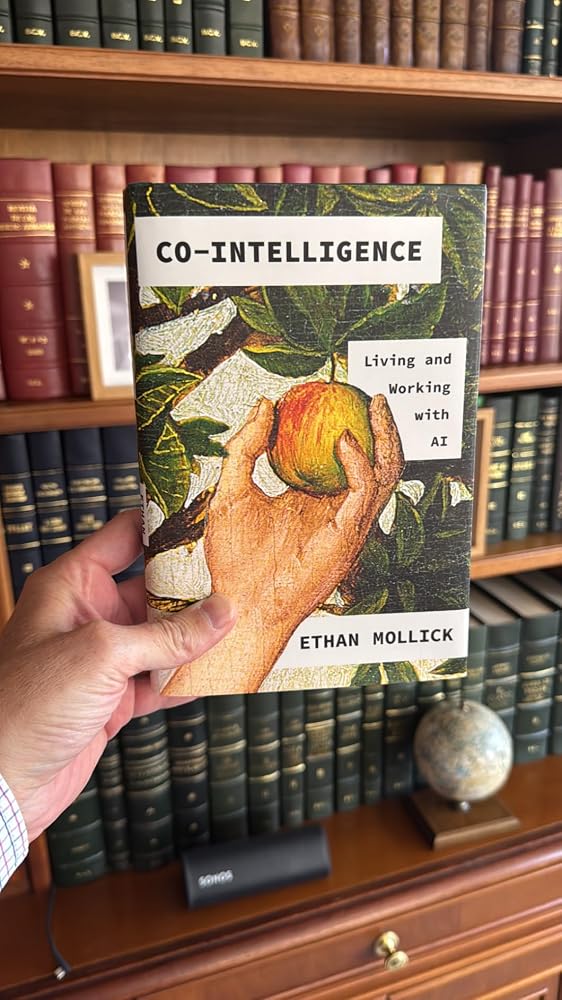
This is a book filled with practical examples about how to use AI.
Excellent instruction on how to have the proper relationship with AI. Having worked with a couple of AI engines extensively over the last few months, I find Ethan Mollick’s encounters to be consistent with mine and his approaches sound. If AI was better integrated into Amazon’s customer facing systems, AI would have co-authored this review.
El libro se deja leer fácil; las ideas o temas se plantean de forma directa y amena a la vez. No cae en fatalismos anticipados ni extravagantes futuros.Leyendo este libro, se aprende lo esencial acerca de lo que está detrás de las IA, sus implicaciones y limitaciones.Muy recomendable.
I enjoyed this book and thought it did a good job of explaining AI and how to prompt AI to give you better outputs. Definitely have utilized some of the information in the book in the real world and professional life. Would definitely recommend.
I had a coworker who was totally enamored with ChatGPT and couldn't stop talking about it. I'm a skeptic and a late adopter, but it did get me wondering: How should I regard generative AI? How should I use it? How will it impact the future of education and work? This book addresses all of these in just the way I was looking for. If you're seeking a technical deep dive into building LLMs or something, look elsewhere. If you need a surface level handling of the question "What's this all about?" this is a good one.
These days, using AI, conciously or not, is inevitable. This book gives you an opening guide to that phenomenon. As an opening, the content in this book may be obsolete as AI grow more advance. However, this book will give us insights on how we see and use AI optimally.
Torn about this one. If I could, I'd rate it 3.5 stars. Maybe because of how fast AI is advancing, a lot of the examples used already seemed a bit outdated. I did think this would be a good primer for anyone who wants to get caught up on the AI hype.
Thank you, Doctor Ethan Mollick.I only wish I had read this book 2 years ago when it first published. Nonetheless, I feel jettisoned in my understanding and thrilled to use AI as co-intelligence into my future. Thank you.(no AI was used in this review)
As a VP of Growth I want to stay ahead of AI trends. This book is so well written. He is the definitive authority on understanding AI from a big picture and "historical" lenses . I would highly recommend reading this and then reading some more tactical material for a robust understanding.
Co-intelligence is both balanced and pragmatic. Ethan Mollick manages to ground big ideas in practical guidance without veering into hype or alarmism. Reading the book feels like you're learning from a smart, self-aware friend who knows how to keep the conversation interesting.The only drawback is one Mollick himself acknowledges: the AI landscape is evolving so fast that parts of the book will inevitably age quickly. But that doesn’t diminish its value today. If you're trying to make sense of how to work with AI, this is a smart and accessible place to start.
Multiple informations and advices useful in 2025 how to work with Ai. I think, however just few of ideas in this book is universally useful for communicating with computer system and virtual world intelligent being in near future. 4 stars for good writing and knowledge for now. I expected more visionary approach to future of ai. Rapid development of ai will make the content of this book outdated very soon in my opinion.
"Co-Intelligence: Living and Working with AI" offers a really insightful look into navigating the evolving landscape of artificial intelligence. The book does a great job of moving beyond the typical hype or fear, instead focusing on how we can effectively collaborate with AI to enhance our work and lives. It's thought-provoking and practical, providing a balanced perspective on integrating AI into our daily routines. If you're looking for a grounded and optimistic guide to the future of human-AI partnership, this is definitely worth a read.
I have gotten a few AI books - this is the one that I listened to from start to finish. It was exactly what I wanted - a book that I could read/listen to and finish with the sense that I know the basics of AI as a technology, its place in the world right now, and have a leg up on most. I found myself mentioning the book and the information several times in conversation as my own company sets AI policy.
AI is a tool just like a calculator, typewriter or ball point pen. The line I remember that started a chapter was: "Use AI in everything you do"
I found this book quite useful to learn more about how advancements in AI is affecting daily living. Good stuff!
Here's a refined and insightful book review based on your thoughts:---Ethan Mollick’s book serves as an excellent primer for those new to artificial intelligence, breaking down complex concepts into accessible insights. As someone who does not consider themselves an expert in AI, I found this book particularly helpful in demystifying key ideas and making them more understandable.One of the highlights of the book is Mollick’s "Four Rules for Co-Intelligence," which offer a structured and thoughtful approach to engaging with AI. Rather than viewing AI as a replacement for human thinking, Mollick emphasizes its role as a tool that enhances our ability to create, analyze, and innovate. He also delves into the mechanisms behind AI—how it processes information, the sources it draws from, and the inherent biases that can shape its outputs. This discussion is crucial, as it encourages readers to approach AI with both curiosity and critical thinking.What I found particularly compelling was Mollick’s perspective on AI in education. By allowing his students to use AI, he pushes them to think more deeply rather than simply outsourcing their work. This approach aligns with the broader theme of the book: AI is not just a technology to be feared or blindly accepted, but one to be understood and harnessed effectively.For those unfamiliar with terms like GPT and large language models (LLMs), this book provides a solid foundation. It equips readers with the knowledge needed to make informed decisions about the benefits and risks of AI. Given the rapid advancement of this technology, Mollick’s insights are both timely and practical. Personally, reading this book has enhanced my own use of AI, giving me a clearer perspective on how to integrate it thoughtfully into my daily work.Overall, this is a must-read for anyone looking to gain a foundational understanding of AI without getting lost in technical jargon. Whether you're a student, educator, or professional, Mollick’s balanced and insightful approach makes AI feel less intimidating and more like an opportunity to be explored.
Given the remarkable nature of LLM's and their capture of our imaginations it was inevitable the business school perspective would come out. Co-Intelligence is a perspective on how to work with AI to improve productivity and the book highlights how in classroom (and professional settings) how these tools can be used to improve effectiveness, lead to inspiration as well as maintain competitive edge. For me I find looking into the technology engineering side more interesting but how to practically navigate these tools for greatest effect is in many ways much more important as the money required for the training of these models is only justified if they have a revenue stream and a revenue stream is only dependable if the userbase can monetize and this book can help you understand how to do that.The author starts with the technology and its uniqueness and gives a framework of how to think about using technology for productivity enhancement. The book is mainly substantiated in Part II where the author how one can use AI with the chapters being AI as a person, creative, coworker, tutor, coach, our future, as us. Much of what goes into the book is the authors experience in teaching in business school with the students incrementally using these tools to improve their projects. The author shows how prompting can vastly affect the content, how being specific can deliver much more utility than making general requests and the variety of purposes that LLM's can be catered towards. One feels that from the snippets of prompts and responses, all of our expertise is at risk but simultaneously one feels all our productivity can be enhanced. This somewhat inescapably leads to the conclusion that we all need to start embedding the use of these tools in our work streams but not defaulting to copying and pasting results but rather squeezing narrow insights from these frameworks.Overall the book is useful in explicitly showing how the tools could be seen to aid users differently based on how they used these tools reminding us that the tool itself doesn't have answers so much as the tool when properly used can extend ones expertise substantially. Nonetheless I would expect the content of the book to soon become outdated as new models are rolled out. I would like to think the main ideas/lessons will remain true, but the innovation in technology and these models does make one a little be weary to think that co-intelligence is a given rather than eventually a cause of labor substitution that will impact many people differently irrespective of whether they follow the advice.
The first half is more destined to those who have yet to use generative AI on a regular basis – in all probability a shrinking crowd. Anyone who interacted with ChatGPT 3.5 and then 4 will have similar anecdotes. And while certainly useful, I found Ethan’s four principles to mix rules of thumb with prompting techniques and more general observations.Part two I personally found of much greater interest, as Ethan delves into the implications for workers, demonstrating how they can learn to use AI to great effect, e.g. in creative work. Ethan dives deep into how gen-AI can produce efficiencies and superior results, but also lead to disaster if users get too comfy and “fall asleep at the wheel”. While several studies and research papers exist on these topics, it’s one of the first books that explains these concepts to laymen. It’s also enjoying to see him, rather than trying to dissect office jobs he may not be familiar with, instead humbly take himself as a guinea pig to explain in great minutiae how he wields this revolutionary tool in his work, at times using the very paragraphs we read as examples.I found in several occasions echoes of my own book, e.g. when Ethan insists on how technology cannot be treated in a vat but goes hand in hand with frameworks and trends, thus how the way corporations have work organized is likely to change in serious ways, as it did in previous industrial revolutions. He too does not fall for the fallacy that because certain tasks in a job cannot be automated, the job is immune to disruption. He too notes the risks associated with a greater deployment of metrics and the diktat of data, what others have called “Digital Taylorism”, and alludes to what I termed being “pushed off of the sumo ring of cognition” by an AI that calls the shots.He also takes a lucid and pragmatic approach to how such disruptive technology will be deployed in the workforce, detailing how employees use it covertly out of fear that their managers find out, though less convincing are his recommendations to leaders on how to instill a pro Gen-AI culture in the company – a pity given how this is fast becoming a concern for managers. A few other considerations also went neglected, like how those companies that fail to adapt will quickly fall behind those that do. But I feel this is also because he is primarily addressing employees, and that is nice to see in contrast to all the books guiding managers.My favorite is his insistence that AI is proving most beneficial to juniors, who can boost their performance level to the vicinity of veterans; rather than concluding in the lines that “See, this is a great enhancement tool, not something that will eliminate jobs - so don't be afraid!”, or “it’s not AI that will displace workers, but the workers who master AI that will displace those who don’t” as the majority of so-called experts yell and parrot from every hilltop, he questions what implications this might have for seasoned workers, for those whose expertise becomes somewhat eroded and may no longer justify their wages. Following what I called the commoditization effect, AI could become a great equalizer, but (Duh!!) overall this will drag wages down. He notes how now some companies hire fresh graduates for jobs there where they used to hire people with at least five years of experience, because they can do practically just as well now with the help of AI.Alas he also rightly note that expertise will still play a role, with solid arguments. But he dares not venture say how much of this expertise will still be required and how this will reshape companies - indeed, only time will tell. We could end up with a split of say 80% of juniors – or rather people paid with junior salaries – and only 20% of experts there where we had a more balanced split before, and such junior talent could be outsourced instead of employed, etc.I pass on the final chapters on education and the future of AI, not for lack of interest but to avoid too long a commentary. Also great observations, for instance on how a future AI-mentor would be superior both for providing more constant feedback but also in its ability to take on several different roles (as opposed to the subjectivity of a single human coach, teacher or mentor). And here again there is the risk of overdependence, for instance (with his example of architect) consulting the AI on every single stroke.All in all, a very good read that remains concise and echoes some of my concerns which I believe will only balloon with time as organizations reshape work.
Just finished reading Co-Intelligence by Ethan Mollick. In many ways it is an introductory 'primer' on AI (artificial intelligence).Written by Ethan Mollick, a professor at Wharton, it explores what AI is, how we can utilize is as a 'co-intelligence' and what the future might look like with AI.As someone who has used ChatGPT and other tools, but did not have much understanding of how they work, the book provided that background. On the other hand, I found it lacking in the depth and creativity I hoped for in exploring what a future world with AI might look like.Some insights from the book:- AI is built on Large-Language Models (LLM's). These models have huge datasets at their core. By using this information, it can generate responses by predicting (and displaying) the word that is most likely to come next as a response to a prompt (and as a response to what it has already generated. The association between words are called 'weights' and these are adjusted based on the frequency and association between terms (if I have understood this correctly.)- Because of the way that LLM's are built, the biases that we have as humans will get translated into AI. AI tools have a stage called Reinforced Learning from Human Feedback (RLHF) which is a process by which humans look to remove the bias. (Of course, this introduces another source of bias, but is important in ensuring that AI does not become a mirror of the uglier parts of ourselves which often manifest online and in other places which may be sources of data for AI.)- This process means that unlike other areas of technological development, AI finds it harder to be consistent and structured and instead seems to be actively creative. An analogy which is not found in a book, but which seems apropos was the shift in computer graphics from Euclidian Geometry to Fractal Geometry as the basis of graphics.- Mollick notes that the nature of AI makes it extremely difficult to predict exactly what it will be great at and what it will not. It also means that AI will include mistakes and fabrications without any self-awareness that it is doing so.- Mollick believes we are better for 'inviting AI to the table' while maintaining human involvement (you can get great results by working with AI, and poorer results [at least today] from handing over tasks to AI without oversight. He recommends viewing AI as a person in the sense that AI will be quirky and unpredictable. He also notes that whatever AI you are using today will likely be the worse than any version you ever use in the future as the technology continues to develop.- In the book Mollick shows how to use AI (engage with it, provide it with specific instructions "Give me a Mexican recipe that takes under 20 minutes to make using ingredients X, Y and Z [items in my fridge] and can be done by a 12 year-old without any instruments that would potentially be dangerous [like blender's etc]." He recommends breaking down problems into steps (a process you can ask AI to assist etc.)- Mollick is generally pretty optimistic about AI. He points to studies that show that it helps people who struggle in areas to elevate themselves and believes it may help resolve income inequality etc.- Mollick mentions, but in my opinion does not give enough attention to potential issues. He notes that people often hand off tasks to AI without engaging mentally and we are in real trouble if we take another step back in critical thinking (in my opinion). He does not focus on the ways that AI could easily exacerbate income inequality as those with money put guardrails around the best tools etc. He also does give almost any focus on the way that AI can spit out endless content in little time and in the hands of bad actors, can take our current issues with fakenews, and make it 1000x worse very quickly.- Mollick notes that practical changes occur within systems and the changes we are talking about need to contend with the structures (economic, social, political etc) which currently exist. This reminds me of Kuhn's descriptions of changes and the slow pace of the Copernican Revolution, in part because it bumped into theological systems.- As I noted above, I felt like Mollick did not spend nearly enough time exploring the issues that could easily arise from AI. What happens in a world where there is endless content being generated and no clarity on the legitimacy of it? Does it lead to additional conflict? How does it play a role in elections, campaigns etc.? Is additional government regulation generated to crack down? A social media platform exclusive to non-AI where you have to validate everything you are writing (somehow)? Influencers with "Real Human - no AI content" badges? What about Human-Reviewed AI Content? Is there a reason that is a bad thing?All in all, I think that AI is likely to have a dramatic impact on the world of the future. This book is a good intro. In all likelihood large aspects of it will become outdated r...

