

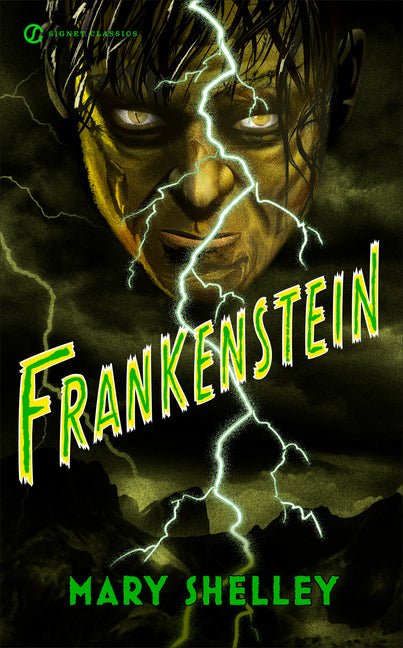
Frankenstein
by Mary Shelley
 )
 )
Couldn't load pickup availability
More than 200 years after it was first published, Mary Shelley's Frankenstein has stood the test of time as a gothic masterpiece--a classic work of horror that blurs the line between man and monster.
"If I cannot inspire love, I will cause fear."
For centuries, the story of Victor Frankenstein and the monster he created has held readers spellbound. On the surface, it is a novel of tense and steadily mounting dread. On a more profound level, it illuminates the triumph and tragedy of the human condition in its portrayal of a scientist who oversteps the bounds of conscience, and of a creature tortured by the solitude of a world in which he does not belong. A novel of almost hallucinatory intensity, Mary Shelley's Frankenstein represents one of the most striking flowerings of the Romantic imagination.
With an Introduction by Douglas Clegg
And an Afterword by Harold Bloom
Share
Book Details
- ISBN
- 0451532244
- Binding
- Mass Market Paperbound
- Authors
- Mary Shelley
- Publisher
- Signet Book
- Published Date
- October 1, 2013
- Language
- English
- Pages
- 272
- Physical Info
- 0.8 in H x 6.7 in L x 4.2 in W (0.3 lb)
Bought for my son, who flies often...good size for a carry-on bag.
Brand new.
Definitely a classic for a reason. Lots of interesting themes and voices played out, I’d highly recommend it if you’re working on doing a classic run for books
Love these cloth covered books.
The creator and the creature endure endless hardships and heartbreak! The writing style is elegant. The story line covers a great tragedy.
- 5 stars: 8 (40%)
- 4 stars: 10 (50%)
- 3 stars: 2 (10%)
- 2 stars: 0 (0%)
- 1 star: 0 (0%)
Bought for my son, who flies often...good size for a carry-on bag.
Brand new.
Definitely a classic for a reason. Lots of interesting themes and voices played out, I’d highly recommend it if you’re working on doing a classic run for books
Love these cloth covered books.
The creator and the creature endure endless hardships and heartbreak! The writing style is elegant. The story line covers a great tragedy.
Amazing book, wonderful storyIt allows you to understand a lot of the needs of a human being from the perspective of the creature, but also the worst of his nature represented by Victor
I enjoyed the book, and it had lots of interesting insights, but I understood no central thesis or idea. Similar to Tolstoy, but as Dostoyevsky said of Tolstoys work "perfect as a work of art" but lacking in meaning.
Mary Shelley's timeless classic, Frankenstein, stands as a haunting testament to the human pursuit of knowledge and the consequences that accompany unchecked ambition. With its gripping narrative and profound exploration of moral and existential themes, this Gothic masterpiece continues to captivate readers even two centuries after its initial publication.Set against the backdrop of a gloomy and desolate landscape, the story follows Victor Frankenstein, a young and ambitious scientist consumed by his desire to conquer death and unlock the secrets of life itself. Driven by his insatiable thirst for knowledge, Victor embarks on a perilous journey that leads him to create a being out of stolen body parts. Yet, this act of creation soon turns into a nightmare, as the creature awakens with a bewildered consciousness, abandoned by its creator and left to navigate a hostile world alone.Shelley skillfully delves into the complex psyches of both Victor and his creature, exploring their parallel narratives and the consequences of their actions. Through Victor's internal struggle with guilt and remorse, Shelley exposes the moral ambiguity inherent in human nature, forcing readers to question the ethical implications of scientific advancement. The creature, often portrayed as a monster, is paradoxically both sympathetic and terrifying—a tortured soul seeking acceptance and love in a world that rejects him based on his outward appearance.The novel's narrative structure, presented through a series of letters and firsthand accounts, enhances the sense of impending doom and creates a chilling atmosphere of suspense. Shelley's evocative prose paints vivid images, immersing the reader in a world of darkness and despair. Her exploration of the themes of abandonment, revenge, and the nature of humanity provokes profound introspection and challenges the boundaries of empathy.Frankenstein stands as a cautionary tale, cautioning against the dangers of unchecked scientific progress and the moral responsibility that accompanies human creation. It serves as a timeless reminder that knowledge without wisdom and compassion can lead to disastrous consequences.In conclusion, Mary Shelley's Frankenstein is a remarkable work of literature that continues to resonate with readers today. Its exploration of human ambition, the moral implications of scientific advancement, and the search for identity and acceptance makes it a thought-provoking and unsettling read. With its beautifully crafted narrative and complex characters, Frankenstein remains a masterpiece that forces us to confront our own humanity and the ethical dilemmas that arise when playing with the forces of life and death.
Amazon groups reviews for the same story even when they are from different editions and in the case of Frankenstein the worst is that there are two similar but not identical versions. The first is the 1818 uncensored edition by e-artnow; the other is the AmazonClassics Edition, it doesn't say which version it is but after reading it is clear to me that it's the posterior 1823 edition. The 1818 edition is a bit more journalistic in the sense to show you the events and let you think your own conclusions, the 1823 edition is a bit more explicit in the moral judgment of the wretched Victor Frankenstein. But these differences are quite subtle... in my opinion it had been better if we just had the 1818 story, it's perfect. Both editions has X-Ray, about the differences I can say:* AmazonClassics Edition (2 stars):In the positive side the formatting is modern and professional, you can easily see that you are reading a letter for example; the typography is clean allowing you to read with more comfort. In the negative side is evil the lengths that AmazonClassics attempt to hide dates, there is no year of publication, which is a sin considering there are the two different versions from different years; the malign editor even hides the date that is in the preface, sobbing his hands in the excitement to draw the readers into the pit of despair.* e-artnow edition (3 stars):In the positive side it contains the pure text, it's a normal formatting, not excellent as the AmazonClassics but works, but it's more useful as it informs you about the edition used. I read it fast along the AmazonClassic so I didn't find errors but could not guarantee their non existence. In the negative side... I have no important observations, I don't like the cover, the cinema version doesn't correspond to the book.In conclusion although the AmazonClassics edition is comfortable sadly it seems there is an attempt to hide the mentioned years. I cannot recommend it. The e-artnow edition is good enough, less comfortable to read but still has X-Ray and the mentioned years as the author intended them are present.Taking aside the editorial aspect I loved a lot to read Frankenstein. Mary Shelley made, barely 20 years old, an awe-inspiring horror novel. In my opinion far more impacting than Stevenson's "Strange Case of Dr Jekyll and Mr Hyde," with which it shares some characteristics. The creature, the creation of Victor Frankenstein, is human, he does terrible actions because he suffers, he has been abandoned by the man that donned life to him. Victor Frankenstein is the monster. Surrounded by persons that love him, even the creature could love him, he betrays them without compassion. He suffers but never for others but by the guilt of his lies being unleashed. Is crystalline that he only love physical beauty, Shelley is quite talented to make you feel like the witness of the mental struggle and physical stress of a dark hearted man.If there is something that reveal both the youth of Mary Shelly and her culture devoid of life experience is the fact that her characters triumph or fail through the study of books rather than from work, knowledge and reality. I felt Europe quite small too, it seemed like either the each of the characters bought the seven-league boots or that Europe is as big as a thematic park. But these are minor details for a classic whose reading at least once could enrich you.
Look, folks, I get that this is a classic. I get that it's gotten a LOT of attention of late for being one of the first science fiction novels ever written -- and by a female author, no less. I can appreciate that it's one of the founding books of a genre, and that the many Hollywood takes on this novel have altered it nearly beyond recognition. But... it's a tedious read. It's not BAD -- it's actually an interesting read for both the philosophical questions it raises and the startling differences between the original story and Hollywood's interpretation. But it's definitely a product of its time, and the florid prose and overwrought, melodramatic plot and characters make it a somewhat tedious read as well.The basic story of "Frankenstein" is well-known to many by now -- a "mad scientist" creates a monster and must destroy it before it in turn destroys all he loves. But that's not only largely inaccurate, it's only a fragment of what's going on. The "mad scientist," Victor Frankenstein, is actually a university student studying natural science, and he creates his artificial human and gives it life in an effort to cheat death... and is immediately repulsed by the hideous creature he's made. The creature, in turn, is actually an intelligent, well-spoken being who starts off kindly, only to be made bitter and vengeful by a world and a creator who all turn against him. And even as both creature and creator set out to destroy each other, one has to wonder -- who is the monster, the creation or the man who created him?The "Frankenstein" of this novel is vastly different from the many film and other interpretations over the years. There's very little horror here, and none of the campy horror we've come to expect from the cheesy Frankenstein films of the past. There's no Igor, no digging up of corpses, no torches and pitchforks, not even a laboratory in a haunted castle. Lightning doesn't play a role in bringing the creature to life (there's mentions of lightning and even an explanation of electricity early on, but that's it), and the creature (NOT named Frankenstein himself) speaks not only coherently but in an amazingly proper manner. It's fascinating to read and compare, but will probably disappoint horror fans expecting a cheesy-creepy read.The book also raises interesting philosophical questions -- responsibility toward what one creates, what makes a monster, and the perils of pursuing scientific advancements at all costs. Small wonder it endures in classroom curriculum...The prose of this book comes across as overwrought and melodramatic, however. The characters angst and whine a great deal throughout the book, which gets obnoxious after awhile, and everything seems to be overwritten to such a degree that I found myself going "get on with it already!" several times. Also, there's a random interlude where we get the backstory of a cottage-dwelling family that plays a tiny role in the plot, and feels like it was lifted from another book entirely and grafted in sloppily. As for Victor and the monster themselves... they're appropriately tragic and troubled, and make for an interesting "who's the real monster" discussion, but both end up pretty unsympathetic by the time the novel is over."Frankenstein" is certainly an interesting read, especially if you watch a "Frankenstein" movie and compare it to the novel (has Hollywood considered making a more faithful adaptation at some point?). Read for entertainment purposes, however, it gets rather tedious, and will come across as a disappointment to anyone expecting an actually-chilling horror story. Still, it's a literary landmark, and deserves at least one read-through.
*Warning: This review contains SPOILERS.*I hated this book in high school and never imagined I'd reread it voluntarily, but here we are. And I actually didn't hate it this time! Funny how these things work out, huh? I've read some articles about this book as well, and they talk about how this book is representative of everything from abandonment and isolation to dysfunctional father-son relationships to queerness, and honestly, if my English teacher had gone into more depth about that kind of stuff, I might have been more interested the first time around.Anyway, I definitely sympathized with the monster. He was so utterly and completely alone. He spent years literally alone, living in sheds and caves and out in the wilderness, on the outside of humanity looking in. He was abandoned and isolated and treated horribly by everyone. Even his own creator did nothing but insult and shun him. The poor guy didn't even have a name, and that's just really sad.But Victor... even though his actions were awful, I sometimes fell into the trap of wanting to sympathize with him too, even though I knew I shouldn't, which I think is the sign of a well-written character. He made a mistake---a horrible mistake born of obsessive fervor and arrogance, but a mistake nonetheless. Haven't you ever done something and then worried that someone would to find out or that something bad would come of it, even if it was just sneaking a cookie before dinner as a kid? Now imagine that feeling x100. And I can understand why he was hesitant to create another---he didn't want to make the same mistake twice. So I think his feelings of despair and horror and guilt and grief made sense, if nothing else.The way I see it, neither character is entirely free from blame---the monster murdered innocents, and nothing can excuse that---but Victor never should have created the monster in the first place if he was going to abandon him. It was essentially like someone having a child and then neglecting them. Once the monster was alive, it was Victor's responsibility to care for him, and he failed entirely at that. He was selfish. I think I could have forgiven the mistake of making the monster in the first place if Victor had just taken responsibility and cared for him. Probably all the bad things could've been avoided if he'd done that. The creation wasn't "born" a monster; it was the way he was treated that made him a monster.Here's another thought I had. Victor didn't want to create a mate because he didn't know if she'd turn out to be even more dangerous, right? But people have babies every day without knowing what they'll be like when they grow up. Some people do become murderers. And the monster in the book only became one because he had no love or companionship. So by that logic, Victor probably should have just taken his chances and created a mate.This book also made me ponder about souls---did the monster have a soul?---and what it really means for a thing to have life, but I won't get into that.But, as is the case with most of the classics I've read so far, the problem I had with this book was that it had so many words but so little meat. (Kind of like this review, to be honest. I don't know how it got so long.) Everyone was so long-winded. There would be pages and pages about the despair a single character felt over a single thing that happened even though a couple short sentences could've expressed it just as well.Also, I was surprised to find the depictions I've seen of Frankenstein in art/movies/media (bolts in his neck, criss-cross stitches everywhere, usually greenish skin and a flat head, walks in a lurching way) isn't at all how he was described in the book. No bolts, no stitches, no flat head. And he doesn't lurch; he's larger than the average human, but his limbs are in proportion, and he's described as being agile and fast. The way I envision it (which is just my interpretation, not right or wrong), the reason he's so horrifying isn't because he's so non-human but rather because he does look human, but... off. I like this artwork (link can found in my review on my blog or Goodreads) best of all the ones I've seen. He looks almost beautiful, but he's just kind of tipped the scales into creepy and unnatural.So, overall, I enjoyed this more than I thought I would. The writing was long-winded, but the story itself was thought-provoking.*The edition I read is the Kaplan SAT one. I’m not aware if there are any differences among different editions (other than the fact that mine had a bunch of SAT words with definitions).**I’ve read this book multiple times. This review was written after my 2nd read.*Rating: 3 StarsOriginal Review @ Metaphors and Moonlight (link in profile)
2018 marks the 200th anniversary of the publication of Mary Shelley's FRANKENSTEIN; OR, THE MODERN PROMETHEUS. While I did not read - or in this case listen to - the novel because of the anniversary, it does seem appropriate that I picked this time to read what is generally considered the first true science fiction novel. I would imagine that most people, myself included, first encountered FRANKENSTEIN as the 1931 movie of the same name, which is somewhat based on the novel. As we know, the movie recounts the story of a scientist who, along with his assistant, piece together a human-like creature from the pieces of dug up corpses. Most infamously, Henry Frankenstein's assistant Fritz acquires the brain of a criminal for the Creature (played by Boris Karloff), thus lending the story the conflict it needs when the Creature comes alive and begins wreaking havoc throughout the local countryside. There have been many movie and literary adaptations and spinoffs of the original FRANKENSTEIN. I am particularly fond, of course, of Mel Brooks' movie Young Frankenstein, in which Peter Boyle portrays the Creature. I'm also fond of Michael Bishop's 1994 novel BRITTLE INNINGS, which links the FRANKENSTEIN story and baseball.It probably would surprise no one who has only seen the movie that it bears only a small resemblance to Shelley's novel.Shelley's novel is told as a framing narrative. The story starts out recounting the correspondence between Robert Walton and his sister Margaret. Walton is traveling to the North Pole to gain scientific knowledge. While on the journey, he and his crew first spot a dog sled driven by a large man, then rescue a man who is near death. The man is Victor Frankenstein, who has been pursuing the man in the dog sled. As Walton nurses Frankenstein back to health, they become friends. Walton shares his story of intense desire for scientific knowledge. Frankenstein, seeing much of himself in Walton, recounts the story of how he arrived on Walton's boat and why Walton should think twice about his intense thirst for knowledge.The framing narrative becomes layered as Frankenstein first recounts his story of becoming obsessed with scientific knowledge, and especially that of how to bring life to an inanimate being. He almost quite literally becomes the "mad scientist", spending all his time researching the subject and then, once he discovers the actual process to bring a creature to life, doing nothing but what it takes to make it happen. He rarely eats and sleeps, and his relationship with his family deteriorates to almost nothing. He does finally bring the Creature to life, but once he sees it he is appalled and disgusted with what he has done, and he aims to destroy it.Next comes the Creature's story as told by the Creature itself, which takes up the bulk of the novel. Unlike Karloff's portrayal of the Creature, the novel shows the Creature learning about himself, learning about language - to the point where he becomes erudite to the point of sounding as if he had what we might call a college education - and learning how and why he is shunned by the rest of humanity. He then realizes that he is what he is because of Frankenstein (resulting in what would be a fascinating study of the nature versus nurture - or in this case, lack of nurture - discussion) and vows to deprive Victor of happiness much like Victor has deprived him of happiness. Eventually the narrative returns to Frankenstein's story and eventually Walton's, culminating with Walton meeting the Creature itself.It was somewhat surprising to me how short the novel actually is. As readers we have been trained to expect complex stories like this to be at least double the length. And while there is much detail that could be discussed - and I refuse to be concerned about spoiling a story that is over 200 years old at this point - I will stop here and let those who have yet to read the novel go ahead and do so without giving it all away.I was pleasantly surprised by FRANKENSTEIN. I guess I've been conditioned by the movie, which I've seen several times, to expect one thing while the novel turned out to be entirely something else. While the name Frankenstein usually is used to refer to the Creature, it's pretty clear that the real villain of the novel is Victor himself. His hubris in creating life from where there is none - and at the time FRANKENSTEIN was written the implication was that Victor was stepping where only God was meant to tread - resulted in a Creature who quite understandably was ticked off at his situation and who also quite understandably blamed the only person he knew to be responsible for his plight. The Creature was shown to be a compassionate being, and one who gave Frankenstein every opportunity to shut down the violence and death that was occurring around him. Yet,Victor chose to let it continue, and indeed brought so much suffering upon himself by his actions the reader might be tempted to believe that he is the Wret...
This book was one of the biggest surprises for me! Absolutely NOTHING what I expected. When someone says word "Frankenstein", you think about a lab, a mad proffesor, some lightning buzzing into the bolts inside monster's head. Drop all this imagination! This classical book had nothing of it! :O Maybe that's why I was so amazed. If I didn't have all those expectations, maybe my rating would be lower, but now, damn, I liked it a lot! Since I have so much to say, I'll just drop it into a list, of good and bad things :)1) It's awesome that Amazon is giving free ebooks for classical literature like this! Thanks, Amazon! And what a surprise it was for me, that this Kindle edition is the real original "Frankenstein", but audiobook narrated by George Guidhall is of a later edition (which was edited by the author herself, when her book became famous). So reading those two books where more like reading two separate books for me - one ebook and one audiobook, with quite a lot of changes, even so major as who Elizabeth was to Victor - a real cousin, or just a girl taken from street! :O2) As I said, I have expected this book to be absolutely different! A horror story, about making a man from different body parts. Actually this only took a few pages of the book. All the book was Victor's thoughts about what he had done, creatures thoughts about humankind, and 3) a lot a lot A LOT of words misery, wretchedness and countenance :D My oh my, I have never read so many same QQing thoughts in my life! :D This book could be a good 5 star if Victor's thoughts weren't so TERRIBLY repetitive. He said he feels misery/is miserable/life's misery at least 135 times (just did a search in my Kindle). I won't even count other of his cryings. I should be ashamed of making fun of his inner tortures. Victor Frankenstein had a really difficult life, but I'm not if it was a good idea by the author to write it in such a repetitive way! but on the other hand - it was an absolutely different style from the books I usually read, so also a good thing.4) Never ever don't you dear call a man-made-man a "Frankenstein"! He didn't have a name! Frankenstein was his creator. But the creature was just that - a creature. And what a surprise he was! All my life I thought of Frankenstein's creature to be a mindless monster, with bolts in his head, making ugly sounds and walking like a zombie. That's what those movies show! But this was such a mistake of mine! :O Creature was one of the most intelligent characters in the story! His ability to deduct, to learn, to feel... he was amazing! The story creature told about his first year of life was so heartgripping that I felt so fond of him, so sorry for him... Sadly later he changed.. Loniness makes people (and other creatures) do bad things... :( But still.. he was not a mindless zombie. He was extremely sensitive being.. With emotions on extremities - both good and bad. But wouldn't we be like that, if we didn't have parents and comfort of other people to learn from?I highly recommend this book to everyone who wants to read some intricate English language, but who has enough patience to suffer though all characters' repetitive sufferings (pun intended).This book is emotional, but not in a romantic way. It makes You think about creators responsibility against the creation. And most of all, it shows how Your decisions can change Your whole life!
Several things because I'm not sure where to begin:First, I can't believe a story has been so destroyed by pop culture since it was first written in 1818. Most people today think 'Frankenstein' was the monster, or they associate the monster with Herman Munster or, even worse, Frankenberry cereal. The monster wasn't some flat-headed green man with spikes in his neck.Shelley's description of him is something quite different. From the novel, the monster is, "an 8-foot-tall, hideously ugly creation, with translucent yellowish skin pulled so taut over the body that it 'barely disguised the workings of the arteries and muscles underneath'; watery, glowing eyes, flowing black hair, black lips, and prominent white teeth."Without any research other than iMDb as a quick reference, I'm left to guess the 1931 Boris Karloff movie portrayal must have molded the green monster who walks in the slow, stiff, and stilted way to which audiences have become accustomed.Second, I saw many parallels to addiction and "addict behavior" in this story. The torture, the shame, the physical illnesses Victor Frankenstein suffers, over his creation and the havoc it wreaks upon those closest to him at times resembles a lost soul who can't help but create self-destructive chaos around him (and his creation isn't much different than he is in this regard). To me, this is how the book portrays him, rather than the mad scientist he's been turned into by Hollywood and other media over the years.I read this, the 1831 version, so I plan to go back at some point and reread the 1818 original. I am quite interested to see what contrast there is between the two. There were times I felt the novel dragged out a bit too much (hence the four stars out of five), and it could have easily been a shorter work. It began as a short story and was expanded to a novel, so I suppose that accounts for some of it. Having three narrators (Walton and Frankenstein, and later, the monster himself) easily made it a longer tale. But as unnecessary as Walton felt at the beginning, I guess you could draw another parallel to his relationship with Frankenstein versus Frankenstein's with the monster (or "daemon", as he calls it in the story).Third, some of Mary Shelley's passages are simply breathtaking and beautiful, for lack of a better phrase. Between highlighting and taking notes, I went to Google images more than a few times to look up the places she describes, to see if the reality matches what I envisioned through her prose. I've never been to any of the locations in the novel, so I found it to be a bit of a travelogue as well.Fourth, man feeling betrayed by God or his Creator. When Frankenstein finally catches up to the "daemon" and vows to destroy him, he reluctantly decides to hear the monster's side of things. What we get here is a tale of a man who feels forsaken by a Higher Power and then is made to feel like more of an outcast later on (I'll spare the spoilers and let others discover what happens for themselves).One of the reasons it took me two weeks to read this book was because of the time I spent highlighting, making notations, and using the dictionary. Again, it was written in 1818, so there is quite a list of archaic words and phrases you don't hear anymore within the pages.
First, a note about the cover of the Penguin Classic Deluxe Edition: I’ve noticed in several other reviews of various books in this series that readers have negatively commented on the “cartoonish” like covers. Personally, I happen to like most of the covers in the Classic Deluxe series because they are bright and fun. Sure, it is nice to own a nice edition of a favorite classic. Yet, I don’t see the harm in the fun covers — there’s no rule that says that because something is a classic that it has to be bound with a stodgy, serious cover. Maybe the comic-like covers will catch someone’s interest, someone who might not normally read a book. Getting someone to read a book is the most important thing, right?In the introduction to this particular edition, author Elizabeth Kostova (who wrote a modern take on the Dracula story: “The Historian”), says that she picked up the book to reread, to refresh her memory, and as she was reading it she realized that she wasn’t rereading it at all. She’d never read it. She realized that she knew the myth of Frankenstein, the Hollywood version, the Halloween version, the bolt through the neck version. What she knew (or thought she knew) had come from pop culture.I knew that I had never read Frankenstein. It was always on my ‘to read …sometime” list. I couldn’t pass up the cover, so I bought the book. Like Ms Kostova, I felt that I knew the story of Frankenstein and his monster. Growing up in the 1970s, with all the weekend and late-night sci-fi/horror movies, I’d seen the old Bela Lugosi version, and many of the various other old black-and-white retellings. And lets not forget the Mel Brooks adaptation (which I was fairly certain had little to do with Shelley’s novel).When I sat down to read the book, I was drawn into the tale by the letters of Captain R. Walton, who is on an expedition to find his way through the icy waters of the north. Walton catches a glimpse of the monster, and not long afterwards rescues Victor Frankenstein from the icy water.The book is broken into three parts: Part One is mostly told via letters from Walton to his sister; Part Two is Victor Frankenstein’s narrative for the first part, then the monster’s narrative for the second half. Part Three takes up the story with Frankenstein again, ending with a few letters from Walton.There are several more detailed summaries of the plot, so I won’t go into much detail. However, there are a few things that I think are important to know (they are, in a slight way, spoilers — but, I promise not to give any of the major points away).The book is quite noticeably different from the Hollywood myth that most of us grew up learning. There’s no scene where Frankenstein is in a tower awaiting lightening, there’s no evil madness to him — he looks at making a creature as a scientific enquiry, rather than anything with evil intentions. There is no Ygor/Igor. There’s no little girl who hands the monster a flower. And, most astonishing: the monster speaks — eloquently.There are several gaps, parts where the reader just has to let the story unfold without pausing to think to rationally about it (the lack of detail on how the monster was created, the way the monster was educated and learned to speak and read, etc.) Don’t get caught up in trying to accept the logic — it’s not there. Just follow the tale, don’t think too deeply about how the monster learned so much from watching a family. Just go with it. The gaps aren’t really that important.What is important is that our pop culture has distorted the story so much that when one hears the word “Frankenstein” one thinks of the monster, not the doctor. In the novel, the monster is never given a name - he is simply referred to as monster, daemon, creature, horror. And, our pop culture version of the story has taken away the deep philosophical aspects of the novel. And, we’ve learned that the creature is the ‘bad guy’, but, there’s much to be said about Victor Frankenstein - most of it not nice. In many ways, he is the ‘bad guy’ of the story. He’s so intent on bringing a creature to life that when he does and sees how ugly and horrid the creature is, he immediately abandons it, leaving the monster to fend for himself. Frankenstein is relieved that the monster disappeared and barely gives him much thought until tragedy strikes the Frankenstein home. Two years have passed and monster and creator finally meet, and the monster speaks what I find to be one of the saddest things I’ve read. Frankenstein is angry at what his monster had done, and wants to kill him. In reply: “‘I expected this reception,’ said the daemon. ‘All men hate the wretched; how, then, must I be hated, who am miserable beyond all living things! … Remember that I am your creature; I ought to be thy Adam, but I am rather the fallen angel, whom thou drivest from joy for no misdeed. Everywhere I see bliss, from which I alone am irrevocably excluded. I was benevolent and good; misery made me a fiend.”The monster believes...

