

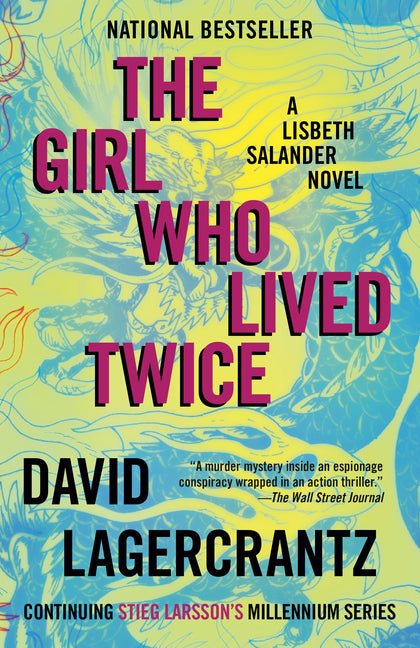
The Girl Who Lived Twice: A Lisbeth Salander Novel
 )
Couldn't load pickup availability
NATIONAL BESTSELLER - The Girl with the Dragon Tattoo series continues: Lisbeth Salander must face the most important battle of her life, and will finally put her past to rest in this thriller that will "leave Salander's legion of followers clamoring for more" (The Wall Street Journal). - Also known as the Millennium series
Mikael Blomkvist is trying to reach Lisbeth Salander--the fierce, unstoppable girl with the dragon tattoo. He needs her help unraveling the identity of a man who died with Blomkvist's phone number in his pocket--a man who does not exist in any official records and whose garbled last words hinted at knowledge that would be dangerous to important people. But Lisbeth has disappeared. She's sold her apartment in Stockholm. She's gone dark. She's told no one where she is. And no one is aware that at long last she's got her primal enemy, her twin sister, Camilla, squarely in her sights.
Look for the latest book in the Girl with the Dragon Tattoo series, The Girl in the Eagle's Talons!
Share
Book Details
- ISBN
- 1101974176
- Binding
- Paperback
- Authors
- David Lagercrantz
- Publisher
- Vintage Crime/Black Lizard
- Published Date
- May 5, 2020
- Language
- English
- Pages
- 448
- Physical Info
- 1.2 in H x 7.9 in L x 5.1 in W (0.7 lb)
I loved the first few of the Salander series, but this one was really hard for me to get through. I put it away several times before actually finishing it - which probably made it worse for me because there were so many characters to track. Too many so I had to keep asking myself, who they were and what their significance was. Each time I came back to the book I thought ot would get better but the plot was lost for me. I did finish it because I'm the type of person that has to, but if a friend asked me about it, I wouldn't recommend the read.
I enjoyed this book. David Lagercrantz did a good job on his contribution to the series.Lisbeth Salander remains one of my favorite fictional characters.
The chain of events kept my interest throughout the reading. I was intrigued on the way the story circled back. Giving even more details on a story that you already knew the outcome. Very enjoyable.
I have read all the books about the girl with the dragon tattoo. I read the ones by the original author and now this author and I enjoy them.
But still an entertaining read
- 5 stars: 6 (30%)
- 4 stars: 6 (30%)
- 3 stars: 4 (20%)
- 2 stars: 4 (20%)
- 1 star: 0 (0%)
I loved the first few of the Salander series, but this one was really hard for me to get through. I put it away several times before actually finishing it - which probably made it worse for me because there were so many characters to track. Too many so I had to keep asking myself, who they were and what their significance was. Each time I came back to the book I thought ot would get better but the plot was lost for me. I did finish it because I'm the type of person that has to, but if a friend asked me about it, I wouldn't recommend the read.
I enjoyed this book. David Lagercrantz did a good job on his contribution to the series.Lisbeth Salander remains one of my favorite fictional characters.
The chain of events kept my interest throughout the reading. I was intrigued on the way the story circled back. Giving even more details on a story that you already knew the outcome. Very enjoyable.
I have read all the books about the girl with the dragon tattoo. I read the ones by the original author and now this author and I enjoy them.
But still an entertaining read
Got a bit bored and had to miss a few pages. Couldnt engage with the whole story of the deaths on mt everest.
I really like Lisbeth Salander for her genius and intensity. It's wonderful that David Lagercrantz has continued the Salander saga, contributing three volumes to Stieg Larsson's original three. This last contribution by Lagercrantz has multiple, but related, story lines going, and this complexity adds to the attraction. Another writer, Karin Smirnoff, has been handed off the series, and I'm looking forward to seeing how the female protagonist is handled by a female writer with her first Salander novel, "The Girl in the Eagle's Talons." I hope the series enjoys a long life in skilled hands.
A fast moving plot. Good use of suspense and action. The characters are great as always. A worthy heir to the original trilogy.
Having read all of the previous books in this series I have to say that the author has done an excellent job of picking up where the previous author left off. The characters flowed as if the original author was writing this story . A very good read. I finished it in record time I highly recommend this book
A good read with layers of twusts and unfolding storylines. Continuation of the familial hatred between Kira and Lisbeth. Could this be the last in the series?
Good news first. This installment of the Lisbeth Salander novels my be the best of the series. The plot unfolds as more facts are uncovered through expert detective work, and the end of the book is open-ended enough to call for additional installments.So carry on, David Lagercrantz!The chief difficulty is that the many Swedish and Russian secondary characters are not given fuller accounts or descriptions, and sometimes seem little more than names, so the reader must have an exceptional memory or make notes as they are first mentioned. Not only do you need who is a good guy and is a bad guy but sometimes that may be hidden by the author.
A strange man is discovered dead on the streets of Sweden. Outside of his spewing of cryptic words during prior public outbursts, all that is known about him is that he is possibly of Asian descent. A phone number is found in his pocket, that of renowned journalist, Mikhal Blomkvist. After Blomkvist is notified, he discovers through eyewitness statements that the man’s prior outbursts pertained to the recently scandalized Minister of Defense. So begins David Lagercrantz’s, “The Girl Who Lived Twice,” the sixth and possibly final installment in Steigg Larsson’s “Millennium” series.One of Blomkvist’s initial reactions is to contact Lisbeth Salandar, the series’ heroin and expert hacker among other infinite qualifications. Salandar has gone MIA, missing since her exit at the end of the last book to search for her sinister twin sister, Camilla. But Blomkvist soon realizes one of the dead man’s final statements was made to another reporter, Catrin Lindell, a fresh character who soon becomes his new love interest. After learning that the dead man was poisoned, his identity is revealed. He was a Sherpa and a mountain tour guide by the name of Nima Rita.Off on her own, Salandar remains off the radar and enrapt in a clandestine operation. She has located Camilla and is presented with a clear shot at eliminating her evil twin once and for all. But at the last moment, she hesitates, and Camilla gets away. Camilla, aware that her sister seeks to kill her, has stepped up the game with a strong cast of cohorts by her side. Now, a showdown between the sisters is imminent.The investigation into Nima Rita’s life leads Blomkvist and Catrin on a mystery that begins with a dangerous expedition to Mount Everest and ends with the deaths of several high profile celebrities on the mountaintop. Not to mention a deeply rooted political scandal. The details of the mystery are sordid and often confusing, sometimes repetitive, and with a slew of characters that must be differentiated between. But Lagercratz’s writing is vivid, on target, and keeps the story well within the tradition of Steigg Larsson’s creation.Before Blomkvist and Catrin can unravel the entire mystery, Blomkvist is kidnapped, which leads Salandar on a fury-fueled chase to his rescue. The ending is explosive yet questionable at moments. The action is paced perfectly, and as always, Salandar manages to survive the unthinkable. Soon, she and Camilla come face to face, and as past memories confront them both, the past goes up in flames.The book may not be the best in the series, but the story is rich and interesting. The final ending leads the reader to believe that possibly, it may be the last in the series. Well done, either way.
I agree with the other reviews here, AND I noticed two other things that made this book impossible to finish. One was the sheer number of characters. I had no idea who was talking to who, who was texting who, who was following who, who was going to visit who, who was trying to kill who. There must be 40 characters in this book, and they all talk exactly the same. In good novels, you can tell who's talking just by their syntax and speech mannerisms. Not so here. It could be a hooker or the chief of police. No way to tell.My second criticism (in addition to agreeing with the other reviewers) is the constant barrage of Swedish names. It seems like every character in the book, and there are a lot of them, has a first name, a last name, and an alias, or a birth name they were called before they bought a fake passport or were mistakenly identified by a government agency. Confusing! And then he refers to everyone with all the different names. Sometimes a character is referred to by their first name, sometimes their last name, sometimes their earlier birth name..... you never know who you are reading about. Plus, everyone talks exactly the same; none of the characters has any personality apart from all the others.The same with all the Swedish places. We are constantly presented with 15-letter names, but we don't know if it's a street, a park, a hotel, a restaurant, a lake, a shop, a river, or a bridge. Therefore, no visuals can be created in the reader's mind. "She walked down to....." or "OK, I'll meet you at....... " but it could be a bar, a private club, an airport, a restaurant, a tunnel, an office building, a hotel, or a subway station. No way to tell.Long story short, I stopped reading about halfway through, and have no desire to go back and finish. Somebody is very mad at somebody, and somebody has a very dicey past, but who are they, and what do they have to do with each other? I don't know.
The Girl With The Dragon Tattoo inspired dozens of book titles starting with the words, “The Girl,” but it also kicked off an era of kick-ass female protagonists. Lisbeth Salander was a computer genius, a dominant lover of both genders, and a fighter unafraid to take on armed thugs and bikers more than twice her size and weight. Though not a figure whom Sunday School teachers would hold up, she nevertheless served as a role model for young women in the early 21st century.Author Steig Larsson passed away after completing the initial trilogy of “Girl” books. His heirs granted David Lagercrantz license to continue the series, and The Girl Who Lived Twice concludes the second trilogy. One might reasonably suppose this book would also conclude the entire series, but Star Wars has shown us that dollar signs can help inspire a story to extend far beyond its natural lifespan.The story in brief: A beggar appears on the streets of Stockholm for several weeks, babbling incoherently about a senior government official. The beggar dies, and investigative journalist Mikael Blomkvist eventually pieces together the man’s connection to the government official, involving a tragedy 10 years earlier during an attempted ascent of Mt. Everest. Meanwhile, Lisbeth is locking horns with her sister Camilla, who is a boss connected with organized crime in both Sweden and Russia. To make it more interesting, the name of a mega-rich American developer of real estate and hotels (sounds strikingly similar to a very real character who has been dominating our daily news for the past four years) keeps coming into the picture in connection both with the Mt. Everest tragedy and the Russian mob. No spoilers here: suffice to say that stuff happens.The book will probably sell a gazillion copies just because of the “brand loyalty” created by the previous five books. But the author’s lazy approach to this story left me hoping that this really is the final installment of the series or, if there must be more, that the heirs will select a writer who tries harder.Some basics:Point of view—POV, as it’s known among writers, shifts from one character to another as the reader turns the pages of this book. That in itself is expected, but sometimes here it shifts even within the same chapter or on a single page.Flashbacks—Throughout the book the author jumps from telling the present story in Sweden to the decade-old tale of mountain climbing. OK, so the old story has a big impact on the current story and needs to be told, but the dizzying turns from one page to the next make the story harder to follow, especially when some of the characters never get a chance to fully develop in the reader’s mind.Backstory—All fiction writers face the challenge of presenting the backstory (i.e., what has happened prior to the current events) without giving readers an “information dump.” But Lagercrantz uses info dumps often, especially in dialog. In conversation a character might recount to another person a lengthy, articulate narrative of events from 10 years earlier without evincing any normal patterns of speech. Sometimes a character may become a walking, talking encyclopedia.The hacking—I think it was the TV series “24” during the first George W. Bush term in which the omnipotent hacker became a mainstay of the modern drama. Whenever master spy Jack Bauer called Chloe O’Brian, back at the office, asking for some highly sensitive top-secret information about any individual in the world, she could key in a few characters at her computer terminal and instantly report the person’s entire life history as well as those of his or her friends, including all their financial connections to each other or shady organizations. Nowadays every cop show on TV has its own Chloe, which allows all the cop characters to stand in a line while they ostensibly study a giant off-camera computer screen and learn everything there is to know without doing any police work. Lisbeth, her friends, and now even her foes all have this superhuman ability to hack any electronic system on earth. Sometimes, solving all the world’s problems just seems too easy.I enjoyed the story of The Girl Who Lived Twice as I was reading it. But if the above gives any indication of the future, I will not clamor for a sequel.
Stieg Larsson’s Millennium Series sets a theme on Lisbeth Salander’s heroic struggle to be freed from her ghastly past. David Lagercrantz keeps this style. “The Girl Who Lived Twice” begins with a scene where a beggar was found in dead at the Stockholm’s park. He was grasping a memo on which Mikael Blomkvist’s phone number were written. Who was this man? Had he any relation with Blomkvist? Was he going to tip-off something to Blomkvist? Lagercrantz willy-nilly drags readers into a thrilling and mysterious adventure. Blomkvist had been suffering from mental agony since Salander’s disappearance. His heart was not in his work while chasing troll factories who were deemed as one of reason which caused a recent stock market crush. Medical Examiner Dr. Fredrika Nyman’s persistent approach gave Blomkvist a tap on his back. He got a good reason to communicate with Salander. On the other hand, Salander was in pursuit of her twin sister Camilla. The confrontation between the twins forms other aspect of the story. Fearing Camilla’s hands reached to her acquaintances, Salander was watchful of them. Different two purposes moves forward, getting entangled with each other, to the ending. Lagercrantz’s story construction is suspenseful. Salander and Blomkvist’s tandem work revealed an identity of this mysterious beggar. They found astonishing reason of his entrance into Sweden and his death. He was a former Sherpa and witnessed a past disaster in Everest, which happened during the same time with a Swedish Defence Minister Johannes Forsell’s succeesful expedition to the mountain.What Forsell confessed to Catrin Lindas, a newly become friend of Blomkvist, was as if reading novels by John Le Carre. Everest was not only a summit for challenge but also an occasion to recruit a double spy. And here again, Alexander Zalachenko cast his long shadow on this incident. The book contains a side story about Salander’s new partner, Paulina Muller. She was a victim of DV from her husband, who was a member of Zala’s syndicate. Even troll factories were found as being affected by the syndicate. Was it difficult for Salander and Blomkvist to get away from the wide-spread network of Zala. Lagercrantz depicts Salander’s fight scene sometimes only through detailed accounts by Kira’s underlings, as seen in chapter 19. This method is effective to stand out her bold action in a desperate situation. “The Girl Who Lived Twice” introduces new characters, Catrin Lindas, a commentator and writer, Kadi Linder, psychologist, non-executive member of various boards, and who purchased Salander’s former apartment. Kadi became a chair of the “Millennium” and Catrin began to write for the magazine. How do they take an active roll in the future episode. In the ending, Salander, after torching one of her evil roots, answers Blomkvist’s text inquiry, “Time to begin again.” What kind of adventure is waiting for them?
I've read all of this series and fell in love with Lisbeth and Mikael at the start. No book in the series - whether by Larsson or the new author - will ever be as good as the first book. However, there have been some really good books in the series, especially The Girl in the Spider's Web which was recently turned into a film. I think the conflict between Salander and her sister is strong, but unfortunately in the latest book, it fell flat. The story focused more on Mikael rather than Salander and although Salander appears in the story, there was nothing new or exciting about what she was up or the conflicts she was involved in. I know it will be hard over the years to keep this series fresh, but Lagencratz proved he could do it in the last few books. Hopefully the next book will be a bit more exciting and reminiscent of the original stories.
Again the Lisbeth Salander drama and intrigue is beautifully laid out in this saga that once against finds our protagonist facing off with her sister Kira (Camilla), interwoven with a fine array of characters and a storyline that while hard to follow, give you a thrill. The main characters are all well intertwined and the ending is fast paced and exciting as we see the end coming in unexpected fashion. Old and new characters are woven into the fabric of the story but all are part of the bigger picture, one which shows the world as we see it and the reality we choose not to see. Continues on the path that was started in book 5 An Eye for an Eye opening with Blomkist fighting his own demons and taking one some of Salander's. Very good read and well written - I miss Stieg but his legacy is getting well handled in this book....
THE GIRL WHO LIVED TWICE is the third 'continuation' by David Lagercrantz of Stieg Larsson's MILLENNIUM series. It is the weakest of the three by a wide margin and that is a profound disappointment to me because I love the series and consider Lisbeth Salander to be one of the top creations of contemporary crime fiction, right up there with Dr. Lecter himself.The premise of the novel is that a homeless man in Stockholm has died under what eventually appear to be suspicious circumstances. The investigation of his death is the central plot line of the novel. Hence it is a Blomkvist book rather than a Salander book, since Lisbeth's relationship with the death is very, very, very tangential. SPOILER (though it is already revealed in the Amazon and other, cited reviews): the dead man is a Sherpa and his death is related to events that occurred on Mt. Everest, events that ultimately involve prominent politicians, international criminals, espionage and adulterous relationships. This is all quite implausible; who chooses Mt. Everest as a site for crime-novel interactions? The crime novel is all about realism. The larger problem is that we are never brought to a point at which we care about any of these individuals except for the dead Sherpa. The events that coalesce in the scene on the mountain are complex and convoluted and the prefatory list of the characters from the MILLENNIUM series does not include any of them, even though the list includes characters with very little function in this story. One ("Ed the Ned", an NSA technician, is only mentioned in passing in this story.) This series is now an international, best-selling series and the politics of Sweden and Sweden's relationship with Russian troll farms is likely to be of far greater interest to a local audience than an international one. Of Russian trolling we have all heard quite enough.I do not wish to spoil the other plotlines here but suffice to say (readers will expect it anyway) that Mikael falls into serious jeopardy and Lisbeth comes to his aid. The climactic scene—the scene for which we have basically purchased the book—is wildly implausible, convoluted and physically impossible in several cases. It is as disappointing as Lisbeth's relative absence from the prior scenes of the book.Stockholm is well-realized technically, with all of the street references, but the feel of the city is never really conveyed and the setting does not rise to the level of importance enjoyed by a major character. The book's themes largely rehash earlier themes in the series. The plotting ultimately fits together but the characters who should dominate the story spend too much time on the sidelines and the scenes too often concern characters for whom we have little curiosity or care.One strange little wrinkle: this is the first of the Lagercrantz continuations which was not deckle-edged. Is Knopf trying to tell us something about how serious it takes the book?Bottom line: I will be watching the early reviews before I purchase the seventh volume in the series. This one has made me very guarded. Note to readers: there are scenes of torture here, but they are more comic bookish than excrutiatingly realistic. Some adult language.
The series started great, lots of action, intrigue and suspense. Lisbeth Salander is tough, brilliant and self reliant. She has had to take care of herself since childhood and overcome great injustices and abuse. She is a recluse and doesn’t trust anybody. Because of her research capabilities and computer savvy she is asked to assist a journalist, Mikael Blomkvist, in an investigating case. They become friends, lovers and have a great working relationship. She develops feelings for Mikael and thinks he returns them. Their is a change in her, she seems more trusting, less withdrawn and happier. When she decides to give it a chance she finds out Blomkvist has other lovers and once again she retracts to her old self and becomes even more withdrawn and isolated.After the 1st book there is little action. The books are lengthy convoluted investigational stories made even more confusing by the large number of characters. Salander dissociates from Blonkvist as much as possible to further safeguard herself from attachments. Blomkvist is totally incognizant of what happened and can’t understand why Lisbeth withdrew from his life. She has hacked Mikael’s computer, which he knows, and when they communicate is mostly by encrypted data via his computer.All the stories he writes about in someway or another has to do with Salander and her family. Salander always knows what Mikael is writing about and since she is computer genius and an incredible hacker she get the most damaging for him and guides him in what direction he should go. When there is trouble, which is not often, she shows up and takes care of everybody.I am very disappointed in this series, i had big expectations. Unfortunately the stories were incredibly confusing and boring. I expected the novels would be about Salander as the main character working together with Blomvist investigating casa with as much research as action.
Let me begin by stating that I was in favor of the continuation of Millenium series by an author other than the late Stieg Larsson and I've enjoyed the first two books ("The Girl in the Spider's Web", "The Girl Who Took An Eye for An Eye") but this one failed to meet my, admittedly high, expectations. It is an overall mediocre attempt in bringing beloved fictional characters such as Lisbeth Salander or Mikael Blomkvist back to life, in a story which lacks a clear direction and a plot that seems to be flat and without the necessary esciting twists and turns that usually make a crime novel a success.Lisbeth has a secondary role here, and even though her conflict with her sister Camilla is built from the early pages, she is mainly busy with hacking in order to help Mikael to uncover the truth about a suspicious suicide of a foreign man who was once a guide at Mountain Everest. The main plotline seems compelling enough in the first part of the novel but it quickly reveals its weak structure and lack of inspiration. When the reader learns the truth about the beggar's suicide in the third and final part of the book, he is not sure if he really cares any longer. The subplot concerning the feud between Lisbeth and Camilla is equally dull and the final showdown is so implausible that almost makes you laugh.David Lagercrantz's prose has a nice flow, but seems to be rather naive in some parts while the characterization in "The Girl Who Lived Twice" is not as strong as it was in the previous two novels. Both the two protagonists, Mikael and Lisbeth, seem to be constantly out of depth, while the secondary characters and villains, who were one of the most interesting aspects in S. Larsson's original "Millenium" trilogy, are outlined in an awkward manner. Lagercrantz tries to connect the book's plotline with those of the previous two but even that is unsuccessful as the result seems -more or less- forced.There was a major conflict between the Larsson's family members, Stieg's father and brother, and Eva Gabrielsson, Stieg's partner for more than thirty years, regarding the rights in the "Millenium" legacy. Gabrielsson claims to be the only person suitable to continue the series, as she was involved in some parts in the original trilogy -though not in the writing process itself- mainly having to do with some of the characters and locations used in the novels. Thus, she was not supportive to D. Lagercrantz's writing endeavor, but the Larsson family, who finally inherited the rights, aggreed and gave him the green light to extend the series. The reading audience was divided into two groups, with some absolutely loving the new novels and others hating it. Personally, I was positive from the beginning as I'm in favor of bold writing experiments like this one. Unfortunately, "The Girl Who Lived Twice", which is the last book in the series written by Lagercrantz, left me with a bitter taste and as I finished reading, I couldn't help but feeling kind of nostalgic remembering the original trilogy's brilliance.

