

Grant
 )
 )
Couldn't load pickup availability
The #1 New York Times bestseller and New York Times Book Review 10 Best Books of 2017
"Eminently readable but thick with import . . . Grant hits like a Mack truck of knowledge." --Ta-Nehisi Coates, The Atlantic
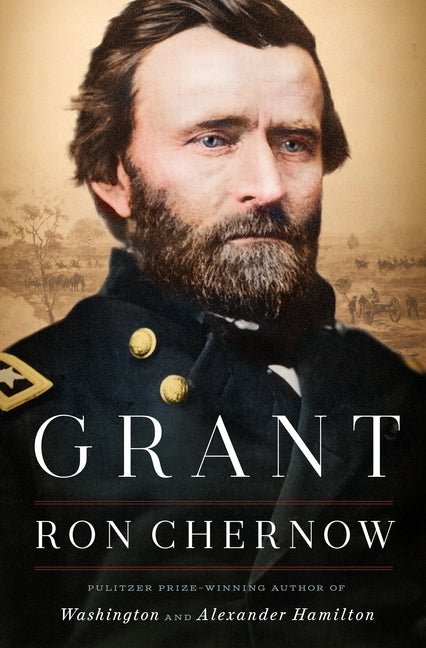
Pulitzer Prize winner Ron Chernow returns with a sweeping and dramatic portrait of one of our most compelling generals and presidents, Ulysses S. Grant.
Ulysses S. Grant's life has typically been misunderstood. All too often he is caricatured as a chronic loser and an inept businessman, or as the triumphant but brutal Union general of the Civil War. But these stereotypes don't come close to capturing him, as Chernow shows in his masterful biography, the first to provide a complete understanding of the general and president whose fortunes rose and fell with dizzying speed and frequency.
Before the Civil War, Grant was flailing. His business ventures had ended dismally, and despite distinguished service in the Mexican War he ended up resigning from the army in disgrace amid recurring accusations of drunkenness. But in war, Grant began to realize his remarkable potential, soaring through the ranks of the Union army, prevailing at the battle of Shiloh and in the Vicksburg campaign, and ultimately defeating the legendary Confederate general Robert E. Lee. Along the way, Grant endeared himself to President Lincoln and became his most trusted general and the strategic genius of the war effort. Grant's military fame translated into a two-term presidency, but one plagued by corruption scandals involving his closest staff members.
More important, he sought freedom and justice for black Americans, working to crush the Ku Klux Klan and earning the admiration of Frederick Douglass, who called him "the vigilant, firm, impartial, and wise protector of my race." After his presidency, he was again brought low by a dashing young swindler on Wall Street, only to resuscitate his image by working with Mark Twain to publish his memoirs, which are recognized as a masterpiece of the genre.
With lucidity, breadth, and meticulousness, Chernow finds the threads that bind these disparate stories together, shedding new light on the man whom Walt Whitman described as "nothing heroic... and yet the greatest hero." Chernow's probing portrait of Grant's lifelong struggle with alcoholism transforms our understanding of the man at the deepest level. This is America's greatest biographer, bringing movingly to life one of our finest but most underappreciated presidents. The definitive biography, Grant is a grand synthesis of painstaking research and literary brilliance that makes sense of all sides of Grant's life, explaining how this simple Midwesterner could at once be so ordinary and so extraordinary.
Named one of the best books of the year by Goodreads - Amazon - The New York Times - Newsday - BookPage - Barnes and Noble - Wall Street Journal
Book Details
- ISBN
- 9781594204876
- Binding
- Hardcover
- Authors
- Ron Chernow
- Publisher
- Penguin Press
- Published Date
- October 10, 2017
- Language
- English
- Pages
- 1104
- Physical Info
- 2.1 in H x 9.4 in L x 6.1 in W (3.3 lb)
Ulysses S. Grant’s life was remarkable for the fact that he had almost no choice in any of it. The current of history swept him along at a breakneck pace and yet he managed to carve out a miraculous place for himself in its annals.As a boy, his father decided to send him to West Point Military Academy. Grant had no desire to go and graduated middle of his class (the one area where he excelled was horse riding). Soon after, he fought as a soldier in the Mexican-American War, and was then assigned to west coast territory as the California gold rush of 1849 saw a flood of settlers traveling west and looking for riches. This two year stint in California and Oregon is where he developed his taste for alcohol, the consumption of which placated his depression at being so far away from his wife and family. (His “abuse” of alcohol would haunt him for the rest of his life.) He resigned from the military in 1854 due to his loneliness and went back to the Midwest, spending the next seven years in relative poverty as he tried to support his growing family, once pawning his gold watch to buy Christmas presents.Then, with the outbreak of the Civil War in 1861, the rest of Grant’s life took off like a racehorse. Truly brilliant at warfare, he steadily rose in ranks until he achieved the summit position: Commanding General of the United States Army. And, as we all know, he won the war for the Union side. He was then a shoo-in for President, accepting the job without campaigning, and served two terms before stepping down. He completed his life with a two and a half year trip around the world (a well deserved vacation) followed by a mad-dash to finish writing his memoirs as his health steadily declined. He died of throat cancer at the age of 63 due to a lifetime obsession with smoking cigars.The most notable characteristic that comes across in this book is Grant’s emotional stoicism. Whether in the heat of battle or the turmoil of a Presidential cabinet meeting, his reaction to news of any kind was nondescript. Time and again, he was described by onlookers as unmoved, regardless the intensity of the situation. This is not to say he was unemotional, as there are documented occasions of him expressing joy or sadness (for example, his despair when his daughter Nellie married an Englishman and moved across the Atlantic), but these episodes are few and far between. When surrounded by military or political peers, he was unflinching. This, obviously, is a major contributor to his effectiveness as a general. Commanding an army requires the absence of emotional reactions to events in preference to rational analytical thinking.Another aspect of Grant’s personality that is illuminated in Chernow’s expansive tome is his trustworthiness. This is also an element of necessity in warfare: a general must trust that his officers will carry out his orders. While this was of paramount importance in the Civil War, it hurt him tremendously in his Presidency and other business ventures as foes took advantage of his generous nature. Grant suffered from a rotating roster of figures in his Presidential cabinet with several departing due to scandals. To be fair, Grant was elected the leader of the United States at a time of tremendous economic growth (exemplified by the booming railroad industry and the expansion of farming and mining out west), and the money that resulted was tremendously tempting to those with the disposition for it. Corruption was rampant, as it always seems to be when money is ubiquitous and oversight is minimal.The saddest affair of Grant’s Presidency was his perpetual struggle with post-war Reconstruction in the south. Despite his best efforts, blacks in the south were continually terrorized and murdered for decades after the war as they sought equal rights as citizens under the law. It would be another one hundred years after the Civil War before President Lyndon Johnson signed the Civil Rights Act of 1964. Grant did his best, but he was depressingly unable to change the spirits of the racist south. The only remedy for that poison would be the slow and brutal passage of time.All in all, Ulysses S. Grant lived a remarkable life. He was an honest man in a time of questionable morals. He knew Abraham Lincoln intimately in addition to the famed author Mark Twain (who published Grant’s memoirs to fantastic acclaim). He went from selling firewood on a lonely street corner to presiding over the richest country in the world in the span of a decade. He was a humble man, who never wavered from placing his faith in others despite the numerous times throughout his life this tendency backfired in spectacular fashion. Most importantly, at a time in history when it was scorned, he believed that all men and women should be treated equally in the eyes of God and the law, and he did his best to champion these ideas. Without him, the shape of this country would surely be a different one. We are all indebted to this stoic and trusting man for pu...

In the process of dying the man was best defining his life. In his life he best defined why we all die.
Reading of the last year of his life and his desire to leave a legacy of confidence, compassion, and care by writing his memoirs. It brought me to tears. The unbelievable response to his death was a testament to an incredible human being who had overcome so much to become the giant that he became. I’ll never think of Ulysses S Grant the way that I did before I had read Mt Chernow’s masterpiece. What an incredible story and an incredible telling of that story.
Enjoyed it
To know and understand is why I wanted to read this book, and was not disappointed, and grateful for the lesson.
Simply put I learned so much about the Civil War and the horrors of Reconstruction but this book was written so brilliantly that in the end I felt I had lost a great friend.
The Past is Prologue - this is a must-read for understanding how we got here today in politics and policy. We really haven't changed much at all. Grant was a flawed genius but he always put his country first, hated war with a passion, and fought until his death for freedom for all people and never sought revenge from those he fought in war or those he disagreed with. I listened to the audio-book and the reader did a good job of bringing President Grant back to life. This book reveals how Grant traveled worldwide (first president to do so), met Kings, Queens, PMs, and common people, went to China, visited the pyramids, met with learned scholars, and was friends with Mark Twain and President Lincoln. I hated to finish this 1000 + page book. This is not just a history book, not just a Civil War book, not just a rags-to-riches book - this is a great human story as told by Ron Chernow. If I could give it 10 stars, I would.
I loved and LOVE this book. I am forever grateful for Grant. Every American and person should read this biography--it is beautify written to say the least. His story has changed me and inspires me to try my best no matter what. Thank you, Mr. Chernow, for writing this beautiful book for us to read and cherish.
Wow U.S. Grant - formerly H. U. Grant!! It's understandable he stopped correcting people. What kind of parents name their kid Hiram Ulysses anyway? Thank goodness his congressman got it wrong on his recommendation to West Point. Things got better after that. Well they did and they didn't.For me this is a great big example of how a bad reputation can last more than a century. It turns out he hardly ever drank. But when he did (almost always when idle) he had no control. The author deems him a recovering alcoholic who by the time he was president had won - well known as the "wine glass turned down" guy. He was not dumb either, an avid reader who finished in the middle of his graduating West Point class, and this after half the class had already dropped out. He also achieved long term successes as president - reconstruction, defeating the KKK which was omnipresent in the south at the time, confrontation and then partnership with England, fair dealings with Native Americans and despite plenty of scandals of the day, an unsurpassed reputation for integrity and honesty after two terms.And then there is the Civil War rep. He won because of superior numbers, supplies etc. Lee was smarter and somehow more noble and heroic, deserving of one of the largest sculptures in the world.If only someone would write a fair minded, honest and comprehensive updated biography of Grant. Oh wait someone did! Thank you Ron Chernow, the guy who formerly lifted Alexander Hamilton off the $10 bill and gave his story dimension, life (and led to a really cool musical) and inspiration.Some of my comments to myself while reading this book - "This is a sad book." (Grant unemployed and middle aged). "This is a super exciting book" (The whole Civil War segment, in which half the book flies by. "Why didn't anybody ever teach this in my school." (Wholesale massacres of African Americans after the Civil War and during and after Reconstruction.). "Stop telling me the same story about the wine glass turned down - I GET IT - HE'S SOBER NOW!" And finally - "OMG you got me" (So I unexpectedly cried at the end - spoiler alert - he dies.)I'm not really a Civil War buff or fan. I wasn't a U.S. Grant fan. But I am now. Also - in the 90's when I lived in NYC we visited Grant's Tomb, which you can see from the West Side Highway of Manhattan - its super prominent, can't miss it. In my mind I couldn't believe what a huge deal a lot of people made at the time on the tomb - and a lot of money spent. You'd think it was royalty or something. Turns out it was.
This sucker would weigh 10 lbs. if you bought the physical book, but I have it on Kindle, so there’s little chance of breaking my face should I fall asleep with it over my head. That’s a left handed compliment to author Chernow, and the thoroughness of his research, and just how well written it is. I doubt there is even one shred of documentation left in the entire world that he does not know about! Or did not incorporate into the book!This is another case where the person being biographed (sic) is much more complex than what we learn from legends. This book is a welcome deep dive! As an example, I received confirmation that Grant had a drinking problem, but I also learned that he kept it mostly in check, with help from two key people in his life. But many people tried to take advantage of Grant, by making up and circulating stories of his drinking. Also, his thinking evolved on the battlefield, such that he operated strategically as he was compelled to destroy the enemy’s army, and not just win battles. At the same time, he developed policy and implemented it in the field as circumstances dictated, such as employing freed peoples to support his army, or to join his army, or to begin to educate them. Chernow makes the case that Grant’s thinking evolved with that of Lincoln’s, such that he essentially became an Abolitionist because of his great insight into the President’s struggles and how our country needed to change. Grant was a complex man, described by Ron Chernow as possessing the wisdom of the ages, yet naive and gullible, such that he was an outstanding General, maybe the best there ever was, but also a President who inadvertently allowed his presidency to be marred by scandal due in large part to his unending faith in the virtues of others. Even as they used their office for personal gain. I would say that Grant’s introspective nature and self-reliance led to staffers observing of him that ‘we do not know how he succeeds, but he succeeds!’This is not a page turner of a book, but should be required reading for responsible citizens today. It still speaks to our present day politics! Reconstruction failed because political winds changed course and too many northern voters lost interest and the will to see it through. This book is not for the faint hearted as it covers ugly truths in detail. And I’m only about 55% through it!Read it, and be better for it!
Breathtaking in scope, Chernow’s work is likely to stand as the definitive biography of Ulysses S. Grant for several years. Its subject is an under appreciated American figure, who the vast majority of Americans know little or nothing about. That’s remarkable in light of the fact that throughout his postwar life, especially after his presidency, he was quite possibly the most highly-regarded living American, which is not to suggest that he was universally praised or admired, but very greatly so. When about 1.5 million people came out for his funeral procession in 1885 in New York City, it was the largest-yet public demonstration in American history. Not all of Grant’s skills that helped him win the Civil War translated well to serving as president, and yet he served two terms, being soundly re-elected for his second term, at a time when getting re-elected as president was less common than it is today.Clearly, U.S. Grant today deserves to be far better appreciated and known about, deserves to be more than “the guy on the 50 dollar bill,” and the easy dismissals of him as “a drunk” and of his presidency as being merely a time of corruption need once and for all to be recognized as being so overly simplistic as to be ridiculous.That is not to suggest that Grant didn’t make mistakes as a general and as president. It’s not to dismiss the fact that ultimately, he put union ahead of justice for Black Americans during Reconstruction. It’s not to fail to acknowledge that his view of how best to navigate relationships with Native Americans was paternalistic at best.But as Chernow ably shows, Grant alone proved to be the general with a sufficiently integrated and broad view of strategy and logistics necessary to finally win the war—thereby being the proximate cause of the salvation of the Union, the ultimate cause being the determination of Lincoln and the majority of Americans—when not one but two prior generals-in-chief failed to do so. He proved also to be prepared to do far more to protect and advance civil rights as president for Blacks in the South than Democrats did but ultimately more than even many in his own party and in the North were willing to do, as Republican and public opinion soured on Reconstruction when it became clear than probably nothing short of multi-generational and militarized federal presence in the South would ensure anything approaching truly representative, safe participation by Blacks in elections. In the final analysis, it was America that gave up on Reconstruction, as shown by Democratic candidate Samuel J. Tilden winning the popular vote—though not the presidency—in the 1876 election, (in which he also carried some Northern states that Grant and Republicans had won previously), having campaigned on a Democratic platform supporting the end of Reconstruction. And even in regards to Native American policy, Grant’s paternalistic, assimilationist plan of corralling Native Americans into reservations—a death knell for much of Native culture—stood in marked contrast to the exterminationist sentiments in the United States, perhaps especially in the US Army and in various Western states.What is more, there is something truly admirable in Grant’s ultimate overcoming of his drinking problem, in his dogged determination through periods of business failures—failures which reveal Grant to be inordinately too trusting of others’ stated or implied good intentions—personal courage and uncommon calm in combat, in his desire for reconciliation not vengeance at the end of the Civil War, in his devotion to his wife, in his self-improvement as a public speaker (and international proto-diplomat) and as a writer, and finally in his effort to secure his wife’s future financial prospects by undertaking the writing of his memoirs despite the excruciating physical pain of his terminal cancer.Chernow’s is a tome of daunting length perhaps, but it is to the benefit of our understanding of a sometimes particularly inscrutable American that Chernow goes into such depth.
My reading of Mr. Chernow's biography of Grant made me realize why he won such acclaim for the book. It opened up several avenues of discovery for me and then filled in the gaps of what I did not previously know of Grant. For instance, the wealth of material on Grant's family life -- both the relationship with his parents and the dealings with his in laws -- gave me a solid picture of the private struggles Grant endured through his life. Mr. Chernow's research not only brings Grant to life, but it makes a reader sympathize with Grant, who despite his well-known role as warrior, drew upon a part of his character as broker/keeper of peace. The author emphasizes that the generous surrender terms offered to Lee at Appomattox represented Grant's wish for healing that he advocated after the war as well. That feeling during Reconstruction became something that haunted President Grant. Chernow's writing on Reconstruction was enlightening. That era of U.S. History is an entanglement to say the least, and the author did well in guiding the reader. One of the starkest points in the book involves the difficulties of Reconstruction which saw the rise of the KKK , serious curtailing of Black voting rights, and widespread violence against African-Americans, all in violation of Federal goals. Grant worried that if those activities were not stopped that all he and the Union troops had fought for and won in the Civil War would be lost. It is a sobering thought, and given civil rights struggles that are ongoing, it might be a thought we should still ponder. Two points of criticism/questioning involve battle action in the Civil War. Mr. Chernow states that General Meade wanted to retreat instead of fighting at Gettysburg. While a famous council of war was held with his generals at Gettysburg, and the question of standing or falling back was on the table, I believe that Meade scholars would disagree that Meade wanted to retreat. The second point concerns a statement made about CSA General Braxton Bragg. The line reads: "...Bragg had won significant victories at Perryville, Stones River, and Chickamauga... ." Chickamauga was no doubt a significant victory, but I have toured these fields and done considerable reading on the battles and have found nothing to make me believe that Perryville and Stones River were "significant victories" for Bragg. In both cases, his army left the field in Union hands, and the Confederate attempt to claim Kentucky was turned back and ended at Perryville. However, that said, those thoughts should not be a deal-breaker for a prospective reader. Mr. Chernow takes one on a march with U.S. Grant that is rewarding.
“Grant” was my first Ron Chernow book, and I can easily see why he is considered today’s most prolific biographer. Despite its length and potentially dense subject matter, it was an absolute pleasure to read. Chernow weaves a narrative tale that never loses steam while allowing the reader to learn (and retain) a great deal about Grant, the times in which he lived, and his truly incredible impact on American history. In doing so, he makes a strong case that Grant, while certainly not one of our greatest presidents, was probably one of the most underrated chief executives in American history and was truly ahead of his time in many respects.Chernow treats each stage of Grants life with the attention it deserves, and manages to strike the optimal balance between the personal aspects of Grant’s life with the historical context in which he lived. While Chernow does an excellent job at highlighting Grant’s unforeseen rise and subsequent strategic genius during the Civil War, which rightfully comprises the bulk of the book, I was surprised to find how interested I was in other facets of Grant’s life. His exemplary record as a junior officer in Mexico as an adjutant during a harrowing, diseased-ridden expedition across Panama were page-turning sections. Likewise, Chernow’s treatment of Grant’s presidency, though not the most exciting period of American history, is well told despite potentially dense subject matter. Specifically, Chernow portrays the tragedy of Reconstruction quite well and gives Grant much-deserved credit for being a champion of equal rights while still holding him to account for various scandals that erupted during his administration. Grant’s post-presidency world tour and marathon effort to publish his memoirs against the backdrop of financial ruin were also brilliantly written sections. Overall, the reader comes to really know and sympathize with Grant, who comes across as an intelligent, dutiful man who seldom sought the spotlight, but repeatedly rose to the historical occasion despite a troubled personal life and a sympathetic naïveté in his private affairs.At nearly 1,000 pages of text, the book inevitably has flaws. Most are not a big deal, but two stood out for me. The first was more of a personal pet peeve, but I felt the author relied a lot on secondary sources, especially during the Civil War section of the book. It didn’t necessarily take away from the story, but he references other Grant biographies so often that at one point I wondered why I wasn’t just reading those. Similarly, he references Shelby Foote - who isn’t a historian and has an objectively problematic and historically inaccurate view of the Civil War - a great deal during that section of the book, which made me wonder about the validity of Chernow’s sources during other periods (i.e. Grant’s presidency) with which I am less familiar. The second issue, as other reviewers have noted, is the degree to which he discusses Grant’s alcoholism. It’s an important topic that I believe Chernow diagnoses correctly, but he references it so often that it becomes quite distracting. It fortunately subsides throughout most of the book’s second half, but inexplicably bookends Grant’s life at the tail end, which I think does a huge disservice to both Grant and the text itself.But these criticisms are ultimately hair-splitting issues. Chernow has done a great service in rehabilitating Grant’s reputation with this book, and I can’t imagine a more comprehensive yet engaging single-volume account of Grant’s life. I greatly enjoyed the book and would recommend it to anyone who is willing to learn more about one of the 19th Century’s most consequential American figures.
U. S. Grant is an amazing story. Even how he came upon his name (which was latter joked to be Unconditional Surrender Grant) is an interesting story. At the dawn of the Civil War, Grant was broke, having failed in several business attempts. He had been dismissed from the army due to his drinking problems. Eight years later, after having led the Union forces to victory, Grant is the President of the United States. In this massive biography, Ron Chernow tells Grant’s story. Chernow challenges many of the presuppositions that are often held about Grant such as his military achievement was due to his superior numbers and that he, like his presidency, was corrupt. While acknowledging the truth of the Union superiority in numbers and the corruption of his administration, Chernow believes that Grant was a superior officer and he, himself, wasn’t corrupt. Grant’s greatest fault, according to Chernow, was his loyalty to friends. It appears Grant best action and clearest head was in the chaos of battle. In his private life he often overlooked the faults of his friends and was too trusting. In battle, he had no problems removing ineffective commanders. Grant is certainly a study in complexity. His father was overbearing, a successful businessman, and a strong abolitionist. His wife, Julia, came from a Southern Planter family and his father-in-law remained an unrepentant Southern even as he lived in the White House during Grant’s presidency. The two families hated each other. His father, who was critical of his son’s failures before the war, was proud of his son during the war even while he attempted to use his son for economic gain. His father, in business with two Jewish merchants, sought to benefit from Grant’s position in the western theater in order to acquire cotton. Grant became so mad that he banned all Jewish merchants from the army’s camp (a ban that was later rescinded). Grant would have to deal with embarrassments from his family for much of his life. Grant was a graduate of West Point and served in the Mexican War (and later admitted that he felt the war was unjust). After the war, he served in California and Washington Territory, before coming back East as a civilian. At the beginning of the Civil War, he volunteered as an officer and joined in Ohio.Grant rose to prominence following his wins in the Western theater of the campaign (where he became close to Sherman), he didn’t meet Lincoln until he was being made the General of the Army. In this position, Grant was able to coordinate the movements of all the armies of the North with a goal of not defeating the South on the battlefield, but of defeating the Confederacy. While much of the war had been fought with armies working independently, Grant, in 1864, coordinated the attacks on all fronts, a strategy that kept the South from shuffling troops from one front to the other and led to the end of the war.Grant knew many within the leadership of the Confederacy. He had been a good friend of James Longstreet since their time at West Point and after the war, the two continued their friendship. He had met Lee in Mexico, but unlike other Union generals wasn’t intimated by him. Grant’s strategy was to always keep pushing. Even if he lost a battle, he would quickly regroup and attack again, before his enemy was able to rebuild his troops. Often, in battles such as Shiloh, the first day was lost but because of continuing the attack instead of withdrawing from the field, victory (or at least reaching objectives, which he saw as more important) were achieved on the second day. During the war, Grant despised the guerrilla tactics of John Singleton Mosby, but after the war he, too, became friend and supporter. Mosby would later become the United States ambassador to Thailand. Grant and Lee had only one additional meeting after the war. Lee called on Grant about a railroad project and didn’t laugh when Grant suggested the two of them had done enough destroying of railroads for them to become builders. While Grant wasn’t intimidated by Lee, neither is Chernow, who challenges a lot of presumptions held about the Southern General.I found many interesting insights into this book. One was how Lincoln feared that Grant might decide to run for the presidency in 1864, something Grant denied. In many ways, he was a humble man. But he was married to a former Southern Belle, who delighted in the spotlight. I was also amazed that after Hayes’ presidency, who had announced early on that he would only serve one term, Grant considered (and other pushed him) to return to the White House. But his attempt at a comeback failed when the Republicans chose Garfield.While Grant’s presidency had its corruption, which Chernow deals with, I felt he tended to sweep allegations of Grant being beholding to business leaders (many of whom had given him homes and money) under the table. Chernow paints a picture of the President who was concerned about Reconstruction and the danger of losing that wh...
Chernow’s Grant reveals a grossly unwarranted maligning and discrediting of President/General Grant. Ulysses S. Grant might be the most misunderstood person ever to become President.When I was in American History in High School and later at West Point, I was taught that President Grant, a great Civil War General, was one of our worst Presidents, prone to drinking and corruption! Instead after reading Chernow’s book, I have come to believe, President Grant may have been one of the best Presidents ever to hold that office. It appears that much of Grant’s reputation was written by people who detested him and what he tried to accomplish.What we failed to learn in our school Histories and what Chernow effectively illustrates were the great American principles that Grant had and tried to invoke throughout his life. Among these are honesty, integrity, humility, and respect for all people regardless of where they originated from, their race or their culture. In War, he was relentless as a General and military strategist. Lincoln once said when General Halleck tried to fire him for missing reports (reports that were filed but misdirected by a hidden Confederate spy in General Halleck’s administration,) “I can’t spare this man: he fights.”BUT, whereas in battles before Appomattox, Grant required the unconditional surrender of the military forces, at Appomattox he gave amnesty, possession of their horses and mules, and return to home, with only the affirmation that they do not take arms again against the United States, to the Confederate Armies under General Lee. He tried to lighten their load for the future to the abhorrence and severe criticisms of many in the Union at that time.Grant was a Republican in the same vein as Lincoln. As a President, Grant was faced with extraordinary challenges to rebuild the United States. Among accomplishments that must be given to Grant were the retirement of the huge Civil War debt, the reestablishment of statehood to the Southern states, the settlement of the USS Alabama case with England and restoring their friendship with the United States, the appointment of a record number of blacks to high profile positions, schools for the blacks, attempts to incorporate fair elections in the South and an attempt to fairly deal with the American Indian populations in the West. Post presidency, he became the first ex-President to serve as an unofficial Ambassador at Large in around the world tour, starting in England, passing through several states of Europe, and then various states of Asia including India, Thailand, China, and Japan.It cannot be said that Grant was always successful. The gains to free the black peoples and provide them with equality in life affairs, made through battle were quickly lost by the rise of groups such as the Ku Klux Clan and others in the South. The Democrats and some Liberal Republicans at that time favored the traditions of the South, their aristocracy and suppression of the blacks. As Chernow demonstrates, the North became fatigued by the constant need to intervene in the South. In the West, after trying to create fair treaties with the Indians, these were quickly broken by the hordes of gold miners flocking to the Indian’s sacred Black Hills who could not be controlled. And his presidency was marred by a stream of high-profile crimes of Grant’s appointees and ‘friends.’It wasn’t that Grant was without faults; however, those faults were more of innocence than Grant’s culpability.It is true Grant was an alcoholic. His alcoholism was evident when he was remote from both his wife, Julia, and John Rawlins, and after a stressful event or series of events. It appears that alcoholism never interfered with the major events around Grant. During the Civil War, General Grant recruited his friend, John Rawlins, from Galena, Illinois, to serve as his personal secretary. But Rawlins was far more to Grant: he watched over Grant and prevented him from imbibing alcoholic beverages as well as providing a critical sounding board for Grant’s ideas. For most of his public life, his alcoholism was under control. As Mark Twain commented, “He [Grant] set out to conquer not the habit but the inclination—the desire. He had gone at the root, not the trunk.” However, this never stopped his detractors from immediately suggesting he was a drunkard when it was convenient for them to do so.It is also true that Grant was a bad judge of character and was overly loyal to those he thought to be friends even when they hurt him deeply. Grant, who always honest in his life, naively gave that same characterization to his friends and close acquaintances even though there was evidence that they were betraying Grant’s trust. Many of these ‘friends’ used Grant for their own corruptive purposes. While Grant never knowingly took part in any of these corruptions, he was declared guilty by association by his opponents. And he would have many opponents as he tried to reconstruct the South. Thus, his re...

