

How to Disagree Better
 )
 )
Couldn't load pickup availability
NATIONAL BESTSELLER
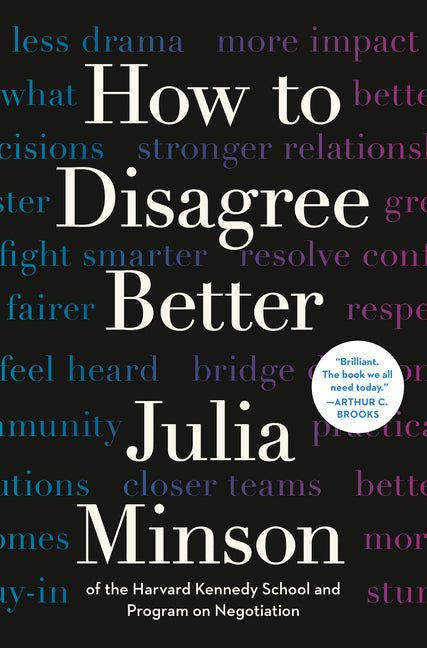
In this "brilliant" (Arthur Brooks) and "both timely and timeless" (Adam Grant) book, pioneering Harvard Kennedy School professor and behavioral scientist Julia Minson reveals the counterintuitive secret to a life of less drama and more impact.
We are in a disagreement crisis. The average person would rather go to the dentist than have a twenty-minute conversation with someone that they strongly disagree with. Yet disagreement is both inevitable and essential for everything from navigating decisions at home to running innovative and agile companies to governing democratic societies.
In How to Disagree Better, Minson brings to bear her decades of research into understanding the psychology of disagreement and its relevance to negotiations, conflict resolution, and decision-making, revealing the hidden skill that all the best mediators and negotiators share: displaying receptiveness to opposing views.
The science shows that receptive individuals don't just fight less, they also get more done--they are better decision-makers, better peacemakers, and yes, better influencers than the rest of us. Through original research and case studies, How to Disagree Better will show you why traditional persuasion strategies don't work as well as you think they do, how you can bridge division and reach better outcomes simply by utilizing receptiveness strategies, and that disagreeing better is a skill all of us can learn to apply at home, at work, and with our neighbors.
Book Details
- ISBN
- 9780593855003
- Binding
- Hardcover
- Authors
- Julia Minson
- Publisher
- Avery Publishing Group
- Published Date
- March 24, 2026
- Language
- English
- Pages
- 304
- Physical Info
- 1.14 in H x 9.26 in L x 6.4 in W (1.0 lb)
This is a must read, very helpful and relevant for our current times when even small disagreements can feel so overwhelming! What I liked the most is how practical it is—doesn’t overcomplicate things, and instead gives clear, useful ways to handle everyday conversations.Minson’s personal stories really make it work. They’re easy to relate to, sometimes funny, sometimes emotional, and more than once I found myself thinking, “I’ve definitely been there.” It makes the whole book feel real instead of preachy.It’s also a quick, engaging read, and the ideas actually stick. I finished it feeling more confident about handling disagreements in a calmer, more thoughtful way. Highly recommended!

Loved this book! Can’t wait for her next one!
Julia Minson's framework is (unfortunately...) all-too-appropriate for our times. I have been following her work for years, and applying her principles in knotty healthcare situations, such as when employees were resistant to vaccine boosters during the Pandemic. The book not only provides new detail on the framework but rich descriptions of how it has evolved and can be applied. Her approach is so much better than avoiding topics. She makes clear that disagreement is one more type of diversity, and we will have richer lives and be more effective by embracing it.
Julia Minson gives us a brilliant, practical step-by-step guide to learn how to disagree better. As she writes in her introduction, ‘By disagreeing more effectively, we can help humanity thrive, yes, but we also have more engaged, honest and productive conversations at work and at home.’ Nothing could be more valuable now at a time of deep fractures in our families, communities, nations and world.
Julia Minson brings genuine research expertise to the subject of disagreement. The science here is rigorous, drawn substantially from her own work, and it never gets in the way of a very readable text.The HEAR framework - hedge your claims, emphasize agreement, acknowledge other perspectives, and reframe to the positive - is simple enough to remember mid-conversation and substantive enough to actually change how you argue.For me, the standout chapter is on signaling learning goals. Expressing an explicit desire to learn, it turns out, lowers the odds of conflict escalation.Highly recommended!
Julia Minson is a brilliant writer and educator. She has honed these ideas in an incredibly challenging environment at Harvard Kennedy School and at an especially difficult and challenging time. We are lucky that she has put this book together for for all of us. Highly recommend.
In a time when even small differences can ignite full-blown conflict, this book offers a rare kind of hope: disagreement doesn’t have to be painful. And it’s a skill anyone can learn. Her core idea, “receptiveness,” is about the practical ways we signal respect and openness, even when we strongly disagree. You can make someone feel genuinely heard while still being clear and honest about what you believe.What makes the book so powerful is how concrete it is. Minson gives you specific language, examples, and behaviors you can use right away to keep disagreements thoughtful instead of tense. If you’ve ever dreaded a difficult conversation or stayed silent to avoid conflict, this book offers a better option: a clear, usable roadmap for disagreeing with more calm, more curiosity, and far less friction.
“How to Disagree Better” is a readable, practical guide to how we can better manage the conversations we all dread and often try to avoid: the ones that seem destined to become arguments. By changing how we listen and respond, it’s possible to ease tensions and even facilitate steps toward cooperation. This is the right book at a critical time.
What a gift to have decades of rigorous research available on a topic that is more important than ever. Julia's energy for this topic shines through on every page and you feel like you are a journey of discovery that will change how you approach conflict with others. Every reader will learn something valuable they can do from the book.
I recently read How to Disagree Better and really enjoyed it! It's super engaging, fun, and very easy to read!The author walks you through bits and pieces of her own journey and how it sparked her interest in all these questions about disagreement and human connection. As you go along, you find yourself seeing so many parallels with your own life, maybe because of how relatable the examples are. (Not to mention that it's kinda fun to get a peek into how researchers actually go about studying human behavior!)The book breaks down what feels like a seemingly huge challenge -- talking to people we disagree with -- into small, tangible things we can do to make those conversations a little easier. They're small shifts, some that even feel a little obvious in hindsight, but exactly the kind of thing we miss in the moment when we're so focused on how the person we're talking to could be so wrong about the issue.Overall, a very engaging read! Would highly recommend!! Especially right now, when the world feels like it's getting more and more polarized and the distance between people keeps growing, this book makes it feel like there's still a little hope for things to get better -- if only we could all just learn to disagree better! Good read :)
How to Disagree Better is an engaging, practical read filled with clear, research-backed insights. It made me think about a disagreement I had that escalated too quickly and how differently it could have gone using Julia Minson’s ideas. It’s a genuinely useful guide for handling tough conversations. I’d highly recommend it.
The increasingly contentious nature of interactions in every aspect of life make Dr. Minson’s book quite timely and incredibly helpful. Whether it’s politics, the workplace, church school or community groups, sports, family dinners….interactions too often become heated dead ends. “How To Disagree Better” is for all of us. Dr. Minson presents practical and more productive ways to manage discord and make it part of a process that can lead to better outcomes for everyone.
If disagreement is inevitable, HOW TO DISAGREE BETTER?Evidence-based and highly practical, How to Disagree Better translates rigorous research into clear, actionable strategies, showing how shifts in language, mindset, and the use of tools and frameworks can meaningfully shape how conversations unfold and how relationships evolve. Reading it made me more aware of my own habits and biases in moments of disagreement—and how I might approach them with greater thoughtfulness, while also better understanding where others are coming from.If you’re interested in making disagreements more constructive—and, in turn, improving both your own life and the lives of those around you—this is an engaging and worthwhile read!
I'm thrilled to finally have this book in my hands! I've been following the author's blogs, and find them truly helpful. Having struggled for years with significant differences within my family, I am hungry for accessible and research driven tools for staying connected - and that's what this book promises. Today, more than ever, we need this!!!
If ever there was a right time for this book, it is now. I may be a bit biased since I am mentioned in the book, but the fate of the world itself may rest upon our ability to disagree better. This book is the toolkit for creating environments where opposing views are freely expressed and well received.
This book is fantastic! Before reading it, I hadn’t thought about the difference between disagreement and conflict. Learning to negotiate the former without having it blow up into the latter has been invaluable in professional and personal relationships. In a time when we all need greater connection and less division, How to Disagree Better is a must read!
Disagreeing well is one of the hardest—and most important—skills today. This book offers a practical, research-based way to do it better.I’ve seen Julia Minson teach and test these ideas in a wide range of settings, and what’s striking is how well they translate into everyday conversations. The approaches in this book are not just theoretically sound—they have been refined through careful research and real-world application.Although the book is rich with practical guidance, it never reads like a dry manual. Minson writes in a personal, engaging style, using stories that bring the research to life and make the insights memorable. The result is a rare combination: scientifically grounded ideas that are also easy to apply.Whether you are a parent navigating conflict with a teenager or a professional engaging across high-stakes differences, this book offers concrete strategies for fostering more constructive conversations.A thoughtful, well-crafted guide for anyone who wants to communicate more effectively across disagreement.
What I love about this book is that it offers a complete paradigm shift in how most people think about disagreement. If you want to learn how to completely change your disagreements to be more constructive - and strengthen your relationships at the same time - this is the book. Julia Minson is the absolute authority on this topic.
This book changed my life. Truly. It is the BEST science-backed book for how to actually disagree... how to disagree in a way that doesn't destroy your relationships. And can even make them better.
We needs more open disagreement in our lives! Minson is onto really important and science backed insights that she beautifully weaves into addressing problems ranging from disagreement about the day to day to issues of global importance. A book we should all be reading to make our lives better.

