

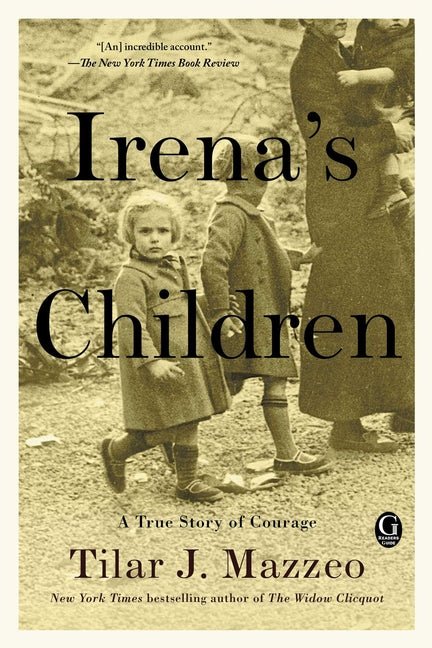
Irena's Children: A True Story of Courage
Couldn't load pickup availability
From the New York Times bestselling author of The Widow Clicquot comes an extraordinary and gripping account of Irena Sendler--the "female Oskar Schindler"--who took staggering risks to save 2,500 children from death and deportation in Nazi-occupied Poland during World War II.
In 1942, one young social worker, Irena Sendler, was granted access to the Warsaw ghetto as a public health specialist. While she was there, she began to understand the fate that awaited the Jewish families who were unable to leave. Soon she reached out to the trapped families, going from door to door and asking them to trust her with their young children. Driven to extreme measures and with the help of a network of local tradesmen, ghetto residents, and her star-crossed lover in the Jewish resistance, Irena ultimately smuggled thousands of children past the Nazis. She made dangerous trips through the city's sewers, hid children in coffins, snuck them under overcoats at checkpoints, and slipped them through secret passages in abandoned buildings.
But Irena did something even more astonishing at immense personal risk: she kept a secret list buried in bottles under an old apple tree in a friend's back garden. On it were the names and true identities of these Jewish children, recorded so their families could find them after the war. She could not know that more than ninety percent of their families would perish.
Irena's Children, "a fascinating narrative of...the extraordinary moral and physical courage of those who chose to fight inhumanity with compassion" (Chaya Deitsch author of Here and There: Leaving Hasidism, Keeping My Family), is a truly heroic tale of survival, resilience, and redemption.
Share
Book Details
- ISBN
- 9781476778518
- Binding
- Paperback
- Authors
- Tilar J Mazzeo
- Publisher
- Gallery Books
- Published Date
- June 6, 2017
- Language
- English
- Pages
- 352
- Physical Info
- 0.8 in H x 9 in L x 6 in W (0.8 lb)
A lesson in humanity
Bought this for my daughter. She loved it.
True story
Great books
After being in Warsaw and hearing some of Irena's story, this book filled in a lot of the story. Well written. I had to take time to digest several sections before continuing due to the content of the story, Highly recommended,
- 5 stars: 15 (75%)
- 4 stars: 4 (20%)
- 3 stars: 1 (5%)
- 2 stars: 0 (0%)
- 1 star: 0 (0%)
A lesson in humanity
Bought this for my daughter. She loved it.
True story
Great books
After being in Warsaw and hearing some of Irena's story, this book filled in a lot of the story. Well written. I had to take time to digest several sections before continuing due to the content of the story, Highly recommended,
So much is difficult to read but necessary to show the bravery these people endured. After reading this I realized how sugar coated the other stories have been.
Irena’s Children tells the story of a very courageous young women and her friends resisting the Nazis and hiding Jewish children and some adults from death. Her story is not unique as there were other groups in Europe who also hid Jews, but what is unique is that she was able to smuggle 2500 babies, toddlers and children out of the Warsaw ghetto.
A very moving book. It is horrible what the Jews had to endure. It was very well written. I recommend tissues if you read this book.
Irena Sender was one brave magnificent lady!
An amazing story of a woman who chose to put her and her own family at risk to save others from horrific events. Knowing that there were/are people in the world like Irena and her tribe, gives you hope for the future. Great research and very well written.
I knew a bit about Irena’s story. This book does an excellent job of showing the heroism and sacrifices of her and her group.It’s well worth the read. If only because it’s good to be reminded that in a world of coarseness and selfishness that there were - and are - people who are selfless and willing to sacrifice to help othersThat reason is enough to read this book.
I had never heard of Irena Sendler before so I was interested to read her story. I enjoyed the photos at the end. The writer did a lot of research and that is how it is written, very factual, like an encyclopedia. It was hard for me to get engaged in the story because of that, and also because of the many characters/names & places. There also wasn’t much, if any, character development except to make me dislike Adam. But otherwise it was mostly who did what, nothing about what these people were like, very dry reading. Many times I did not want to continue reading.
The story of Irena was riveting. It was almost like watching history coming to life. The struggles of all the people who were willing to put their lives in danger with Irena to save strangers was moving. Their character, integrity, and dedication was beautifully expressed in this book. The author captured the horrors of war and human cruelty alone with the human love demonstrated by those who were willing to die so others may live. I recommend this book to younger generations and any one with a heart of a lion like Irena.. Thank you.
The story was very complete chronicle of the affairs of the German invasion of Poland during WWII and the awful atrocities against the Jewish citizens. This is a story of Irena who organised an underground group that rescued many Jewish children. It was hard to read about the terrible things that were done to resistors and to the Jewish people. However, it is important to read the story and understand that this did happen. It should never happen again to any group of people ever. We must not let another group harm and attempt to destroy another. The story is told in great detail. I would give the story a 5, but the details got very hard to continue reading. It could have been shorter. I wonder what the children's edition is like to read.
Irena's children is about a brave, spunky and courageous woman who, with the help,of many others, helped about 2500 Jewish children, and some adults in Warsaw, Poland. She was a social worker who had a pass to go into the ghetto until the very end.This book is well researched but for me, because Irena was fleeing any public praise or acclaim, preferred to leave many details about her miraculous accomplishments quiet. We know she had a Jewish married lover, but little is known about him. Many sentences said things like: "Maybe they were walking, or perhaps coffee, or simply chatting". It was very vague at times, and I wish the author had taken some liberties and just made it be a concrete sentence.With that being said, it is perhaps the best read on Irena and her moral compass to help the Jewish people in Warsaw. She was a hero. She deserved the novel prize that Al Gore got instead, because her story is relevant insofar as people turning their backs, she opened her arms and took as many as she could.
This is the latest account of a now much told story of a young Polish social worker, Irena Sendlerowa, who rescued more than 2500 Jewish children from the Warsaw Ghetto during WWII. Due to the deligent primary source research by the author, this book is probably the most complete account of Irena's heroic spellbinding story. However, to get the true full story of Irena and the Polish people's role you should not miss "Life in a Jar," which explains how the Poles were prevented from telling the story until the late 1990's. The Russians had nearly totally blocked such accounts from being made public. Irena's Children and Life in a Jar should be read as a set. Both books present a truly uplifting story about an ordinary young woman that on her own rose to epic heroics and inspired countless others to do the same. BTW, Irena was not alone. Read the Zoo Keeper's Wife, another account of individual courage in the face of ultimate danger. It has been estimated that each rescued Jewish person of Poland required the direct involvement of 10+ Poles; for Irena's Children that is 25 - 30,000 average Poles risking everything, in particular their whole family being immediately shot, no exceptions. The best account I have read that conveys what being a rescuer was like, spine chilling, terrifying; and the best account of what the parents went through is depicted in Life in a Jar. The best account how it all came to be and presenting a canvass of the sweap of what was accomplished to overcome impossible odds is "Irena's Children." Both books will have you in tears and thankful for human grace when all seems lost.
This is a newly written book about Irena Sendler, the Polish Catholic social worker who saved over 2500 Jewish children during the Holocaust.She smuggled them out, one by one, in most cases, from the Warsaw Ghetto, in which thousands of Polish Jews were crammed, starving, likely to be shot at any time, or forced to board trains for extermination camps. (Though for most of the time no one knew for sure the destination of the trains.....later rumors began to spread, but people still found it hard to believe....).Irena Sendler worked with many others, but was the moral and physical leader of her group.....she took daily risks, going into the Ghetto and then talking Jewish families into giving up their children to her, based on just the hope that they would safer with her organization than left with their families. (In most cases, the children were hidden in convents and among sympathetic Polish families, who all knew they risked their lives and their family's lives by taking in Jewish children).Irena Sendler wanted to try to reunite these children with their families after the war....therefore she hid each child's name in a glass jar, buried in a friend's garden......(That is why the older book about her is called "Life in a Jar".....it is also an excellent book....and was instrumental in leading to Sendler being nominated for a Nobel prize.....)Of course, almost all the families of these children did not survive the war......So few people really cared to know what was going on in those years......only a few risked it all to try to save some people......she was one, and was, sadly, forgotten by history until very recently.....I'm glad she is now being recognized for her deeds......
Warsaw, Poland, according to the author nicknamed "the Paris of Eastern Europe" for its colorful streets, lively cafes, and intellectual ferment before the Nazi invasion in World War II, became one of the most grim and lethal places on earth for the next five years. If you rendered support to the resistance, the Gestapo would torture you ruthlessly then kill you. If on the other hand, you collaborated with the Germans, the resistance would find you and put a bullet in you. If you tried to hide out, roving bands of self-appointed bounty-hunters would rat you out to either the Gestapo or the resistance, receiving no more than a loaf of stale bread or a sack of rotten potatoes in exchange for your life. If you managed to avoid all of the above, then you were free to die of starvation, cold exposure, one of many epidemics of typhus, or simple despair. In the midst of all this stood a band of true heroes, risking all to oppose tyranny and fascism, putting their lives on the line every day to save lives of the innocent. Irena Sendler - the 'female Schindler' - stood at the nexus of a network of jewish and Polish resistance cells.As a Catholic social worker, Irena created and maintained an underground railroad to spirit children out of the Warsaw ghetto and into safety, literally putting her own life at risk day after day for years on end. This is her amazing, carefully researched, dramatically told story of noble spirit, boundless energy, cheeky deception, and personal courage worthy of the bravest Navy SEAL. Read it on the edge of your seat; for enlightenment, entertainment, and perhaps most of all, for homage to Irena and her many beloved fellow resistance fighters, many of whom lived, fought, and died unsung, lost in the fog and chaos of war.
This truly is an extraordinary book about an extraordinary woman. I couldn't put it down. Reasonable women don't make history, they say, and certainly Irena Sendler was not a "reasonable woman". She was a zealot, driven by a strong moral compass, a deep sense of purpose, and unbelievable courage to put an indelible footprint on the meaning of humanity amidst unbelievable inhumanity. But what particularly sets her apart, I think, was her unique ability to translate these traits into action - to attract others to the cause and to organize their efforts toward a common goal, always under intense stress and just one small misstep from disaster. No question she was totally devoted to the cause, often at the expense of other facets of her life. She was no role model for work-life balance. But through her efforts the lives of some 2,500 children were saved. Surely that's balance of another sort.Anyway, Sendler's is a gripping story and Tilar Mazzeo, as readers of her previous books know, is a gripping story-teller. She does what so many scholars and teachers of history fail to do - bring the events and characters of her story to life. She is an indefatigable researcher who has a fine eye for details, but couples this with a deft narrative style that keeps things moving along at a good clip. Fair warning, though; this is not an easy story to be drawn into - the milieu is so unbelievably horrible and gruesome - and good does not always triumph over evil. But there are enough times when it does to restore one's faith in human nature and provide a ray of hope for the future.So thanks, Tilar. You've hit another home run..
It has been said that Irena Sendler was the female Schindler of WW II. After reading this true story, I can only say that this lady should have been awarded the Nobel Peace Prize instead of someone who won it for global warming.At 4' 11" of height one learns quickly that diminutive in stature has absolutely nothing to do with courage. Her absolutely daring exploits while working as a public health specialist allowed her access to the Warsaw ghetto in 1942 and beyond. Thus, begins the story of Irena and the 2500 Jewish children that were somehow brought to safety on the Aryan side. She was the first to admit that she was only one of many to help. And, always downplayed her role of saving the children.Dr. Radlinsha was a major influence in her life from 1935 to 1940. Dr. R’s students became known as her ‘girls’ later in the book and all were involved in the ghetto. Previous to that, Irena’s father was one that played an important role in creating the Polish Socialist Party. One is able to ascertain that she had major role models earlier in her life. Did they contribute to Irena’s stance in the ghetto? Absolutely, I feel.This is a complex story and the reader will soon learn that Irena is gifted with not only courage but purpose and righteousness. She also had that innate skill of organization coupled with a knowledge of Jewish culture which would also be life-saving in many instances. Decisions were made quickly and sometimes when the boots of the Gestapo were heard approaching.One also learns the importance of the formation of resistance cells in Warsaw. As one would expect, code names were used and no one knew the true identities of others. The Catholic Church and their endeavors to assist in ‘hiding’ the children was also incredible.I had to take a break every few chapters while reading this book. So, evocative and powerful that I truly had to come up for air. I kept thinking that the plight of so many was in the hands of so few individuals. The sheer number of daily executions was mind-numbing along with the inhumane treatment they suffered in the ghetto..For me, courage, an indomitable spirit and an innate knowledge of right versus wrong sum up Irena and the rescue of 'her' children. Thank God that Irena lived to be 98 years of age.Most highly recommended.

