
Land is a Big Deal
*When you open this audiobook on Libro.fm, be sure to select Aveson as your bookstore so that your purchase supports local literacy programs and tree‑planting.
Couldn't load pickup availability
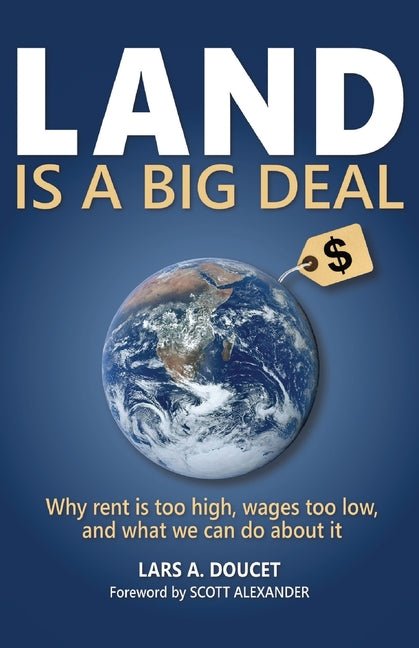
Land and the policies that govern it hold an incredible but largely forgotten power over our lives. When land is wasted and squandered, we get sky-high rents, oppressed workers, ruined businesses, depleted natural resources, a polluted earth, and an impoverished society. Poor land policy is the chief culprit behind sky-high urban rents, homelessness, and endless suburban sprawl. Meanwhile, real estate has become the world's number one asset class, comprising an ever-growing share of bank loans worldwide. Land is a Big Deal draws on the insights of legendary American economist Henry George to explain how things got this way, as well as what we can do to fix it.
Share
Book Details
- ISBN
- 9798985322521
- Binding
- Paperback
- Authors
- Lars A Doucet
- Publisher
- Shack Simple Press, LLC
- Published Date
- October 15, 2022
- Language
- English
- Pages
- 306
- Physical Info
- 0.64 in H x 8.5 in L x 5.5 in W (0.78 lb)

Good introduction to Georgism in more modern language.
Lars A Doucet's "LAND IS A BIG DEAL" is a 'must read' for those wanting to understand why world economies are on their last legs. Real estate guru and reinstalled President, Donald Trump--"Trump: The Art of the Deal"--needs urgently to take a peep at this particular 'deal' if he is to make America great again. He'll find a skillful and at times humorous exposition of the path we need to take for socio-economic resurrection. Donald? Donald, are you there?
I had been vaguely familiar with Georgism before but this book laid out Henry George’s arguments with great elegance and clarity, and thoroughly contextualized the ideas in a modern setting. Read this book with an open mind. It will challenge your assumptions about how land ownership ought to work, but Doucet makes a convincing case why our current system of land ownership is misguided and unsustainable, and why we need to use land value taxes to address our land use problems.This book inspired me to read Progress and Poverty which I highly recommend as well.
Really great work on LVT.
Lars Doucet has made an admirable effort to popularize the ideas of 19th century economist Henry George.A rough representation of his thesis might be that land should be taxed because: (1) land is easy to assess, (2) taxing land doesn’t diminish the quantity of land, (3) land is a limited resource that is broadly desired, (4) land is necessary for labor and capital to produce wealth, and (5) no one created land and thus, no one should fully own it.Lars shines when he challenges his own ideas with counterpoints, and he is also surprisingly contactable for questions.My quipples with "Land is a Big Deal" is with overreaching statements and I'll offer three examples:(1) Lars poses a total US land value that exceeds estimates from government entities as well as conservative and liberal economists. I think his argument would be stronger if he accepted a more widely recognized land value.(2) I think Lars is stretching the definition of the word “monopoly” when he implies that anyone who sells land is doing so as the sole owner of a unique item and thus, has a monopoly (if I understand him correctly).(3) I disagree with Lars' repeated statement that all wars are fought, in some way, over land. I think it would be more accurate to state that while wars typically involve land, they are somethings fought over ideology or arise from complex alliances, or involve cold economic battles involving tariffs and intellectual property theft. To my mind, his war argument is an unnecessary distraction from his central thesis.Ultimately, it would be fantastic if taxpayers grappled with the ideas presented in "Land is a Big Deal," and Lars reads his book in an entertaining fashion on Audible. My friends and I spent five hours discussing the ideas within this book, and found many worthy insights and clever ideas. Ultimately, we would like to see a land value tax tried in a state or large city.
)