
Let Us Descend: Oprah's Book Club
by Jesmyn Ward
Couldn't load pickup availability
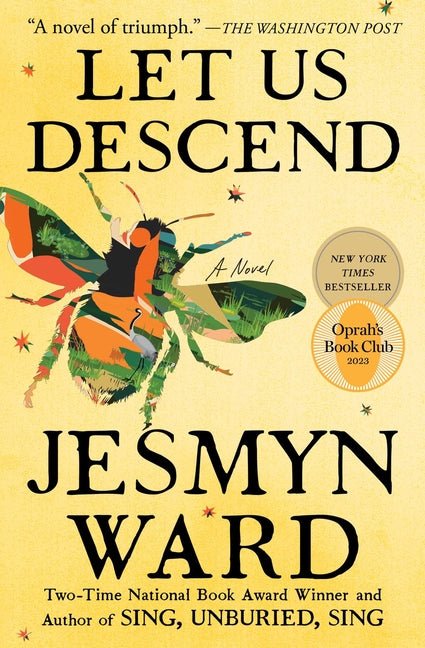
OPRAH'S BOOK CLUB PICK - Instant New York Times Bestseller - Named one of the best books of 2023 by The Washington Post, Vanity Fair, The Boston Globe, Time, The New Yorker, and more.
"Nothing short of epic, magical, and intensely moving." --Vogue - "A novel of triumph." --The Washington Post - "Harrowing, immersive, and other-worldly." --People
From "one of America's finest living writers" (San Francisco Chronicle) and "heir apparent to Toni Morrison" (LitHub)--comes a haunting masterpiece about an enslaved girl in the years before the Civil War that's destined to become a classic.
Let Us Descend describes a journey from the rice fields of the Carolinas to the slave markets of New Orleans and into the fearsome heart of a Louisiana sugar plantation. A journey that is as beautifully rendered as it is heart wrenching, the novel is "[t]he literary equivalent of an open wound from which poetry pours" (NPR).
Annis, sold south by the white enslaver who fathered her, is the reader's guide. As she struggles through the miles-long march, Annis turns inward, seeking comfort from memories of her mother and stories of her African warrior grandmother. Throughout, she opens herself to a world beyond this world, one teeming with spirits: of earth and water, of myth and history; spirits who nurture and give, and those who manipulate and take. While Annis leads readers through the descent, hers is ultimately a story of rebirth and reclamation.
From one of the most singularly brilliant and beloved writers of her generation, this "[s]earing and lyrical...raw, transcendent, and ultimately hopeful" (The Atlanta Journal-Constitution) novel inscribes Black American grief and joy into the very land--the rich but unforgiving forests, swamps, and rivers of the American South. Let Us Descend is Jesmyn Ward's most magnificent novel yet.
Share
Book Details
- ISBN
- 9781982104498
- Binding
- Hardcover
- Authors
- Jesmyn Ward
- Publisher
- Scribner Book Company
- Published Date
- October 24, 2023
- Language
- English
- Pages
- 320
- Physical Info
- 1.1 in H x 8.5 in L x 5.7 in W (1.0 lb)

Excellent product and service! Thank you! Highest recommend!
Well written, but dark
This is a difficult novel for a white woman to read. It's very graphic with words. I always knew that slavery was so very wrong. However after reading this book this I have a greater understanding of the horror of slavery!To abuse another human is unforgivable!I strongly recommend this book to those wanting more knowledge of the horror of slavery.
Reading a novel dealing with such a torturous time in our nations’ history, brings about a range of emotions: anger, sorrow and weariness. I imagine the author must have felt much of this as she was writing “Let Us Descend. “ Each page was wrapped in hopelessness, but pockets of love and resilience shone through in unexpected places, much like light shining through the cracks of a stone wall. The story centers on a young enslaved girl named Annis. She is fortunate enough to have her mother with her and it is she teaches Annis to fight with weapons hidden in the woods behind the slave cabins. During this time of bonding with her mother, Annis learns to wield the weapons with accuracy. Soon after, her and her mother are torn apart, a common occurrence in slavery. Annis is unmoored , but finds comfort in her friend Safi. They both are later sold to slave masters in the Deep South, which is a hell within itself. On the long journey to New Orleans, Annis is guided by Aza, an ancestral spirit from centuries past who embodies the warrior women. She manifests herself in various forms of nature ( water, wind) and prods and challenges Annis, watches over her, but withholds what Annis needs the most: love and belonging, safety and protection; all of the things that never have rightly belonged to the enslaved. Annis learns to fight for her life, using whatever weapons are handy. She is able to push forward forging a destiny of her choosing.
I hope there’s a sequel…I want to know what becomes of Annis, but I know her tenacity will continue to lead her. Ward never disappoints, and this book is no different. This book took me on a journey of reflection and remembrance, and I’m so glad I took it.
- 5 stars: 8 (40%)
- 4 stars: 7 (35%)
- 3 stars: 4 (20%)
- 2 stars: 1 (5%)
- 1 star: 0 (0%)
Excellent product and service! Thank you! Highest recommend!
Well written, but dark
This is a difficult novel for a white woman to read. It's very graphic with words. I always knew that slavery was so very wrong. However after reading this book this I have a greater understanding of the horror of slavery!To abuse another human is unforgivable!I strongly recommend this book to those wanting more knowledge of the horror of slavery.
Reading a novel dealing with such a torturous time in our nations’ history, brings about a range of emotions: anger, sorrow and weariness. I imagine the author must have felt much of this as she was writing “Let Us Descend. “ Each page was wrapped in hopelessness, but pockets of love and resilience shone through in unexpected places, much like light shining through the cracks of a stone wall. The story centers on a young enslaved girl named Annis. She is fortunate enough to have her mother with her and it is she teaches Annis to fight with weapons hidden in the woods behind the slave cabins. During this time of bonding with her mother, Annis learns to wield the weapons with accuracy. Soon after, her and her mother are torn apart, a common occurrence in slavery. Annis is unmoored , but finds comfort in her friend Safi. They both are later sold to slave masters in the Deep South, which is a hell within itself. On the long journey to New Orleans, Annis is guided by Aza, an ancestral spirit from centuries past who embodies the warrior women. She manifests herself in various forms of nature ( water, wind) and prods and challenges Annis, watches over her, but withholds what Annis needs the most: love and belonging, safety and protection; all of the things that never have rightly belonged to the enslaved. Annis learns to fight for her life, using whatever weapons are handy. She is able to push forward forging a destiny of her choosing.
I hope there’s a sequel…I want to know what becomes of Annis, but I know her tenacity will continue to lead her. Ward never disappoints, and this book is no different. This book took me on a journey of reflection and remembrance, and I’m so glad I took it.
I enjoy Jesmyn Ward’s work so everything she writes is an automatic read for me, synopses not necessary. I went into this book not knowing what it was about and only expecting that I’d enjoy because it’s Jesmyn Ward. I finished the book confused and unmoved because I didn’t really understand what was happening and I’m still kinda unclear about the messaging of the novel.Something that made this book confusing for me were the prose. They waxed a bit too poetic for me making it a bit difficult to understand and even clogging to story at times. The overly poetic prose also contributed to the vagueness of the writing making the story a bit difficult to follow at times. I felt like I was missing things as I was reading because I didn’t fully get what the characters were discussing or alluding to.I understand that this is a story about multi-generational trauma and healing. I appreciate that this novel reveres ancestry which is a common theme in Jesmyn Ward’s work. As someone currently living in Benin, I liked the inclusion of the Beninese Neale warriors in the narrative and that Benin gets another spotlight in popular media. However, I just didn’t understand this stir and the purpose and what we was supposed to be driving us forward in the story.Because this is Jesmyn Ward I’ll consider reading this book again to better understand what I didn’t get the first time. But this is the first time I’ve been disappointed by her work.
Normally I love anything on Oprah’s book club list, this one was just alright. The book is almost like a mix between a novel and poetry making it hard to keep up with sometimes. I think the relationship between Annis and her spirit guide forces deep thought from the reader, I’ve never experienced a novel with that perspective so it does check that box. All around I didn’t hate it but it’s not a favorite.
While it is not my favorite from Jesmyn it wad still an amazing read. It was confusing during some scenes but I was content with how it ended.
Poetic and mystical in the telling of a life of brutal suffering in slavery. The acts described are ugly and horrible, but the writing is beautiful. The story haunts me after I’ve finished reading it and moved on to other novels. Well worth reading.
I have read several of Ms. Ward's books. I liked them all. This one was by far the most captivating and the most challenging to read. As a writer myself I can only imagine what it took for her to produce this masterpiece. It is a very different look and a much deeper look at the institution of slavery.Sandra L Manigault
How does one find hope in the most dire of circumstances? We can only build a faith in what we've known and cling to stories told us as children. Jesmyn Ward is an oracle of the human experience that most of us forget to be grateful we escaped. She tells amazing stories and gives a glimpse of real struggle that needs to be told.
A Wonderful reading experience ! I was pulled into the lives of the characters as never before! I love how Ward connected Annis to the spiritual world (Aza, Water, They who take and give) and to nature (the bees). I felt empowered to strive continuously to fight for and guard my freedom and that of my precious Black people.
“Let Us Descend” by Jezmyn Ward requires a strong stomach, like most novels about slavery. The reader wants realism, then reads about rape and technical incest and wishes for less. The protagonist, Annis, takes us on a journey inspired by Dante’s Inferno when her Sire (father) cruelly sends her mother away.“Magical Realism,” one of the suspicious genres assigned to this intense book by Goodreads, is my kryptonite. I get lost if I struggle to transition from the real to the fantastical. When Annis meets spirits, however, she thoroughly introduces us to them. Having a caring spiritual being with whom you could consult while going through the humiliating process of a slave market provides promise in an otherwise hopeless situation.I watched a Jezmyn Ward interview on the Seth Meyers show in which he described this as an “easy read.” I needed several double-takes to comprehend everything. I simultaneously thought the action was a horrifying representation of slavery and that I did not know what was going on. I had a professor to help with “Inferno,” thankfully.Still, you will enjoy Annis as she struggles to find creative ways to have freedom. Annis finds solutions despite her struggles, some of which are too late in the book to mention here. The author based this story on the journey process instead of a sequential plot or specific destination. Dante’s classic “Inferno” qualifies as the same quirky classification.I read for the same reason I teach: I like “A-Ha” moments. This book had them, but you had to go a long time between them. It was a grueling experience. I wanted to like it more than I did, but my comprehension started to slip, which affected my interest in the characters and the storyline.
I lived in a story for a week so beautifully written that my dreams, my daydreams, my private moments were all about this girl. My God, Jesmyn, your mind is magnificent.Thank you for writing this book. Reading it, I feel as though I have brushed up against the divine.
An interesting tale of slavery, not only the cruelty, the pain, the hunger, but also the bonds between the slave sisters and especially their mothers. The use of spirits and the personification of earth and water take the story to a new level…it was a good read.
My knowledge of the experiences of the enslaved in the US was graphically relived in my mind as I read this book.It covered many of the life experiences of a slave from birth to the desires of freedom of the enslaved through Annis’ life (main character).I read this book because it was on the Oprah book list.Very good book.
Jesmyn Ward is my new favorite author. Let Us Descend is a compelling book. Is it a difficult read? Absolutely. But it is a worthy read to be reminded of the evils of slavery. It's a powerful book to read because the human spirit is survival at all costs. I learned a great deal from this book. Annis and her story will stay with me for a long time and I'm looking forward to reading more from Jesmyn Ward.
I would love to read and discuss in a women's book group.I could envision this being used in a college lit course.
In her afterword, Ward acknowledges that she struggled with this book, and that struggle shows. I'm a huge fan of almost all of her work, but not as big a fan of "Let Us Descend". The stories of the cruelty and privations experienced by slaves is moving and very familiar. Perhaps it can't be retold too often. Ward's descriptions of scenes are vivid. However, I didn't feel that there was enough movement in the plot, enough change, to accompany the descriptions of hardships. I was just not able to get immersed in "....Descend" as I've been immersed in her previous work. The effectiveness of the spirits which attempt to guide the protagonist did not work as well for me as they apparently did for others. The book also seems to have a couple of "seams" which don't quite stick together, and the ending seems somewhat forced. Still, I remain a huge fan of her previous work, and I look forward to her next book. Without question, I'll buy and read that book.
This novel opens with as magnificent a sentence as the human mind can devise. Towards the end, the protagonist's efforts to extricate herself from a toxic relationship with her spirit guide, demonstrates tremendous dexterity of thought on the part of the writer. But for me, everything between was a slough.My first question about this novel was, what is it? I could not make sense of why it has been marketed as prose fiction when it is clearly written in verse. When I recognised that it is in conversation with Dante's "The Divine Comedy", I counseled myself to continue plodding. Unfortunately, the interesting vision was not enough to warm me to this work.It may be that I'm just tired of slave narratives. Chattle slavery in the Americas was horrendous. I know that. If I am to read another slave narrative, it must tell me more than I know. But my dissatisfaction does not end there. The fact that the protagonist, an enslaved woman with no formal education, delivered the bulk of her narrative in a version of English that only educated people speak, was mystifying. Her vocabulary included words like, "detritus”, “occluded”, “purview”, “inexorable”, “interrogating”, “infinitesimal”, “instinctual”, “dissipate”, “duplicitous”, “dissent” and “unfurls”. Yet when we read her in dialogue, she speaks a black vernacular English. The novel gives us no explanation of how she came to be bilingual.The bottom line is I found this work dull, dull, dull. If any of you enjoys it, please help me understand what I've missed.
)
)
