
Skip to product information
1 of 1

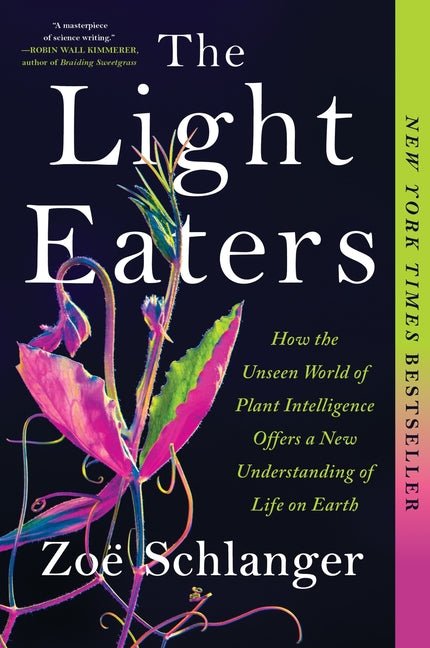
The Light Eaters: How the Unseen World of Plant Intelligence Offers a New Understanding of Life on Earth

by Zoë Schlanger

Regular price $26.99 USD
Regular price $29.99 USD Sale price $26.99 USD
Sale Sold out
Book cover type
Quantity

NEW YORK TIMES BESTSELLER

The New Yorker's Best Books of 2024 - TIME's 10 Best Nonfiction Books of 2024 - New York Magazine's 10 Best Books of the Year - Washington Post's 50 Notable Works of Nonfiction of 2024 - Smithsonian's 10 Best Science Books of the Year - A Best Book of the Year: Boston Globe, Scientific American, New York Public Library, Christian Science Monitor, Library Journal, and Publishers Weekly - An Amazon Best Nonfiction Book of the Year

Longlisted for the National Book Critics Circle Nonfiction Prize - Finalist for the Chautauqua Prize - Finalist for the Los Angeles Times Book Prize - Winner of the National Outdoor Book Award for Natural History

"A masterpiece of science writing." -Robin Wall Kimmerer, author of Braiding Sweetgrass

"Mesmerizing, world-expanding, and achingly beautiful." -Ed Yong, author of An Immense World

"Rich, vital, and full of surprises. Read it!" -Elizabeth Kolbert, author of Under a White Sky and The Sixth Extinction

Award-winning Atlantic staff writer Zoë Schlanger delivers a groundbreaking work of popular science that probes the hidden world of the plant kingdom, "destabilizing not just how we see the green things of the world but also our place in the hierarchy of beings, and maybe the notion of that hierarchy itself." (The New Yorker)

It takes tremendous biological creativity to be a plant. To survive and thrive while rooted in a single spot, plants have adapted ingenious methods of survival. In recent years, scientists have learned about their ability to communicate, recognize their kin and behave socially, hear sounds, morph their bodies to blend into their surroundings, store useful memories that inform their life cycle, and trick animals into behaving to their benefit, to name just a few remarkable talents.

The Light Eaters is a deep immersion into the drama of green life and the complexity of this wild and awe-inspiring world that challenges our very understanding of agency, consciousness, and intelligence. In looking closely, we see that plants, rather than imitate human intelligence, have perhaps formed a parallel system. What is intelligent life if not a vine that grows leaves to blend into the shrub on which it climbs, a flower that shapes its bloom to fit exactly the beak of its pollinator, a pea seedling that can hear water flowing and make its way toward it? Zoë Schlanger takes us across the globe, digging into her own memories and into the soil with the scientists who have spent their waking days studying these amazing entities up close.

What can we learn about life on Earth from the living things that thrive, adapt, consume, and accommodate simultaneously? More important, what do we owe these life forms once we come to understand their rich and varied abilities? Examining the latest epiphanies in botanical research, Schlanger spotlights the intellectual struggles among the researchers conceiving a wholly new view of their subject, offering a glimpse of a field in turmoil as plant scientists debate the tenets of ongoing discoveries and how they influence our understanding of what a plant is.

We need plants to survive. But what do they need us for--if at all? An eye-opening and informative look at the ecosystem we live in, this book challenges us to rethink the role of plants--and our own place--in the natural world.

Book Details

ISBN
0063073854
Binding
Hardcover
Authors
Zoë Schlanger
Publisher
Harper
Published Date
May 7, 2024
Language
English
Pages
304
Physical Info
1.1 in H x 9.1 in L x 6 in W (1.2 lb)
View full details
  • 5 stars: 18 (90%)
  • 4 stars: 2 (10%)
  • 3 stars: 0 (0%)
  • 2 stars: 0 (0%)
  • 1 star: 0 (0%)
B
Brandon
Awe-inspiring

This book made me consider becoming a carnivore.

L
Ludice
Fine Book, fine print

Great bookThe paperback edition: In small/fine printHad to buy the Kindle edition

J
J D Hultine
Biochemistry

The biochemical wave of the future.

S
Sarah
A mind-blowing introduction to recent research on plant "behavior"

If you are interested in plants, you should read this thrilling tale about new research on how plants sense and respond to their environment. We are finally recognizing that plants have ways to not only detect changes in their environment, such as a new caterpillar invasion, but also respond to such changes by releasing chemicals that will fight the pest.This is a paradigm shift in our understanding of "plant behavior." I enjoyed it immensely.

B
Brett Nelson
Fascinating

Lots of discoveries I'd never heard about

C
C. Hilton
Amazing eye-opening book

Fantastic book. Absolutely a must read for anyone who appreciates nature.

F
Falex
This book is sensational

A must read

E
Ellen W.
The facts here are amazing

What a fascinating book. Very scientifically researched, it truly changes your perspective on the nature of plants and of our living world.

N
Niki
Plants are amazing chemists and so much more than just passive beings.

This book was so good. Good enough to buy the hardback and take up space on the shelf.Highly recommend.

O
Odaward
A fascinating read

Well researched and skillfully told. Glad I found this book and I bought a copy for my science oriented friend. Also sharing tidbits with my microbiology coworkers.

D
Dr. Sock
The plant equivalent of "Immense World" but a little too dramatic at times

I liked the book Immense World which was about animal perception, and I wouldn't be surprised if the two authors are colleagues and friends. Certainly I saw The Light Eaters as the approximate equivalent from a plant's point of view and am glad I read it, but took exception to it in some ways. In the first chapter the author states that she was a dramatic child. At times the book was too dramatic for me, in a way that detracted from the subject at hand and may damage her credibility. The one clear example that I can offer was on page 156. Shortened here to fit better, the sentence said: "In the United States alone"..."each year'..."another 385 million are severely poisoned but don't die" (from pesticides), with a footnote: " *Incredibly, that means about 44 percent of all farmworkers are poisoned by pesticides each year." She didn't need to say that; it's not the topic of the book and it's just like she says: incredible (aka unbelievable). I suspect her numbers are either a typo or -- more likely in my opinion -- she's being unforgiveably loose and dramatic with her numbers. The problem with the numbers is that there weren't even 385 million people living in the United States at the time. Did everyone in the US get poisoned that year, some of us more than once? Pesticides are a big problem, so maybe that's true at some low level. But how could that possibly mean that this is "44 percent of all farmworkers"? In any given year, how many farmworkers does she think there are in the US? It's like she says: "Incredibly". Her editor should have seen that word, triple checked the math, and then suggested she just leave all of that out. Even if it's somehow true, it's a little off-topic and potentially damaging to the credibility of the book. This seemed especially ironic to me in this particular book, because she made such a point of discussing the credibilty problem created for botany researchers by inaccuracies in the book from the 1970s, The Secret Lives of Plants. Good book -- I'm glad I read it -- but the drama of some sections hurt the quality and credibility of the book for me.

a
adrienne hertz
mind bending

Once you read it, there is no going back. One’s perspective of the natural world opens up to consider that we are one being interconnected to other types of beings, some that we are just now recognizing and which we have always lived amongst. Rather than reductive thinking, we read through a course of expansive thinking considering network theory. A leaf will never be just a leaf again but an entire ecosystem upon which we are dependent and interdependent.

D
David Parker
The desire for life itself:

The most memorable scene was in the cave where seedlings struggled for light.“They tried to survive in an inhospitable landscape the best way they knew how. I felt moved by this. This was a craning toward life, even in the face of impossible conditions.”

C
Coneflower Books
A Journey Into the Powerful World of Plant Life

What an incredible read! I am currently on a reading quest to learn more about plants. This title truly explored the realm of plants and their innate abilities.The author explores plant research from BC to the present. The overriding question is: are plants intelligent? Since they cannot move themselves, they have developed the capacity to change themselves to adapt to their surroundings. This ability allows them to flourish by arranging what does work well.You will never look at plants the same way after reading this book!

R
Richard Redmond
Great book, 5 stars is not enough

One of the most interesting books I have ever read. Full of fascinating and totally unexpected stories from the frontier of plant science.

J
Jesse
Like Plants? Know Everything About Them? This Book Knows More! Great Read.

This is a fantastic book. I haven’t taken notes on a book since university, and every few pages of this book resulted in me finding something else to look further into.It’s extremely well written. You can read it straight through, but it’s also great for just reading a page or two as you find the time.It brings up point after point that deserve serious thought and makes the world of botany even more fascinating.

E
Elkay
What is “man’s dominion?”

Or, what is humankind’s stewardship? Or perhaps better yet what relationship among nature’s entities is well, healthy, proper, or complete?1972. The year an essay titled from this query was published. Philosophical, theological, ethical in nature. The words, though now awkward if not somehow offensive to my ear, invite a profound wondering.2024. The year of publication of The Lighteaters. It invites a similar wondering. By design, by evolution, or otherwise, humankind is in a position (time/place) to think and behave in a manner to enable community or to enable self.From 1972, “The contemporary reappraisal of man’s relationship to his environment now confronts society at large with a question that has always been of major concern … What is man’s dominion? … The words kivshu and rdu both have a basic root-meaning of exerting pressure, that being, however, merely a point of departure for a whole spectrum of derivatives, so that scholars have translated the words according to individual taste and temperament to convey various ideas and types of dominion. Thus the dictionaries tell us that radad, with the basic meaning of trampling the earth … specifically means “to plow,”while kavash, with the original idea of squeezing or hugging, can mean everything from “violate” to “cherish.” … In all the interpretations we are confronted by two opposing concepts of dominion that have always divided the human race.From this book: “The hard evidence of plants’ primacy is not hard to find, in a practical sense. The harder thing is to feel it. To begin to include plants in our vision of the moving, living world, and see them as animate individuals in their own right, takes mental effort. We may sense it, but many of us have been given neither the way of seeing nor the words to turn that feeling into fact … This business of drawing a line between what does and doesn’t deserve our respect and attention can feel like an exercise in absurdism. It produces a great deal of cognitive dissonance in me now … We are the new kids on the block. Traditionally, you should pay respect to the elders,” by which she meant bacteria, fungi, and plants. She called the view of humanity at the top of an evolutionary chain “arrogant” and “juvenile.”“Opposing concepts of dominion.” To violate or to cherish? “Does and doesn’t deserve our respect.” Objects to analyze (mechanistcally) or entities to seek to comprehend and respect.A heart song: flourishing co-existence. There is truth in this heart song.Philosophically profound. Scientifically informative. This book is an outstanding synthesis, reflection, and invitation.

J
John
The green aliens are watching us

Look beyond the quotidian people-theater, where a verdant jungle of experience awaits. The plants have so much to teach us, and Zoë Schlanger isn’t afraid to take the existential plunge required to understand their lessons. But first, we have to let go of what we know.We sapiens are simplifiers. Sandwiched by the unfathomable complexity of the universe above and the microcosmos below, we search for practical rules and concepts to exploit, building ever more powerful tools and collaborations in our pursuit of prosperity. But our reductionist analyses do not reveal the world as it is. By simplifying the roiling beauty of nature, we in fact obscure it beneath a conceptual veneer. What we call intelligence is really just a memorized heuristic diagram. Our version of consciousness is as limited as our worldview.It’s no surprise, then, that we see vegetable intelligence as an oxymoron and struggle to attribute consciousness to other creatures. We defined the terms to describe ourselves, so generalizing them to include others would dilute their meaning and anthropomorphize nonhumans. But such recursive nonsense blinds us to the obvious awareness of other life forms. Worse, we are deluded into believing we are somehow separate from them, even as the microbes in our gut digest our food and mitochondrial foreigners power our cells.Mercifully, even through the narrow lens of our science, what we have discovered in the plant kingdom undermines all our facades. Plants listen with tiny hairs, taste predators, warn their neighbors, defend their family, trade with fungus, conscript ant guards, farm bacteria, and some can even shape-shift as camouflage. The botanists who study such things might timidly bow their heads to institutional conservatism and avoid using words like intelligence and consciousness, but (thank Nature!) Zoë Schlanger does not. Further, she rises to challenge the ultimate human illusion: separation. “The environment extends into the organism and the organism into its environment, in ways that obscure the boundary between them.”“Individual” is a misnomer. All of us, including plants, are part of a continuum with everything else. We’re composite organisms in a tight collaboration—holobionts. We’re not fragmented parts of an ecosystem; we’re a unified whole with an identity as large as nature itself. As Alan Watts phrased it, “If I am my foot, I am the sun.””Nature is not a puzzle waiting to be put together, or a codex waiting to be deciphered. Nature is chaos in motion. Biological life is a spiraling diffusion of possibilities, fractal in its profusion.”

a
algo41
Eye opening

The author is a nature lover who thinks like a scientist and writes well. The subject is fascinating, eye opening. The beginning of the book is somewhat marred by too much attention to controversies about whether words like intelligence can be applied to plants. The bottom line is that they are sophisticated in what they can learn from the environment and how they adapt to that learning. In the following, each capability applies to at least some plants, not necessarily all plant species. Plants have memories; some time their flower display to the intervals between bee visits, and will change the next day if the interval changes. They can count, which guides the Venus Fly Trap whether a touch is by prey, more touches, or some random object blown by wind. They can distinguish kin from others which impacts how loudly they send out chemical distress signals or how aggressively they promote their root growth. A root can determine not only in which direction there is a source of water, but whether it will encounter soft clay or hard rock. Depending on the quality of light falling on them, a plant can sense if it is being reflected from rival plant leaves so that it needs to grow taller. In a lab, parasitic dodder vine seedlings appeared to detect the size, shape, and distance of neighboring plants, and used that information to decide which plants to grow toward and parasitize. Depending on the sound of chewing, a plant can summon an appropriate predator. If a plant senses a drier environment, it can modify its seeds so they have more porous surface area. Plants are experts in formulating appropriate chemicals. They can make their leaves distasteful or even deadly to predators. They use volatile chemicals for communicating with other plants, or between different plant parts; for the latter, they also use electrical signals, hormones, and other non-volatile chemicals. Some plants can make their leaves appear like those plants they are growing among, possibly using sight, but more likely because of microbial RNA shared with the other plants. Like humans, microbial RNAs play a big role. Plants also rely on fungi attached to their roots for gathering resources, communicating, and possibly sensing the environment. How do plants do all this without a brain – by distributed intelligence. Note, “when neuroscientists peer inside the (human) brain, they find a distributed network. No discernible command post exists.” Pollution, and even rising CO2 levels, can impair the plant’s use of volatile chemicals. Breeding plants in a protected environment can have the side effect of selecting for plants with less innate capability to withstand pests.

a
alan h. flinchbaugh
Worth reading but flawed

The Light Eaters -- catchy title -- is about the latest discoveries in Botany suggesting that plants are far more complex and active in looking out for themselves than previously supposed.This isn't some New Age claim that plants like classical music and thrive if you talk nice to them. Zoe Schlanger is an experienced journalist, and fairly disciplined about citing authoritative sources for what she expounds, and she is mostly careful not to make unwarranted claims about the abilities of plants at communication, socialization, fighting off pests and disease, adapting to their environment and so forth. Mostly.Now and again, however, the reader finds himself down the rabbit hole, as Ms. Schlanger rhapsodizes in a flurry of ifs, maybes and perhapses about plants that talk, see, shape shift, and have emotions. There are occasions, too, when Schlanger seems to contradict herself and leave out scientific details that one suspects contradict her conviction that plants are conscious entities.Example: the remarkable shape shifting Boquila, we're told, can't be successfully grown in a botanist's lab, but, a few pages later, some guy in London sends that same botainist pictures of a Boquila growing nicely in his apartment and mimicking the appearance of one of his other houseplants. She exquisitely details a theory about Bacteria clouds causing the Boquila's ability to mimic other plants by hijacking the copied plants genetic material and altering the Boquila's DNA with it, without explaining how the Boquila has been known to mimic plants made of plastic (there is no DNA in plastic), or how mutations in DNA takes far longer to show up as a phenotype, than it takes a Boquila to mimic a plant.Ms. Schlanger may be forgiven for dwelling a little much on the philosophical ramifications of the 'plants are people too' suggestions in The Light Eaters. In these times when mankind seems to be working hard at killing off itself and all living things on the planet, her fantasy of giving plants legal rights and standing in the courts is not a bad idea, however fanciful it may be. Her prose, on these occasions is a little too purple " drawing attention to itself, and away from the story being told." The author would do well to let the facts in her book draw the reader to his own conclusions than try to enforce hers.On the whole, though, the book is a worthwhile, fascinating, informative and thought provoking read, making some important points about the plant life that is essential to the survival of us and of our planet.
