

One Day, Everyone Will Have Always Been Against This
 )
 )
Couldn't load pickup availability
2025 NATIONAL BOOK AWARD WINNER
From award-winning novelist and journalist Omar El Akkad comes a powerful reckoning with what it means to live in the heart of an empire that doesn't consider you fully human.
On October 25th, 2023, after just three weeks of the bombardment of Gaza, Omar El Akkad put out a tweet: "One day, when it's safe, when there's no personal downside to calling a thing what it is, when it's too late to hold anyone accountable, everyone will have always been against this." This tweet was viewed more than ten million times.
One Day Everyone Will Have Always Been Against This chronicles the deep fracture that has occurred for Black, brown, Indigenous Americans, as well as the upcoming generation, many of whom had clung to a thread of faith in Western ideals, in the idea that their countries, or the countries of their adoption, actually attempted to live up to the values they espouse.
This book is a reckoning with what it means to live in the West, and what it means to live in a world run by a small group of countries--America, the UK, France, and Germany.  It will be The Fire Next Time for a generation that understands we're undergoing a shift in the so-called "rules-based order," a generation that understands the West can no longer be trusted to police and guide the world, or its own cities and campuses. It draws on intimate details of Omar's own story as an emigrant who grew up believing in the Western project, who was catapulted into journalism by the rupture of 9/11.
This book is El Akkad's heartsick breakup letter with the West. It is a breakup we are watching all over the United States, on college campuses, on city streets, and the consequences of this rupture will be felt by all of us. His book is for all the people who want something better than what the West has served up. This is the book for our time.
Book Details
- ISBN
- 0593804147
- Binding
- Hardcover
- Authors
- Omar El Akkad
- Publisher
- Knopf Publishing Group
- Published Date
- February 25, 2025
- Language
- English
- Pages
- 208
- Physical Info
- 0.88 in H x 8.47 in L x 5.88 in W (0.74 lb)
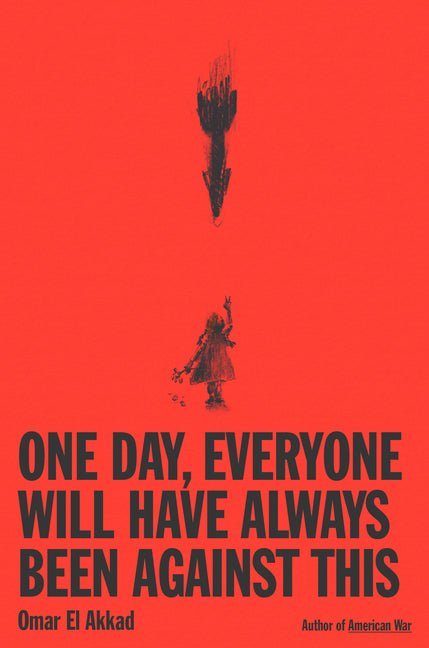
El Akkad, O. (2025). One day, everyone will have always been against this. Alfred A. Knopf.Omar El Akkad is a Canadian journalist and author who currently lives in Portland, Oregon.El Akkad begins with a striking assertion: "Rules, conventions, morals, reality itself: all exist so long as their existence is convenient to the preservation of power. Otherwise, they, like all else, are expendable." His core premise: power structures will discard even fundamental principles when they no longer serve their interests. He explores how this preservation of power requires the classification of certain groups as "other" or "nonhuman" to justify violence—a pattern repeated throughout history across many nations. When discussing the United States specifically, El Akkad identifies a profound contradiction: Americans simultaneously hold the "belief that one's nation behaves in keeping with the scrappy righteousness of the underdog" while ignoring that the "most powerful nation in human history is no underdog, cannot possibly be one." El Akkad notes that the "immense violence implicit in the contradiction will always be inflicted on someone else"—those designated as outside the protected circle of humanity. Horrifically, he observes, "the same people who did the killing and financed the killing and justified the killing and turned away from the killing will congratulate themselves on doing the right thing... there will be those who say it was all the work of a few bad actors... to avoid contending with the possibility that all this killing wasn't the result of a system abused, but a system functioning exactly as intended." Even so, he concludes on a note of possibility: "Even during the worst of things... courage is the more potent contagion... it is always possible to stop looking away."In this memoir emerging from experiences as a wartime journalist, El Akkad eloquently exposes the intricate justifications employed to maintain power amidst contested claims to moral high ground. He reveals how power structures craft narratives that legitimize their actions while dehumanizing others, creating a framework where violence becomes not just acceptable but necessary. As these justifications grow increasingly transparent, ordinary people begin to see through the duplicity. The contradiction between proclaimed values and actual behaviors becomes impossible to ignore, leading to an erosion of trust in the entire system. This loss of trust represents not just disillusionment with specific policies or leaders, but a fundamental questioning of the moral framework that allows such contradictions to persist. El Akkad suggests this moment of recognition—when people refuse to look away—contains the potential for transformation, as the courage to confront uncomfortable truths can spread more rapidly than the willingness to accept convenient falsehoods.

A beautifully written, very insightful book. This book is far more than just a biography or history, it is a very insightful reflection of human society and of the morals/norms of our age. It is also so well written that I would classify it as great literature as well.
My original reaction to this account of the Gaza War wasn't as positive as this review, which is written only after much reflection. What the title means is that it apparently takes human beings too long for the world's horrors and injustices to fully sink in. Or, perhaps better stated, to convince themselves that they were right about it all along even if, at the outset, their opinions were totally opposite. This is not a history per se nor was it intended to be objective. It is impressionistic and unashamedly so.
Beautifully written work.
Rating a book at all is shallow to say the least. If you want to remove your veils of illusion, read it. One cannot rate "truth".
Superb and heart-breaking
What a great book. The author masterfully shows that some lives are seen as less. Their suffering trivialized, ignored and justified by those who stand by unaffected by a suffering that will not personally affect them.
This powerful book should be assigned reading for anyone who cares about the state of the world. I could not put it down and it will stay with me for a very long time.
Apparently every generation has to rewrite Those Who Walk Away From Omelas. This is a decent version. I hope one day we won’t have to anymore, but probably not. Omelas is less humanity’s fate than our choice and we’ll keep choosing it for as long as we can.
A devastatingly precise analysis of how the West chooses power with a humanitarian sheen, with line after line of elegant, memorable prose. If you are looking for justification of American foreign actions or inactions, this isn’t the place. A call to action that floats above its visceral focus. It may meander a little at the end, but a bracing and worthwhile read.
A must read for those seeking some understanding of a senseless time in our history
A must-read for everyone. Incredibly moving. Painfully honest. Beautifully written.
This book is powerful and timely; I’m forever changed. The author delivers the message with skillfully and carefully-selected language that seems to come so naturally.I’m ordering additional copies for family, friends, and to donate to our libraries.
I was caught up by the title which told me what I thought I’d agree with, and I did. What I didn’t anticipate was the beautiful writing. I was and am and remained moved by the writing. I knew I would agree with the premise; I just didn’t know I would be so moved by the writing.
This is a very painful and beautifully written book because it is spot on and I'm not better than everybody else. A must read. However, as is so often the case with non-fiction books, the point(s) could have been made just as effectively in half the number of words, or even a long magazine article.
Makes us look into our own being and evaluate where we stand and we behave. Difficult and right on target
My only problem is that this is a large print edition, not what I wanted, a fact that is only evident if you dig into the details and could have been made clearer on the main product page.
I find this book to be so poignant and relevant. I appreciate his story about his family’s journey to America and what he believes American democracy and Liberalism was meant to be. This part really resonates with me and it is a unique look into the complexity of a hyphenated American identity. The book is also great in describing the heartache of realizing that while many can give their hearts and souls to the American ideals of democracy. Sometimes, large segments of Americans don’t reciprocate. In this sense the book articulates a complex reality beautifully. Perhaps if more white Caucasian Non Muslim Americans (who care deeply about democracy and liberalism) can see the fault lines American Muslims deal with on a daily basis- we can collectively work to actualize what American democracy and could be. His premise that we need to care about all people’s humanity in all moments instead of disregarding it when it serves our political, social and economic purposes is the necessary first step. A book that changes you.
The body of this book closely follows the theme of the title. I certainly agree that in decades to come it will become generally accepted that a great injustice has been done to the people of Gaza. And when that acceptance arrives many will claim to have been against all the killing and suffering that is now ongoing. Yet for the present the revulsion (in the US and Israel) is surprisingly muted, if it is really there at all.To its credit, the book is not primarily outrage nor is it centered around depicting the individual tragedies of the Gazans. It does call up analogous situations in history where settled peoples have been decimated by colonizers who acted in conformity with the mainstream attitudes of their countries of origin. In Gaza as in these prior regions the people being displaced are usually seen as lesser beings than the peoples who come in. Consider what you see in the US on the nightly news. The attention is given to one or two Israeli families who had members killed or abducted. Yet on that same day there are dozens of new, equal tragedies in Gaza. That suffering of the Gazans goes largely unnoticed or else it is all blocked together into a single piece.So one could ask why this merits a whole book? The book does not cover the history of Palestine. Nor does it look at the political forces in the US that are so effective at holding down any widespread criticism of Israel. Nevertheless the author brings plenty of personal experience as well as original points of view into his analysis. I think it is a valuable and interesting read. I was stirred up inside, I bet many readers will come away similarly.
For Omar El Akkad, Israel’s invasion of the Gaza Strip and the United States’ backing of that genocide was the final nail in the coffin of the liberal West and its purported ideals of liberty and justice. And I think he’s right.Throughout this 188-page book, autobiographical anecdotes are woven with a tapestry of historical events to depict how a boy enraptured with the ideals of freedom from censorship could become a young man interviewing detainees in Guantanamo Bay and later grow into an adult watching as his fellow journalists self-censor to prevent themselves from calling a genocide what it is. Bullets don’t just go into a child’s head on their own—there was a shooter who killed her—but we can’t say that.Parts of the polemic are poignant and poetic, and these are where the book truly sings. Although I’m unabashedly a leftist, I don’t think I’ve seen a better critique of the Democratic Party and its failure to take a stand beyond anemic rhetoric only partially obscuring self-interested actions. I also don’t think I’ve seen a better mix of resignation to despair and righteous call to action, which is pretty much our current milieu in a nutshell.We need more writers, thinkers, and men like Mr. El Akkad. I can’t wait to read more of his work!

