

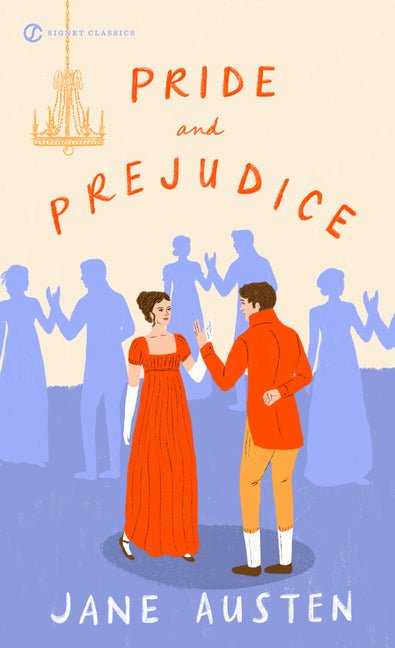
This is such a gorgeous edition of Pride and Prejudice…the quality is absolutely amazing…the texture is super soft and I love the pink metallic details…the book came in great condition and was packaged very securely, the only thing I don’t like is that there is a sticker on the back but it’s ok…for how beautiful and nice this book is the price was awesome…I’m extremely happy! Thank you so much!


There was only a small bend on the top part of the spine as you will see on the photos I provided. The books is black with a semi 3D effect on the flowers which are of a metallic blues, pinks, greens, and silvers. The pages are glossy, therefore not good for annotating. It comes with a ribbon bookmark and sprayed silver edges. It comes loose on the packaging with no protection so be aware of this, luckily mine was ok other than the small bend on the spine.


Ok... I never write reviews on Amazon, but this copy.. 👌 I have been looking for a beautiful copy for a couple months now, all over the place. I stay in a small town in the middle of Arizona, where the closest Walmart is an hr away..( the grocery store is in the hardware store if that tells you anything). I was worried about the condition in which the book would arrive in. Especially because the closest place to return anything is of course an hr away, but when I opened the box... I was just absolutely blown away! It's the small pocket size that I wanted, so I can carry it with me everywhere. It's dangerously beautiful. I definitely recommend this copy if you're looking for a nice and classy looking copy, that will make your book collection just pop! 😍 Not a mark, dint, scratch, or crushed in corners.. very impressed with the condition after shipment.


This was not LARGE PRINT but approximately Font 12-13. My old nearsighted eyes need > or = to Font 16
I haven’t read it but I heard was awesome.
The media could not be loaded.
All pages and cover in good nature. I’m excited to rebind this copy!
I am not a fan of romance in general. But I can understand why this book is a classic and loved by so many. The language was rich, and the story was wonderful.
One star removed because there is a strange lack of pause between chapters.
This was a great book. Funny, drama filled and wonderful characters. These scenes were really well written. I am looking forward to reading more by Jane Austen.
Hoorah Miss Austen. Always her Best. Every January I read Pride and Prejudice, For about 16 + years now. It is my private method of recovering from the Holidays, and braving a New Year. Jane Austen and P&P always make life clearer.
To this day, one of the greatest novels in English or any language. Not a word out of place, written with an easy charm, sharp observation of its many characters, and an endless stream of wit and satire perfectly tuned to its story. Modern readers need to make allowance for its context, in which a woman in the heroine's class must depend for her happiness and support on finding a husband of means who would offer genuine respect to her. But if we can manage not to impose on our judgment of Elizabeth Bennet (not to mention Fitzwilliam Darcy) modern expectations concerning the place of women in society, we will be rewarded by an immortal romantic story punctuated by laughter and deeply satisfying skewering of pretension, conceit and ignorance.
Jane Austen’s Pride and Prejudice is a classic that packs a punch with its emotional drama and satisfying payoff, but it didn’t quite hit the mark for me, landing at a solid 3.5 stars. The story, set in the lush English countryside with its grand estates and lively balls, follows a sharp-witted heroine navigating love, family pressures, and societal expectations. The scope feels big in its exploration of relationships and social clashes, and I’ll give it credit for that—it’s got the sweep of an epic tale, even if it’s not the adventure I usually crave. The characters, especially the sisters and a certain reserved gentleman, are the heart of it. They’re deep, flawed, and easy to root for, carrying the story through messy family dynamics and romantic tensions that kept me engaged. The emotional payoff at the end? Absolutely worth it. Those moments of reconciliation and growth hit hard, delivering the kind of redemption I love in a story.But here’s the thing: the book as a whole didn’t grab me. Austen’s writing, with its chatty, back-and-forth banter, felt clunky and dragged down the pace. I prefer a linear story that pushes forward, not one that lingers on endless conversations and social maneuvering. It’s not my style, and it made skimming tempting at times. The prose didn’t flow the way I wanted, lacking the lyrical spark that pulls me into a book. Still, I get why it’s a favorite, especially for readers who love emotional drama and intricate relationships—it’s got that in spades, and the sisters’ bonds and romantic arcs shine bright.“We are all fools in love” sums it up perfectly. That line captures the heart of the story: love’s messy, complicated pull that makes everyone stumble but keeps you hoping. For all its highs, the slow, talky style held it back from being a gem I’d revisit. If you’re into epic character-driven stories with big emotional wins, it’s a classic worth tackling—just don’t expect a straight shot to the finish.
Edition Review:The Chiltern classics are classy, collectible, and most definitely giftable. Each copy is a work of art in the gorgeous raised cover art, gilt-edged pages, thick paper stock, ribbon bookmark, and well formatted pages and font. Just above the size of a paperback and comfort-cushioned hardbound feel in hand. Readers will love this edition.Book Thoughts:The Bennets of Longbourn are a frolicking family of five daughters, a bookish father and a fluttery mother. A young man of fortune moves to the neighborhood and all the matchmaking mamas are on point with Mrs. Bennet leading the way especially when he is joined by a friend of even more wealth and status.Too bad, the imminently handsome and wealthy Mr. Darcy makes a terrible first impression and his struggles to deny his attraction for second Bennet daughter Lizzy are dismal and he slips in love with a woman who is unlike any he has ever before encountered.Of course, there are other iconic characters and they invariably do their best to throw a spanner in the works for Darcy and Lizzy.But, a few fortunate twists of fate and the generosity of Lizzy's Gardiner relations give them another chance if youngest Bennet daughter Lydia's escapades don't scotch it all for good.Each time I read or listen, something different captures my attention. With this time around, it was eldest and beautiful tranquil Jane and also Mr. Bennet father to five grown daughters and husband to a woman of simple mind and purpose with an overwrought set of nerves.After reading the dialogue between Jane and Lizzy discussing Wickham's 'woes' and Darcy's perfidies, I was never more struck by just how intensely determined Lizzy was in her prejudices. Gentle Jane made good sense in her observations and advice even if her own tranquil nature and boisterous relations messed up her own romance, but Lizzy was determined to think her quicker, livelier mind was superior to her sister's when it came to knowing people.Then there was Mr. Bennet. I get a kick out of those opening pages each time when he enjoys teasing his wife and girls about Mr. Bingley when he secretly went and introduced himself so the family had a chance of meeting him at the neighborhood social gatherings, but he pretended to not have bothered. I think he was a lousy parent in many ways, but he is a comic addition to scenes several times. So droll!All in all, another delightful outing with a favorite classic.
I'll admit, the thing that made this novel easier for me to figure out was that I'd watched Pride and Prejudice (2005) starring Keira Knightley. I'd put off reading the actual Jane Austen novel for most of my life. This is not my usual fare, at all, but because a good friend of mine, Helen Moffett, is seeing the release of her P&P sequel Charlotte, I figured I'd better get reading so that I could have the background.Historical fiction written during contemporary times is one thing, but actual fiction from more than hundred years ago is quite another. Austen writes for an audience that would take conventions in clothing and the environment for granted, focusing instead of dialogue and mannerisms. So we're left with a kind of shallow, limited third person that doesn't feed readers who're used to a deeper point of view. So it helps immensely for folks like me, who honestly don't have a clue, to have watched that film. It gave me useful context. Don't be ashamed to watch the film before reading the novel.I believe it does the book a disservice to evaluate it using contemporary standards. Authors these days have a deep well of literary conventions to draw from, so applying those to Austen will rob the book of much of its character. For me, P&P exists as a time capsule, offering a glimpse into particular cultural and social mores prevalent within English society at the time. We step into a world where characters are trapped by their status within society, and while it can be argued that many of Austen's characters are shallow (um, hello, Mr Collins much), I feel that Austen is taking stabs at society. And it makes me also realise how much society has changed, and what we, as women, take for granted in terms of our liberties and empowerment in contemporary times.While I didn't gain the same sort of enjoyment from Pride and Prejudice as I would from the usual titles I'll slide onto my Kindle, I nonetheless walked away from this novel feeling as if I'd gained a better understanding as to why Regency-era stories have carved themselves such a beloved niche among readers. It's easy to loathe some of the characters, and at a glance, people like Mrs Bennett seem facile and annoying, but if you dig a little deeper, the social commentary becomes crystal clear. Sure, Mrs Bennett's obsession with marrying off her daughters seems exhausting, but if you understand her very real fears that she would not be able to care for them if they never got married – for there were no prospects for a woman in those days to have a career – then it's possible to be more sympathetic towards her. Despite each character having perceived privileges, they themselves are trapped by their social standing. And don't get me started on Mr Collins, and especially his appalling commentary when one of Elizabeth's sisters elopes.It took me some time to get used to Austen's style, and now that I'm done with the novel, I also realise it's a story that begs being reread at some point. The beauty of the telling lies in what the characters have to say to each other, and how they respond to circumstances, and I feel on the first read through there were many subtleties that I may have missed.
A favorite that is listened to year after year! I was first introduced in an English Lit class in high school and I have read and reread this beautiful story at a rate of once or twice a year since.The characters are so well drawn, the follies so well orchestrated and the times captured in so much detail it almost takes your breath away. The writing is truly beautiful and flows over the reader like the softest piece of silk. The sentences are intricately constructed yet easily comprehensible and the meaning is not lost even though a single sentence might cover a third of a page. Jane Austen's mastery of the English language is more remarkable today in this age of acronyms and sentence fragments than it was in her own time, I am sure.The story itself is incredibly detailed and the characters are drawn in a depth that is not commonly seen today. Eliza Bennett understands herself incredibly well and is able to recognize when she has made a mistake and rectify it in a gracious way that does not occur today. She is also able to repel unkind inquiries and remarks just as graciously. What she is not so easily able to do is forgive the chance hearing of an unkind remark said in a moment of pride. Hearing an unkind description of her appearance that is said by Mr. Darcy at a dance, she takes an instant dislike to him and from then on proceeds to be as unkind to him as her generous nature will allow. Mr. Darcy, however, after uttering these fateful words that he does not know were overheard, begins to have an attraction to Elizabeth that he fights for months afterwards. When he finally surrenders to his strong feelings for her, Eliza rejects him so utterly that he is shocked beyond recognition. He sets about trying to rectify her perceptions of him and is making a sound beginning when the unthinkable occurs. Can he overcome his pride? Can she overcome her prejudice?Listening to an excellent narration of this classic was almost as fun as understanding the story with the help of Mrs. Martindale, my saintly English Lit teacher, all those years ago. Rosamund Pike does a rather astounding performance. All of the voices she creates are well done, singular, and fun to listen to. I couldn't stop listening and enjoyed every second of it!
My impression is that it is a farce written for the pleasure of young women, with just enough politics and class distinctions to make it notable to critics, but represents nothing significant in terms of historical importance. Austen took advantage of the new medium of public print houses to distribute this shallow silliness, and nothing of this base level nature would have become famous previous to this development that made literature accessible to the untested, and therefore low, standards of the general populous of Britain.Like a sitcom of modern television, the delivery of romantic drama depends entirely upon our connection to the characters: no one remembers the plot lines of individual “Friends” episodes so much as the attachments developed with the characters over time. The whole of Elizabeth, from whose viewpoint we experience the plot of “Pride and Prejudice”, is dull in comparison to the depth of characters created by Austen’s peers. Examples of superior characterization include those in early Gothic literature like Ann Radcliffe’s “The Mysteries of Udolpho” (1793) or in American literature like Hannah Webster Foster’s “The Coquette” (1797). Elizabeth’s disposition bores against those of Shakespeare's female characters - I don’t need Elizabeth to kill herself to prove her love, but Austen leaves us with nothing but a walk in a park to the same end. Uncomplex, unchanging in nature, and poorly portrayed, her character creates no real emotional attachment to the reader, leaving the reader just distant enough to never emotionally invest themselves into the novel. By extension, the plot can be labeled with an equal degree of removal and distance, leaving the critical reader with a shallow and wholly unsatisfactory sense of experience. The plot - and by extension theme - are straightforward: politics and tradition must be navigated as young people discover romance. The depth of the complexity of that romance can certainly be argued, but I do not think a girl changing her “first impression” (the original title of the work) of a man to be much to get excited about. The mistaken first impression never really presents itself as a character flaw to be overcome, but rather ends up being justified as a wholly honest, logical, and (therefore) unflawed judgement.Upon this end, Elizabeth is completely flat: she (as a character) possesses no “philosophical” complexities that imply any remarkable degree of enlightened thought outside of ideology in regards to marriage and other romantic topics. She certainly has a nature to imply that she could extend her logical personality to the world outside of romance, but Austen “condescends” only to represent Elizabeth’s logical nature in romantic situations. Elizabeth, then, becomes not a symbol of female intellectual empowerment but a symbol of the delusioned and inconsequential nature of intelligence possessed by women. A high regard for logic gives Elizabeth no real power, neither over her station in life nor over Darcy, and certainly not in the ability to attain anything more than the honour of being wife to a man whose own logical sensibilities grant him much in both real and subjective terms.Darcy persuades Elizabeth, and as a consequence attempts to persuade the reader, that Elizabeth’s initial refusal of him causes him to change his character. But in reality, it does not, though Austen does everything she can to argue the contrary. Elizabeth’s frank refusal of him only convinces him that he can have power over Elizabeth by being less hidden about the character he already possesses. He too, then, has no innate flaws he must overcome to win her and undergoes no real character shifts besides being less hidden. Don’t get me wrong, I love Darcy - an introspective character who certainly had the possibility to be complex - but instead Austen shovels this “lifting of the mask” into our mouths with no real sense of plot to explain it. He may acknowledge the fact that he has flaws, but instead of being provided with the subtleties of these flaws, we are only left with little more than an archetypical character; if a man who comes to terms with his pride and station was new to literature, throw this response away, but otherwise Darcy is about as uncreatively represented as he could be.“Pride and Prejudice” is only entertaining for its shallow drama and the resultant comedic episodes in reference to its setting in the “era of enlightenment”; the novel relates the basic ideology of enlightened thinkers questioning the arbitrary nature of social institutions. Austen never delves into these ideologies beyond the most basic and shallow interpretations of the principles of Voltaire and Kant (it would be worth pursuing how much of these men’s work she would have been familiar with). Austen does prove that she can poke fun at the illogical nature of the periods social structures, but she does it so subtly and rarely that the novel only reaches any real depth when presented with ...
Pride and PrejudiceBy: Jane AustenRating: 4 starsAges: 13 and upI adore the movie inspired by this book, Pride and Prejudice. Jane Austen created fascinating, wonderful characters that I adore. Pride and Prejudice has been a long-time classic loved by generations of girls like myself. What makes this story so fascinating? The enthralling romance. Tons of dialogue. Incredibly real-in-their-decisions characters - Pride and Prejudice is undoubtedly fun. I found myself anticipating the wonderful conclusion, smiling and laughing at some of Mr. Collin's rediculousness, and really wanting to watch the movie. :)Pride and Prejudice is quite fascinating. The story moved along easily and (if you read over a hundred pages in one day, like I did), moved quickly. The story was dynamic, sweet, and interesting.Characters:Elizabeth Bennet (main character) was vivacious, to say the least. She was bold and showed it quite often. She's reasonable, and her actions and sentiments were very understandable. A great heroine.Fitzwilliam Darcy ('hero' of the story) was such a different kind of male character than what I see in books today. At first, he seems proud and self-centered, and he looks down at others for inferiority of birth, lack of wealth, etc. But underneath is such a loveable character. The true Mr. Darcy finally comes out in the last third of the story, leaving you smiling. He changed so much from the first page he entered the story to the last.Mr. Whickam (most villanious character) is eventually proven to be a blackguardly fellow, but doesn't appear to be so. He was more dimensional than most villians are created to be. Really, though, I didn't like him.Mr. Collins (Elizabeth's cousin) was so much more annoying in the movie! In the book he was actually a tall young man. (In the movie he is short, has a nail-on-chalkboard voice, and isn't very handsome.) An interesting character who added to the plot and was memorable.Mrs. Bennet - a most irritating and disturbing character. The only important thing in her life is to see her daughters married well-off - that is practically her only focus at all. Terrily rude, nervous, and so changing in attitude. The poor girls who had her as a mother!Lydia Bennet (Elizabeth's youngest sister) was most bothersome and...annoying. Most annoying. Really, she was a cringe-worthy character.Overall:I enjoyed the book, but not as much as the movie. I am very glad I read it. I would recommend it to classical literature readers.Also, two of the quotes I like from Pride and Prejudice are:"A lady's imagination is very rapid; it jumps from admiration to love, from love to matrimony in a moment." (Mr. Darcy)"Laugh as much as you choose, but you will not laugh me out of my opinion."
"It is a truth universally acknowledged, that a single man in possession of a good fortune, must be in want of a wife."That's probably one of the most famous opening sentences of a novel, along with Moby Dick. Pride and Prejudice is also probably one of Jane Austen's most famous novels. I certainly liked it much more than Northanger Abbey. It is the story of Elizabeth Bennet, who lives with five sisters, and an odd pair of parents at Longbourn. Her mother is constantly scheming about marrying off her daughters to wealthy young men, so when Netherfield Park is let to the rich Mr. Bingley, she is very excited indeed. (Mr. Bennet's estate will be entailed away from the immediate family upon his death, so at least one of the sisters has to marry well to provide for them.) And Mr. Bingley brings his very proud friend, Mr. Darcy. The book is about the courtships, and, of course, has many twists and turns. Mr. Darcy, Mr. Bingley, Mr. Wickham, and I suppose, the detestable Mr. Collins (who the estate will be entailed to) are the main men of the story.I really loved this one; it had humor and wit in it, and great characters. I enjoyed Mr. Bennet and his sarcasm very much, though Mrs. Bennet and Lydia are really too silly sometimes. So stupid. And of course, Elizabeth. She is really a very smart and spirited young woman, who will not be ordered around. I also watched the 1995 TV series from BBC, and I must confess, Mr. Darcy...never mind.Anyway, all the characters were well portrayed, and while the TV series is wonderful, it doesn't quite have the subtlety of the conversations in Pride and Prejudice itself. The TV series did have excellent casting though; all the Bennets, Mr. Darcy, and Mr. Collins were portrayed very well. (Yes, I suppose this is sort of a double review.) I would say though, that Caroline Bingley should have been a little prettier; she was just hideous, and Mr. Bingley was kind of silly-looking. But everywhere else, they did very well.Back to the book. As I said, there were many twists and turns which made this one a thoroughly enjoyable read. And really great characters. Though she is certainly less descriptive and florid than Dickens, Austen still manages in this one, to portray everyone extremely well. Mr. Collins really is detestable, Bingley overly-cheerful and positive, and Darcy stiff and stern (though he has his reasons, of course.) Mrs. Bennet is an extremely foolish woman, as is Lydia, the youngest Bennet. The pride and prejudice of the story refer, I believe, to Mr. Darcy's pride and Elizabeth's prejudice (though it is certainly debatable.) Mr. Darcy is very proud indeed at the beginning of the story, and Elizabeth's prejudice prevents her from seeing his true character for a while.I will just add that I read the Penguin Classics Deluxe Edition from 2009, and while it has a very nice design, it does not have any analysis or introduction, so if you want that you'd be better off reading the Penguin Classics regular edition or Oxford World Classics. However, my Penguin Classics Deluxe edition arrived slightly damaged on the spine, which was a disappointment.[...]

