

Rebecca
 )
 )
Couldn't load pickup availability
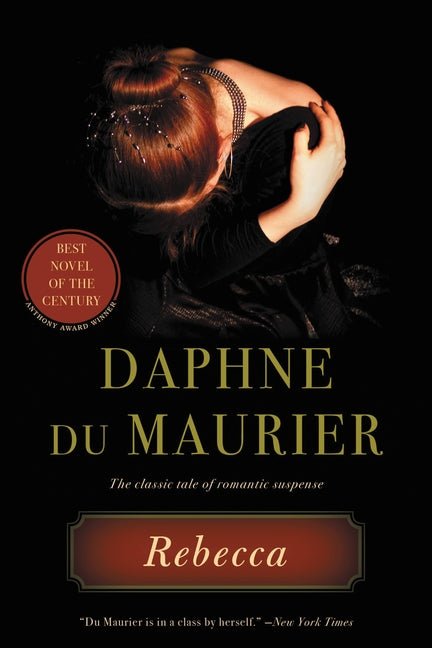
The multi-million-copy bestseller that has enthralled generations of readers. A haunting tale of obsessive love. A mesmerizing psychological thriller.
In Monte Carlo, our heroine is swept off her feet by the dashing widower Maxim de Winter and his sudden proposal of marriage. Orphaned and working as a lady's maid, she can barely believe her luck. It is only when they arrive at Manderley, her husband's cavernous estate on the Cornish coast, that she realizes how vast a shadow his late wife, Rebecca, will cast over their lives--introducing a lingering evil that threatens to destroy their love from beyond the grave.
This universally acclaimed novel has remained consistently in print since its original publication in 1938 and has frequently been adapted--for television, radio, the theater, and film--most notably in 1940 by Alfred Hitchcock, whose Rebecca received the Academy Award for Best Picture, and in the 2020 Netflix film starring Lily James and Armie Hammer.
"Excellent entertainment...Du Maurier created a scale by which modern women can measure their feelings." --Stephen King
"One of the most influential novels of the twentieth century, Rebecca has woven its way into the fabric of our culture with all the troubling power of myth or dream." --Sarah Waters
Book Details
- Binding
- Paperback
- Authors
- Daphne Du Maurier
- Publisher
- Back Bay Books
- Published Date
- September 5, 2023
- Language
- English
- Pages
- 448
- Physical Info
- 0.89 lb
On the Kindle version, occasionally carriage returns would be inserted into the middle of sentences, thereby making it look like a new paragraph and a little confusing to read. See attached picture.

Rebecca is a Gothic novel written in 1938 by English author Daphne du Maurier. I had to pick up this beautiful classic to add to my personal shelf. Read it back in middle school, but I did not know or understand the true masterpiece that is this novel was. If you haven't read it, I definitely recommend you challenging yourself and reading this specific classic as it was not too hard to follow, being that it's almost 90 years old. The vivid imagery portrayed is mesmerizing, and the plot will not let you put the book down for hours (can be finished in a day if you wish).The condition of the book itself came in decent shape besides the small little dings included in the photos. I do not mind being that it's a paperback and normal wear and tear is bound to happen -- it gives it character! I'm glad to have it in my collection; Please do give it a try!


This just happens to be one of my favorite classic novels. It's well written and an easy read. Rather like Jane Eyre, but still a great English novel. I give it a big thumbs up!
THE Reading List, drew me to this book. It was described as a haunting mystery. The characters living rent free in heads.I found it much different than I expected. Two characters have a mean streak. Horrible things are done by the said two. One character you get to watch grow and bloom. The husband, Mr de Winters is wrote like a blank man, hollow, when emotions do come out it is lust, or anger. It is not an underdog story, ending is a cliffhanger.
Came in near perfect condition besides a bit of denting in the top left corner. Great book!
I’m excited to start reading this book. I love this author and I’ve heard nothing but good things about this book.
In this time of craziness, nothing better than to read an old novel. This one checks all the boxes. I truly recommend it, especially to the younger generation whom I want so desperately to know that people were real, alive with problematic issues many years ago.
I was intrigued by this novel since I read that it was made into a movie by Alfred Hitchcock. Now that I’ve finished it, I’m curious how he interpreted it. But frankly, I was disappointed in the ending and found the main characters irritating. I think it was misclassified as a romance.
Beautifully written! Manderley becomes a part of who you are, it lives on in my mind now. As do all of the characters. I love this story, even despite the somewhat abrupt ending. I need to buy the hardcover now, this needs to become a part of my library.
All of these describe the novel Rebecca.It is so very easy to become lost in the main character, who, alas, is unnamed. We "become" the wife of Maxim de Winter and thus are enthralled in all events taking place.The language is expressive and perfect and reminds one of Jane Eyre in its evocation of an era and way of life forever lost to us.I highly recommend this book.
Being stuck in this narrators head & point of view was excruciating for me. Very childish & insecure perspective. The story had some twists & turns but it dragged on with descriptions for too long.
Sydney M. Williams“Rebecca,” Daphne Du MaurierNovember 28, 2020“I can close my eyes now, and look back on it, and see myself as I must havebeen, standing on the threshold of the house, a slim awkward figure in mystockinette dress, clutching in my sticky hands a pair of gauntlet gloves.” The narrator thinks back on her arrival at Manderley Rebecca, 1938 Daphne Du Maurier (1907-1989)Rebecca, among the most famous book titles, opens with one of fiction’s most recognized sentences: “Last night I dreamt I went to Manderley again.” Two years after publication, Alfred Hitchcock directed the Academy Award film starring Joan Fontaine and Laurence Olivier. In 2020, Ben Wheatley directed a new version, with Lily James and Arnie Hammer. While Hitchcock does a better job in portraying the dark mood of the story, neither, in my opinion, captures the novel’s full range.Daphne Du Maurier wrote historical novels. She was a master of creating an atmosphere of dark moods and mysterious characters. Born in London, she spent much of her life in Cornwall. Novels like Jamaica Inn, Frenchman’s Creek, The King’s General and My Cousin Rachel were set in England’s west country. Manderley, Max de Winter’s home, is a large estate on the rocky coast of Cornwall; the time is the 1920s.The story is told through a narrator, whose name we are never told, though Max de Winter tells her, “You have a very lovely and unusual name.” When we meet her, she is a paid companion to a wealthy, overbearing American, Mrs. Van Hopper – “…her short body ill-balanced upon tottering high heels, her fussy, frilly blouse a complement to her large bosom and swinging hips…”. They are staying in Monte Carlo in late winter. While the narrator is never described, we are led to understand she is English, about twenty years old, comely not beautiful, innocent not worldly – the antithesis of Rebecca, which is what attracts Mr. de Winter. He is a widower; his wife Rebecca having died the previous May. He is “tall and slim, with dark hair,” wealthy, aristocratic, in his early forties.The dead Rebecca hovers over the novel, like a dark cloud. She obsesses the narrator who has become the new Mrs. De Winter. Rebecca was tall, clever, fond of sport, “a very lovely creature…full of life.” Mrs. Danvers, formerly her childhood nurse, is now housekeeper at Manderley. We first meet her through the eyes of the narrator: “Someone advanced through the sea of faces, someone tall and gaunt, dressed in deep black, whose prominent cheek-bones and great hollow eyes gave her a skull’s face, parchment-white, set on a skeleton’s frame.” The ghost of Rebecca, a deceitful phantasm, hovers over the large, isolated estate, made real through the devious intrigues of Mrs. Danvers.Neither movie ends as does the book. Movies are a visual, but passive, art form, where the eye works and the mind can nap. Books require concentration and are most effective when the reader employs his or her imagination, guided by the author. Rebecca’s last sentence, as Max and the narrator drive home to Manderley: “And the ashes blew toward us with the salt wind from the sea.” Not the end a movie requires, but perfect for this story; you will be captivated by Ms. Du Maurier’s creative genius. I will say no more.
Review 5 starsThis was a classic that I thought I had read, but I hadn’t. Now I’m glad I did as it’s memorable and worthy of multiple reads.Although the novel is described as gothic – and by some as a romance – for me it was also a mystery. Its style by today’s standards might be called dated and yet it was ahead of its time – as was the author.Much of the narration is as chunks of description mixed with reflection and conjecture by the un-named protagonist living in the shadow of Rebecca. In comparison with the title character, this new Mrs de Winter seems naïve, powerless and at the mercy of others. At first, it would be easy to dismiss her – even the novel – without giving either a chance…without understanding the heroine or the shy author.I grew up in a world not dissimilar to Manderley, albeit one that had lost its glitter but not its attitudes. I felt myself intimidated by scary and overbearing people – especially when I did something wrong. Society and doing the right thing frightened me.Especially when such amazing people as Rebecca were being fawned over.Rebecca may be the deceased wife of Maxim de Winter, but she pervades the story, the house and the grounds. She’s on everyone’s lips. It’s a clever device making her so dominant, giving the novel her name, and naming her, not the protagonist. And it works. The reader is fooled along with the new Mrs de Winter into believing the myth – until the doubts appear.Mrs Danvers, doth protest too much, methinks. She is the archetypal retainer that creates fear and doubts. Rebecca haunts Manderley in one way, Mrs Danvers in another – a brilliant creation, reminiscent of other classic scary presences. A living vampire?All the characters are distinctive. All reminded me of people I had met – even worked with. The mannerisms felt familiar, whether Beatrice, the loquacious sister, or Frank Cawley, the faithful agent for Manderley. Even Maxim de Winter was real with all his faults and guilt buried.If I had to befriend just one, it would be Jasper. The dog? Yes, the faithful exuberant spaniel.One other character enfolds the novel – Manderley. The house becomes character, atmosphere and setting. At first magnificent and untouchable with buried secrets. Manderley fills the narrator’s thoughts, not just the house but the gardens and the sea coves. As the protagonist’s thoughts change so do the descriptions of setting, of home, of the weather, of the vegetation. Or is it vice versa? The weather changes and then her thoughts?But they are all one, interacting as the plot unfolds – setting and thought and events. The past even before Rebecca. Even before Manderley. The sea and the fog.Cliffhanging language that I need to immerse myself in again.Story – five starsSetting/World-building – five starsCharacters – five starsAuthenticity – five starsStructure – five starsReadability – five starsEditing – five stars
Rebecca. This is a classic I had been meaning to read for years. I started it a few years back (it’s been on my Kindle that long) but was distracted by something else I “needed” to read.We never learn the first name of our narrator. She is described as young woman without worldly experience. You know straight away she is impressionable, a bit naive but kind-hearted. She is often referred to as the new or second Mrs. de Winter. Personally I think she was named after her father. I thought that after this exchange with Maxim de Winter over dinner.“You have a very lovely and unusual name,” said Mr. de Winter.” “My father was a lovely and unusual person,” our narrator replies.Our young lady is swept off her feet by the worldly and kind Maxim de Winter, eager to take her role as wife and lady at Manderley. She daydreams about her new home, how they will have children and what a wonderful life they will have. Gothic themes, love, jealousy and murder abound in this story.When the second Mrs. de Winter meets Mrs. Danvers she hopes the two can become friends, have a friendly face to assist in her new role. The arctic personality of Danvers was evident from the start – no friendly face or help with that one.“There were never any complaints when Mrs. De Winter was alive”, said Mrs. Danvers. She is comparing me to Rebecca and sharp as a sword the shadow came between us……..”Frankly, I would have been very nervous around Mrs. Danvers. I didn’t grow up in a high society or upper class setting and I can imagine poor little new Mrs. de Winter is intimidated. In over her head, absolutely. It’s only later that you realize what an unhealthy, obsessive one-sided relationship Danvers had with her employer.**Spoilers**Since the beginning of the book is actually a description of the end of their lives at Manderley, I had to go back and read the first chapter again. It all dovetails into a complete story.Their lives are nothing like they hoped, they are merely existing. Now I see Maxim had a genuine desire to experience a loving marriage with his young bride. While she thought she was being compared to Rebecca and found wanting, it was actually the opposite. Max was delighted with her open genuine spirit and her love.!! Remember, I did state Spoilers and they will continue….. !!We discover Rebecca didn’t drown but was murdered, her body placed in a boat and submerged. Are we then surprised that Maxim did it? That the second Mrs. de Winter stays with him and is actually happy he truly loves her rather than appalled over the murder? Once Manderley burns they live a faded existence, avoiding talk of their past, staying in hotels but living frugally. It’s a sad story but oh so well written.MenusCurried prawns, roast veal, asparagus, cold chocolate mousseIce cold consume, fillets of sole and hot shoulder of lambThose dripping crumpets, tiny crisp wedges of toast, piping hot floury scones, gingerbread and Angel cake….and so much more.I wanted to prepare the sole and asparagus but, as luck would have it, a friend caught 20 Mangrove Snappers and gave us some fillets. What a gift! It’s a wonderfully solid fish that grills exceptionally well. We did manage the asparagus though. And a Martini.
I'd never read this before, nor have I seen the movie I was missing so much. A wonderfully dark and deceptively told tale. I could feel the ambiance coming off the screen. I was shocked at all the psychological twisty, rather deep and dark Freudian/Jungian stuff found in this novel.It really affected me more than most dark and twisty psychological thrillers do.Rebecca seems a fierce response or callback for lack of a better word to Jane Eyre. Both novels stand very firmly on their own. Rebecca need not be seen in light of other novels, but it's interesting to see how she responds to some of the material in the earlier classic.Normally a simpering woman who is dying for a man to just sweep her away from it all (no matter when it was written) would turn me off. The fact that she's afraid to trouble him or speak up to him makes sense, but also made me very sad for her at first. The genius is though I kept thinking "pack it up. Leave him," I felt connected to the nameless narrator through the novel as if I was the one in her position. I felt stuck. I felt nervous. I cringed along with her. I found my pulse quickening every time Mrs. Danvers came near. I was scared - literally scared while reading this in the middle of the day.The dreams that begin and end the book are stunning in the way they set the mood and tell the truth when our narrator can't seem to tell herself the truth. Her daydreams are full of fanciful, childish nattering, but the dreams are the real thing. The juxtaposition of the truth in her dreams v the silliness of her daydreams is very telling and full of foreboding. Du Maurier writes very melodramatic plot without ever tipping into sentimental or soggy language so well that it's almost easy to miss how melodramatic the plot actually is. She's also a master of class and all those games people play, which is a callback to Jane Eyre, but so much of this is in the narrator's fearful mind that it's wildly different from the actual scenes in Jane Eyre.I also think the nameless narrator is a perfect way to add one more layer of her personality -- added to her hair, the way she dresses, all of her hiding, acquiescing, nail biting, her class and the way they met -- this is a well-built and very believable character. The daydreaming tops it off for me. She can't deal with her life and shunts all of her wishes and fears into fantasy.One more thought is that these women - the two Mrs. de Winters - are like two sides of the same person, and in the end de Winter manages to kill them both (and they're both willing to let him.) Sure, the narrator is technically still alive, but it's just a slower/different form of death. There's a lot to say about that from the world of psychobabble, but I'll spare us all.My final thought was "did Sylvia Plath love this novel?" I don't know, but in her late (mostly Ariel-era) poems, there's a lot that has the feel (and some of the imagery) of this novel. I tried to do a quick search, but all I learned is that Agatha Christie wrote to du Maurier about the nameless narrator.I loved it. It moved me. If I'd gotten a degree in psychoanalysis, I would have wanted to use this as some part of my dissertation: especially in the responses of women to the women in the novel.
The subject quote is taken from the excellent afterword of Sally Beauman, written in 2002. Daphne du Maurier, who lived from 1907 to 1989, wrote this work, her fifth novel, in 1938. There is absolutely no mention of international events, and thus there is no sense of the “Gathering Storm” that would become the Second World War. There are elements of
Gone with the Wind
, written about the same time, by Margaret Mitchell. And there are elements of Charlotte Bronte’s
Jane Eyre
, which was written almost a century prior. This is the first novel of du Maurier that I have read.Manderley is a central “character.” It is a place, with an imposing large mansion, way down, Cornwall way that had been in the de Winter family “since the Conquest,” that is 1066, and all that. A while, in other words. Maxim de Winter is the current owner. Rebecca was his wife, but she is recently deceased, drowned off the coast in an apparent boating accident. He seeks a change in scenery, in Monte Carlo of all places. There he meets the unnamed narrator, who is serving as a paid companion to an insufferable snob, Mrs. Van Hopper. In his fashion, he woes the youthful companion, with day trips while Mrs. Van Hopper is recovering from the flu. To fill the new void in his life, he asks her to marry him. She agrees. And he takes her back to Manderley, as the new Mrs. de Winter. She is almost half his age, and certainly not of his class.For today’s reader, it is difficult not to think of the long-running TV series, “Downton Abbey,” while reading “Rebecca.” Another imposing mansion. British upper crust customs, and the many servants necessary to maintain the lifestyle, which naturally includes the tea ritual. And no one is very happy, with “maintaining appearances” a dominant consideration. Setting up one’s own tent, and boiling one’s own water for the tea, in the same locale, which contains “Happy Valley” and loads of azaleas, is just so much more appealing, as well as conducive to happiness. But I interject my own bias.The youthful narrator has her work cut out for her, trying to fill Rebecca’s stilettos. She knows she is neither very pretty (ah, Jane Eyre), nor worldly-wise, and is completely out of her milieu. The head servant, Mrs. Danvers, was deeply devoted to Rebecca, and views the youthful narrator as an interloper. Others in the milieu range from forthright and frank assessments (Maxim’s sister), to a more sympathetic property manager. I felt that the novel started slowly, with almost trivial concerns and observations on life at Monte Carlo, but I soon found it to be a true “page turner” as du Maurier deftly develops the characters while maintaining a critical level of suspense. It is not surprising that Alfred Hitchcock turned this story into a classic movie, starring Joan Fontaine and Laurence Olivier.Kudos to Beauman for her important afterword, which helped explain this works enduring popularity, as well as du Maurier’s circumstances when she wrote it (she was pregnant, in Egypt, with her husband who was serving in the military). Beauman argues that this is not just “women’s fiction” but has made “…a transition rare in popular fiction: it has passed from bestseller, to cult novel, to cultural classic status.” Furthermore, it has spoken to the readers, if not critics, since it depicts the story of two very different women, and their relationship with one rather overbearing (and insecure) man. As Beauman concludes the subject quote: “…one that undermines the very genre to which critics consign it.” 5-stars.
I've saved this book on my to-read list for so long. It's one of the "secret treat" books I've stocked up like emergency supplies for desperate moments, when I need something new to me but 100% guaranteed lovely. After a lot of recent travel, stress, and child minding, I finally found a few hours of respite in a warm lamplit room, deliciously alone. Rebecca was indeed exactly what I needed.All this aside, the book isn't for everyone. If you're not already a fan, this checklist may help you decide whether or not to add Rebecca to your own secret treat shelf:1. Do you like gothic fiction?Although it was first published in 1938, Rebecca ages exquisitely and i's not hard for a modern reader to fall deeply in love with it. The style and turns of phrase are no barrier--it's the genre itself that will either draw you in or leave you cold. I loved Jane Eyre as a child, and this love abetted my love of Rebecca, which is famously derivative of Jane Eyre's general plot: woman falls in love with a man haunted in mysterious ways by his former wife. If the idea of women wandering windswept grounds of great houses, plagued by mysterious barriers to love, sometimes in the form of the ghost (literal or figurative) of another woman sounds cozy to you, if you loved Catherine and Heathcliff or Darcy and Elizabeth, and you fancy dark psychological acrobatics, give Rebecca a shot.2. Does a warm bath, a hot drink, and a new sweater sound good to you right now?Rebecca is a fall read, hands down. It's rainy, it's morose, it's the dominating presence of a grand old mansion in a remote location.3. Have you seen the movie Rebecca (1940), did you like it, do you like old movies at all?The movie does not follow the plot exactly, but having loved the movie for a long time and now having read the book, the tone of the movie feels authentic and true to the novel. Once every few years, I go on an autumn binge and watch The Uninvited (1944), Vertigo (1958), Rebecca, and to end on a lighter note, The Ghost and Mrs. Muir (1947).4. Are you a feminist?Old fashioned gender roles in Rebecca's setting will definitely irk some readers. As a feminist, I was less annoyed than interested. The mirroring of the protagonist (shy, inexperienced, subservient) and the dead Rebecca (domineering, brave, selfish, accomplished) added a great sociological layer to the experience of reading. Sally Beauman's excellent Afterword offers a wonderful explanation of the gendered forces at work in Rebecca, and also addresses several misinterpretations of the novel at the time of its publication.If you've answered yes to any of the questions above, I absolutely recommend that you read the first 30 pages at least. Get past the description of Manderly in the dream, and begin to read about when the protagonist first meets widower Maxim de Winter, and if you're liking it by then, you'll love the rest.
"Last night I dreamed I went to Manderley again." I must have read REBECCA before, but can't be sure. Still, something of the writing must have stuck. Reading the opening of the forthcoming book
ALENA
, Rachel Pastan's homage to du Maurier (and my next book to review), I felt such a sense of déjà vu in the opening pages as to make me almost dizzy, and knew that I first had to check the original at its source. I am glad I did so -- and that I chose this Kindle edition, not least for its wonderful concluding essay by Sally Beauman, who puts the novel into a much more radical feminist perspective than the cloak of gothic romance in which du Maurier chose to drape it. [Beauman also wrote her own prequel to the novel in
REBECCA'S TALE
, events at Manderley as narrated by the first Mrs. Maxim de Winter.]"Last night I dreamed...." My memories had faded into a collage of moods and moments, perhaps from the book itself, perhaps from the several screen versions. Yet one of du Maurier's skills is that, even for first-time readers, the story triggers deep memories. It is both romantic and archetypal. The parallels with JANE EYRE are obvious -- the great estate, the humble heroine, the aloof master, the shadow of a former marriage -- but Charlotte Bronte was tapping into archetypes also: Cinderella and Bluebeard, to name but two, as the Beauman essay points out. One of my surprises in reading the book again now was to find how much time its nameless narrator spends dreaming or daydreaming. Feeling out of place as the modest new bride in historic Manderley, she imagines the servants or neighbors talking about her in disparaging terms. Even when looking forward to something as vague as her future life as chatelaine or as specific as an upcoming costume ball, she plays through little scenes in her mind, imagining how people will greet her and what she will graciously reply. And with almost every step she takes, she imagines her beautiful predecessor Rebecca, the REAL Mrs. de Winter, playing that role before her, with far greater charm and elegance than she can hope to muster."...I went to Manderley again." That "again" is important. For REBECCA is written in unexpected tenses and from an unusual perspective. The entire book takes place in memory; it is a still-young woman looking back at a past when she was dreaming of a future that she now knows she never will have, having been sabotaged by something even further in the past; there is almost no graspable present there at all. It is also a mystery story, but again a highly unusual one. Within a few pages, we already know the essential outcome. The one major denouement comes not at the end, but two-thirds of the way through the book -- and it will indeed be a denouement for those who know the story only from the considerably less shocking
Hitchcock movie
, constrained by the production codes of its time. So far from being the patient elucidation of a crime, the tension in the latter part of the book comes from how and if a known criminal can escape justice."...I dreamed I went...." Who, finally, is that "I"? Uniquely, she has no name. She is not merely an anonymous narrator, but a nameless heroine also. It is a daring stroke. Does it permit every reader (or at least every woman reader) to cast herself in her place? Perhaps, but we also look beyond her edges at things that she, as a naive narrator though not an unreliable one, does not see. And do we want to identify with a woman so subservient that all her happiness is bound up in pleasing her husband? Sally Beauman thinks not, and believes that the woman we really take away from these pages is the brilliant but never seen Rebecca. Personally, I did not find it so. I was as seduced as anyone into wanting this Cinderella story to work out, But Beauman makes a powerful case that this woman -- whose only identity, as Mrs. de Winter, is borrowed from her husband -- is as much his tragic victim as his bride. For a popular romance, this leaves a lot to think about.

