

Return to Sender
 )
 )
Couldn't load pickup availability
An award-winning, moving, and timely story about the families of undocumented workers by renowned author Julia Alvarez.
After Tyler's father is injured in a tractor accident, his family is forced to hire migrant Mexican workers to help save their Vermont farm from foreclosure. Tyler isn't sure what to make of these workers. Are they undocumented? And what about the three daughters, particularly Mari, the oldest, who is proud of her Mexican heritage but also increasingly connected to her American life. Her family lives in constant fear of being discovered by the authorities and sent back to the poverty they left behind in Mexico. Can Tyler and Mari find a way to be friends despite their differences?
In a novel full of hope, but with no easy answers, Julia Alvarez weaves a beautiful and timely story that will stay with readers long after they finish it.
Winner of the Pura Belpré Award
Winner of the Américas Award
An NCSS-CBC Notable Children's Trade Book in the Field of Social Studies
"A must-read." --Kirkus Reviews
"Communicates in compassionate and expressive prose the more difficult points of perhaps the most pressing social issue of our day." --San Antonio Express-News
"This timely novel, torn right from the newspaper headlines, conveys a positive message of cooperation and understanding." --School Library Journal
"The plot is purposive, with messages about the historical connections between migrant workers today and the Indians' displacement, the Underground Railroad, and earlier immigrants seeking refuge. . . . The questions raised about the meaning of patriotism will spark debate." --Booklist
"A tender, well-constructed book." --Publishers Weekly
Share
Book Details
- ISBN
- 9780375851230
- Binding
- Paperback
- Authors
- Julia Alvarez
- Publisher
- Yearling Books
- Published Date
- September 14, 2010
- Language
- English
- Pages
- 352
- Physical Info
- 0.83 in H x 7.81 in L x 5.07 in W (0.51 lb)
Good product !!!
My child loved the book at first she was I don’t want to but after having to read it for summer reading she was this was a amazing book. A must read so good and it takes place in there day and time.
My kid bought this for school and I also read. Good story. Glad it is being promoted in her education.
I read this story as part of a graduate class, and I absolutely loved it. The two different perspectives of the kids in this book give two sides to a complicated issue that even adults can't solve. Now that I am a reading teacher, I make sure to tell students about this book, because it shows life from different perspectives, and lets students know that there are two sides to every issue. Such a beautiful story of empathy and understanding.
This was a pretty good book. I read it with my son. I would have given it 5 stars but I didn't like how the author told a lot of the story through letters. In other words, a young girl is writing to her mother and you learn about what has been happening through her letters. There are several chapters of that type of writing style in the book.
- 5 stars: 11 (55%)
- 4 stars: 7 (35%)
- 3 stars: 2 (10%)
- 2 stars: 0 (0%)
- 1 star: 0 (0%)
Good product !!!
My child loved the book at first she was I don’t want to but after having to read it for summer reading she was this was a amazing book. A must read so good and it takes place in there day and time.
My kid bought this for school and I also read. Good story. Glad it is being promoted in her education.
I read this story as part of a graduate class, and I absolutely loved it. The two different perspectives of the kids in this book give two sides to a complicated issue that even adults can't solve. Now that I am a reading teacher, I make sure to tell students about this book, because it shows life from different perspectives, and lets students know that there are two sides to every issue. Such a beautiful story of empathy and understanding.
This was a pretty good book. I read it with my son. I would have given it 5 stars but I didn't like how the author told a lot of the story through letters. In other words, a young girl is writing to her mother and you learn about what has been happening through her letters. There are several chapters of that type of writing style in the book.
Return to Sender places a human face on the immigrants who make their way to the United States and to the families who benefit from their labor. Children are children, families are families no matter from what country. This is an important lesson that I wish to teach my grandchildren, since we are an international family. Too often the hardships that immigrant families endure are marginalize and even discarded because we, as Americans, do not pay attention to the human factors.
The topic of immigration is a complicated one, and I love how it is told from different points of view focused on the people surrounding this issue, both the farming family wanting to make ends meet and the family from Mexico trying to create a better life for themselves. If books do not portray differences, students cannot learn to transcend them. I appreciate to see what it'd be like on both sides of illegal immigration. It was difficult to read some of Mari's entries. As the oldest, she carries the most fear about her mother's absence. In addition, her undocumented status was a huge burden for her, more than any eleven-year-old should ever have to bear. The characters and their problems are very real, and Return to Sender is a sympathetic treatment of the human side of illegal immigration.
This story has us traveling from Mexico to Vermont and eventually back to Mexico. We find ourselves meeting Mari and Tyler two young teens that meet each other at the family farm. Mari's family are undocumented worker she lives with her father,uncles, and two younger sisters. Mari's mother is currently missing while she was returning to the family with the coyote, a smuggler. It's been months since the family has heard from her. Mari deals with her loss of her mother by writing letter to her although she is not allowed to mail them for fear the immigration might locate them. Tyler and Mari become friends and quickly confiding in each other. This book teaches acceptance,tolerance, and dealing with bullies. Great as a read out loud book.
With all the controversy in this country about borders, immigration, illegal aliens, and in particular Mexican immigrants, this book couldn't have come at a better time. Our students are sitting in classrooms with students who are learning English as a second language while simultaneously trying to learn the same content as their peers. Our neighbors are using labor from illegal aliens to keep their farms and businesses afloat. And our government is currently in a federal vs. state war regarding the rights of non-citizens. I would say the YA genre is well overdue for a book to examine both sides of this controversy.The story begins with a young boy named Tyler who has grown up on the farm that has been run by his family for generations. His older brother and sister are uninterested in the back-breaking work it takes to keep the farm going, but Tyler dreams of running the farm one day, even though he is only eleven. When his grandfather dies suddenly and his father is badly injured in a farm accident, the family resorts to the last hope to keep their farm going: Mexican labor. They hire three men to help with the farm work and live on the farm, but they are surprised to find the men arrive with three young girls. Maria, Luby, and Ofie are with their father, but no one knows where their mother is. She left to return to Mexico almost a year ago to see her dying mother, but after calling Maria's father to let them know she was returning, she disappeared and they haven't heard from her since.Tyler is having a difficult time with the new residents of the farm. He believes in his country and the constitution and hiring illegal immigrants is breaking the law. Therefore, he is very upset by the turn of events on the farm, and he is torn because he knows this is the only way to save the farm. When the girls are enrolled in his school and Maria is in his class, he gets to know them as more than just illegal immigrants, and gets to know the crueler side of his peers. While Ofie and Luby are US citizens and born in the states, Maria was born in Mexico, and the kids at school don't let her forget it. Slowly, though, the two families grow to care for one another deeply. The girls think of Tyler's grandmother as their own grandmother, Tyler's family invites Maria's family over for dinners and holidays, and all are devastated when Maria's uncle Felipe is picked up by immigration. Now the family must find a way to avoid immigration, run the farm with less men, and find out the truth of where Maria's mother is.This is a bitter sweet story that shows both sides of a controversial situation. Chapters alternate between Tyler's story told in prose and Maria's story in the form of letters to her mother, the President of the US, and Guadalupe. It makes the reader understand that immigration is more than just a numbers and borders game- real people are the focus and their lives are in the balance. Not to mention, these people are hard workers who just want to support their families, and they have become a strong support system for businesses that couldn't continue without their help.I found the message to be well thought out, but the writing was just plain awkward. I would have been fine if only Maria's story was choppier, but Tyler's was too. And the beginning where Tyler is concerned with the legality and moral aspects of the new farm workers, it is simply overdone. It sounded like a robot: "Illegal immigrants are illegal, the constitution is the bestest thing in the world, we follow the constitution in the bestest country in the world, therefore we don't break the law, and illegal immigrants are breaking the law, so they are all bad. Very bad." It was simply silly. It made it hard for me to take the book seriously for a while. Tyler's opinions clearly changed as the story continued, but it was almost as if Maria's family were real aliens from outer space and no one knew about them until now. This part I find hard to believe. It is set in 2005, and I find it hard to believe a family in VT would have no contact with a Mexican family until then. This part of the book was much less realistic and much more contrived.The book is still an interesting one, and might be best as a school assignment with teacher guidance, or one read with a parent. I don't see many kids picking this story up and sticking with it long enough to get to the important messages. The writing is hard to peg because it is so awkward, but not necessarily written at a lower reading level. The topic is a great one for kids and adults at all ages. It is also an interesting choice for a student learning Spanish, because Spanish words, phrases, and sentences are scattered throughout. Basically, I would read the story first before giving it to a student, and if you are going to use it in your classroom or read with your child, be aware of the flaws in order to reap the benefits of such a story.
"Return to Sender" in my own opinion, as a former undocumented immigrant, had to be the best book that I have read because the plot was relatable and meaningful. "Return to Sender" is a very engaging book, it keeps you on your toes and opens up another word for students to learn from.The main characters share the plot and give us input in letters they write to each other and family members. . First Tyler's family are the owners of a "bad luck farm" where incidents have been occurring back to back and the money flow isn't what it used to be. In the beginning we learn that Tyler's grandfather had just recently died and his dad suffered a serious accident with the tractor. These couple of accidents Tyler's family endured, has made a huge impact the farm. In order for his family to prevail this hardship they hire some migrant Mexican workers to help out with all the chores at a cheap rate, since they can't do it by themselves anymore. As the migrant workers arrive , Tyler's family are surprised to find out they come bearing three spunky bundles of joy: Mari (non citizen of US) and her two sisters (citizens of US). Little does the reader know that their Mother has been kidnapped and elongates her welcoming home arrival to them. A huge serious of events occur and both Tyler and Mari have to give it their all to keep moving forward. Towards the end we meet a whole new family, as both families emerge with each other they are able to understand their differences are actually what brought them close together.Both Tyler and Mari faced similar struggles in the book which is hard to pick who is the protagonist of this story. Tyler in my perspective became more of a dynamic character as he let his guard down and understood that Mari's also had walked in his shoes. However, I do feel that Mari kept in a lot of emotional feelings back to portray that she was stronger mentally. Overall, I could not put this book down because I was so emotionally involved in the events that occurred. This is a wonderful book as it addresses immigration, patriotism, and friendship without borders.
In Julia Alvarez' Return to Sender, the struggles of one American farm family and one Mexican immigrant family collide in a moving story about friendship, hardship, and culture. Tyler's family is struggling to keep their farm. With his father injured and nobody else to help with the labor, they are forced to hire migrant workers to keep their home. Mari's family is living in fear of being found by the authorities. They are illegal immigrants and have to be cautious to avoid being deported back to the poverty they so desperately wanted to get away from. Tyler and Mari find an unlikely friendship in each other and build a bond that breaks through culture barriers and changes their views on culture. Alvarez does a great job at accurately depicting what it is like to be part of an immigrant family and allows young readers to step into a world they may never experience themselves. Through this touching story, Julia Alvarez brings a very real problem in America today to the front of young readers minds, which is sure to spark interest in the issues they were once oblivious to. I very much enjoyed this book and find it not only accurate but interesting.
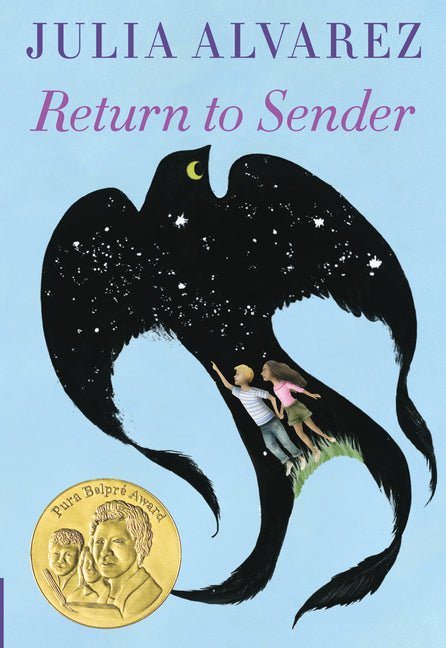
Return to Sender is an inspirational, encouraging and absolutely intriguing story of hope, determination and trust. This is a must read for children between grades 6th to 12th and beyond. This was a story of a young boy, Tyler eager to hold on to his childhood memories of his family owned and operated farm, and everything that is physically and emotionally important to him. In doing so, he had to alter his moral beliefs and question the system of politics and laws set forth in his very own, firmly believed in country, The United States of America. This story is a great one to share with student in a classroom where you are helping student understand the different cultures that exist in the USA and what it took for these cultures to become a `part' of our grand nation. In the story we're introduced to a young girl, Mari. She is from Mexico and just as eager as Tyler to share her love for the United States of America, only it isn't as easy for her, being considered an `illegal alien'. Through the journey of the story, Tyler and Mari realize that even though they are far different in a cultural aspect, they share many of the same interests and desire for a better life for all those who wish for one. The story touches on an issue much deeper than the cover portrays. Julia Alvarez intelligently combines two storylines here, putting them side by side to show the audience how different these two families are yet, at the same time equally struggling through the most difficult times. This book was a wonderful read, which I encourage young teens and adults to enjoy.
"I felt my heart folding up like a letter in a sealed envelope stamped Return to Sender," Mari tells her diary of the sadness she felt when thinking about leaving her special friend Tyler.Return to Sender made me tear me a few times. Julia Alvarez captures and reveals a few different cultures in this story. The farm life in Vermont and the characterization of the average American small town is portrayed very well. She shows the dynamic and controversial way our society reacts to the surrounding change in the world and our country. I really loved how Julia Alvarez showed that people can come together to help each other in ways that might not seem possible.A heartfelt tale of immigration, loss, and new friendships, Return to Sender found a way to connect with me, as I believe it could connect with almost any person. The author, Julia Alvarez, depicts serious situations but from the eyes of the youngest ones affected by them. Sometimes, we all need to see things from the perspective of people different from us to fully understand painful truths about our world.
Return to Sender is an excellent choice for educators to use in their classrooms and most certainly worthy of the Pura Belpre it was awarded in 2010. There is so much to be observed, explored and reflected upon throughout this story which draws attention to the very pressing issue of immigration. One of the many things I found interesting was that it was written from the more than one perspective and background. Aside from different perspectives we are able to culturally compare the two families through their customs and traditions. I find Return to Sender to be a very culturally authentic book. Although these are not Julia Alvarez's personal experiences, they are certainly close. Her parents were natives of the Dominican Republic and came to the United States when she was 10 years old. Julia therefore understands how it feels to be new to a country and the ridicule and fear that comes along with it. The experiences shared are the stories told to her by the children of Mexican migrant farm workers with whom she would help to translate for in the Vermont schools. Alvarez appeals to our inner empathetic emotional state to bring light to the issues of immigration and its policies throughout the book.
An eye-opening book full of hope and inspiration. In today's society, especially living in San Antonio, Texas I've heard lots of different perspectives about illegal immigrants. So often are those perspectives negative. This story was primarily written for children, but I would recommend it for adults as well, because it unveils sides to illegal immigration that people often overlook or simply don't think about, including the separation of families and the struggles they face in America on their quest to find a better life. Return to Sender creates a beautiful friendship between two young children from different walks of life and highlights the struggles of growing up and learning how to understand and accept different cultures. It is a little bit of a tearjerker, so be sure to have tissues handy! A Pura Belpre Award winner and an excellent way to introduce multiculturalism and immigration to a classroom. Recommended for fifth grade and older.
A tale of inspiration and hope, Return To Sender will grab you and take you on a wonderful journey of tears, joy, fear, and love. Based on modern day immigration and border control, you will be introduced to Tyler and his family. A farmer family trying to get by in life, but having troubles keeping up with all the work that is needed to be done on their farm and having the funds to keep it all up. They need help, and that is when you will meet Mari and her family. A Mexican family illegally in the country, but trying to reunite themselves with their mother and still make money for their family back home, all without being caught by Homeland Security. The two families must learn to work together to keep both of their lives and families safe. The two children, Tyler and Mari, spark an unlikely friendship and bond that becomes unbreakable. Learning of all the hardships and trouble they must go through will keep any reader raveled into the story. This eye-opener novel will inform and intrigue any of its readers to keep turning page after page. Will Mari's mother be reunited with them safely? Will Tyler's family get to keep their farm? Find out on this excursion!
Return to Sender is a heart felt novel about the struggles of growing up and the added struggles of immigrants. The book is told from two different view points, Tyler's first person and Mari's letters. I really liked this form of writing because it gives the reader two intimate viewpoints of the story. The author even covers many of the same scenarios from both view points. Julia Alvarez made the story seem so real, I was sucked in after the first chapter. Mari and Tyler's speech was spot on for children of their age and experiences. The sibling dynamics in both households were so realistic. Even just the thoughts that Tyler had and the worries that Mari wrote about were very believable. Being on the farm in hiding is a constant struggle for the entire Cruz family and they are having to find ways to cope like Ofie and Luby finding a grandmother figure in Tyler's and Mari escaping to the stars to `look up when she's feeling down'. Even Tyler is struggling with his concepts of pride and his family beliefs that are changing before his eyes. The author does a wonderful job really telling a story and covering all aspects so the reader feels what they feel and begins to feel for them and their struggles. I had no idea what I was going to think when I started this book but I am glad I got to experience this piece of literature.
Could you imagine returning home from school every day worried that your parents had been seized by "la migra"?In the young adult novel Return to Sender, Julia Alvarez does an excellent job of placing the illegal immigration debate into context by using the point of view of children who are affected by it. Overall I rate this book positively because I appreciate the message, and I grew as a person by getting to "walk two moons" in an illegal immigrant's shoes. However as an avid adult reader this book missed the mark for me, the pace was slow and the characters failed to spring off the page. I think the book would fare better with young adult readers. Alvarez uses letters from Mari to tell her story, but I just didn't believe that the letters were written by an eleven year old; and as the letters make up the majority of the book, it was a struggle to stay engaged. Although there were places the author really grabbed my heartstrings:"'El papel lo aguanta todo.' Paper can hold anything. Sorrows that might otherwise break your heart. Joys with wings that lift you above the sad things in your life."An immigrant from the Dominican Republic herself, Julia Alvarez wrote Return to Sender to demonstrate that "at the heart of any political issue there is a person who is not very different from us". The topic of the book is immigration, but the main theme is friendship; as Alvarez also manages to address patriotism, the transition from child to young adulthood, death, and responsibility. Spanish words and phrases embellish the text and readers are treated to Mexican traditions as Mari strives to preserve her native culture in a land where she is labeled an "alien".An ideal book for middle school teachers to use in the curriculum; Return to Sender is a multicultural contemporary realistic fiction novel that has earned the Pura Belpre Award; Americas Award for Children's and Young Adult Literature; and the NCSS-CBC Notable Children's Trade Book in the Field of Social Studies for its cultural authenticity.
"Return to Sender" may focus on the plight of migrant workers, but it is also more than that. Tyler Paquette is grieving the loss of his beloved grandfather, and to top it off, his father is recovering from a horrific accident, one which has left him incapable of running the family farm on his own. Tyler fears losing his family farm and the way of life that is so important to him. Then he discovers that his parents have hired new migrant workers from Mexico (by way of North Carolina), and he wonders why his parents are being so secretive, telling him not to tell his friends and classmates about the new workers. Later, Tyler finds out that these workers are undocumented, and feels conflicted - why would his parents risk so much to hire these people? What if they get into trouble for harboring illegal immigrants? Yet Tyler realizes this may be the only option available to his parents in order to keep the farm going, and the migrant workers appear to be decent, hardworking folk.Tyler also finds that the eldest daughter of the migrant family, i.e. Mari, is about his age and shares a common interest in astronomy. Over time, Tyler comes to care about Mari, her two younger sisters and the others, and does not wish to see them deported. However, others in the community are not so benevolent and are bent on seeing these migrants sent back to Mexico. Mari, meanwhile, struggles with her own conflicts - her mother has been missing for a while, and as the days pass by, the family's hopes of seeing Mama grow dim.There is no real happy ending in this story, so it does credibly address some of the real issues having to do with the uncertain life of migrant workers, who literally live from day to day in the hopes that la migra will not arrest them and send them back to a life of poverty, with no means of supporting their families. There is an obvious political message here, but I felt it was well-integrated into the story without a happily ever after ending that would have diluted the story's message. The reality in today's United States is that there are many immigrant students in school without legal status, and it is time that other students, both citizens and legal aliens learn to understand how their peers might feel, living in constant fear. It is not a pleasant subject, but I felt the author did a credible job in weaving a compelling human interest story of friendship, immigrants, and life.
Julia Alvarez knows how to characterize the blur in the line between right and wrong. She knows how to make it clear that reality and morality are continuums and not dichotomies of this or that, up or down, or yes or no. There are no absolutes. (Now, there's an oxymoron.) We have a long way to go.Alvarez begins with a young man, her protagonist, Tyler, the younger eleven-year-old son in a family who has survived and thrived by running a dairy farm in Vermont. The family's farming heritage is at risk. Tyler's older brother is away at college, mostly unavailable to help out on the farm without jeopardizing his education and eventual career, and Tyler's father has been injured and disabled, perhaps permanently, in a farming accident. Tyler's father can't do the work he normally did. It is unclear when and if he ever will be able to do the work again. Extended family also can't adequately help out. So paying the bills and keeping the farm is at risk. The family needs help or to change their dynamics: selling the farm, moving from their land, doing something entirely different than farming.Tyler's parents eventually hire undocumented immigrants --- a couple of men --- to assist with the dairy work. One of the immigrant men is married and has three daughters. The oldest, Mari, slowly becomes Tyler's friend and ally, an unfolding as miraculous as springtime. Mari's mother has disappeared in the murky criminal element that arose to fulfill the void created by ambiguities in United States immigrant policies, underfunded policies that for years tacitly approved of undocumented immigrants coming to the United States to work in jobs that citizens in better times didn't want to do.The analysis of various notions is tenderly at play in Alvarez's book: What is a family? What does it mean to be honest? What good is it to have a law without compassion, or without implementing it and adequately funding its substantial enforcement? What does it mean to be a good neighbor and a friend? What sacrifices are appropriate and necessary of good neighbors and friends? And does all of that that apply only to individuals and not to communities and to nations? What is charity? Is it a weakness or strength? What about religion and the mystical, and gazing into the heavens? Hope?"... life is about change, change, and more change. 'When you're born as a child, you die as a baby. Just like when you're born as a teenager, you die as a child.'... 'But there are good sides even to bad or sad things happening,' my mom reminds me...."This is a coming of age adventure where a boy and a girl have more love and compassion than the men and the women do, where a couple of families have greater diplomacy toward each other than the greatest nations on earth do for each other. So it would be good to take their advice and look into the heavens and contemplate the beauty of the night before flying apart.Not just one star but five.

