

The Silmarillion
 )
 )
Couldn't load pickup availability
Experience Middle-earth like never before in this special edition of the forerunner to The Lord of the Rings, illustrated throughout in color by J.R.R. Tolkien himself. The Silmarillion is a doorway to the history, mythology, key characters, and defining tales of the early ages of Middle-earth—an essential volume for any Tolkien reader eager for a deeper journey.
The Silmarilli were three perfect jewels, fashioned by F«anor, most gifted of the Elves, and within them was imprisoned the last Light of the Two Trees of Valinor. But the first Dark Lord, Morgoth, stole the jewels and set them within his iron crown, guarded in the impenetrable fortress of Angband in the north of Middle-earth.
The Silmarillion is the history of the rebellion of F«anor and his kindred against the gods, their exile from Valinor and return to Middle-earth, and their war, hopeless despite all the heroism, against the great Enemy. It is the ancient drama to which the characters in The Lord of the Rings look back, and in whose events some of them such as Elrond and Galadriel took part.
The book also includes several shorter works: the Ainulindal«, a myth of the Creation, and the Valaquenta, in which the nature and powers of each of the gods is described. The Akallabªth recounts the downfall of the great island kingdom of Nºmenor at the end of the Second Age, and Of the Rings of Power tells of the great events at the end of the Third Age, as narrated in The Lord of the Rings.
Tolkien could not publish The Silmarillion in his lifetime, as it grew with him, so he would leave it to his son, Christopher Tolkien, to edit the work from many manuscripts and bring his father’s great vision to publishable form, so completing the literary achievement of a lifetime. This special edition presents anew this seminal first step towards mapping out the posthumous publishing of Middle-earth, and the beginning of an illustrious forty years and more than twenty books celebrating his father’s legacy.
This definitive new edition includes, by way of an introduction, a letter written by Tolkien in 1951 which provides a brilliant exposition of the earlier Ages, and for the first time in its history is presented with Tolkien’s own paintings and drawings, which reveal the breathtaking grandeur and beauty of his vision of the First Age of Middle-earth.
Book Details
- ISBN
- 0345325818
- Binding
- Mass Market Paperbound
- Authors
- J R R Tolkien
- Publisher
- Del Rey Books
- Published Date
- January 12, 1985
- Language
- English
- Pages
- 480
- Physical Info
- 1.08 in H x 6.86 in L x 4.26 in W (0.51 lb)

This is a very high end version of the silmarillion. Hard back cover with a gorgeous design made with a reflective material. Gilded pages and a silk ribbon book mark!

The book is AMAZING and in great shape, BUT, the only reason why I’m not returning this book is because I REALLY wanted it, and the ONLY reason why I’m not giving this product or the seller a 5 star review is because it took MORE THAN A MONTH to arrive. (I ordered it as a Christmas present for myself on CHRISTMAS, and it just arrived TODAY [January 30th, 2025]).


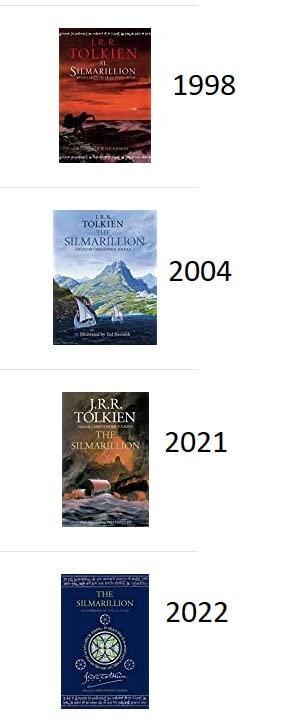
This is a review of the editions, with an image, not the text itself. If I'm wrong about anything let me know and I'll correct it.1998 edition:Cover: “Maglor casts a Silmaril …” (male throwing white gem against red background)18 illustrations by Ted NasmithReadable, nice, can be found around $20-$30 used. Crazy that this edition is almost 35 years old.Art:1. The Sea2. The Lamp of the Valar3. At Lake Cuiviénen4. The Light of Valinor on the Western Sea5. Fingolfin Leads the Host across the Helcaraxe6. The First Dawn of the Sun7. Maedhros's Rescue from Thangorodrim8. Eöl Welcomes Aredhel9. Felagund among Beor's Men10. By Moonlight in Neldoreth Forest11. Lúthien Escapes upon Huan12. Morgoth Punishes Húrin13. Túrin and his Band are Led to Amon Radh14. Finduilas is Led past Túrin at the Sack of Nargothrond15. Ulmo Appears before Tor16. Eärendil the Mariner17. The Eagles of Manwe18. The Ships of the FaithfulFront over: Maglor Casts a Silmaril into the SeaBack cover: Beren and Luthien are carried to Safety2004 edition:Cover: “White Ships of Valinor” (white boats sailing in fair weather, island in background)45 illustrations by Ted NasmithGlossy paper, which can be a positive or negative I guessCan be found around $25 new, which is a DEAL. This is mine for reading without fear of damaging a collector’s item.Art:1. The Sea2. The Lamp of the Valar3. Aule Prepares to Destroy His Children4. At Lake Cuiviénen5. The Light of Valinor on the Western Sea6. The Ships of the Teleri Drawn by Swans7. The Kinslaying at Alqualonde8. Fingolfin Leads the Host across the Helcaraxe9. The First Dawn of the Sun10. The Burning of the Ships11. Maedhros' Rescue from Thangorodrim12. The Gates of Sirion13. Eöl Welcomes Aredhel14. Eöl is Led to the Walls15. Felagund among Beor's Men16. Fingolfin's Wrath17. The Orc-Host is Ambushed in Brethil18. Tarn Aeluin19. By Moonlight in Neldoreth Forest20. Lúthien Escapes upon Huan21. Transformed22. Beren and Lúthien are Carried to Safety23. Huan's Leap24. Morgoth Punishes Húrin25. The Hill of Slain26. Saeros' Fatal Leap27. Túrin and his Band are Led to Amon Rûdh28. Beleg is Slain29. Túrin Bears Gwindor to Safety30. Finduilas is Led past Túrin at the Sack of Nargothrond31. Túrin Reaches the Abandoned Homestead32. Up the Rainy Stair33. Húrin Finds Morwen34. Tuor Follows the Swans to Vinyamar35. Ulmo Appears before Tuor36. Tuor and Voronwe see Turin at the Pools of Ivrin37. The Escape from Gondolin38. Maglor Casts a Silmaril into the Sea39. Earendil the Mariner40. White Ships from Valinor41. The Eagles of Manwe42. Tar-Miriel and the Great Wave43. The Ships of the Faithful44. The Forging of the One45. The White Tree2021 edition:Cover: “Ships of the Faithful” ship sailing amidst storm/red sky49 illustrations by Ted NasmithCan be found closer to $40Regular flat paper, not glossy. More standard book-shaped, whereas the 2004 version is more square, like a coffee table book. Mine was used and did NOT include a fold-out map, but the colorized Christopher Tolkien Beleriand map is in the front plate and endplate (inside the cover, both ends).Art:1. The Sea2. The Lamp of the Valar3. Aule Prepares to Destroy His Children4. At Lake Cuiviénen5. The Light of Valinor on the Western Sea6. The Ships of the Teleri Drawn by Swans7. The Kinslaying at Alqualonde8. Fingolfin Leads the Host across the Helcaraxe9. The First Dawn of the Sun10. The Burning of the Ships11. Maedhros' Rescue from Thangorodrim12. The Gates of Sirion13. Eöl Welcomes Aredhel14. Eöl is Led to the Walls15. Felagund among Beor's Men16. Fingolfin's Wrath17. Turgon at Fingolfin's Cairn18. The Orc-Host is Ambushed in Brethil19. At Tarn Aeluin20. By Moonlight in Neldoreth Forest21. Lúthien Escapes upon Huan22. Transformed23. Beren and Lúthien are Carried to Safety24. Huan's Leap25. Lúthien at Tol Galen26. Morgoth Punishes Húrin27. The Hill of Slain28. Saeros' Fatal Leap29. Túrin and his Band are Led to Amon Rûdh30. Beleg is Slain31. Túrin Bears Gwindor to Safety32. Finduilas is Led past Túrin at the Sack of Nargothrond33. Túrin Reaches the Abandoned Homestead34. Up the Rainy Stair35. The Slaying of Glaurung36. Húrin Finds Morwen37. Tuor Follows the Swans to Vinyamar38. Ulmo Appears before Tuor39. Tuor and Voronwe see Türin at the Pools of Ivrin40. The Escape from Gondolin41. Eärendil Searches Tirion42. Maglor Casts a Silmaril into the Sea43. Eärendil the Mariner44. White Ships from Valinor45. The Eagles of Manwe46. Tar-Miriel and the Great Wave47. The Ships of the Faithful48. The Forging of the One49. The White Tree2022 edition:Blue cover with circular design59 illustrations by Tolkien himself – BUT more than half of these are “devices,” neat little square symbols at the start of a chapter and so on—not big full color paintings or drawings.Around $40. Be aware, Tolkien’s artwork consists more of drawings and sketches with limited color. They are not the epic Ted Nasmith paintings you see in others. If you value his quaint older sketches, these are gre...
The fold-out map of Beleriand is a nice bonus.
Good read
Martin Shaw does a great narration. Feels like the weight of time is intensified from the cadence.
this particular edition makes a great keepsake, with fantastic illustrations by Ted Naismith. Just don't make it a wereguild to be handed down to your descendants like Isildur would've done -to say nothing of how Feanor would've hoarded it!
Super genial muy bello
This is a wonderful overview of the history of Middle Earth. I love Tolkien’s poetic writing. I will suggest reading with a group so fine points can be discussed. Also take notes on characters so you can remember who people are in their family lines. And who the Valar and Maiar are.
Amazing in how it underscores vanity and hubris to be the main impetus for once good beings falling from grace and resorting to villanious behavior and how such characters pander to the anger of constituents to secure succor in one's own selfish agenda. Many a subsequent fantasy and action story takes inspiration form this tale. That being said, with the obscure names and sophisticated writing style, reading this work comes with the same level of difficulty as does James Joyce's "Ulysses".
I must have read this book about summer 2000 for the first time. At that time, it had been so engrossing that I was reading it while in the army on quite moments when I could read. Whenever we had to wait or something, I would just read this book.Now, after almost 25 years, I have read it a second time. And I must say, I still really liked it a lot. I have read that people were disappointed when it was first published in 1977 because they had expected a second Lord of the Rings. It is not. Sometimes, I would describe it as a history book. It is not this either.J.R.R. Tolkien had had foremost an interest in creating legends and this is exactly what this book is. He had actually started to write parts of it in 1917 or so. At that time, he had had the idea of publishing a book called “The Lost Tales”, where some legendary stories would be told to an Anglo-Saxon castaway ship-wrecked on a Western Isle by an Elf he had encountered there. The three stories of Beren und Lúthien, of the Children of Húrin and of the Fall of Gondolin among others were slated to be in this book. Later, he had developed the idea of combining these stories into a whole legendarium, among others called the Silmarillion. Unfortunately, he never managed to finish this work.He would thus on and off work on this work, which would be, once finished, his magnum opus. He would finish short sketches of it, but never got around of finishing the whole thing. In the meanwhile, he had published other works, among others, “The Hobbit”. His publishers wanted a sequel to “The Hobbit”, and J.R.R. suggested the Silmarillion. The publishers politely declined. Consequently, J.R.R. Tolkien wrote “The Lord of the Rings”. Once that had been finished, 40 odd years had passed since J.R.R. Tolkien had started on these legends. I can imagine that he had now other things on his mind, still he apparently kept working on it on and off again up to his death.In the end, it was up to his son Christopher Tolkien to publish the work. To do that, he had to work as editor and, as not few would say, as author. The result of these labors is this book. Christopher Tolkien later on to counter these critiques published all the materials of his father concerning Middle-earth in a 12-volume set of books called “The History of Middle-earth”. As few people will probably read all these 12 books, Christopher Tolkien then also published three books just with the material for the three main stories. Incidentally, I have read to of these three books while reading this book. Today, I have now also finished this one.And, again, it is just astounding. In it, J.R.R. Tolkien thus developed legends, from the creation of the world, over the creation of three Silmarils by Fëanor, the exile of the Noldor, the siege of Angband, the three main stories of course and several battles until Melkor is overcome by the Valar. Not to stop there, we also have here the legend of Númenor, later also called Atalantë by the Elves, where the kings of Men and their people are allowed to live long lives in sight of Tol Eressëa. However, not contempt with being mortal, they eventually turn against the Valar. Spurned on by Sauron, they set out to conquer Valinor, only for their fleet and their island to be directly submerged under water by the Valar. Some few-remaining Elf-fiends have survived and they settle and found in Arnor in Eriador and Gondor further south. Eventually, they make an alliance with the Elves to fight Sauron and his men, which leads directly into the story of “The Lord of the Rings”. The last pages, before Index and Appendix, then indeed summarize “The Lord of the Rings”.I can thus only recommend this book to anybody who has read and loves “The Lord of the Rings” and wants to know more about this world. This book does indeed give the whole story of Middle-earth.
Read the Hobbit? Isn’t it great?Read the Lord of the Rings? Isn’t it awesome (in the true sense of the word)?Answer yes to the two above questions, and you may be ready to embark upon this third volume of the Legendarium.I say “may,” and I promise I’m not trying to be condescending; but “may” is the word.First, the content:This has been elucidated by many others on this review page, so I won’t say too much. Suffice to say that this is the tale of the First Age, from the creation of the world until the final defeat of the Elder Evil, Melkor, called by the Noldor “Morgoth.”The beginnings of all races (save hobbits, more on that later), and the days when “gods” walked the Earth; great tales of heroism and tragedy; epic battles and terrible deeds that echo down through the millennia. It’s all here, and written in prose that will appeal especially to fans of classical literature (from the ancient Greeks, to Rome, to Anglo-Saxons and Finns, with a dash of the ancient books of the Bible and Gilgamesh thrown in).Now, to the “may:” this is not an easy read. It is dense, it is complicated, there are names and events and concepts that will find you flipping to the index/glossary to try to remind yourself what happened and when. Partially, this is by virtue of it being an edited work. At Tolkien’s death, this remained unfinished. Christopher Tolkien, his son, one of the original draft readers of LOTR, compiled the Silmarillion over the course of four years (?) and put it into the form you see here. But this was always a version of the form it would take. It was always going to be dense and was always going to require attention and focus. This, more either the Hobbit or Lord of the Rings, is what Tolkien the philologist wrote.It is, in short, history, rather than fantasy. It is more like reading a history book than a fantasy book.The Hobbit was a children’s novel, the Lord of the Rings was a “romance” (Tolkien’s word), while this is a historical chronicle.It is also epic, deeply moving, fascinating, and very rewarding.There are no hobbits in this story. I know, I’m as disappointed as you, but hobbits are a stand in for modern humans, and, unfortunately, during the time when the elves and the elder houses of Man we’re battling with the ultimate evil bent on destroying and enslaving the world, we didn’t rate any attention. We were just smoking tobacco and growing root vegetables.Try it out. If it’s too much, set it aside and try it again later.If you want more (read, if you’re weird like me and the rest of us singing its praises), there’s more. Oh, Lordy is there more.PS: I also highly recommend the Letters of Tolkien, compiled by Humphrey Carpenter. Lots of goodies and background, and fascinating insight into the mind of the man.
Apropos of a new TV show whose name I have forgotten, I decided to read the Silmarillion in order to have better grounds to watch it. I have forgotten about the TV show and now I am devouring more and more of the lore by Tolkien. That good and addictive is his art. Maybe you already know what the Silmarillion is about: the genesis of what will be Middle Earth, the angelic powers of Arda, the world, and how elves got to be children of the stars, and afterwards men would be the children of the Sun, until the fall of Númenor and ending in the Rings of Power.Borges said that although publicly Shakespeare is the venerated national author of England, secretely their classic book is the Bible. Reading Tolkien's Silmarillion I feel that way, as it harmonizes... unconsciously? with his identity of both Catholic and an Englishman. There is the English tradition of seas, the stories sometimes as tragic as Job and so hopeful as Genesis, there are the languages as Quenya and Sindarin mutating and diverging and creating poetries with their own music. I believe a theologist said that the cross is the salvation from the labyrinth of the circle, and the fall in the Silmarillion feels like falling in that labyrinth, and makes you wish for the straight line to the real West. It is not in the nose, it is not Tolkien's intention, is how I feel after reading it. Is this a successful book according to the goals of Tolkien? I think yes, he makes a whole palace from his thought in the way the Ainur are inspired to make a symphony. This world is quite real that almost could feel as the true past turned mythology. Not in the artificial way that some modern writers do for shock value; it feels true. Being quite picky, or maybe a petty dwarf, I'd say the only aspect I would criticize, and maybe there is an explanation, is normal humans imposing their will and ideas over elves with centuries and even thousands of years of life. This is a fantastic reading and I will be happy when I get to read The Lord of the Rings.
The Silmarillion needs no recommendation to fans of Tolkien. And those who are not fans are rarely going to consider purchasing it. But I found its beginning to contain some of the most imaginative theodicy in modern prose.Theodicy is concerned with explaining the problem of evil and suffering. If God is all good and all powerful, why does he allow so much suffering in his creatures? Though having an ancient history, its modern formulation is due to the celebrated mathematician and philosopher Leibniz who introduced the term and wrote his own theodicy. He was soon followed by the mocking parody of Candide by Voltaire.One answer to this question is that God gave men free will to use for good or evil. But this doesn’t explain those evils that come from nature. Nor is it particularly comforting to someone who is undergoing real and powerful pain.The beginning of the Silmarillion contains Tolkien’s mythological theodicy. In this version, God and the demigods all gather to listen to the Creator sing a song of incredible beauty.The most powerful of the demigods then introduces his own song, resulting in disharmony. But the Creator and the good demigods craft a new theme that uses the notes played by evil and encompasses them in something even greater than the first.While the evil demigods play their themes loudly and repeatedly, God takes up all this discord and crafts a final song that is all the greater for the cacophony they crafted. This final song then becomes the physical universe.This is the epitome of the Christian answer. Why does God allow suffering? Somehow, in a way we do not understand, all of this suffering is going to result in a cosmos even greater than if there was no such thing as pain. Just as the cross is the epitome of evil and yet led to the greatest of all good, so too will all the many sufferings creation has endured. It is a message that gives meaning to suffering and the sufferer in a way that atheism and agnosticism simply cannot.Whether there is any truth to this in our real, physical cosmos is another question. But it is an articulation greater than the rationalism of Leibniz; it is also greater than the power of Voltaire’s mockery. It remains at the core of the beliefs of untold numbers throughout this world. Hopefully, someday Tolkien’s articulation of this mythopoetic vision will receive the attention it deserves.
What an absolute master.I read the first 80 pages or so of this book from June of last year to April of this one. I then read the next 300 pages in the last seven days. I absolutely could not put it down. While it is true that portions of this book are dull, dense, or wordy, I do not think these were reasons why it took me so long to get through the beginning. Rather, because of my perception of the book I attempted to read this book little by little as a side endeavor to my main reading. This was a mistake. I am not someone who can offer half-baked concentration to a book, and The Silmarillion is a book which demands one's full attention. But I want to make one thing clear about this book, because it has a pretty heavy reputation (as was made immediately clear whenever I brought up the fact that I was reading it). The Silmarillion is a must read. Yes there are a thousand names and sometimes it's slow and on occasion it feels like you're reading an encyclopedia of mythology. Those things aren't untrue, but they do not encompass this story. Understand that these things are (in my opinion) overblown, and beyond them is a vast reward.If you are a fan of Tolkien's world you simply must read it. I can say nothing--offer no praise--in this review that has not already been heaped upon Tolkien a million times over; but he deserves it. I have never (not after reading The Hobbit, not after reading Lord of the Rings, both of which I love), ever been as enthusiastic about Tolkien's world as I am right now having just finished this book. It is an absolute masterwork. It is the most fully realized world I have ever had the pleasure to read, and was built by an absolute master of the craft. I know that people sometimes bounce off the language, as it comes off archaic, but what a disservice you are doing yourself! Tolkien is a linguist, and thus he comes at his creations from the very heart of things; the very origin of the workings of our thoughts and mind. He builds languages and worlds pour forth. He even commented in a letter to his editor that he felt that these stories were not merely inventions, but something that was being channeled through him. "...yet always I had the sense of recording what was already ‘there’, somewhere: not of ‘inventing’." The skill of his writing simply can't be understated. I mean, I could read the man's grocery list and be happy. There is a reason a book of his letters was published (and I'll definitely be reading it). Reading it after Lord of the Rings is the way do it I think, because it adds so much to it when you eventually circle back around. LotR throws around names and places and events that intrigue and astound, and ignite the fires of mystery within the reader. The Silmarillion fans those flames, and shows you how the fire was built. So I say again: if you are a fan of deep, realized worlds and expert writing, what are you waiting for?But beyond his technical skill The Silmarillion is a veritable gold-mine for fans of Fantasy (and obviously fans of the Lord of the Rings). Tolkien takes those tantalizingly mysterious legends of the Third Age and weaves them into a complex and nuanced tapestry of mythic, tragic tales. This is the story of the First Age (and less so the Second and Third). The story of Arda. Stories of Iluvatar and the Valar and Maia. Of Melkor, later Morgoth. Of the Eldar and the Silmarils. Of the first Men. Of the Numenorean kings. Of oaths broken and oaths fulfilled. Tolkien crafts an entire mythos full of beauty and wonder. Full of grand deeds and creations. Full of love. But also full of corruption and hate; avarice and war. He is truly a weaver of myth and legend, and it is no wonder his work is still being read all these years later. In the Lord of the Rings one has the tangible sense that there is an entire world stalking the shadows behind this story. In The Silmarillion, that sense is proved true. Bravo.
WARNING: SOME SPOILERSI first read Lord of the Rings when I was ten years old. Since then I've been a passionate fan, reading the books multiple times throughout the years. When I was eighteen, I tried to read the Silmarillion; it took a few tries, but I finally got past the rather heavy, slow beginning and had reached the part where Morgoth and Ungoliant escape from Valinor with the Silmarils. Then I lost the book and couldn't find it for a long time. By the time I did find it, I had forgotten a lot of what I'd read and couldn't seem to get back into it. So I put it aside, and the book was lost during a move.I did purchase The Children of Hurin, which I loved and have read several times.But I finally read The Silmarillion last month and now I'm like, why in the WORLD did I wait so long? This book is seriously epic. Even the beginning, slow as it is, is pure poetic prose. The names are magic. And so much that I hardly noticed in LotR, because I didn't understand it, makes sense now. Beren and Luthien: it's so much more than just a love story (and there's a heroic dog, too!). Earendil: I always had a hard time reading through Bilbo's song about Earendil because it was so long and didn't seem to make a lot of sense. Now that I know who he was and why he built the ship and journeyed through perilous waters, I love the poem and the story behind it.And elves! By the time of LotR they are fading; you only get glimpses of who they really are or were. In The Silmarillion, they are full-on amazing. Tragic, stubborn, bull-headed, valiant, so many words to describe them. The human characters are awesome too. Hurin isn't just Turin's father; he is a mighty warrior in his own right, and faces Morgoth down and mocks him (with tragic consequences, unfortunately).This stuff is epic in every sense of the word.When I finished reading, I was reeling a bit from all the feelings it gave me. It was almost like experiencing Lord of the Rings for the first time, just this time I was older and able to appreciate it even more.This is absolute poetry from someone who knew just the right way to make every word sound like music. It's also an amazing epic from a man who had some kind of crazy busy imagination.The Akallabeth is epic too, but it's much more condensed and doesn't have the same weighty feeling of ancient history (though it too takes place long before LotR). It's valuable, though, because in it we learn about the Men of the West, where Elendil and Isildur came from, and also we see the first rise of Sauron after his own master's defeat. The Akallabeth has basically no elves; this is a story of men, of the rise and then terrible fall of the Numenoreans. I can't say that I enjoyed it as much as The Silmarillion; but of course it would be hard to top that!In conclusion, I'm so glad that I read this at last; and though I sort of wish I'd read it sooner, the first-time experience of reading it was so amazing that I'm glad it was recent, as it still lingers in my mind. Go out and buy a copy of it, if you enjoyed Lord of the Rings. Persevere through those first chapters of set-up, and the payoff will be worth it. I promise.
There are no Hobbits in J. R. R. Tolkien's Silmarilion. This may appear to be a trivial observation but it is an observation worth considering when reading Tolkien's works. Tolkien, it seems, wrote in two styles. He had a "low" style that he used in The Hobbit. This was a familiar, wryly humorous style, perhaps too deliberately written for children in places to be entirely successful as a children's story. The other style is a grand, epic style, more suited for the affairs of kings, elves and great battles. The Lord of the Rings was a mixture of these two styles. It began in much the same style as The Hobbit, but as the story became more serious and the danger of the Ring and its pursuers more acute, the style became darker and more serious to match. By The Return of the King, with its tale of the great War of the Ring, the style became almost entirely, but not quite, the grand style. There were always the hobbits to return the story to a more down to earth level.The Silmarilion is written entirely in the grand style. The stories are epic tales of gods, elves and men fighting against the first, and far mightier, dark lord Morgoth. There is little room for the sort of humble details of everyday life found in The Hobbit or the Lord of the Rings. The characters are all kings and heroes of ancient times, not humble gardeners. This is not to say that The Silmarilion is not a good book to read. It is an excellent book, and Tolkien is, in his way, comparable to the great composers of national epics like Homer or Vergil. That was indeed his intention when he began writing these stories of the Elder Days and to some extent he did succeed.There are actually five parts to the Silmarilion. The first part is called the Ainulindale and tells of the creation of the world by Eru, the One, who the Elves call Illuvatar. Illuvatar first creates the angelic powers or Ainur, and teaches them to sing to a melody He has made. This song was a vision of the world and many of the Ainur longed to dwell in that world so Illuvatar created it and sent the Ainur, or Valar to complete the work of creating and ordering the world. This they did against the opposition of Melkor, the mightiest of the Valar, and one who sought to rule the world for himself.The next section is called the Valaquenta, is simply a list of the chiefs of the Valar and their names, and attributes. There is not a narrative here, but it is useful to read it as a guide for laterThe middle and longest section is the Quenta Silmarilion, or the Silmarion proper. This is the epic story of the Elves in the First Age of Middle Earth. The Silmarilion tells of the awakening of the Elves in the dark times when Melkor ruled Middle Earth. The Valar go to war against Melkor to save the Elves and he is defeated and imprisoned. TheValar then offer to take the Elves to their home, Valinor, far in the West. Many Elves agree to make the long journey and are named the Eldar. Many others prefer to stay in Middle East and call themselves the Avari.The Eldar travel to Valinor and become mighty in lore and power. The most skilled of all the Elves is Feanor and his greatest work is the three jewels, the Silmarils in which he captured the light of the Two Trees of old. After a time Melkor feigns repentance and is released. He poisons the Two Trees, steals the Silmarils and flees to his stronghold in Middle Earth. Against the will of the Valar, Feanor leads his clan, the Noldor in pursuit of Melkor, who he has renamed Morgoth, the Black Enemy. Feanor is slain but the Noldor and their allies among Elves and the new race of Men continue the war. They fight bravely against Morgoth and managed to confine him to his stronghold for many years, but in the end, their war is hopeless. Morgoth has hosts of Orcs, troll, Balrogs and dragons and is himself a Valar, one of the mightiest beings in the world. The Elves and their allies are utterly defeated only the intervention of the Valar prevents Morgoth from ruling forever. Morgoth is defeated and the Silmarils are lost. Much of Middle Earth is damaged beyond repair and the Western lands where the Noldor fought and died is submerged beneath the sea.The Akallabeth tells of the history of Numenor, the island that the Valar gave to the Men who fought on the side of the Elves. (Most Men sided with Morgoth). The Numenoreans were given a life span beyond any of the Men of Middle Earth though they were not immortal and could not travel to Valinor. Over time, the Numenoreans grew increasingly jealous of the immortality of the Elves and since they could not make themselves immortal, they began to seek for wealth and dominion in Middle Earth. The last king of Numenor, Ar-Pharazon challenged Sauron, the servant of Morgoth, for the rule of Middle Earth, actually defeated him, and carried him back to Numenor as a hostage. Sauron quickly gained the confidence of Ar-Pharazon, and preying on the old king's fear of death, induced him to assault the Valar and wrest i...

