

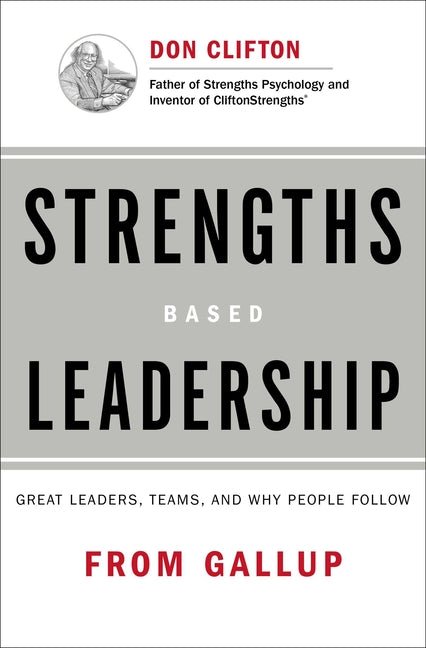
Strengths Based Leadership: Great Leaders, Teams, and Why People Follow
by Gallup
Couldn't load pickup availability
From Gallup: a landmark study of great leaders, teams and the reasons why people follow.
More than a decade ago, Gallup unveiled the results of a landmark 30-year research project that ignited a global conversation on the topic of strengths. Since then, more than 23 million people have taken Gallup’s CliftonStrengths (formerly StrengthsFinder) assessment, which forms the core of several books on this topic, including the #1 international bestseller StrengthsFinder 2.0.
In recent years, while continuing to learn more about strengths, Gallup scientists have also been examining decades of data on the topic of leadership. They studied more than 1 million work teams, conducted more than 20,000 in-depth interviews with leaders, and even interviewed more than 10,000 followers around the world to ask exactly why they followed the most important leader in their life.
Gallup reveals the results of this research in Strengths Based Leadership. Based on Gallup’s discoveries, the book identifies three keys to being a more effective leader: knowing your strengths and investing in others’ strengths, getting people with the right strengths on your team, and understanding and meeting the four basic needs of those who look to you for leadership.
As you read Strengths Based Leadership, you’ll hear firsthand accounts from some of the most successful organizational leaders in recent history, from the founder of Teach For America to the president of The Ritz-Carlton, as they discuss how their unique strengths have driven their success. Filled with novel research and actionable ideas, Strengths Based Leadership will give you a new road map for leading people toward a better future.
Share
Book Details
- ISBN
- 1595620257
- Binding
- Hardcover
- Authors
- Gallup
- Publisher
- Gallup Press
- Published Date
- January 6, 2009
- Language
- English
- Pages
- 288
- Physical Info
- 1.25 in H x 8.6 in L x 5.5 in W (1.0 lb)
The Kindle version didn't come with a code to take the online test. Given that, it's really expensive for the minimal content. It's just four stories of CEOs who have different strength domains, then an extensive list of suggestions of how to lead people based on your strengths or theirs. Not worth the money.
Purchased this book for a class. Easy to read and understand!!
Tom Rath and Barry Conchie's 'Strengths Based Leadership' is a transformative book that offers profound insights into leadership and team dynamics. This book builds on the strengths-based approach popularized by Gallup, focusing on identifying and leveraging individuals' strengths to drive leadership success. What sets this book apart is its emphasis on the unique qualities that make great leaders, rather than trying to fix weaknesses. Rath and Conchie provide compelling research and real-world examples to illustrate how leaders can maximize their own strengths and those of their team members to achieve exceptional results. I found the concept of 'StrengthsFinder' particularly enlightening; it helps readers discover their top strengths and understand how to apply them effectively in leadership roles. The book is well-organized, with practical advice and actionable strategies that leaders can implement immediately. Whether you're a new leader looking to understand your leadership style or a seasoned executive seeking to enhance team performance, 'Strengths Based Leadership' offers valuable insights and tools to inspire and empower. I highly recommend this book to anyone interested in developing a strengths-based approach to leadership."This review highlights the book's strengths-based approach to leadership, practical insights backed by research, clarity in presentation, and its potential to transform leadership styles and team dynamics, making it essential reading for anyone in a leadership position or aspiring to lead effectively.
If you're a fan of strength-based leadership and development and have used Gallup's StrengthsFinder, this is a great read. Pay attention to the details and avoid skimming through too quickly. Some chapters contain a lot of valuable information for your own development and that of your teams.
According to the contents of the Kindle ebook, the access to the assessment "will be provided by retailer." According to other reviews, this should be provided via an email that contains the access code. I didn't receive any such email. Checked spam, trash, and every single email since the order. Nothing.
- 5 stars: 7 (35%)
- 4 stars: 9 (45%)
- 3 stars: 2 (10%)
- 2 stars: 2 (10%)
- 1 star: 0 (0%)
The Kindle version didn't come with a code to take the online test. Given that, it's really expensive for the minimal content. It's just four stories of CEOs who have different strength domains, then an extensive list of suggestions of how to lead people based on your strengths or theirs. Not worth the money.
Purchased this book for a class. Easy to read and understand!!
Tom Rath and Barry Conchie's 'Strengths Based Leadership' is a transformative book that offers profound insights into leadership and team dynamics. This book builds on the strengths-based approach popularized by Gallup, focusing on identifying and leveraging individuals' strengths to drive leadership success. What sets this book apart is its emphasis on the unique qualities that make great leaders, rather than trying to fix weaknesses. Rath and Conchie provide compelling research and real-world examples to illustrate how leaders can maximize their own strengths and those of their team members to achieve exceptional results. I found the concept of 'StrengthsFinder' particularly enlightening; it helps readers discover their top strengths and understand how to apply them effectively in leadership roles. The book is well-organized, with practical advice and actionable strategies that leaders can implement immediately. Whether you're a new leader looking to understand your leadership style or a seasoned executive seeking to enhance team performance, 'Strengths Based Leadership' offers valuable insights and tools to inspire and empower. I highly recommend this book to anyone interested in developing a strengths-based approach to leadership."This review highlights the book's strengths-based approach to leadership, practical insights backed by research, clarity in presentation, and its potential to transform leadership styles and team dynamics, making it essential reading for anyone in a leadership position or aspiring to lead effectively.
If you're a fan of strength-based leadership and development and have used Gallup's StrengthsFinder, this is a great read. Pay attention to the details and avoid skimming through too quickly. Some chapters contain a lot of valuable information for your own development and that of your teams.
According to the contents of the Kindle ebook, the access to the assessment "will be provided by retailer." According to other reviews, this should be provided via an email that contains the access code. I didn't receive any such email. Checked spam, trash, and every single email since the order. Nothing.
Book did not come with access code.
I am a power user for years of the Strengths method in my work in higher education. Bought this on Kindle and enjoyed the material … but a lot of it was reused from other books and resources from Gallup and CSF so I was disappointed in that. The how to manage people with this Strength write ups at the end were nice but far too short.
There are plenty of reviews on the book proper, but I'm specifically leaving this to help people like me make the most out of it as a textbook.I bought this for a class and we were required to get a new book for the code for the strengthsfinder assessment. If you're like me, you ordered the Kindle version and didn't realize that the code came in an Amazon promotional email right after the order! Look for the "Here's your promotional credit from your recent Amazon order" email after you purchase to find the access code for the assessment. Remember, you can only use it once!
This was super confusing for me, so I thought I'd share. Even Amazon support doesn't know how this works. They told me that I needed to buy the hardcopy or paperback or contact the publisher. The book says that the e-book retailer will provide the code. I started sensing a wild goose chase was ensuing.The code is sent in a separate email almost immediately after you get your confirmation of the kindle purchase. The email will be from Amazon directly and the subject of the email will be "Here's your promotional credit from your recent Amazon order".I'd trashed mine, and couldn't actually find it without searching on my iPhone. I hope this helps someone else who like me, paid more for the kindle version than the others. :PThey should update the details of this product with more specific instructions on what to expect for the e-version.Bottom line, you do get a code with the Kindle version and it comes in a separate email.
I have purchased almost 150 of these books in the last 5 years. I was introduced to the Gallup Strengths series and the Strengths Finder assessment about 7 years ago and I greatly appreciate the value it adds to my professional and personal life.I lead a group of 40+ employees and the Strength Finder assessment in this book in an invaluable management tool for us. Every employee that joins our team takes the assessment during their first month of their employment. After we have them meet with those that supervise them and go over the areas that jump out at them as something that will help them succeed in their new role or things they think it is important that their supervisor know about them. Time and time again we have found that these things we learn the first month we work with someone turn out to be the most important characteristics or work traits of that individual. When we take the time to understand someone's strengths up front and how that fits into our existing team we get a great jump start on helping our new employees be successful.I will continue to purchase these for all my new employees as well as for gifts for clients and friends. It is a great tool in my life and the more I use it - the more I learn about it.
Before I get into the review, a word of advice to all potential buyers: Unless you have already taken a StrengthsFinder quiz and know your dominant themes, you must buy this book new. A new book comes with an exclusive one-time access code in the back that unlocks an online survey. Your unique survey results will then calculate what your strengths are, so that you can get the most value out of Strengths Based Leadership.Research demonstrates that people tend not to utilize their natural talents, leading to frustration. Even more, most people also tend not the scale their strengths, but instead focus on scrutinizing their weaknesses. This book makes the case that the best leaders are not, in fact, well-rounded, but maximize their innate gifts with an acute awareness of who they are and the needs of those they lead. This book provides a general framework for effective leadership and helps you identify what your strengths are.Strengths Based Leadership is the “executive version” of the acclaimed StrengthsFinder 2.0. Both books use the same formula to compute your strengths: by taking a 177-question online assessment. Your “grade” on this test computes your top five themes which you can then read about amongst the 34 themes described in this book.What Strengths Based Leadership does very well is introduce you to the real leader in you and not the version of a leader formed in the image of popular culture. This book provides tailored, specific and actionable advice on how you can lead in all areas of life. Ultimately, Strengths Based Leadership will likely be a go-to resource well into the future.
First, on the overall content of book itself, there is marginally more or different information than in the strengths 2.0. Same exact test/assessment with a few more insights and possibly suggestions if you can really call them that.I was unimpressed with their basic assumptions, methodology and general categorizations; especially when compared with other personality, talents and strengths materials and assessments. This was by far the weakest and most inaccurate of any I've experienced or reviewed over the past 25 years.I do fully understand the reasoning behind creating a timed test; and, as a general rule for most people it is probably okay. However, the fact that it is merely 20 seconds per question or it just skips over them, leaves a lot of unanswered questions. They even mention in their FAQ's they don't want to have time to think or process. The problem is that quite often, their is hardly enough time to read the question and even process the words before you just have to check any answer.Additionally, many of the pairs truly have no correlation and are non-sensical thereby taking more time to process in the brain. But again with only 20 seconds, it gives no processing time at all. And, it makes the assumption that all things are either black or white/one way or another rather than relative or contextual to situations. As such, they do not believe anyone can be well-rounded (this is in their FAQ's explanation) which is why they make no allowances for such things as mentioned.They would argue that people have a natural inclination toward one direction which is why they do not count neutral answers. However, most answers could be neutral because 1)they use completely unrelated things that truly make no sense in the brain when processing, 2 many can be strongly both (yes both, contrary to their state assumptions) or 3) "strongly neither" (again contrary to their assumptions). Since they assume people are not well-rounded (their words), they make no accomodations for such.So, for myself, most answers were not counted leaving only a small sampling of answers for comparison to strengths. These are reasons that I believe led to results that were no where close to accurate. The only reason I gave it a 2 star rather than a 1 star is that they did get in a general direction with a few things and I would put the strengths in their results in my top 15. But, the top 5, wow, were they really off base with 3-4 of them. I know quite well both my strengths and weaknesses and have taken multiple assessments over the years and done much self-development and introspection. They might argue I just was not aware or might be denying my natural tendencies and traits but that really would not be accurate.The trend I noticed with this test is that it is geared/designed rather generally toward the average worker in an organization rather than any type of true entrepreneur or renaissance persons who are multi-talented with many strong dominant traits that would not merely be limited to 5. For such individuals, they are extremely strong in many areas with many strengths and talents which would thereby create more than a top 5 but top 10 with many traits scoring equally.Another real criticism is that only focuses on one state of being with regard to your strengths. It does not account for situational, contextual nor a comparison with your adapted styles.I believe this to be a true flaw in the overall results. Yes, I 100% agree it's more important to know your strengths & talents and to focus on those. However, there is validity in knowing and acknowledging your weaknesses so that (especially as an entrepreneur or business owner) you can outsource or hire out those areas which are not your strengths. We need to do more of our brilliance and hire others to do their brilliance. If however, you focus only on strengths to the exclusion of awareness of weaknesses, they do not disappear simply because they choose not to see them. We must see the entire picture and create strategies based around information.Now, in reviewing their new Entrepreneurial Strengths Finder test, the general consensus even with those who reviewed it somewhat high, is that it is very generic in their questioning with no consideration for contextual answers, but way too right/wrong in their descriptions of the final results and does not really give any real insights. Thus, it is rather pointless and not worth the time.Honestly, if you want a better reflection of your strengths and overall weaknesses, the best assessment over the years with the most accurate results for people across the board is the DISC profile. My favorite person who uses these assessments for both job-based people as well as those who are business owners is Dan Miller at 48Days. He even has an all inclusive set of DISC that includes the basic, the sales profile and the talents profile (based on christian principles) so one gets a well-rounded viewpoint.
Define lay worth a read but the one caution is that while the tool descriptors are largely helpful, the workplace application recommendations seemed simplistic and not really realistic (but you don't need the book for that - you know what your company needs). Also, some commentary, while well intended was a bit dangerous (like with Achievers who perform well that you may not want to promote them but rather, give them more work they are interested in. The key word is "May" but unless you really understand this tool, a reader might interpret that you shouldn't promote Achievers to managerial positions which is not the intent. This happened a lot in the book and I kept having urges to edit it, to set the intended record straight. Still it is a good book and I would recommend it, but just be aware of these watch-out limitations
Following in a long line of Strengths focused texts, Rath and Conchie’s Strengths Based Leadership is a concise guide to how leaders and teams can best leverage their individual and combined strengths to effectively operate an organization. Based on the research of Donald O. Clifton, Ph.D., the text and its associated Strengths Finder poll code allow the purchaser to identify and consider personal and team strengths when making important decisions. These are further organized by larger domains that help teams understand balance and diversity of their perspective.As an educator, I have had the opportunity to work with the strengths framework both in the teaching and leadership contexts as well as to teach students that took the connected Strengths Explorer poll. As a result, I frequently find myself revisiting sections of the text as it reads well both from an overview of strengths as well as a reference tool. In fact, the latter half of the text is largely devoted to tips on leading with…(complete with one of the 34 strengths).Published in 2009, a few of the introductory narratives about well known leaders and their strengths could use to be updated, but sections on how to maximize your team and understand why people follow leaders continue to be relevant and amongst this book's most valuable elements. In fact, the previously mentioned “leading with…” section is organized firstly by the strengths, but also by four broad criteria commonly identified for why people follow a leader.I would certainly recommend Strengths Based Leadership and continue to use it both when developing strong, cohesive teams, and as a valuable tool in framing not only my or my team’s strengths when making decisions, but also in understanding how those with other strengths (particularly those not represented in the team's "top 5" might view decisions and how best to engage their strengths and talents to support the organization.
I'll be honest... I really don't remember much at all about what's in this book. The main takeaway I remember is to try and play to people's strengths, rather than trying to shore up their weaknesses. Generally speaking people prefer to play to their strengths anyway, so this results in better output and happier people.What I do remember thoroughly is the StrengthsFinder assessment, and comparing my results to my co-workers. I found that to be highly interesting, and fairly useful for getting a relatively quick handle on what sort of personality they all had. Of course it's not as good as working closely with them for months/years, but it's a great way to get in the right ballpark relatively quickly.I will say that I'm not convinced the assessment is actually all *that* reliable/repeatable. I took it twice about 3 months apart, and of my top 5 strengths, 2 of the original 5 were gone completely and another was downgraded significantly. The ones I related to most strongly were still present, so I don't think it's total garbage, but it's not perfect.Additionally, the test included with the book does not include any sort of ranking beyond the top 5, and it does not provide any measure of relative "magnitude" of the top 5 strengths against each other. By that I mean, are your top-5 strengths all approximately equally representative of you, or do 1 or 2 of them show through far more strongly than the others? The test does not provide this sort of information. You can have 2 people with the same exact top 5 lists (in the same order), but significantly different personalities. Consequently you kinda have to just start with the #1 strength, and slowly try to build the other 4 into your interactions, until you figure out just how strongly each of them shows through.If you like the idea of measuring people's strengths, and trying to play to people's strengths (instead of trying to shore up their weaknesses), you'll probably get value out of this. If you find "personality assessment tests" to be complete and utter hokum, you're less likely to be a fan.
Below are key excerpts from the book that I found particularly insightful:1- "Three key finding emerged from this research: 1) The most effective leaders are always investing in their strengths. 2) The most effective leaders surround themselves with the right people and then maximize their team. 3) The most effective leaders understand their followers' needs."2- "What great leaders have in common is that each truly knows his or her strengths - and can call on the right strength at the right time. This explains why there is no definitive list of characteristics that describes all leaders."3- "The Four Domains of Leadership Strength: Executing, Influencing, Relationship Building, Strategic Thinking. We have found that it serves a team to have a representation of strengths in each of these four domains...Although individuals need not be well-rounded, teams should be."4- "As you can hear int he stories of these four leaders, they have exceptional clarity about who they are - and who they are not. If any one of them had chosen to spend a lifetime trying to be "good enough" at everything, it's doubtful they would have made such an extraordinary impact. Instead, they've all been wise enough to get the right strengths on their teams, and this has set up their organizations for continuous growth. Unfortunately, very few teams are truly optimized around their strengths."5- "What strong teams have in common: 1) Conflict doesn't destroy strong teams because strong teams focus on results. 2) Strong teams prioritize what's best for the organization and then move forward. 3) Members of strong teams are as committed to their personal lives as they are to their work. 4) Strong teams embrace diversity. 5) Strong teams are magnets for talent."6- "For a team to create sustained growth, the leader must continue to invest in each person's strengths and in building better relationships among the group members."7- "...followers have a very clear picture of what they want and need from the most influential leaders in their lives: trust, compassion, stability, and hope."8- "Perhaps the ultimate test of a leader is not what you are able to do in the here and now - but instead what continues to grow long after you're gone."
This book was required for a course in my master's degree program. I was highly skeptical of a book focused solely on strengths without figuring out how to correct weaknesses, but this ended up being one of my favorite leadership books of all time. I enjoyed the case studies, the research, and the practical application and tips at the end of the book. The strengths assessment that comes with the text is pretty enlightening (but not unexpected, at least in my case) and the cost of the book is worth it for that alone. The one criticism I have is that the book doesn't tell you how to apply the use of your strengths until the very, very end, and even then it isn't part of the text itself-- it's like an appendix or epilogue. The whole book builds up to it so you're left wondering if you're going to learn anything useful to apply to your own life. This is a pretty typical formula for a self-help style book so I guess I can't criticize too much for that. Otherwise, this is a quick and worthwhile read and you will definitely learn a lot about yourself and others.
If you want an honest and direct approach to leadership, Rath and Conchie will give it to you, along with solid proof of its effectiveness. Before reading this book, I must admit that I used to envision the typical leader archetype as someone who was skilled at nearly everything, but this book extinguishes that notion right from the very first page by bluntly stating "the greatest misconception of all is that of the well-rounded leader." Instead, their main proposition they present is to exercise an individualized style of leadership, which will yield higher rates of success in all aspects of organizational life.One of the main sources of evidence for their arguments is the StrengthsFinder, a test that evaluates an individual's strengths and compiles these to highlight one of four domains: executing, influencing, relationship building, and strategic thinking. I found this to be particularly useful, not only because they give you an access code so you can take the test yourself, but also by the way they proceed to chronicle the unique experiences of four individuals, and how each have been successful using vastly different approaches, coinciding with their domain. Each story is remarkable and inspiring, yet is recounted in such way that makes them relatable, not larger than life. For instance, Wendy Kopp, the "executor," after pacing back and forth about what to do after graduation from Princeton, decides to simply take an issue she saw needed fixed, educational inequity, and run with it. She now is the CEO of Teach for America. What is truly thought-provoking about this book is not the theories and studies about leadership, which can frankly get a bit dry. Not only do Rath and Conchie give useable tools to sculpt your leadership techniques, but they also provide you with personal stories from authentic leaders, which makes it all seem attainable.
I found the on-line test interesting, and at least for me, seemingly accurate. However, the book consists of about 30 pages describing the theory behind the test and a few ideas on considering strengths while leading. The remainder of the book is just descriptions of each of the strengths. The book leaves me wondering how to best use my strengths as well as those of others I'm leading.The on-line portion includes a worthless "Leadership Guide" report which is comprised of all too obvious advice including: "When making decisions, discuss options candidly and thoroughly;" "Be aware of your own biases;" "Take time to study the strategies employed by effective leaders you respect or admire." Not only are the statements obvious, they aren't really related to my particular strengths.The "Leadership Report" is full of vague statements like: "It's very likely that you might have extra energy to work hard when you are acquiring information to broaden your knowledge base;" "Perhaps you want to deepen your understanding of certain topics;" "It's very likely that you now and then have moments when you are keenly aware of things around you." Are these written by the same person that writes horoscopes?The test is worth taking. However, neither the book nor the website provide any really direction on how to best use your skills or lead by them. It is very likely that might enjoy taking the test now and then. But I doubt you'll get much out of the book.

