

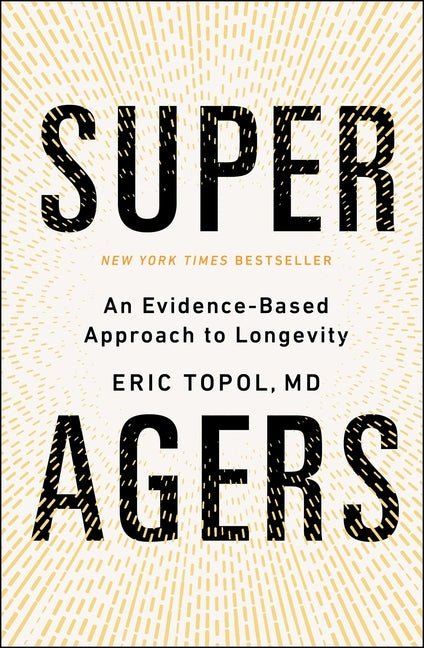
Super Agers: An Evidence-Based Approach to Longevity
by Eric Topol
Couldn't load pickup availability
A New York Times Bestseller
Super Agers is a detailed guide to a revolution transforming human longevity. This is a breakthrough moment in the history of human health care. The person making that bold claim is one of the most respected medical researchers in the world, Eric Topol.
Dr. Topol’s unprecedented, evidenced-based guide is about how you and your family and friends can benefit from new treatments coming available at a faster rate than ever. From his unique position as a leader overseeing millions in research funding, Dr. Topol also explains the fundamental reasons—from semaglutides to AI—that we can be confident these breakthroughs will continue. Ninety-five percent of Americans over sixty have at least one chronic disease and almost as many have two. That is the essential problem this revolution is solving. He explains the power of the new approaches to the worst chronic killers—diabetes/obesity, heart disease, cancer, and neurodegeneration—and how treatments can begin long before middle age, and even long after. In thirty years, we will have five times as many people at least one hundred years old and they will be healthier than ever because of the breakthroughs Dr. Topol describes.
The amazing discoveries Topol brings into sharp focus are deeply inspiring about our human potential. We can now realistically see how we can make considerable headway for preventing age-related diseases and may one day be able to slow the body-wide aging process itself.
Share
Book Details
- ISBN
- 1668067668
- Binding
- Hardcover
- Authors
- Eric Topol
- Publisher
- Simon & Schuster
- Published Date
- May 6, 2025
- Language
- English
- Pages
- 464
- Physical Info
- 1.4 in H x 9.3 in L x 6.1 in W (1.4 lb)
Solid insights. Very good scientific references.
Fantastic information! I found myself saying OMG this is incredible! Very easy to understand language and the information relating to studies has informed me how to make some changes. Very glad I bought this one!
Great diet important. Gabe to friend. Will het aydio
I have say with honesty that the content of this book is a tough reading starting from Chapter 1 as the author assumes that the reader has a strong academic background in biomedical sciences. Even though I have a PhD in physics and extensive research career in basic physical sciences, I was lost starting in page 4 with terms such as hypertrophic cardiomyopathy.I kept on reading as the author gives important easily understandable information on lifestyles impact on health in chapter 3.I did read thru the entire book with the intention of going back later on to try to understand the content better after I first learn biology from online courses.It is definitely a biomedical science book, not for beginners like myself.
Finally an authoritative analysis of aging. Every claim is backed by links to the scientific literature.Eric Topol knows his stuff and can be trusted.
- 5 stars: 13 (65%)
- 4 stars: 5 (25%)
- 3 stars: 2 (10%)
- 2 stars: 0 (0%)
- 1 star: 0 (0%)
Solid insights. Very good scientific references.
I have say with honesty that the content of this book is a tough reading starting from Chapter 1 as the author assumes that the reader has a strong academic background in biomedical sciences. Even though I have a PhD in physics and extensive research career in basic physical sciences, I was lost starting in page 4 with terms such as hypertrophic cardiomyopathy.I kept on reading as the author gives important easily understandable information on lifestyles impact on health in chapter 3.I did read thru the entire book with the intention of going back later on to try to understand the content better after I first learn biology from online courses.It is definitely a biomedical science book, not for beginners like myself.
Great diet important. Gabe to friend. Will het aydio
Fantastic information! I found myself saying OMG this is incredible! Very easy to understand language and the information relating to studies has informed me how to make some changes. Very glad I bought this one!
Very well written. Author doesn't water down the technical information so nonmedical readerswill need extra effort to understand much of the information.
Finally an authoritative analysis of aging. Every claim is backed by links to the scientific literature.Eric Topol knows his stuff and can be trusted.
I’m just starting to read the book but it looks like there is a ton of information.
Got the free audio book.Growing old without suffering sounds good me.This guy is a genius.
Very interesting, learning alot
Good read and informative
Although this book is very technical at times, it is very informative & backed up with data.
The book is an excellent read and highlights research on aging and disease, and some facts about pharmaceutical research
Easy to make tasty recipes
Well written so that all can understand. Full of useful information and fact based. Even entertaining.
Overall, Dr. Topol’s book offers a valuable overview of the medical literature relevant to aging. However, as a psychiatrist, I found Chapter 11, which addresses mental health, lacking in several important respects.First, Dr. Topol’s discussion of SSRIs in major depressive disorder (MDD) is incomplete. While he notes that the effect size of SSRIs is modest in depression, he omits the robust evidence supporting their efficacy in cases of severe major depressive disorder. Multiple meta-analyses and clinical guidelines indicate that SSRIs are effective for moderate to severe depression, particularly when combined with cognitive behavioral therapy. The effect size may be small in mild depression, but for severe cases, SSRIs remain a cornerstone of treatment and are recommended by major guidelines. Additionally, SSRIs are effective in preventing relapse when continued as maintenance therapy.Second, the chapter raises unwarranted doubts about the effectiveness of electroconvulsive therapy (ECT) for depression. On page 270, Dr. Topol questions whether ECT is a valid treatment for depression. This overlooks a substantial body of evidence demonstrating that ECT is highly effective for treatment-resistant depression, bipolar depression, and certain cases of refractory psychosis, such as catatonia. While ECT is not appropriate for all patients, it is a critical option in the therapeutic armamentarium for select, severe cases.In summary, while Topol’s book is generally informative, the treatment of psychiatric interventions—especially regarding SSRIs and ECT—does not fully reflect the strength of the current scientific evidence. A more nuanced and comprehensive discussion would have better served readers seeking guidance on mental health in the context of aging.
Rather technical. Good information, but not the easiest read.
A very dense book, citing endless trial results that mean little to the average reader. Now more than half way through the book and not yet clearly seen his connection to longevity and life span. Much of the advances identified are probably unreachable by your average country doctor.
I am 83 and have been building my knowledge of aging since the 70’s when I first heard Kenneth Cooper speak on longevity and went to his clinic. I read Super Agers by Dr. Eric Topol a second time, and I highly recommend it to anyone interested in living longer—and more importantly—living better. It’s packed with science-backed insights on how lifestyle, movement, sleep, and how AI are changing the way we think about aging. Whether you're 40 or 80, this book will give you practical, hopeful guidance on how to add more healthy years to your life and an overview of the current research that may change healthcare and our potential for a longer healthspan.. Give it a read—you might just be inspired by his view on how AI will be changing our health futures. I admit that a couple of the sections of his book were difficult to read but I loved his notes at the end of his book that make it easy to build your knowledge on any of the subjects he covered with a simple click. My rating is a 5+
This book is a must have. Seriously. I think this is the 7th copy I have ordered for myself and for friends and colleagues. How good is it? Well, I am currently temporarily on crutches and ordered a copy for all 3 floors in our house so I could have one on every floor to read and reread when I have time (which I have more of now because of the crutches)This book is a totally evidence based discussion of current realities based on data and current fads/misrepresentations of data or lack of data when it comes to aging. The focus is on healthier living with a full life mentally and physically and NOT necessarily living longer if it is meaningless life. As an MD with a Ph.D. in nutrition, I am very, very picky about books I give to friends, other physicians, and/or recommend. This one is high on the list of must reads. I would love to see Drs. Topol and Attia discuss the topics covered in this book on joint podcasts.Get this one and keep an open mind. You will NOT be disappointed.
In Super Agers, renowned cardiologist Eric Topol offers a sweeping, densely packed guide to the evolving science of longevity. Topol’s central mission is clear: to show how modern medicine—bolstered by genomics, pharmacology, and AI—may allow many of us not simply to live longer, but to delay the onset of chronic disease and enjoy an extended healthspan.The book brims with valuable, up-to-the-minute insights, yet prospective readers should be forewarned: Super Agers is no breezy popular science title. Large sections read more like rigorous academic reviews than general-interest prose. Topol marshals hundreds of studies and showers the reader with specialized terminology, technical data, and acronyms, many of which would likely bewilder even the most diligent, college-educated audience. Skimming, rather than savoring, may become a survival strategy for many readers.Given Topol’s professional roots, it is no surprise that his discussion of cardiovascular disease prevention is among the book’s strongest and clearest contributions. By contrast, the opening to Chapter 6, which addresses cancer, is strikingly disjointed—an odd lapse in an otherwise meticulously constructed narrative.Among the most revelatory sections is Topol’s exploration of GLP-1 receptor agonists, a class of drugs already famous for their role in diabetes and obesity treatment. Topol convincingly argues that their potential impact extends much further, suggesting they may reshape the landscape of medicine itself. “The impact of GLP-1 drugs in medicine—for improving patient outcomes—will likely be more substantial than any prior class of medications,” he writes, noting their “major triumph” in combining high efficacy with favorable safety profiles. At one point, Topol even speculates that “it is conceivable that most people will be taking one of the GLP-1 drugs in the future.” It’s a bold assertion, but one he supports with considerable evidence.Topol’s scholarly rigor is reinforced by an exhaustive list of references, although the unconventional note system—linking citations to chapter and page numbers rather than traditional footnotes—and the minuscule font size used for these notes are sure to frustrate anyone wishing to dive deeper without a magnifying glass.The ultimate question, then, is: for whom was this book written? Despite its glossy cover and broad promises, Super Agers seems best suited to practicing physicians, researchers, and highly motivated lay readers with a tolerance for complexity. Those willing to persevere will be rewarded with a bracing, if at times arduous, journey through the cutting edge of preventive medicine.Super Agers may not offer an easy path to a longer life, but it is a serious guide for those determined to understand—and perhaps seize—the promise of modern longevity science.

