

The Book Thief
 )
 )
Couldn't load pickup availability
#1 NEW YORK TIMES BESTSELLER - ONE OF TIME MAGAZINE'S 100 BEST YA BOOKS OF ALL TIME - A NEW YORK TIMES READER TOP 100 PICK FOR BEST BOOKS OF THE 21ST CENTURY - A KIRKUS REVIEWS BEST YOUNG ADULT BOOK OF THE CENTURY
The extraordinary, beloved novel about the ability of books to feed the soul even in the darkest of times.
When Death has a story to tell, you listen.
It is 1939. Nazi Germany. The country is holding its breath. Death has never been busier, and will become busier still.
Liesel Meminger is a foster girl living outside of Munich, who scratches out a meager existence for herself by stealing when she encounters something she can't resist-books. With the help of her accordion-playing foster father, she learns to read and shares her stolen books with her neighbors during bombing raids as well as with the Jewish man hidden in her basement.
In superbly crafted writing that burns with intensity, award-winning author Markus Zusak, author of I Am the Messenger, has given us one of the most enduring stories of our time.
"The kind of book that can be life-changing." --The New York Times
"Deserves a place on the same shelf with The Diary of a Young Girl by Anne Frank." --USA Today
DON'T MISS BRIDGE OF CLAY, MARKUS ZUSAK'S FIRST NOVEL SINCE THE BOOK THIEF.
Book Details
- ISBN
- 9780375842207
- Binding
- Paperback
- Authors
- Markus Zusak
- Publisher
- Alfred A. Knopf Books for Young Readers
- Published Date
- September 11, 2007
- Language
- English
- Pages
- 608
- Physical Info
- 1.5 in H x 7.8 in L x 5.1 in W (0.93 lb)
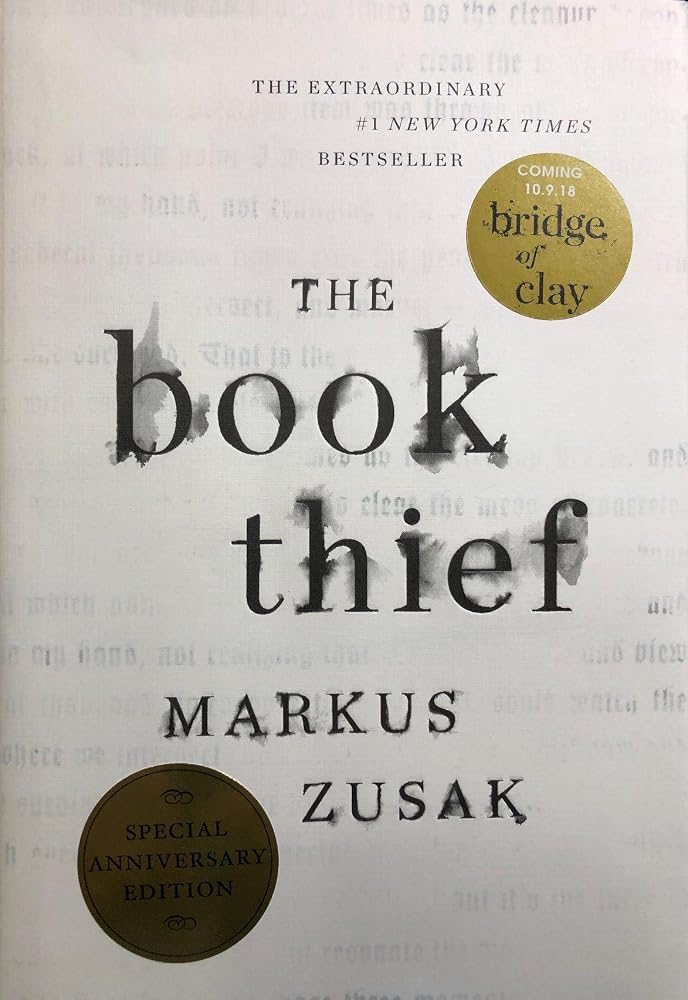
January 13, 2019A Review by Anthony T. Riggio of the book The Book Thief by Markus ZusakThis book was recommended to me by Chris Manion, author of God's Patient Pursuit of my Soul, who advised that I would really like this story about Nazi Germany in the 1930's through the end of World War II. I ordered this book from Amazon in the Special Anniversary Hardback edition.Markus Zusak in his writing created an interesting way to present the dialog of the narrator. At the outset I thought it was the main protagonist Liesel Meminger narrating then it seemed to morph into another person, not clearly identified at first. It made for an uncomfortable and challenging beginning only to learn after several appearances to be the spirit of Death. This however did not create a feeling of horror or was it distracting once you got the hang of this unnamed narrator. It did not take away from the overall story and the flow was rhythmic and consistent throughout the book, The overall style was very interesting and provided the reader with a glimpse of what was to follow in the succeeding chapter.Many reviews described the book as a something a child would enjoy or relish. I am not sure if this is accurate as the story was very mature in its concept and gave one an inside track on the happenings of Germany during the rise and fall of the Third Reich. The human protagonist is a young girl about ten years old and how she is being abandoned by her natural mother to a family living in a suburb of Munich, Germany. She is traveling with her mother and younger brother who is quite sick. When the train stops, some distance from the final destination in Munich, the boy dies and they have to bury him in a small cemetery where the grave diggers misplace a book; The Grave Digger's Handbook and Liesel, purloins it for no apparent reason other than a simple souvenir of remembrance of her deceased brother. The mother deposits Liesel with the Hans and Rosa Hubermann family, a peasant family who lived in the poorer section of town. Rosa is a seemingly strict foster mother and her husband Hans is unemployed and on disability. Hans becomes Liesel's mentor and teaches Liesel to read via the book she stole from the cemetery. During a book burning in Munich, where Jews were being persecuted, forbidden books were cast into public bonfires and Liesel stole her second book and added to her foster father's reading curriculum. Her friend Rudy is a Tom Sawyeresque young boy who develops a love for Liesel and several fun experiences are had by both.The Hubermanns take in an escaped Jew into their home and hide him in their basement, a very dangerous thing in Nazi Germany. Max the Jewish fugitive becomes a second mentor to Liesel and she develops a similar relationship as she has with Hans.During one of the book burning events, Liesel steals her third book which add to her curriculum being used by Hans and now Max. She is spotted by the Mayor's wife and consequently a covert relationship is developed by the wife of the mayor and Liesel, which results in another mentor for Liesel.The book has all the drama and sadness one would expect in a novel contemporaneous with Nazi Germany but it is a book worth reading. It has humor, love, sadness, drama, tragedy, suspense, unexpected and predicted outcomes.I have to say I loved this book and reading it became obsessive with me and I believe it demonstrated the author's great talent. I unhesitatingly gave this book five stars and highly recommend its reading.
This WWII fiction was great! I liked how all of the characters were woven together. The importance of each character showed the reasons Leisel did what she did.
Very great price. This book was a summer reading from my child's school.
Gave this an A+ because I’m still thinking of the characters weeks after finishing the book! Warning: this book has a strange beginning, but read on! Once you get past it the writing & plot are outstanding!
i’ve read this so many times before, and it’s still so beautifully written and gut wrenching every time i read it.
I’ve read this book twice now about 15 years apart and thoroughly enjoyed it each time. The author does a fantastic job of narrating from a very unique perspective.
Very well written and moving. I recommend this book to every one of all ages. It’s a different World War II story than any I have ever read.
It took me awhile to wonder why it was taking me so long to read this book. 177 pages on Kindle to 608 pages in print so it took three page turns to equal one in the print edition. This technical problem in some ways ruined the pacing of the story, but in the end I cannot fault the author for this problem. This book has been sitting in my Kindle library for 11 years. In the meantime I have read hundreds of largely meaningless books. Oh how glad I am to have finally brushed off the digital dust and read this beautiful, haunting story. I leave 5 star reviews to only the very best books I have ever read. The writing flows, the story blends such love with such horror which are both captured in the ending. Just a magnificent story of how love and compassion can exist in the worst of times. Highly recommended to readers of all ages.
This book has been previously banned. Apparently, for harsh language, this was not an outstanding characteristic. What makes the book interesting is that the story is told by a person who served as "Death" and collected the souls of the deceased. It centers a little girl whose mother was a communist in Germany during the rise of Adolph Hilter. She is being placed with foster parents. But while on their way there, her brother dies. She is given to the foster family, and they raise her. The father is especially good because when she arrived she could not read. She had stolen her first book during her brother's burial. Her foster father helped her learn to read, and slowly reading became an important part of her life during the tumultuous years in Germany. She developes friends and enemies. I enjoyed her perspective and strongly recommend this book. It would be good for young readers.
I’d heard of this book, but knew very little about it. The Amazon description categorized this book as “Teen & Young Adult Holocaust Historical Fiction”. That’s unfortunate, as older adults (I’m 79) may choose to not read this book simply due to that “teen and young” label. This is a book that can be appreciated by readers of any age.What is the book about? Well, using the author’s own words (which I found in a “Bonus Material” section of this Kindle version): “I’d collected three central ideas. One came under the blanket of my parents’ stories. The second was about a girl stealing books. The third was that … Death would be the narrator.” (The author’s parents told him stories about their experiences living in Nazi Germany in the late 1930’s and early 1940’s.)Part of the author’s intent was to show that not every Germany citizen blindly and enthusiastically accepted the Fuhrer’s claims of Germanic racial superiority -- and the campaign for extermination of the Jews. So, unsurprisingly, many (but certainly not all) of the characters in this book are depicted as basically good people trapped in circumstances created by a powerful and cruel government. Still, the author did not whitewash the anguish and suffering of the Jewish Germans.But in the midst of all this sorrow, we have the story of Liesel Meminger who is, in 1939, eleven years old. (She may be The Book Thief, but the first book she “steals” was simply found dropped by someone in the snow and the second book she “steals” was a book meant for one of the Nazi’s book burning.) It is Liesel, and those in her life, that are the heart of the story -- with wartime Germany being both a pervasive backdrop to the story and a catalyst for much of what drives the circumstances that impact her life.Bottom Line: “The Book Thief” is character-based drama that takes place during dark and deadly times – a drama that perhaps only Death could tell.
The ‘Book Thief’ is set in Germany during World War 2 where being a Nazi was displayed in every street. The book focuses on the main character Liesel Meminger who has just lost her brother while on the way to being given away to a foster family in the town Molching with Rosa and Hans Hubermann. Once Liesel settles into her foster family she explores her town and meets other people including her best friend Rudy Steiner which then leads to her exploring her interest in books which “coincidentally” connects to the book title. Liesels life gets a big obstacle when Max Vadenburg, who is a Jewish man, comes into Liesel's home and he has to hide in her basement while the family is already being suspected of being against Nazi views. The Book Thief explores challenges Liesel has to face and tragedies that occur due to living under Nazi rule.Overall there wasn’t anything I disliked about this book and I think a huge part of it was because of how much I liked the scenes given to us along with the characters. For example, the book-burning scene is strong as we see the people's ability to learn the truth being taken away. At the same time, we also see Liesel being rebellious when she steals a book from the ashes, marking a quiet rebellion against the Nazis. Then we have heartwarming scenes in the book like when Hans Hubermann teaches Liesel how to read. Then we are given the friendship of Liesel and Max who is the Jewish man in her basement, they have a touching relationship as Liesel treats him kindly and their connection grows stronger when he gives her a hand-drawn book. Since this book brings both dark, strong, and heartwarming scenes you can’t complain about not getting one of them. I feel like this is done because the book is narrated by Death, Death doesn’t focus on the negative, it's only made to tell Liesel's story. The characters in the book are characters you wouldn’t forget because they each have their traits. Liesel who is the main character stands out the most because of how rebellious she is even during the Nazi time and we’re able to see her figure out who she is during this time while having to go through obstacles. The way each character was written is a reason why I didn’t dislike this book because you never get bored with them, even if you seem to hate them, they’ll still give you a reaction. [SPOILER ALERT] In the end, the book is a book I'll never forget but it’s because of the tragic ending it has in which the town Liesel lives in gets bombed and Liesel loses almost everyone she loves, excluding the Jewish man Max in the basement. It’s a heartbreaking tragedy that will most likely get you to tear up or even cry (I cried)Markus Zusak has a writing style that is one you never see in other books because he was able to write this book in the narration of Death. With the book being told by Death you are already given foreshadows of what will happen in the book but it’s also an explanation of why the book has a dark tone while also being neutral because Death isn’t on either side, it’s only there to collect and observe. Then the book is slow paced which is what allowed us to get a deeper connection with the characters and the author gave us many scenes that either gave us a wake-up call on what each character had to go through or gave us details on what made each character them. Aside from the author's being able to write the book as if they’re Death, the characters are what made the storyline, without them the setting in Nazi Germany wouldn’t have had such a strong impact. Nazi Germany was already a tough time to live in but the author adding a Jewish character that they had to hide made the storyline more interesting. Aside from the Jewish character, Markus made other unique characters and each has their own story that makes you either like them or not. For example, Rosa Hubermann who you can say is Liesel's foster mom, has a strong personality where she comes off as rude and it seems she doesn’t have much care towards Liesel or her husband Hans Hubermann. Throughout the story and especially in the end the author lets us get a deeper sense of her personality and that she truly cares for her husband and Liesel. The actions that she does are made to help her family even if they seem as harsh as she just wants to protect them and keep them afloat. Then her husband, Hans Hubbermann is a character that was made for everyone to love, Hans doesn’t show any dislike towards Liesel and is the one to help her settle in and learn more about the world. In the book, Hans helps Liesel learn to read which helps Liesel's obsession with reading books. The author did an awesome job of making Hans a caring father figure for Liesel which did not help with [SPOILER ALERT] seeing Hans die at the end. Then we have the main character Liesel Meminger whose unique character was created because of what’s been thrown onto her life like losing her brother, being sent away to a foster family, and having to adapt to the Nazi wo...
If there’s one book that surprised me, it’s The Book Thief. I brushed it off for the longest time due to my aversion to historical fiction and young adult novels. However, an unexpected trip to Poland, with a visit to Auschwitz on the agenda, led me to reconsider. It all started with Elie Weisel’s Night, but my wife’s suggestion for our girls to read The Book Thief truly piqued my interest. Narrated by Death, this story of Liesel’s resilience and growth during World War Two captivated me from the first chapter. It’s a beautiful and powerful narrative.Narrated by Death, it tells the story of Liesel, who moves in with her new foster parents, Hans and Rosa, after her mother can no longer care for her. On the train to her new home with her mother, who will leave her with foster parents, Liesel’s younger brother dies, and she steals her first book, The Gravedigger’s Handbook. Hans teaches Liesel to read and write, and she develops a love of books, developing some kleptomania for them, even stealing them from Nazis before she even knows to read them. As the story develops, Hans and Rosa hide a Jewish man named Max Vandenburg in their basement, and Leisel develops a relationship with him as he hides in the basement. Eventually, Max is forced to leave when authorities begin to notice the family. While carrying laundry for her mother to wash for the Mayor’s wife, Liesel also befriends her, Ilsa, who lets her read in her library.And now the stage is set. In a year Hitler will send German troops to invade Poland, then Denmark and Norway, followed by France, Belgium, the Netherlands, Greece, and beyond. In a year or two, more Allied planes will begin to bomb the heartland of the Fatherland, returning to Germany the pain it administered to others, with little discrimination. It would be a bloody and deadly chapter in Europe’s and the world’s history, and the innocent would be those worst abused and harmed by the carnage.Into this milieu drops the young Liesel, alone, poor, fostered to strangers by parents who are themselves disappearing into Nazi concentration camps. She is ignorant, alone, and broken, and as she drops into the home of Hans and Rosa, her life is at a nadir. To use a more modern label, she is at risk, and many would write her off as a lost cause.And yet, something about her catches Death’s attention, and his admiration for her spills out as he narrates her story, for rather than decline into a miserable abyss of wartime Germany, the love of Hans and Rosa and others insight into her growth to become a powerful and inspiring figure. Zusak’s telling kept me hanging on his every word from the first chapter. Even as one tragedy after another crosses her path, the beauty of her path makes it impossible to love her. They say that great fiction requires that characters grow, even at high cost, and Zusak ensures that Liesel pays every possible cost in her growth.It’s a beautiful book, and I wish I had found it sooner. I hope you’ll pick it up if you’ve not read it yet and not waste any time bringing this beautiful story into your life.
Zusak, Markus,, and Trudy White. The Book Thief. New York: Alfred A. Knopf, 2007. Print608 pages, US $6.99 on Amazon (on 05/13/2021).***Spoilers will be included***Liesel, the perfect example of showing that one can overcome anything if they try really hard for it. In the beginning, she struggled with reading since she didn’t know how at all. That was until her adopted father Hans taught her how. She was made fun of for being a slower reader than her classmates. She just has a way with words, which encouraged her to steal books even if cost her own life. Her family helped hide a Jew in their basement during the Hitler Regime, which is the equivalence of having a death wish. At a young age, she had to keep dark secrets from others just to keep her family alive. She learned the seriousness of war, how people won’t submit to the fears of Hitler so easily.This story shows the importance of education, how words make a person so strong. A part in the book mentions how she’s stealing the words that Hitler used to make people support him. Like I mentioned before, she didn’t know how to read. She became more powerful once she learned how to. I think that’s why it was so important for her father to teach her how to. This book made you fall in love with the characters. Rudy, the one who loved Jesse Owens and dreamed to be him. He was super athletic and was pretty smart in class. Which was why it wasn’t a surprised when they wanted him to join their new program for making the best race. Max, the Jew who is so selfish and felt like he had to be in some way. It was sad when they had to go to someone else’s basement for the bombings while he had to stay alone at Liesel’s basement. He even gave Liesel a book, with small pictures throughout the story. People around her really made Liesel’s life more bearable. Like how she became friend’s with the Mayor’s wife. The massive library in their house gave Liesel hope. That she will be surrounded with books her whole life.What’s different about this book is that it’s narrated by death himself. It was clear that he had some biases. It was harder for him to collect people’s souls compared to others. He was always attached the book thief and the people that surrounded her. I had mixed emotions about death spoiling the ending, like how he told the readers that Rudy died. However, it did create the suspense about how it ended up happening. In the beginning, it was hard to read because I didn’t understand it. It was talking about colors and random things such as bombings. It was a lot to handle but it eventually became more clear. The writing style was definitely unique and something I really appreciate from the author. In other books that relate to WWII, they mostly mention people that support Hitler either out of admiration or fear. This book was clearly different. Yeah they did their salutes for the leader, but they just did it when they had to. They didn’t care about him being leader. They went against him but they didn’t make it so obvious like those who join the revolution. Her father deserved a lot better, he did escape death twice so I guess a third time was impossible. I never expected that Liesel would be the only only one alive from her street. Her love for words was clearly so strong that it helped her stay alive through the bombings. Max is eventually liberated from the concentration camp that he was in and visited Liesel right away. I think that’s where everything felt rushed from me. I wanted to know more about Max’s story. How Liesel cooped with everyone’s death. Especially the death from her lover. Then again, it’s up to our interpretation for everything. I highly recommend this book to any historical fiction lover like myself. I read this book in two days, it was too quick. I spent many days rereading many scenes and noticing small details that I missed before. Liesel and everyone on Himmel Street, including the Mayor’s wife, their lives will continue to live in my soul.A 5/5 book indeed.
The Book Thief written by Markus Zusak takes place in 1939 Nazi Germany. The main character Liesel Meminger is traveling to Munich via train with her brother and mother. Liesel and her brother were about to be given over to foster parents, when tragedy strikes and Liesel’s brother passes during the train ride. Liesel is only nine years old and is experiencing life-altering changes. Things don’t get much better when she arrives at the home of Hans and Rosa Hubberman in Molching. Liesel has nightmares every night for the first several months. Hans would sit up nightly with her helping her through her nightmares, eventually creating a trusting relationship between the two. Liesel starts school and is soon made fun of because she can’t read. The only thing that helps Liesel through the days and nights in Molching is her only possession that serves as a connection between her and her mother and brother; The Grave Digger’s Handbook. The presence of the Nazi party grows strong in Liesel’s new home. The burning of enemy propaganda takes place. Liesel finds a book that survives the burning and keeps it for herself. Little does Liesel know, she is caught taking the book by Ilsa Hermann, the mayor’s wife. It turns out, Ilsa has an extraordinary collection of books herself in her home library and shares her loves of books with Liesel. Liesel and her school friend Ruby visit the mayor’s house frequently in the night to steal books from the library. Her actions become notably accepted when Liesel finds a dictionary/thesaurus left by the window of the library one night as a gift. Aside from Liesel’s book thievery, she carries another secret with her daily. In the basement of the Hubberman’s home lives a man by the name of Max. Max is the son of a the man who saved Hans life during World War I. In return, Hans offered to repay him in anyway possible. Max and Liesel became good friends after realizing that both of them have lost their families, are fist-fighters and both have nightmares. Max is also fascinated with the power of words like Liesel, and writes Liesel a book about his life for Liesel’s birthday. When the air raids begin, Liesel and Rudy’s families find protection in a neighbor’s basement after determining their basement’s were not deep enough to protect them from the bombings. Ilsa Hermann brings Liesel a black book one day so that Liesel may start writing the words to her own story. Liesel is in the basement writing her book as bombs begin to drop on Himmel Street, where Liesel lives. She emerges from the basement to find her mama, papa and Rudy dead from the bombings. Liesel is taken away by air raid officers and it is then that Liesel’s book is found. The Book Thief ends with the story of Liesel’s death by age after living a life in Sydney, far from Molching and Himmel Street with her husband, her three children and her many grandchildren. Ever too often do you pick up a book where there is just word after word filling page after page. However, in Markus Zusak’s young-adult fiction novel The Book Thief, Zusak appeals to many different elements of literary composition. I enjoyed how the book was separated into ten parts plus a prologue and an epilogue. This helps you follow Liesel’s story as she grows into a strong, young women throughout the Nazi invasion in Germany. I also liked the bold text inserted selectively within the text serving as means of clarification for parts of the story. Sometimes, the bold text would be a definition, an excerpt of dialogue or thoughts from inside the mind of one of the characters. The plot of the story is simply surviving the Holocaust. However, embedded within this broad plot are smaller character plots such as Liesel’s struggle to learn to read while stealing literature and Hans ability to protect his family from the Nazi invasion. I think the author’s decision to include multiple story plots allows this book to be enjoyed by a wider audience. Adolescents and young-adults can enjoy the youthful spirit of Liesel and her will to steal books and learn how to read while living through Nazi Germany and the Holocaust. Older audiences can enjoy the adult ideas of safety, protection, war, sacrifice and choosing between right and wrong. The layered effect the author uses here keeps the book entertaining and constantly evolving without losing the reader. As a reader, I felt confused, scared, brave and inspired with the characters. The use of a narrator combined with segments of the story being told from the character’s perspective also adds to the author’s ability to share these emotions with his readers. As part of my Reading Across Curriculum Course at The Ohio State University, I was expected to choose a book to use as a multi-genre book project piece. I remembered the title The Book Thief and the great reviews about the book and the film. Instantly I knew this was the book I would choose with my passion for world history. The book contains historical topics that can generate...
The Book Thief is beautifully written. Markus Zusak turns a phrase and his analogies in describing scenes are poignant. Though, some say the book is for youth because the main character is young, there is no reason adults shouldn’t read it. The Diary of Anne Frank was universal.The story is touching and special. It is different than other Holocaust or World War II books in challenging our assumptions and our capacity for understanding. Death narrates the story. How unique is that? Can Death be objective?The story begins in 1939 Germany (and ends in 1943), as 10-year old Liesel Meminger is on a train with her mother and six-year old brother. The brother dies. They get off the train to bury him and Liesel, unable to read, picks up the book the gravedigger drops, a manual on grave digging. It is her first book theft.She is to be put in the foster care of Hans and Rosa Hubermann on Himmel Street (“would anyone bomb a street named Heaven?”) in Molching, on the outskirts of Munich. They are an older couple with two grown children, the son a staunch Nazi. The reader’s – at least, mine – assumption is Liesel is Jewish, who is being rescued by a non-Jewish couple, but she is not Jewish. There are inferences later that her father might have been a Communist.Liesel calls Hans and Rosa Mamma and Papa. The loose end is the neighbors unquestioning about this when they know there were two older children.Rosa is acerbic and verbally abusive toward her husband and Liesel. Hans is the calming influence, tending to Liesel when she is awoken by nightmares, using the time to teach her to read, using the gravedigger’s manual.Despite the tenor of Nazi Germany and specter of war, the children of Himmel Street engage in the innocence of childhood. Liesel becomes immediate friends with the boy next door, Rudy Steiner, and she is the only girl in the street soccer games. Rudy gained fame a few years earlier, when he was so impressed by Jesse Owen’s four gold medal performance in the 1936 Berlin Olympics, he painted his face and went to a local track to copy Owens. That did not go over well.The children attend school and obligatory Hitler Youth meetings. Everybody hangs Nazi flags on Hitler’s birthday. You don’t hear the children utter Anti-Semitic comments, so maybe in this corner of Nazidom, these German children weren’t accepting the brainwashing propaganda. Rudy gets in trouble with the Hitler Youth leader when he tries to explain Tommy Müller can’t keep in goosestep because he is hard of hearing.Hans’ application to the Nazi Party has been rejected or delayed and he doesn’t seem to care. As a painter, many of his customers were Jews. Now that the Jewish neighborhood has been ransacked, he no longer has work.A Jewish man saved Hans’ life in World War I, which cost the man his. Now, the parallel story begins. Twenty years later, the man’s 22-year old son, Max Vandenburg, shows up at the Hubermann’s door. You expected Rosa to yell at Hans, saying they are at danger if they hide Max. Instead she feeds Max soup. Her manner changes from that point.A special relationship develops between the two protected people. He, too, is haunted by nightmares. There are great differences. He is hidden in the basement. Liesel has a room upstairs. Max must be a secret. Liesel can go out and live. She brings him the crossword puzzles from the newspaper. He asks for weather reports, since he can’t even look outside.With war arriving, rationing hits Germany, too (just as in Europe and America). Rudy and Liesel join gangs going on expeditions stealing apples from farms. Liesel, with Rudy often as lookout, steals books from the Mayor’s wife’s library. Meanwhile, Max is sketching and writing a book about his experience, The Word Shaker, to be given to Liesel at another time. Words and books play a central role, and a reference is made to Hitler coming to power on words.The challenge is can we identify with these people? After all, they are German. Germany was the enemy. That was difficult with the movie, Das Bot. What comes across in The Book Thief, is there are innocents in all wars on all sides, and it’s usually children. Once when their end of Himmel Street is in a bomb shelter, Rudy’s father is able to coax everyone to hold hands.“From other shelters, there were stories of singing “Deutschland über Alles”…No such thing happened in the Fielder shelter. In that place, there was only fear and apprehension…The cold hands melted into the warm ones, and in some cases, the feeling or another human pulse was transported. It came through the layers of pale, stiffened skin. Some of them closed their eyes, waiting for their final demise, or hoping for a sign that the raid was finally over…Did they deserve any better, these people? How many had actively persecuted others, high on the scent of Hitler’s gaze, repeating his sentences, his paragraphs, his opus? Was Rosa Hubermann responsible? The hider of a Jew? Or Hans? Did they all deserve to die? The children? Th...

