

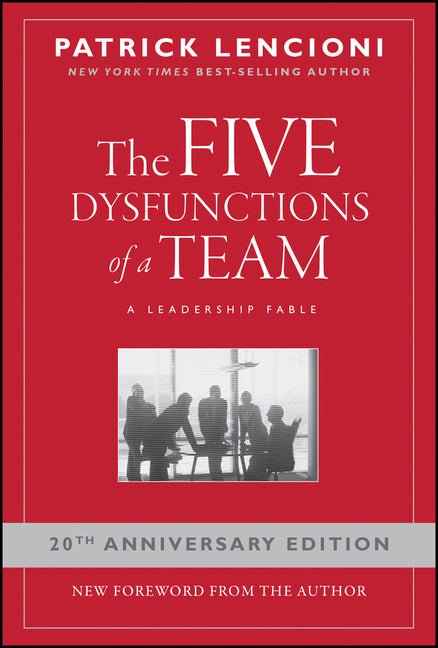
The Five Dysfunctions of a Team: A Leadership Fable
 )
 )
Couldn't load pickup availability
The New York Times best-selling team leadership handbook for modern executives, managers, and organizations
After her first two weeks observing the problems at DecisionTech, Kathryn Petersen, its new CEO, had more than a few moments when she wondered if she should have taken the job. But Kathryn knew there was little chance she would have turned it down. After all, retirement had made her antsy, and nothing excited her more than a challenge. What she could not have known when she accepted the job, however, was just how dysfunctional her team was, and how team members would challenge her in ways that no one ever had before.
For twenty years, The Five Dysfunctions of a Team has been engaging audiences with a page-turning, realistic fable that follows the travails of Kathryn Petersen, DecisionTech’s CEO, as she faces the ultimate leadership crisis. She must unite a team in such disarray that it threatens to derail the entire company.
Equal parts leadership fable and business handbook, this definitive source on teamwork by Patrick Lencioni reveals the five behavioral tendencies that go to the heart of why even the best teams struggle. He offers a powerful model and step-by-step guide for overcoming those dysfunctions and getting every one rowing in the same direction.
Today, the lessons in The Five Dysfunctions of a Team are more relevant than ever. This special anniversary edition celebrates one of the best-selling business books of all time with a new foreword from the author that reflects on its legacy and lessons.
Share
Book Details
- ISBN
- 0787960756
- Binding
- Hardcover
- Authors
- Patrick M Lencioni
- Publisher
- Jossey-Bass
- Published Date
- April 11, 2002
- Language
- English
- Pages
- 256
- Physical Info
- 1.1 in H x 8.3 in L x 5.6 in W (0.9 lb)
I asked my boss for a suggestion on a leadership book that he would recommend. He is someone who reads a lot of books in this space and when he told me this book without hesitation I knew I needed to pick it up. After I picked it up, I literally never put it down and read it in a day! The author presents and outlines his premise through the use of a hypothetical example of a team that was together for awhile but was dysfunctional. Although the scenario is from a corporate/business setting, I think the principles can be applied easily to educational settings or even interpersonal relationships. This book is accessible to anyone, entertaining and eye opening in its direct simplicity and easy to understand principles. I would highly recommend this to anyone!
I could not put it down. The storyline is simply fun and interesting. And it is clear what theory is described. Amazing merger of fiction and workbook.
Packed with so much wisdom and thought provoking concepts while also being an easy/digestible read. Great for any leader of any size of team!
As your reading, you are progressing in a real time example. It is easy to read as well as having aha moments to your team and the examples used.
This was one of the best management books I’ve read. What I appreciate most is the surfacing of the manager’s inner dialogue as she navigates the complicated process of turning a team around. Much of what separates an excellent leader from a poor leader when enacting major change management is what they do not do. Choosing when to allow situations to proceed without intervention and when it is necessary for them to direct the actions of others is far more difficult that one without such experience would assume. This book is offers exceptional guidance in a framework of a wonderfully told story.
- 5 stars: 16 (80%)
- 4 stars: 2 (10%)
- 3 stars: 0 (0%)
- 2 stars: 1 (5%)
- 1 star: 1 (5%)
I asked my boss for a suggestion on a leadership book that he would recommend. He is someone who reads a lot of books in this space and when he told me this book without hesitation I knew I needed to pick it up. After I picked it up, I literally never put it down and read it in a day! The author presents and outlines his premise through the use of a hypothetical example of a team that was together for awhile but was dysfunctional. Although the scenario is from a corporate/business setting, I think the principles can be applied easily to educational settings or even interpersonal relationships. This book is accessible to anyone, entertaining and eye opening in its direct simplicity and easy to understand principles. I would highly recommend this to anyone!
I could not put it down. The storyline is simply fun and interesting. And it is clear what theory is described. Amazing merger of fiction and workbook.
Packed with so much wisdom and thought provoking concepts while also being an easy/digestible read. Great for any leader of any size of team!
As your reading, you are progressing in a real time example. It is easy to read as well as having aha moments to your team and the examples used.
This was one of the best management books I’ve read. What I appreciate most is the surfacing of the manager’s inner dialogue as she navigates the complicated process of turning a team around. Much of what separates an excellent leader from a poor leader when enacting major change management is what they do not do. Choosing when to allow situations to proceed without intervention and when it is necessary for them to direct the actions of others is far more difficult that one without such experience would assume. This book is offers exceptional guidance in a framework of a wonderfully told story.
As I read this book and the progression of dysfunctions, I found it uncomfortably close to the reality of my experience. Simultaneously, it does a good job of capturing the team atmosphere and ways of engaging with others that reflect what we want.
Enjoyed reading this as a follow up to my company doing a ranking against the dysfunctions. The storyline kept things moving along and related to each of the five areas quite well. The summary at the end tied it all together based on the survey results we’d shared as a company and areas we wanted to work on specifically.
It provides some very good points to consider that help evaluate how well a team is functioning, or not :-)Tiles using a fictional team, which made it a ver easy read, and still manages to communicate the principles very clearly.
These 5 Dysfunctions are well known today. Unfortunately, the advice to overcome these 5 are ignored or at least, not followed. As a leader in the not for profit industry, the local church specifically, we ignore these recommendations to our peril. How to do so may not be clear, but we must start. It will take time, time that will make the difference worthwhile.
I used this book in a doctorate level course. I had been trying to gain leadership experience at work, but had not been given any opportunities to lead. My coworkers had all been working together for 20+ years. When I took the class, I was in my second year of employment. The book helped me see clearly which dysfunction was impeding my progress the most. I used one of the suggestions offered after we all took the survey on page 193 to strengthen my image in the minds of my coworkers. It was accurate and helpful.
I picked up Lencioni's book on the advice of several manager/executive friends. I take their opinions seriously, so I set myself down to absorb everything in this book. Ultimately, what I absorbed is that Lencioni simply does not know what he's talking about.The first problem is Lencioni as an author. He presents his case first in the form of a short story that has a 100% happy ending for Kathryn, the newly hired leader and protagonist of the story. It's a self-centered tale told from only a single point of view that gives no insight into the consequences of Kathryn's decisions one way or the other.The second problem is Kathryn is treated as a cipher for good management, though she does not demonstrate it. In this very, very short story, Kathryn manipulates her way around her team, figuring out how to push their buttons to get them to do what she wants. Rather than coming out and requiring specific performance and being open about what she sees, Kathryn engages in double-talk, withholds valuable information, openly plays favorites, happily creates chaos, and gets a pat on the back from a board member who never holds her accountable. If I didn't know better, I would think the author was acting out some kind of fantasy to heal old wounds at a failed management endeavor.The final problem is that the book and its points are utterly obtuse. The story consumes 80% of the book. The worksheet and associated instructions comprise the remaining 20%. This is less required reading and more a fatally flawed jumping off point to terrible management.The book specifically suggests:- A team can achieve anything if they're "all rowing in the same direction." While it's a cute sentiment, it does nothing to actually explain the vision of this book.- Managers should be free to cut each other down, as long as its done via calling out someone on their missed deadlines (even though they are not personally responsible for managing those deadlines), and other passive-aggressive tactics.- Everyone should reveal deep personal details about themselves, ignoring all respect for privacy. (For those who think this point is harsh, remember that Lencioni's innocent low-risk questions only apply to people who are perfect. For anyone who is an actual human, being interrogated about details that have no place in a work environment is deeply disrespectful and borderline psychpathic.)- It should be up to anyone but the actual boss to decide what the goals are. Just think for a minute about how well this would fly at Apple or Tesla.- Everyone should sacrifice their personal goals in favor of the "team" goals. That's right. You don't get to think about your career. You don't get to decide what is and what is not best for you. Don't like it? Get out. Why would anyone ever want to work for a boss who thinks like that? That's a team killer is what it is. It's a philosophy of pure poison.This is a book written by a mediocre consultant who will help you achieve mediocre results at best. This book is the opposite of "A players want to work with A players." It's a cast of B and C players who behave more like children than professionals. It's simply not realistic.Mickey is the perpetual debbie downer who rolls her eyes at everything. Sorry, if Mickey was this bad in real life she would not have risen to the level she is at. Here's a more realistic picture: if I were Mickey I would roll my eyes, too. She's absolutely justified in the contempt she has for the clueless board above her, and for her do-nothing co-workers. The story admits that Mickey produces outstanding marketing material. She's quick, efficient, and she takes great care of her team. Even when she's facing termination for insubordination, she deftly negotiates herself a severance. Yet the story throws Mickey under the bus and paints her as a toxic saboteur instead of the A player she is.Martin the senior engineer slash developer is another A player ground into submission by Kathryn who admits -- ADMITS -- she does not understand technology and has never led a technology company before. Yet, here she is, telling Martin how to do his job and publicly chastising him for using his laptop during a meeting -- something Martin points out is standard procedure and doesn't bother anyone but Kathryn. This is poison! A leader should be intimately familiar with a company's products, inside and out. Do you think Elon Musk doesn't know how batteries work? Do you think Carly Fiorina doesn't know how toner and fusers work? (Well, maybe she doesn't. She single handedly ruined HP.) The point is, no one can respect a leader who doesn't have at least a general understanding of what she's been asked to lead.The rest of the cast is what you would expect from a mediocre team: a manager who can't manage unless he has a bullet point agenda, a do-it-all guy who has no initiative of his own, a couple of D- level people who only left because they were probably hired by C- level managers. Everyone sounds like a desper...
Patrick Lencioni provided an instant classic when he wrote The Five Dysfunctions of a Team in 2002.The fable is about DecionTech, a Silicon Valley startup company with 150 employees. The two-year-old company has struggled of late with missing key deadlines, infighting, and low morale so they have asked their current CEO and co-founder Jeff Shanley to step down.Next, we meet Kathryn. She’s a 57-year-old woman with a completely different background than the high-tech world where she’s been hired on as CEO to help with a turnaround.There’s plenty of skepticism given her different background, her age, and the fact that during her first few weeks she does little but observe and meet with a few key employees one on one.The skepticism only grows when she informs her department heads that they’re going to be spending time at some off-site meetings. We are struggling to make deadlines and we’re going to take time away from the office for meetings?It’s at these off-site meetings where Kathryn provides the framework for the five dysfunctions of a team which she believes to be why her group at DecionTech is underperforming.The five dysfunctions of a team are written on a pyramid and are listed below from top to bottom.• Inattention to Results• Avoidance of Accountability• Lack of Commitment• Fear of Conflict• Absence of TrustThe off-site meetings foster some good debates after Kathryn works on building trust with her department heads. She’s candid with everyone and says that she expects that her team may not wind up staying intact and that turns out to be true.This is a short read but it’s compelling with memorable characters and great lessons.Amazon reviewers give this one 4.6 stars after 1,910 ratings. Goodreads gives it 4.01 stars after 45,454 ratings and 2,218 reviews. It’s evident to me why this has become an instant classic and I gave it 5 stars.#FridaysFind #MIAGD #TheFiveDysfunctions #PatrickLencioni
I belong to a LinkedIn group whose members are all applicants for employment at a large company. One candidate told us that the company recommended this book to him in an interview, so I purchased it. It is well written, easy to read and understand, and really gets to the heart of how companies can form good leadership teams.It starts with a "story" that describes how one leader put these practices into play to "save" a struggling leadership team at a tech company. The story part is entertaining and effectively demonstrates the steps to team effectiveness. I think it's interesting that the author couched the title in negative terms, a better title for this book would have been Overcoming the Five Dysfunctions of a Team. But maybe that was too long. The second half of the book deals in more direct, technical terms with the dysfunctions identified and how much time should be spent on overcoming each along with suggestions for steps to do so. The one thing I missed in this book was that there wasn't just a list of the Five Dysfunctions so that I could refer to it to refresh my memory.The ideas were all ones I thought were obvious after decades as a team leader, but they were well-distilled into one place here, and this book would be a valuable addition to any leadership library. The big bonus was that I purchased it for Kindle, so my Echo Dot at home could read it aloud to me. I listened while I did my household tasks on a weekend, then I sat down with my mobile device and Kindle app, to review the more in depth portions of the book.Overall, I found this book well-written and well worth an afternoon's time to read it.
*Five Dysfunctions of a Team* should be required reading for anyone who is part of a team, especially at the leadership level. After reading this book, I ordered copies of this book to the rest of my leadership team and have begun putting a lot of the suggested solutions to practice.To describe the content of the book in a gist: a great team is focused on the achievement of a clear set of collective results, with a clear plan that they hold one another accountable to. There's a high level of trust and a willingness for engaging in unfiltered debates.But great teamwork is hard, especially in the high-paced political climate of corporate America, and teamwork deteriorates if even a single dysfunction is allowed to flourish, like a chain with just one link broken.My biggest takeaways:* Create a "team scorecard" of collective goals. Think back to 5th grade basketball... are your goals as clear and actionable as a basketball scoreboard? Collective goals can't just be pinned on the wall – they must truly come above everything else (individual or departmental achievement) and drive decisions and behavior. Focus intensely on the results.* Constantly "mine" for tensions and unresolved issues. Seek out and encourage healthy conflicts at meetings – it's a necessary part of being an effective team.* Make sure issues don't linger around. Force deadlines for decisions and make sure those decisions are made and communicated with input and ultimately full commitment across the team. Collectively deciding on messaging after meetings in order to leave no room for interpretation or spinning.* Make sure action plans, milestones, and responsibilities are clearly defined so everyone knows who is carrying out what. Encourage team members to hold each other accountable.* Invest in getting "naked" with your team. Vulnerability-building exercises and personality profiles can help increase trust rapidly. It is amazing how little some team members know about one another, and how just a small amount of information begins to break down barriers.
Patrick M. Lencioni, the author of The Five Dysfunctions of a Team: A Leadership Fable, explained teamwork perfectly as “mastering a set of behaviors that are at once theoretically uncomplicated, but difficult to put into practice day after day” (p. 2). This book delves into the seemingly all-to-familiar dysfunctions of every team or small task group and it provides valuable insight into acknowledging and amending these dysfunctions to promote a successful team. Lencioni presents these dysfunctions as a pyramid beginning with inattention to results at the top and descending down to avoidance of accountability, lack of commitment, fear of conflict, and absence of trust as the foundation to the dysfunctional pyramid. Lencioni puts a spin on his informational book by incorporating his lesson on teamwork into a fable about a dysfunctional team of company leaders and the steps a new CEO takes to amend their political environment and transform them into a productive team. I really enjoyed this book and I believe Lencioni’s tactic to transform his lesson into a fictional story was brilliant. I felt he did a great job putting his lesson into a feasible situation allowing the reader to have a better understanding of the material while also being immersed into the story. The material offered in Lencioni’s book goes well with the material I have learned in various classes about small group communication. I believe he touches on some of the dysfunctions discussed in small group communication but then goes further to explain each dysfunction and then actualizes them in the fable. I would recommend this book to anybody involved in a team or task group, but I would especially make a recommendation to those who manage a group of people. The only critical review I have for this book would be some editing mistakes I noticed throughout the book.
This is a novel, not a reference book, but the storytelling works fairly well. Consequently, while it works okay for replicating the success in the story within your own team, if you happen across a situation that falls outside something they addressed in the story, you may be a bit lost in how best to deal with it. That's the nature of dealing with a novel instead of a direct implementation guide. On the plus side, it's a heck of a lot easier to read a story than a dry manual. :)It does feel just a bit contrived to me. The situations are relate-able, but they feel just a little forced... like the situations are designed to fit the lessons, rather than being strictly based in reality. The company and characters sometimes don't feel *real*... they feel as though they were designed to be generic, so as to be more generally relate-able... but in so doing they lose a dimension of their personality, and it's (paradoxically) harder to relate to them very deeply. It makes the story feel rather "jack of all trades, master of none." Which is okay, it provides a solid all-around basis, but I'd also want something more specific to either my industry or my field, or my particular problems.The actual 5 dysfunctions seem pretty solid to me. I somewhat disagree on just how bad each one might be and what sorts of behaviors will be better or worse, but it's a reasonably good framework for looking at a team and judging it's overall effectiveness.I do suspect that the book does not stress the lower dysfunctions (particularly the lowest one, lack of trust) strongly enough. This is based on my own experience- people want to try and talk about failures at all levels of the pyramid, but the reality is it's extremely difficult to effectively solve any problems above trust, until trust is already solved. Therefore, I believe it would be better to focus heavily on trust only until you're sure it's really nailed down, then move up the pyramid. Even the team in the story makes this mistake, and consequently backslides easily. I believe the book does not do enough to dissuade readers from trying to fix problems at every level right off the bat.To my earlier point of wanting a more focused book, I will add that if you're looking to fix an IT department specifically I'd *highly* recommend "The Phoenix Project" by Gene Kim, even instead of this one. This is still good (and there's a lot of info that's complementary), but that one is just flat better, for that specific scenario. It is also in novel form, but reads much more naturally to me (as an IT manager). I could certainly relate to things in 5 Dysfunctions, but I could feel the protagonists challenges in my soul in TPP. It's a whole other level of precision and applicability. I imagine there may be books like this for other disciplines.
In any organization there is a tendency for people to become entrenched in their own departments and protective of their turf. Is that good or bad? Well, most of the time that is bad. Patrick Lencioni gives us a great book to provide the tools for any organization to overcome the dysfunction that causes them to not be productive, effective, harmonious and happy.Through a style of writing that is both engaging and fun Lencioni takes us through a fictitious technology company that finds itself at the top of the heap with start up capital and a bank account that all companies would envy. But they find themselves at the bottom of the heap in market share, productivity and frankly being a place that people want to work. Why?Well, Lencioni takes us through their transformation by way of writing us a parable of how Kathryn turns their Executive team around. She takes the Executives on a two day retreat to start laying the ground work for that turn around. What she does is take them through the 5 Dysfunctions of a Team. She shows them how they have struggled because they have fallen into these Dysfunctions.She then starts them on the path to overcoming these Dysfunctions and putting the team back together. Unfortunately that can be painful. Some will quit, some will take on different roles and some will mature in their jobs and their social skills as well as their Leadership.If you are part of an organization that is struggling you will find this book helpful.For me I am reading it after having left a place where I was for twenty years. I wish I had seen this before leaving, it would have been helpful. It would have given me insight in understanding how a team can go from being harmonious and morale very high to a team that finds itself in a little bit of turmoil and morale slipping terribly.I encourage anyone on an organizational team to read this and learn the principles that will help them to grow in their ability to be a team player that understands what is needed to make the organization successful.Enjoy!
This is a very short read. It took me about 3 hours to read the book over-to-cover, and I did not feel as if I skimmed over any major concepts.The book is written as a novel, in which a new highly effective CEO is placed in charge of an extremely dysfunctional silicon valley startup company. The CEO takes the executive team to a leadership retreat where she teaches them about teamwork and the five major dysfunctions of a team.The five major dysfunctions as stated by the book are:1) Absence of Trust2) Fear of Conflict3) Lack of Commitment4) Avoidance of Accountability5) Inattention to resultsAt first the team is very skeptical of the CEO, and generally feels that the entire retreats are a waste of time. Gradually the CEO wins over each member of the team, and over the course of the 'novel' (warning: spoiler), fires a team member and re-organizes the executive team to better match the needs of the organization.Ok, now for my criticisms of the book...My first criticism - this reads like a cheezy TBS movie, where a new woman CEO wins over her team with compassion and competence. I have nothing against the general message of the author's novel, but in real life, people simply don't open up as personally as they do in this novel. The entire 'case study' feels canned and artificial.For example, when Kathryn, the new CEO takes over the company, the former CEO, Jeff, goes to a VP of Biz Development role. By the end of the book, he's so committed to the teamwork mentality that he voluntarily demotes himself, so that he is no longer an executive level staff member, and he reports to the COO as director of Biz Development.... I worked in a number of different companies and frankly, this would *never* happen. No self-respecting CEO would demote themselves two levels for the sake of teamwork...In another scene, Kathryn fires the VP of marketing. This added some credibility to the book, but there was quite a bit of writing focusing on the dialogue and thoughts of the characters in a dramatic fashion. Personally, I found this type of writing distracting. While at some level, many working in middle management might be able to relate to this kind of event, personally I don't need the 'entertainment factor' of dramatic dialogue and canned thoughts and would prefer that the author focused on providing criteria by which to judge if team members are willing to work within his framework or not (which was not presented by the way).My second criticism - I could forgive the novel style writing, but my second major issue with the book is that I question its core message of teamwork.Yes, you heard me correctly, I have no idea how the author developed his so-called pyramid of teamwork, whether its based on empirical data, or just his personal observations from consulting. While the 5 dysfunctions certainly sound important, perhaps only 1 or 2 (i.e. trust, fear of conflict) of them are truly of strategic importance to teamwork, and the other 3 relate to personal management style of leaders (i.e. inattention of results). Frankly, I'm not sure how well thought out the pyramid is at all.The worst part is, everything in the book is fiction.... so it's no wonder that the CEO, Kathryn, is able to turn around the company as soon as her executive team embraces the great pyramid of truth... again cheezy TBS movie material.At the time that I purchased this book, I also purchased two other books on leadership... one of the others is a book that I'd highly recommend to anyone interested in the subject, and that is - 'Lincoln on Leadership.' The book details Abraham Lincoln's ability to lead the Union to victory during the Civil War, and specifically focuses on his management style through a fairly meticulous reading of letters, speeches, and historical records.Lincoln is a great case study, because first everything that happened is REAL, and second he was dealt an almost impossible hand of cards. He initially was elected to president with a minority of the national vote (plurality of several candidates), people felt at the time that he was a 'second-rate country lawyer' and had little faith in his ability to solve seemingly intractable problems between the North and South, numerous politicians attempted to undermine his executive authority related to the war effort or diplomacy with the South, former generals and members of his own cabinet even ran against him as a presidential candidate either in the first election or his second re-election.I read the Lincoln book immediately before reading Lencioni's Five Dysfunctions, and what struck me was that Lincoln's team probably violated almost every rule in Lencioni's book. In short, he probably had one of the most dysfunctional teams imaginable, and yet is widely regarded by historians as the greatest among US Presidents and leaders.While I think teamwork is important, I'm not certain that Lencioni's Five Dysfunctions, really captures the essence of aligning people to achieve a particu...

