

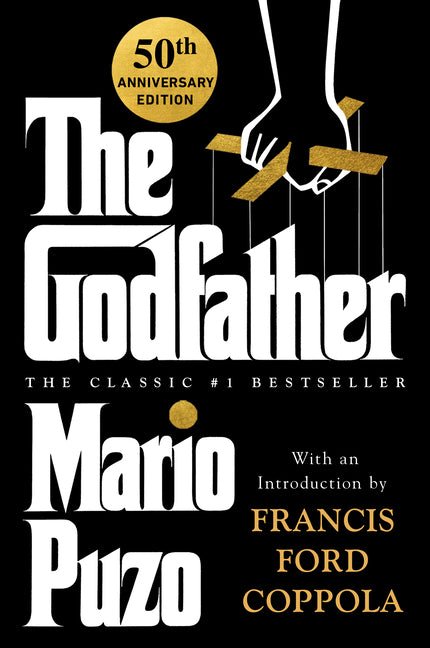
The Godfather: 50th Anniversary Edition
by Mario Puzo
 )
 )
Couldn't load pickup availability
50th ANNIVERSARY EDITION—WITH A NEW INTRODUCTION BY FRANCIS FORD COPPOLA
Mario Puzo’s classic saga of an American crime family that became a global phenomenon—nominated as one of America’s best-loved novels by PBS’s The Great American Read.
With its brilliant and brutal portrayal of the Corleone family, The Godfather burned its way into our national consciousness. This unforgettable saga of crime and corruption, passion and loyalty continues to stand the test of time, as the definitive novel of the Mafia underworld.
A #1 New York Times bestseller in 1969, Mario Puzo’s epic was turned into the incomparable film of the same name, directed by Francis Ford Coppola, which won the Academy Award for Best Picture. It is the original classic that has been often imitated, but never matched. A tale of family and society, law and order, obedience and rebellion, it reveals the dark passions of human nature played out against a backdrop of the American dream.
With a Note from Anthony Puzo and an Afterword by Robert J. Thompson
Share
Book Details
- ISBN
- 0451205766
- Binding
- Paperback
- Authors
- Mario Puzo
- Publisher
- Berkley Books
- Published Date
- March 5, 2002
- Language
- English
- Pages
- 448
- Physical Info
- 1.02 in H x 8 in L x 5.28 in W (0.82 lb)
The canonization of Francis Ford Coppola's two-part adaptation of this book in the film world has made us forget that, upon its release, The Godfather (the novel) was actually considered quite pulpy, and not of the high-art status that the films have achieved.Personally, I couldn't care less -- Mario Puzo is an entertaining storyteller, and the characters he created were marvellous -- the seemingly docile Michael Corleone; hothead Santino; Tom Hagen, the brilliant lawyer with an identity crisis; Luca Brasi (underused in the film version), the subhuman brute; Albert Neri, a man driven by circumstances into the world of crime; and of course Vito Corleone himself, the elegant mastermind, a man with a dream, a romanticization of the crimelord as a patriarch of King Lear proportions.The novel benefits from its chosen form. A scarcely acknowledged fact about the Godfather pictures is that much-needed exposition often had to get excised because there was so much back story to each character set up in the book that the film form couldn't handle adequately. You might notice in the Godfather films how Michael's return to America is completely unexplained; Luca Brasi's power and strength are never shown onscreen (he appears at the wedding, then dies in the bar at the hands of the Tattaglias); Paulie Gatto becomes a skimpish character; Genco Abbandando disappears; and Tom Hagen's conflicts about being consigliere are minimized. Even given two three-hour films, the amount of information in the one source novel couldn't be disclosed properly, resulting in huge gaps of information. Puzo's novel does it well, with exaggeratedly elevated language, character behaviour, and third-person narrative. It works beautifully, even given its trashier inclinations (eg. commentaries on Lucy Mancini's anatomy, and the large Johnny Fontaine/Nino Valenti subplot).Small wonder that this larger-than-life novel spawned the most famous film series of all time, the first entry of which has been called the best film ever made (I have contentions with that). The Godfather can be read as pure entertainment and, if so desired, as literature.
This is my fourth or fifth time reading The Godfather, and it never disappoints . I can recite verbatim certain sections or scenes from the book, with my most used section coming when Michael is explaining to Kay how the Don was actually a great man and not just a hood. Mr. Puzo had great insight into the reality of our society and how the true power structure works. The line where Michael tells Kay that he has no intention of leaving his future in the hands of the politicians whose only ability is conning a bloc of people into voting for them is one of the great passages in the book .The movie is truly one of the best of all time , but as usual , the book is better!
This book is a mandatory reading for anyone who wants to make it in the corporate world, or in the world in general. The phylosophy of the Don Corleone is brilliant, his cold logic undeniable. The reasoning of Don Corleone is what the reasoning of anybody who wants to be successful should be. You would do well to read this book, let it simmer a little bit, then read it again.
Better than I expected and the book is not as long as you would think. I've seen bits and pieces of the movie, but never really thought about reading the book. It's good though. Now I need to watch the movie all the way through
I have read the Godfather several times in the years since it was published, and every time I am amazed at how plausible and relatable the finely crafted characters are. I find myself in sympathy with the characters and following the logic of their actions in their circumstances. And I take the lessons to heart.
- 5 stars: 15 (75%)
- 4 stars: 5 (25%)
- 3 stars: 0 (0%)
- 2 stars: 0 (0%)
- 1 star: 0 (0%)
The canonization of Francis Ford Coppola's two-part adaptation of this book in the film world has made us forget that, upon its release, The Godfather (the novel) was actually considered quite pulpy, and not of the high-art status that the films have achieved.Personally, I couldn't care less -- Mario Puzo is an entertaining storyteller, and the characters he created were marvellous -- the seemingly docile Michael Corleone; hothead Santino; Tom Hagen, the brilliant lawyer with an identity crisis; Luca Brasi (underused in the film version), the subhuman brute; Albert Neri, a man driven by circumstances into the world of crime; and of course Vito Corleone himself, the elegant mastermind, a man with a dream, a romanticization of the crimelord as a patriarch of King Lear proportions.The novel benefits from its chosen form. A scarcely acknowledged fact about the Godfather pictures is that much-needed exposition often had to get excised because there was so much back story to each character set up in the book that the film form couldn't handle adequately. You might notice in the Godfather films how Michael's return to America is completely unexplained; Luca Brasi's power and strength are never shown onscreen (he appears at the wedding, then dies in the bar at the hands of the Tattaglias); Paulie Gatto becomes a skimpish character; Genco Abbandando disappears; and Tom Hagen's conflicts about being consigliere are minimized. Even given two three-hour films, the amount of information in the one source novel couldn't be disclosed properly, resulting in huge gaps of information. Puzo's novel does it well, with exaggeratedly elevated language, character behaviour, and third-person narrative. It works beautifully, even given its trashier inclinations (eg. commentaries on Lucy Mancini's anatomy, and the large Johnny Fontaine/Nino Valenti subplot).Small wonder that this larger-than-life novel spawned the most famous film series of all time, the first entry of which has been called the best film ever made (I have contentions with that). The Godfather can be read as pure entertainment and, if so desired, as literature.
This is my fourth or fifth time reading The Godfather, and it never disappoints . I can recite verbatim certain sections or scenes from the book, with my most used section coming when Michael is explaining to Kay how the Don was actually a great man and not just a hood. Mr. Puzo had great insight into the reality of our society and how the true power structure works. The line where Michael tells Kay that he has no intention of leaving his future in the hands of the politicians whose only ability is conning a bloc of people into voting for them is one of the great passages in the book .The movie is truly one of the best of all time , but as usual , the book is better!
This book is a mandatory reading for anyone who wants to make it in the corporate world, or in the world in general. The phylosophy of the Don Corleone is brilliant, his cold logic undeniable. The reasoning of Don Corleone is what the reasoning of anybody who wants to be successful should be. You would do well to read this book, let it simmer a little bit, then read it again.
Better than I expected and the book is not as long as you would think. I've seen bits and pieces of the movie, but never really thought about reading the book. It's good though. Now I need to watch the movie all the way through
I have read the Godfather several times in the years since it was published, and every time I am amazed at how plausible and relatable the finely crafted characters are. I find myself in sympathy with the characters and following the logic of their actions in their circumstances. And I take the lessons to heart.
Very well written
Prepare to be immersed into a captivating and detailed world headed by the Corleone family. The movie barely scratches the surface of Michael’s rise. Haven’t seen the movie? Don’t until you dig into to a pure classic!
Probably like most people in the present time, I saw The Godfather movie before I read the book. Now, all these years later since first seeing the film perhaps 35 years ago, I've finally read the book. The problem with such a situation is that it is then impossible to approach the original written work with fresh eyes. This book does have its thematic and structural issues, but maybe I'd feel differently had I read it before seeing the iconic film, instead of afterwards. But as for my criticisms, here goes:The author, Mario Puzo, has several inconsistencies in the timelines of his characters. The ages of many of them do not add up when comparing previous events mentioned in the book with current actions of the characters. These errors are relatively minor to the strength and flow of the plot, but they do stand out. Also, though this novel is considered high literature by many, in several parts of the book it reads as nothing more than a titillating potboiler or lurid dime-store paperback. There is a lot of very graphic, rather rough sex, not given to sensitivity or tenderness. And quite a bit of profanity.I hope that Michael Corleone does not show up at my door after reading this, saying, in the same vein as he did when talking to Carlo about Santino, "Todd, you must answer for your review!"On the positive side, fans of the movie are going to love this book for the added background it gives to familiar characters, even very minor "side" characters:You will actually get to read about what exactly happens to the boys who assaulted the girl whom the mortician appeals to The Godfather about at the beginning of the movie.You'll learn about what happens to the young man who blew up Michael's car in Sicily (fans of the film know something much more serious happened that day, but I don't want to spoil it for those who've not seen the film).You'll learn more about Mama Corleone, and Kay Adams.To your horror, you'll learn just how brutal Luca Brasi truly was.And so much more.Reading this very gripping, four-star book (nobody tell the Corleone Family!) will enrich your experience with the five-star movie that much more.
It was hard to put this book down and it was fun to make comparisons to the movie as you go. There were scenes where the movie did a better job but other scenes the book clearly brought more to the table.
Let me say that I have seen the entire "Godfather" series as they came out on the big screen as a kid , on cable and also have the DVD collection. It's been viewed numerous times and each time it grows on me more largely due to the cast and story. When I was in my young 20s while in college I tended bar in a notorious club in Brooklyn, NY and always had a facination with these "family", wise-guy stories as I witnessed alot in the couple of years working in that environment. A real wake-up reality for me to say the least. So, I finally decided to read the 'Book" itself by Mario Puzo. It is a worthwhile read in that it gives one another view. Is it better? No. Just different. There are times when Mr. Puzo seems to go off the rails as he writes about a womans surgical "pelvic floor procedure" to attain a more youthful body etc.....There are quite a few instances where the reading is not seen in the cinematic version. So there is that.....kind of a bonus if you will. There are some of Mr. Puzos' meanderings I could have done without. Still a good read.
“The Godfather” is a 1969 novel authored by Mario Puzo. It is the author’s third novel. It is the basis for two Academy Award winning movies. I completely enjoyed the novel. I both read the novel on Kindle and listened to the audiobook. The story is quite clearly written. I particularly enjoyed the audiobook, however there are many characters and I am glad that I read along in order to avoid becoming confused. Therefore I did not use this audiobook much whilst commuting. I sat quietly and read and listened.The story is about a family living in the New York area that is quite successful in various ways. There is a successful legal business interest. There are also illegal activities. The story revolves around the various males of the family and various intrigues about the illegal activities.I agree with another reviewer who spoke about an economy of words. The author keeps on point. This story has many parts to it and spans numerous years. It is not a short novel and would have been a vast sprawling epic if the author did not stick to the story.To my knowledge this is the third novel by the author. When I study an author I often read all of his / her novels in the order of publication, I read the first two by this author. They are both good, but this novel seemed to be much better and is by far my favorite of the three. For a casual enjoyable reading experience, I would just start with this novel.In summary, I completely enjoyed this novel. It is very similar to the Academy Award movie of the same name. I like this novel better than the first two novels by this author. Thank You for taking the time to read this review.
The Godfather is the defining story for Puzo, as most people know. Basically they think of the movie. What was a pleasant surprise for me was that this book was actually both Godfather movies, part I and II. However, where things are amplified in the movies, might be only a small paragraph in the book (GF2 - Robert Di Nero, early years as Vito Corleone). And there's whole chapters in the book that don't even get touched upon in any of the movies. And events in the movies that are completely different in the book. You get the picture.The book is so much better. I do love the movies. All of them - even GF3. But the book was written by Puzo as his masterpiece and the way it's laid out delivers so much more than the movies ever could. The story is just... different... but the same. And the nice surprise is the last chapter in the book leaves you with a different feeling than the end of GF1 (Diane Keaton - Al Pacino scene when the office den's door closes on her). I never liked that ending, but the books ending is a lot better. Even though, I can understand why they ended the GF1 movie the way they did. On film, the visual was effective.In sum, this book takes GF1 and 2 and delivers it in the way it was intended. The story is a classic and so much better told in writing. It's still not my favorite Mario Puzo novel (The Last Don, by far was awesome), but it's totally and completely one of his best.
Honestly if you are reading reviews trying to decide if you should read the Godfather or not, you are entirely too picky of a person and would probably spend 30 minutes deciding between two types of Pinot's at dinner. This is one of the top 5 movies of all time, and the book is exponentially better. This is one of the best books I've ever read, and I've read a lot of terrific books.The two most important elements of a story are its plot, and its characters. Oftentimes you can have a terrific story that is taken down by shallow characters, or an average story that is saved by complex and unique characters. This story gets an A+ for both.The plot is interesting, complex but not overly hard to follow, covers a lot of ground over a lot of time, and at multiple points in the book some truly unexpected plot twists that will put your jaw on the floor. It paints a picture of the Mafia as this all knowing, all powerful entity that can reach out and touch anyone, anywhere, anytime. But all of it is believable, cohesive, makes sense and works together.As good as the plot is, the characters really shine in this book. Everyone is unique, has their own backstory, motivations, history, and goals. And (at least with all the major and many minor characters) these backstories and motivations are explored in tremendous detail. While you are reading this book you don't think about them as characters in a book, but rather people you know and care about (or in some cases, loathe and detest).One thing that I think this book does exceedingly well (and better than most any books I've read) is detailing how characters come to specific decisions, and why. It's hard to explain without providing the actual text, but the internal dialogue that takes place throughout the story with the multiple characters is incredibly detailed and compelling. A character may start off a paragraph set on one course of action, and at the end of their "conversation" with themselves have talked them into a new course of action. It's brilliantly done, and pulled off extremely well.In short, if you have read this entire review you have wasted time and could already be reading the book.
TL;DR: a good read, if not entirely to my taste.(SPOILERS AHEAD - READER, BEWARE!) I love stories about the Mafia. From the families depicted on Law and Order to true crime documentaries, I love it all. Being a film buff as well, I wanted to see the Coppola classic The Godfather, but I felt like I should read the source material first. What Puzo excels at is realism. The majority of his characters feel very human, with all of the virtues and faults you'd expect in a novel with such a large cast. His descriptions of sex are passionate and deliciously reverent, and the moments where he allows himself to be less prosy are splendidly vibrant. He also makes characters with different (or non-existent) moral codes compelling. For example, I was very invested in and entertained by Sonny Corleone, though he's not a person I'd like in real life, and his death was one of my least favorite pieces of the story.Some of the weaknesses in the novel, I feel, are the somewhat clumsy integration of Puzo's sociopolitical and moral philosophy into the narrative, and an occasionally meandering plot. The first of those happens most often through large monologues of either Don Corleone and his son Michael. Puzo attempts to elevate seemingly business-focused and down-to-earth conversations into meditations on the justice of the Family's ethical code, the injustice of Western models of governance, the nature of Sicilian people and the characteristics of ideal men and women. The second lies in the fact that there are many threads of story going at any one time, but they don't all have a satisfying conclusion; the central arc comes to a close, but the situation of several important characters isn't addressed in the end, so there's very little payoff for many pages of storytelling and emotional investment.The biggest issues I had, as a modern reader with very liberal beliefs, were not necessarily of Puzo's style. I understand that the book was written in 1969 and set in the 1940s and 1950s, so I didn't expect it to be the most progressive text. Nevertheless, I want to put forward the following.CONTENT WARNINGS: graphic violence, sexual assault, racism, sexism, domestic violenceI expected some of these, but good lord. The violence is not graphic in the same way as the violence of authors like James Patterson, but it is still explicit and can be shocking to those unaccustomed to crime novels. Descriptions of the decapitated horse head and of the physical responses of someone being garroted are the most graphic, but glossing over those portions of text won't reduce your experience of the plot so no worries, fellow squeamish folk! (Sidenote: I found the killing of the horse exceptionally sad. Puzo goes out of his way to describe in an earlier scene how beautiful and dignified the horse is, and the destruction of such a marvelous living thing broke my heart. So if you're a softy like me, be prepared.) One other thing to beware of: the killer Luca Brasi is described throughout most of the book as unusually violent (to such an extent that other Family members are actively terrified of him), and his capacity for violence is stated as being ultimately confirmed by a story that few in the Family know and that none of those will tell Michael Corleone. The story is later revealed to be him forcing a midwife at gunpoint to murder his newborn child by placing it in a furnace. It is obviously deeply upsetting, and it's not treated with the horror that it should be.There is no actual incident of sexual assault in the book, but one of the first arcs we're introduced to is a man seeking Don Corleone's help in revenging himself on two men who attempted to rape his daughter and beat her severely when she resisted. Sexual violence is mentioned in other contexts, largely as a danger faced by economically disadvantaged women. Racism in The Godfather is mostly directed at non-Italians and black people, and an Italian character is at least once referred to by the slur d*go (evolved from deliberate mispronunciation of the common Spanish/Italian name Diego). Black people are referred to as "savages" and characterized as violent drug addicts or abused promiscuous women/sex workers.I expected a lot of that, but the sexism of the book was way more than I was prepared for. Female characters, even those through whose eyes we view portions of the story, are largely appendages to the male characters and are depicted exclusively in the context of their romantic/sexual relationships with men of the Corleone Family. The possessive, patronizing way that the men treat women in the text is "justified" through lengthy asides about how the man in question just loves the woman so much or how it's the Sicilian way or how it's for the women's own protection. This also includes the text's treatment of domestic violence. When Connie Corleone tells her parents about her husband's violent physical abuse, they tell her that she has to work it out herself because the relationship be...
"The Godfather" tells the story of the inner workings of an Italian Mafia family. The main characters are the Corleone family and its patriarch, Don Vito. When the book was written, there was some concern that it would glorify the illegal activity described within. For me, it achieved this as it was hard to dislike the Corleone family. I would liken them to a modern day Robin Hood as Don Vito helped the needy and doled out justice in a seemingly fair manner. Everything they did had a reason, and even murder seemed justified.The character development was excellent and Puzo gave an in depth back story for many. Don Vito's birth name was Vito Andolini. When his father was killed by the Sicilian mafia, his mother sent him to America to protect Vito from the inevitable attempt to end his life. In America, Vito changed his name to Corleone, which was the city in Sicily he was from. Vito was a soft spoken man and not prone to violence. However, during the great depression money was scarce and he turned to robbery with his neighbors Peter Clemenza and Salvatore Tessio. When the local extortionist, Don Fanucci, demanded a cut from the robbery, Vito made up his mind to kill him, thus beginning his criminal career and sealing his destiny.Don Vito had three sons, the oldest named Santino but was called Sonny. Sonny Corleone was in line to take over the family business and was being tutored by his father. Sonny had a short and violent temper, which proved to be his fatal flaw. The middle son, Frederico, called Fredo, was an obedient son, never questioning his father or embarrassing him in public. Fredo, however, froze under pressure and could not be counted on to run the family business. The youngest son, Michael, was the black sheep of the family. Michael wanted no part of the family business and went out of his way to avoid it. Going against his father's wishes, he enlisted in the Army during World War II, in which he was wounded. Michael was the intellectual in the family and attended Dartmouth college. Destiny had plans for Michael and circumstances brought him back into the family business.Despite all the violence and illegal activity, I found myself liking the Corleone family. When the mob war started, I found myself rooting for their success. In the end, revenge was exacted against those who betrayed the family and the Corleones doled out their unique brand of justice.I found the book to be very interesting and hard to put down. The only negatives I found were that Puzo's back stories were sometimes a bit long and distracted my attention from the main story. Also, the writing was at times too abrupt and didn't appear to flow seamlessly. Other than that, I was caught up in the story and would recommend this book to anyone who enjoys a Robin Hood type read and the ultimate brand of justice.
I first read this wonderful book when I was 13. That was 1972 and the movie was out and playing to full houses. I wasn't old enough to see the movie so I read the book. The book made me want to see the movie even more than I already did. Being turned away from my local movie theater for being underage, I sat on the steps of the theater moping. The theater owner eventually, after everyone else was already in, called me in and told me to sit in the back row and keep my mouth shut. I spent the next 3 hours with my mouth wide open marvelling at an awesome movie which I still love to this day.This is a wonderful book from Mario Puzo detailing the complex and secretive lives of one New York Mafia famiy in the 1940's. Very complex characters make up the family with Don Corleone the patriarchal figure through whom all decisions are made. Allegience first and foremost is to the family. Any devience from that rule will be dealt with harshly.Mario Puzo's writing is crisp, colorful and moves along at a pace most readers will find enjoyable. Each character is developed with enough clarity that you'll be able to understand their motivation and maybe even predict their actions somewhat.Such power comes at a price and the sword of Damocles hangs over the Don. He gets gunned down early on due to his refusal to partake in an emerging industry called narcotics. He survives and seeks to re-establish himself as head of the most powerful of the New York families. It's hard to do justice to such a wonderful book in a review.Based purely on the writing style, this book is as good as any you will read. Based on the content this book is a cut above most due to the complexity and the codes these people live by. You will learn things as you wade through their lives and their circumstances.It's a long book but you wont notice. You'll read, absorb and want more once you're done.
I had seen this book at the top of many book list. I have seen the movies and am well versed with all of the related media. I expected is would be difficult to keep interested with all of this information prior, but I was wrong.The story about the Corleone family. You could say it's also a coming of age novel about Michael. I like to view it as the arrival of the modern day mob story. The story switches between characters to provide alternate views of the family.On a side note Mario wrote The Godfather to make money. Throughout the book there is a theme of doing what is needed without apology. It is this theme that is presented by Don Vito's actions many times in the book. What is business is business. The pulp writing background of Mario is demonstrated in the pace of each scene, but it is the overall story and deep character development that makes this book one of the greatest I have experienced.Tom Hagen is one character I did not appreciate much. He seemed to be a replacement for a narrator to the story. While he felt shallow his place in the story was effective in moving it along. Some portions of the story did not have a clean path forward. Bring in Tom to give a little talking to it and move on to the next scene.Kay, Johnny and Vito where the characters that I enjoyed the most. Each of them made me believe they were real. I could hear their voice and see their movements. I also felt their pain and understood their motives.A strength of this book is how timeless the whole story is. While there are some differences today most of the story fits with today as well. The exception is some of the social norms, but I take that as a reflection on the culture of the families and not something that reduces the value of the story.
`The Godfather' by Mario Puzo. What a journey! There was a copy of this book in my mother's library. In all those years I have never read it. Of course I did see the movies a while back, but it has been quite some time. The book and the fluid prose within was fresh to me. I think I will order the movies.I couldn't put it down. Puzo creates characters that are complicated and somewhat fleshed out. The `family' is a complicated place to exist, and one must be complicated to survive. The story is heavy on plot for- let's face it- plot makes a great Mafiosi story become an outstanding Mafiosi story.The heart and drive of the story comes from the Don's rejection of an offer to do business with Virgil Sollozzo, who has the backing of the Tattaglia family. Sollozzo's reaction to the rejection sets off a series of events that reverberates through the lives of every character. The Don's reasoning for the rejection is simple: it assaults his integrity and belief system. He sees that the offer can make a lot of money in the short-run. But the Don is far-sighted and knows such a business will destroy everything he built, and will ultimately decimate his beloved family. This creates a war between the 5 Families, and the repercussions of this war are felt not only in New York, but in the burgeoning Las Vegas, and in the sunny countryside of Corleone Sicily, Italy.I will not go into the story here. Puzo leaves a few questions unanswered in this book. I am going to move forward hoping that these will be addressed in `The Sicilian'. Puzo moves the story along in blocks, or major events. It is a different style of storytelling than I am used to, but an easy one to adjust to. The story is set up like a chess board, with each character being positioned to drive story. Yet, at the same time each character and their actions are driven by the events unfolding in their lives. It is a fine, fine line to walk as an author, and Puzo deftly does just that.Just a side note; Mario Puzo has a little fixation on male and female genitalia that kind of just sits there. I felt it added nothing to the story. I could make the argument that Puzo's fascination with Santino's (Sonny) extraordinarily large penis was a direct correlation with the size of Sonny's ego, bravado, and attitude. I didn't feel it was needed. Puzo was able to clearly show Sonny's impulsiveness, rage, and ego through Sonny's actions and reactions. I don't know. Maybe it was just me.I loved the book. It has taken me 35 years to get to it. There are a few books that maybe one should wait until they are a little older to understand and comprehend the nuances of the author. I feel this might have been one of those books. Had I read it all those years ago, I may have read the same story completely differently. There are several authors I feel this way about.I am glad I found this book at the flea market used books stand. Best $1.00 I ever spent!

