

The Hate U Give: A Printz Honor Winner
 )
 )
Couldn't load pickup availability
8 starred reviews - Goodreads Choice Awards Best of the Best - William C. Morris Award Winner - National Book Award Longlist - Printz Honor Book - Coretta Scott King Honor Book - #1 New York Times Bestseller!
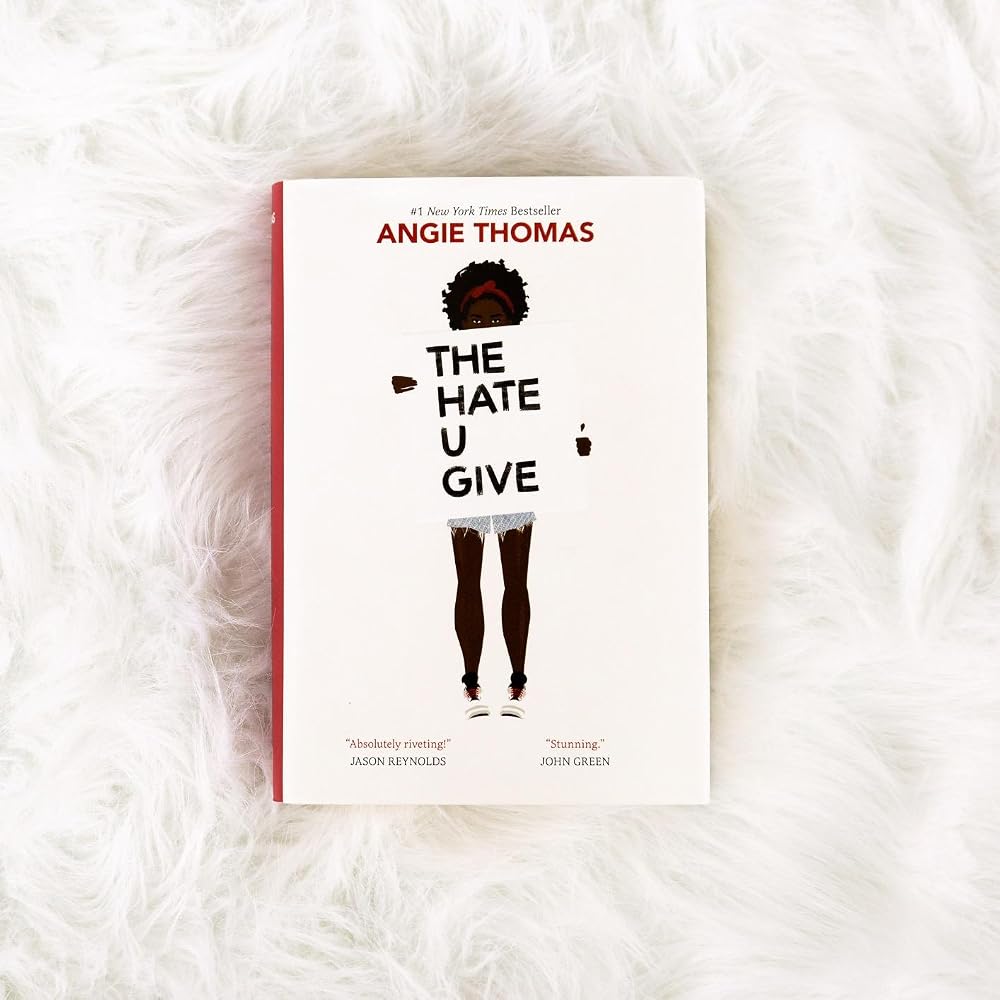
"Absolutely riveting!" --Jason Reynolds
"Stunning." --John Green
"This story is necessary. This story is important." --Kirkus (starred review)
"Heartbreakingly topical." --Publishers Weekly (starred review)
"A marvel of verisimilitude." --Booklist (starred review)
"A powerful, in-your-face novel." --Horn Book (starred review)
Sixteen-year-old Starr Carter moves between two worlds: the poor neighborhood where she lives and the fancy suburban prep school she attends. The uneasy balance between these worlds is shattered when Starr witnesses the fatal shooting of her childhood best friend Khalil at the hands of a police officer. Khalil was unarmed.
Soon afterward, his death is a national headline. Some are calling him a thug, maybe even a drug dealer and a gangbanger. Protesters are taking to the streets in Khalil's name. Some cops and the local drug lord try to intimidate Starr and her family. What everyone wants to know is: what really went down that night? And the only person alive who can answer that is Starr.
But what Starr does--or does not--say could upend her community. It could also endanger her life.
Want more of Garden Heights? Catch Maverick and Seven's story in Concrete Rose, Angie Thomas's powerful prequel to The Hate U Give.
Book Details
- ISBN
- 9780062498533
- Binding
- Hardcover
- Authors
- Angie Thomas
- Publisher
- Clarion Books
- Published Date
- February 28, 2017
- Language
- English
- Pages
- 464
- Physical Info
- 1.6 in H x 8.3 in L x 5.9 in W (0.9 lb)


I'm going to start with this--I just finished this book a little less than an hour ago, and I can already say that it has changed my life.Angie Thomas's book about 16-year-old Starr Carter left me speechless and crying for so many reasons, and I'm not sure I can even explain why adequately. Starr herself is written perfectly. She's a high school junior who loves basketball, used to have a massive crush on a Jonas brother, and collects sneakers. She also loves her family, even when they embarrass or frustrate her, is a good student at the private school she attends with almost exclusively rich, white kids (one of whom is her boyfriend), and helps at her dad's community grocery store when she can.However, her life is very different from the ones her friends at school live. Starr is the only black girl in her junior class, lives in a poor black neighborhood that sees more than its fair share of gang violence, is the daughter of an ex-gang member who served time in prison, and saw one of her two best friends killed in a drive-by when she was ten years old.And on the night she is with her other childhood best friend, Khalil, when he is shot in the back by a police officer, despite being unarmed and not doing anything to provoke the officer in any way, she finds herself in the middle of all the fallout from the shooting while still grieving Khalil's death.I'm more than a little ashamed to admit that I'm a privileged white woman in a tiny, primarily white community who has never really even given a ton of thought to the Black Lives Matter movement. I have heard the news, and I felt a piece of the injustice of it all, but prior to reading The Hate U Give, I had never really tried to imagine what the black community really felt. I'm still a privileged white woman in a tiny, primarily white community, which means that I will never really be able to understand what the black community feels, but I'm trying, and I'm trying so much harder than I ever did before.As far as a review, I'm not sure what to say. This is young adult fiction, so I knew it wouldn't be the level of writing to which I'm accustomed. However, Angie Thomas still did an excellent job of creating living, breathing characters and thought-provoking text that made me grab my highlighter many times as I read. The teenagers spoke exactly as teenagers do without coming across as cliché at all, and I usually find that adult young adult writers either try TOO hard to make teenage characters sound like teenagers OR they make them sound entirely too grown up (I'm looking at you in The Fault in Our Stars, John Green. Yeah. I said it.). Thomas, however, nailed it.Meanwhile, The Hate U Give is filled with the kind of profound statements that I never expected from young adult fiction, but they still felt completely natural and appropriate--statements that made me, as an adult, stop and question my own behaviors and thoughts. Statements like the following:"I always said that if I saw it happen to somebody, I would have the loudest voice, making sure the world knew what went down. Now I am that person, and I'm too afraid to speak.""The truth casts a shadow over the kitchen--people like us in situations like this become hashtags, but they rarely get justice.""That's the problem. We let people say stuff, and they say it so much that it becomes okay to them and normal for us. What's the point in having a voice if you're gonna be silent in those moments you shouldn't be?"When I finished this book a little while ago, I sobbed like I haven't at the end of a book in a LONG time. I sobbed for Khalil and his community, but more so for the list of real names at the end (that's not a spoiler...promise). There were plenty of moments in the book that made me chuckle a little that helped break up the heaviness of the book (especially when DeVante, Seven, and Starr start making fun of white people, because, let's be honest, everything they said was true), but the weight of the truth this book made me see hit me like a ton of bricks. I'm white. I never have to worry about one of my sons being killed by the police simply for their skin color. And I will never understand that particular reality. Instead, I have been living inside my safe little bubble where I believed that ALL police officers are good and ALL police officers are just trying to do their jobs and racism is really not THAT bad in our country. I never allowed myself to see that SOME police officers are downright racist, and SOME police officers are scared of young, black men simply because they are young, black men, and people of color ARE treated differently, and ANY racism IS that bad.The Hate U Give started changing all that. It enabled me to step into the shoes of a 16-year-old black girl who saw her childhood best friend shot simply because he was young, black, and in a neighborhood with a bad reputation. It also enabled me to see that the lives behind the news headlines are so much more complicated than I am oft...
I couldn’t put this book down. The best book I’ve read in quite some time. This book should be read by everyone.
One of my favorite books, absolutely love and recommend!!
This is a first-hand look at the experiences of people directly involved with the tragic killing of Black men and women by White police officers, and Ms. Thomas draws us into the story in a way that we can empathize with everyone involved. It’s one thing to read news reports about such events, but we don’t often get a real understanding of the issues challenging a poor black community.Poverty that makes the temptation to get with a gang and make money selling drugs hard to resist.Living in such a neighborhood that makes everyone a suspect in the eyes of police.Fear of the gangs that makes a person just want to duck their head and pretend that everything is okay.Living with the danger of drive-by shootings and other violence of the inner city.As I read the story and shared with Starr the absolute horror of seeing her friend get shot, I could empathize, but only to a point. We, mostly White folks, who have never had to listen to The Talk, or see what Starr had to see, have no idea. Not really. Racism is so complicated, and the Black community experiences things we will just never know first-hand.The push-pull between Starr’s wanting to speak out and fear of doing so, was so real. And I loved what her mother said at one point, “Sometimes you can do everything right and things will still go wrong. The key is to never stop doing right.”At first I didn’t understand why the author chose to have Starr and her brothers go to a school in an affluent White neighborhood, but as the contrasts between her life and theirs came clearer and clearer, I got it. The cluelessness of one of her school friends about racism in the past and present, reflects the positions of so many people today who want to just erase the injustices and pretend they never happened. “We can just be friends.”The characters are nicely drawn, and it was nice to hear distinct voices. Each spoke in a way that reflected their past and education, and Starr worked hard to leave her “ghetto” speak at home when she went to school. That contrast added another layer to the story, as does her relationship with a White boyfriend, Chris. During the aftermath from the killing of Starr’s friend, she and Chris have to explore their feelings for each other in a way they never had to before.The Hate U Give isn’t always an easy read, but it it an important one. We as a society can’t ignore the facts of racism and how it affects so many people, and this book give us those facts in an engrossing story with a wonderful main character. I highly recommend it.
The thing with “The Hate U Give” is that it’s supposed to be fictional, but this story is not fiction in the slightest. The things Starr experiences, what happened to Khalil, are real, they do happen, they are still happening. Which makes this book so hard to both read and review because it becomes really difficult to separate fiction from reality. Which is probably the point. Starr witnesses not one, but two of her friend’s violent murders. Even though the focus is primarily on Khalil, Starr grew up no stranger to violence. The opening chapter is her at a party that she has to flee because of shots being fired. This is Starr’s reality; she is torn between the community she grew up in and being “black enough” to fit in to these types of parties, and then the preppy, very white private school she attends where she can’t be “too black”. Even though Starr is not a real person, her situation is not fictional. Neither is Khalil’s where, no matter what, he should never have been murdered by a cop. Which is why I do think that this book is very important to read, I just don’t think it’s all that appropriate for younger YA readers.The first half of the book (after the first 2 chapters) was hard for me to get into, not because of the message or the horror that Starr witnesses, mainly it was kind of slow and some of the contemporary aspects don’t age well as trends change. I also found Starr’s school to be overly stereotypical, and a lot of the characters to be rather hypocritical, especially where Chris is concerned. The idea that sending Starr and her siblings to a different school to keep them safe when the violence they witnessed wasn’t centered at their school didn’t always track with me, either. But that’s not why I’d hesitate to give this to a younger reader: this book is heavy. “The Hate U Give” focuses on more than just police brutality, it focuses on addiction in a community under siege from a very active drug dealer and his gang, there are also instances of abuse against kids and adults, and that’s on top of the utter devastation that is Starr’s grief during her tremendous ordeal of trying to get justice for Khalil. It’s just something to keep in mind when you are considering having your younger readers pick up this book.The character dynamics are all messy in a very real way, and I really enjoyed that. Every relationship is complex, important, and rewarding in its own way. But I really loved Starr’s family, and how Starr pushes back against Kenya when she keeps dismissing that Seven is Starr’s brother too. I also have siblings where we share a dad and not a mom, so Starr’s feelings over Seven and his relationship with his other sisters and how that made Starr feel was beautiful, and also important. Honestly, this book is full of important messages beyond just the main plot line! It’s a very complex story line in that regard with a lot going on (another reason this may not be great for younger readers).For as much as is happening in this book with subplots and complex topics around race, family, and friend dynamics, there may have been too much going on that required deeper focus. The ending was both disappointing and beautiful. It’s realistic which is really sad and infuriating, but then you have these sprinklings of hope and a type of happy ending for Starr with Mav finally listening to Lisa about what was best for their family. Plus there is closure and new beginnings for Starr and her friends, as well as what will become of Garden Heights. All of that gets wrapped up in just a few chapters which felt too quick given the importance of those subplots. So it left me feeling… confused. Which, like I originally said, makes this book so hard to review because the story structure wasn’t the best in my opinion, but the fact that many of the topics in this story are not works of fiction… It’s really that first half of the book though that keeps me from loving this novel as much as I wanted to. This story is powerful, it needs to be told and to be shared and discussed, just like all the other books (fiction and nonfiction alike) that discuss these topics. Just some tell the fiction side of things better in my opinion.
This is the perfect time in our society to read The Hate U Give. The book is based on justice for black people which goes along perfectly with the Black Lives Matter movement and protests that are happening today. The book is written from Starr Carter’s point of view. Starr and her friend Khalil Harris are driving home from a party together when they are, without any reason, pulled over by a police officer. Khalil is shot by the police officer because he was thought to have a gun with him, but that gun was a hairbrush, and the police officer continues to point the gun at Starr while he calls for backup. The truth is that, because Starr and Khalil are black, the police officer automatically assumed they were doing something wrong. But they were only two kids driving home, and Khalil deserved to live. Starr is a sixteen-year-old black high school student whose life is split in two. On one side, she’s a girl who lives in a black neighborhood, Garden Heights, surrounded by her black community. On the other side, she is one of the only few black people at her “rich people”, primarily white, private high school, Williamson Prep. She has two brothers, the oldest being Seven, and the youngest Sekani. Seven is her half-brother. Starr and Seven share the same father but have different mothers. Starr shares her brother Seven with Kesha, Seven’s half-sister, who grew up being friends with Starr. Her father, Maverick (a.k.a. “Big Mav”), owns a grocery store in Garden Heights and her mother, Lisa, is a nurse. Mrs. Carter drives Seven, Starr, and Sekani forty-five minutes to school each day so they can go to a good school. Starr struggles as she feels like she must act differently depending on who she's with- her white boyfriend, Chris, and her white friends that go to Williamson, or her childhood friends and family that live in Garden Heights. After Khalil is murdered, she feels she must speak out, even though it takes her a while to realize, and she could be in danger in the process. I love Angie Thomas’s writing style in The Hate U Give. She is writing from Starr’s point of view, so she writes exactly how everyone in the book would talk. She uses slang, and things that are popular in our culture today which makes this book especially enjoyable for young people to read. She even uses lyrics from songs that were popular in 2018. As a teenager, the way Thomas writes helps me relate to Starr. I think this book is great to read. It’s entertaining, heart-breaking, funny at times, and I feel like I learned many lessons from it. I will never understand what life is like for someone like Starr. It is a sad and broken world we live in, and life is not fair. I personally love reading when I find a good book, but I have friends that don’t like reading and they really enjoyed this book. There is never a dull moment. I was never bored while reading this book. It was powerful, inspiring, and I was intrigued all the way through. In my opinion, this book is a best seller because it discusses cultural conflicts in an informative yet entertaining way that makes you want to never put the book down. So many people can relate to Starr’s story on a personal level. This book is fiction, but everything in it has occurred more times that it should.
This was a fairly enjoyable read. There was a lot of drama, along with good characterization, and the sorts of questions and growing up that one expects with YA. YA is not my cup of tea, generally, but I always try to read it like a kid would, which, admittedly, is difficult, as I’ve never been a kid. I recognize that it's a work of fiction highlighting an unusual time in the life of the main character, Starr; however, I felt like there were moments when it was just too much and the suspension of disbelief, for me, started to fail. I have a love-hate relationship with the show "Supernatural," and "The Hate U Give" was starting to reach Supernatural-level of misery porn, and I didn't much like it.The plot was somewhat boilerplate, focusing on an issue du jour, police brutality and racism, and, while I appreciate the salience, it got a bit afternoon special preachy after a bit.The characterizations were pretty decent, especially when it came to describing what characters did or said. When it came to rich description of people and places, I felt there was a failure, and things were detrimentally underspecified.Also, for as rich an interior life as Starr has, I wish there would have been more depth, especially with her struggles. She has reactions, such as crying and throwing up, to the tragedies, injustice, and misery around her, but then she gets over things quickly, without much discussion. Over and over, she confronts issues such as being brave, speaking out, being true to herself, finding her identity, etc., and she has a few hiccups, and then overcomes everything in her path without much more ado, culminating in an iconic Banksy-esque lobbing back of a tear gas canister. I wish there would have been more focus on her struggling, failing, getting back up, and trying again, with some more ambiguous outcomes, at least in part. In a lot of ways, Starr is very naïve, which makes sense, I suppose, with how this is a YA book.There is also the issue of the fact that we are supposed to care about Khalil and Natasha, but we aren't given much information on either and, while we get some flashbacks regarding Khalil, we don't really get much information regarding Natasha. I just can't care much about characters that I'm not invested in. This is a serious flaw in the book and is not unique to it. I recently watched Netflix's "Umbrella Academy," and it suffered from the same problem: it tried to get me to care about characters, relationships, and situations that it couldn't be bothered to flesh out and let me experience. Instead, it opted for saying they happened and showing the characters reacting to them. It's cheap and manipulative and I don't like it. If you want me to care, then you need to put in the work and effort, and actually show me and take me along the journey or it's no dice. The book would've been much improved by giving us a few chapters with Khalil and by fleshing out Natasha and her past better. Again, if you want me to care about the tragedy and injustice, I need to be invested. I didn't feel very invested in Khalil and very much less so in Natasha.There were a few issues that I wish the story would have touched on. The first being Black capitalism. Starr lives in the “ghetto” of Garden Heights but goes to an expensive private school on the other side of a largeish city. Needless to say, nobody else in her neighborhood has that opportunity for total-life advancement. She doesn’t need to live there and, indeed, her mom constantly wants to leave. Her family has the financial means to live in a better neighborhood, but her father has issues with his own identity and feels that they need to live in a dangerous place because it’s somehow more “authentic.” The author touches on this briefly, towards the end, but doesn’t go into needed detail. In fact, Starr is middle class and essentially LARPing as “hood” and this may be the actual source of some of her issues with authenticity. Her father failed upwards, more or less, into a successful business and her mother is a hardworking nurse.Their house was given to them by Starr’s maternal grandmother. They are very unlike other people in Garden Heights, such as Khalil and his family and, in other ways, Kenya and her family. They have money and access to resources that they are choosing not to use essentially for the aesthetics of it. Very briefly, at certain points, characters note how capitalism oppresses them, but then go on to extol the virtues of Black capitalism and Black-owned businesses, as if they will save them instead of oppressing them. I am disappointed in this weak and obscure class analysis. Especially as it ties directly in to the causes of police brutality, systemic racism in policing, and the decay of urban neighborhoods. It also didn’t reveal anything about how inner-city gangs are a toxic form of Black capitalism, nor did it address how capitalism causes gangs and how the police and gangs use each other.The racial analysis in the book was al...
REVIEWED: Kindle version of Angela Thomas, „The Hate U Give“ (2017, B+B - Brazer and Bray, HarperCollins, ©"EPub Edition © February 2017 ISBN 9780062498557)Ms. Thomas proves herself a very worthy novelist with "The Hate U Give," her first and wondrous novel (for youth, but really for all!).Let me recommend, in a related vein, a wonderful national poet from Mississippi's Gulf Coast, Jesmyn Ward in her "Sing, Unburied Sing" (2018). Ms. Ward's work (which I have separately reviewed) needs to be read aloud, as it is poetic-prose of tremendous force.Now to Ms Angie Thomas, who worthily enters the literary world with a novel that reaches out to the mature audience while introducing youth to a literature with immersion in the mind of a deep, spiritual heroine, as well as introducing the young reader to a variety of communities and current civil rights movements.Ms. Thomas introduces the high-school reader to the tools of literature -- musical allusions, alliterative prose, metaphors, literary images.One small example: "115" is the badge number of a bad-cop (without spoiling the plot - this may be an understatement). Starr, overwrought from trauma, wakes up at "11:05" AM -- re-emphasizing the "115" theme. This is only one small example of how the worthy author introduces to young people how good and great novelists use themes throughout a work to create poetic rhythm and spiritual continuity.Ms. Thomas immerses the reader in the mind of Starr Amara Carter, a sixteen-year-old young woman whose loved ones have helped her build spiritual inner strength to grow in the midst of tragedy that no person, much less a person of tender years, should have to live through.Written for youth, this 72-year-old grandfather (helping my grandson in school) found Ms Thomas to be a very worthwhile literary person for my own enrichment.Your high-school student should find much meeting ground with young women struggling with growing into love relationships and dealing with annoying loved ones and peer struggles with cool elite kids and sharing of video games, Harry Potter, rap music and background exposure to substance abuse, and inner city gangs with their own hierarchy and gangland Code of Honor.Tragedy forces young people, who are - and have every reason to be - afraid, somehow find inner strength to face the strong tides and do what is - and feels - right in the face of a storm-surge of gangland violence and police brutality and overreaction.Against these tremendous, oppressive community forces, our young find comic relief in annoying, over-attentive loved ones, who can be counted on to tell our young teenagers what these youth find superfluous, but which they must hear out, because these youth realize that their unaccounted absences in the face of gangland violence caused mom and dad, uncle and aunt, not to speak of grandma, heartache and deep worry, not to speak (shock to dad!) - finding out that his well-loved daughter was dating interracially — which racial concern seems admittedly not only outdated but, one would think, pale in comparison with dangers Dad worried about that his daughter had bravely faced.In short, Ms Thomas brings to life a core of compelling personalities, especially a teenage girl who in short order evolved - or, rather, by the tide of overwhelming community forces — had to mature into a brave, deep-thinking woman, well before her time.As a reader, I for one, feel enormously enriched by my growing acquaintance and even friendship with deep, good persons — definitely including the loved ones who, while amusingly annoying, provided the emotional shelter for Starr to grow strong.
This book was written a while ago and I'm surprised I'm so late in reading it. I mean, the movie has already come out. But I finally read it and it was perfect timing.I'm an older white woman reading about a teenage black girl. I say this because we seem to be far apart in age and race, so how could I grasp how she felt and what she lived through? Huh? However, I was easily able to connect with her. I could feel her (Starr) in my head. I could hear her talking and laughing and crying. And that's what's important. To be able to identify with the main character in a story is critical. The author was very skilled at being able to make this happen. I'm sure others felt the same way.Everybody else has said wonderful things about the book, I'm sure. I haven't read any of the other reviews yet. But by the amount of 5 stars here, I'm positive the reviews are equally high in praise. So I'm not going to say a whole heck of a lot because it will just be a repeat of what others have said before me.What I do want to say is that I wish everyone my age and my race and my sex, would feel compelled to read this book. In fact, if everybody just read it - that would be perfect.It's important that we white people need to try extra hard to understand how black people live in our country and why they feel the way they do on certain subjects. Why? Because if we want them to care about us, we have to show that we have an interest in them and an appreciation of their struggle. They've had to live lives in a way that few white people have had to live. It's not about money. Not enough money does make life worse for whoever has that problem. It complicates things. But it's more about attitudes and treatment. These are the things that white folk don't get. But we can get it, if we are willing to really think about it and take the time to listen to real life stories. To compare our lives with their lives. To walk a mile in their shoes. If we can do that and they can do the same with us. Then we'd be at a place to sit down and discuss how to go into the future. It starts with respect and compassion and understanding first. Getting there will take work. And time.Older women need to be able to read about teen girls and recall what it was like to be that age. We all were at that stage at one time. But we forget about that. However, we all had boyfriends (like Star did) and parents who may not have approved of said boyfriend. We hung out with our friends, went to school and we lived in a neighborhood, either in the city or out in the country. If we want to understand young people of today and what they go through...we have to come from a place of when we were their age.I liked the fact that the author had Starr going to a mostly all white school. Because where she lived was nearly an all black neighborhood, it was great to see the contrast. It was good to see how some of her white friends acted compared to other friends, who were different. It showed how some folks don't see themselves as racist when in fact, they are.This book addresses so many subjects. Here is one spoiler. (ALERT). Starr's long time childhood friend is shot and killed....murdered in the street, while she watched, by a white police officer. How many times do we read about this is the newspapers or on the Internet? It's every week.I hear people saying, 'We're tired of the rioting and the protests'. Well, hey, what might you suggest people do who are not being heard? Year after year. Decade after decade? If nobody was listening or caring about anything you had to say, maybe you'd get frustrated and angry finally. I'm not saying looting and hurting cops or innocent store owners is the right thing. I don't believe that solves anything. But I'm not living their life. Am I? No.The protagonist and heroine of this story is Starr Carter, with many supporting characters. They feel real and alive. Their pain and grief seems real and alive as well. Maybe one day when we see enough 'real life' on the TV and when we read enough books like this, maybe we'll get it. I hope so. It seems like in 2020, we'd be well past all this hate and prejudice. It pains me greatly that we have not advanced as much as I had hoped. At least this year we have learned the truth of what our country really is. We've seen the good and the bad. It's all out there open.Ms Thomas has my vote, as a writer. I love how she crafted her characters. I got pulled into the dialog and the interactions between the characters. The story ended....but the fight goes on in the real world.Update: I did also finally see the film and even though it's not quite the same as the book, I did enjoy it as well. The young lady that played Star (Amandla Stenberg) was prefection.
This book takes you inside Starr's head and helps you not only see what she sees but feel what she feels. She is a high school girl at a party where she doesn’t feel comfortable. She comes across an old friend, Khalil. They are just chatting and catching up when a fight breaks out and a gun is fired. They don’t stop to find out what is going on, they run with everyone else.“I don’t try to see who got shot or who did it. You can’t snitch if you don’t know anything.”They escape, and are headed home, listening to some music, when they get pulled over by the police. Khalil is annoyed and Starr is scared. He tries to reassure her that it’s going to be alright, but when he opens the car door to check on her, the cop shoots him.Her parents come and get her. She is sick and numb. Starr had watched another friend die. Natasha was killed in a drive by shooting by a gang member as the two of them played in the water from a fire hydrant on a hot day. The three of them had been friends. “Tighter than the inside of Voldemort’s nose.”“I always said that if I saw it happen to somebody, I would have the loudest voice, making sure the world knew what went down. Now I am that person, and I’m too afraid to speak.”I love the way we get to know all different types of people in the book who are multi-dimensional. There’s Starr’s older brother, Seven, and her younger brother Sekani. Her father, Big Mav, and her mother, Lisa. There’s a list of characters too big to name in a little book review, it’s a whole neighborhood and then some, but it never gets unmanageable. Sometimes it gets confusing when authors introduce too many people, but not here. Thomas introduces them one by one into the action with situations and characteristics that make them stand on their own like real people.There are so many facets to the story, I couldn’t possibly cover them all here, but she tackles it all beautifully. Starr’s uncle, Carlos, is a cop himself. Starr is dating a white boy from her school named Chris, and they care very much about each other. Music is a major strand, the dating life of teens, social interactions, being one of the few black kids in a mostly white school her mother enrolled her in, and PTSD. The fear that Starr lived with that something bad could happen when they were stopped by a cop. The guilt Starr feels for living and for not speaking up right away. Thomas clearly depicts how Starr gets to the point where she wants to riot, but also sees the damage that the rioting does to her neighbors and neighborhood.The gang activity in the community is a large part of the story, as the head of one gang is married to Seven’s mother. The story is never simple, and yet it is clearly told and easy to follow. We see the good and the bad in the neighborhood. How belonging to gangs can provide for people even as it contributes to the decay. The way the gangs are part of the community, like it or not. Starr’s father is the former head of a gang and went to jail for three years to get out of the gang. Thomas touches on the system of drugs, addiction, selling, jails, and poverty.It is a very rich story that brings these characters beautifully to life. You half expect you could start driving and eventually pull up in front of their house.I don’t think I have a single negative to give about this book. It is wonderful – insightful, accessible, and expressive. I want everyone to read it. If I could give it more than five stars I would. It is another solid example of why I believe that some of the best authors out there are writing young adult literature and everyone should read some.
Starr Turner, the teenage heroine of Angie Thomas' debut novel The Hate U Give, has a pretty neutral perspective on cops when the book begins: her beloved uncle Carlos is a police officer, and she's been taught by him and her parents to behave in a threat-neutralizing way if she interacts with them: be polite, follow orders, don't make sudden movements. And she's never had any trouble. But then one night, when she's getting a ride home from a party from her long-time friend Khalil, they're pulled over on a pretext by a white cop, and he's shot to death, right there in front of Starr. It changes everything about her life and how she sees the world.Starr's already living a fairly unusual life...she lives with her family in the inner city, but goes to a private, overwhelmingly white high school in the suburbs, where she has mostly white friends and dates a white classmate. She's always found herself living half in each world, but what happens that night really blows up her burgeoning racial consciousness. Her relationships with her friends and family shift and change as she tries to navigate the legal system and get justice for Khalil, and she discovers more and more who she is and who she wants to be.This book had been hyped for months before I got to it...glowing reviews all over the internet, movie rights sold before it was even published. I always try to temper my expectations with any kind of media that's been all the rage, but sometimes it doesn't work. And honestly, I think it contributed towards the way I felt about this book: it's very good, and I probably would have thought it was amazing if it hadn't been sold as life-changing and mind-blowing, but it didn't quite measure up to those enormous accolades for me. There's a compelling story, solid writing with both emotion and humor, and great characterization. But as a reader, there just was never that moment where it really went into hyperdrive and became more than the sum of its parts.Like I said, though, it does everything it's trying to do very well: Starr practically jumps off the page and feels very real, and her family is also beautifully, warmly drawn. Even though Khalil is barely alive during the novel, the way that Starr thinks about him as she processes what happened to him is touchingly rendered and makes the reader really feel his loss. Thomas also does an excellent job of balancing the heavy topic at the center of her book with lightness...there were parts that literally made me laugh out loud, but she never either undercuts the seriousness of police violence or gets too ponderous. But the characters of Starr's school friends, and especially her boyfriend, seem underdeveloped for the significance that the narrative places on them. And a decision Starr makes near the end of the book seems out of place, in a way that was jarring.At the end of the day, I'd recommend it to just about everyone, honestly. It's written as YA (and as a primarily non-YA reader, I'd say it doesn't read as typical for the genre but does have some markings of it), so it's appropriate for younger readers, but it didn't feel dumbed-down to me, someone who loves a gigantic tome of literary fiction. Obviously the focus on police violence will be difficult for some, but it's a well-crafted, enjoyable book that will likely inspire you to examine your own pre-existing opinions. I highly recommend it!
Summary: Starr Carter is a girl who leads two lives. She lives in the run-down neighborhood of Garden Heights with her family and goes to school at Williamson Prep.- a predominately white private school. Starr’s life changes when she witnesses one of her best friends getting shot and killed by a police officer. This event spirals into a huge news story that Starr becomes the main witness of. She leads as an activist in her community to get justice for her friend.Characters: Starr Carter: Starr is the sixteen-year-old protagonist of the story. She is a tough girl who is not afraid to share her opinion but can control what she says. Starr is careful of how she speaks around the kids that she goes to school with; always making sure that she does not sound too “ghetto.” Starr witnesses one of her best friends, Khalil Harris, get shot and killed by a police officer. After that event, Starr tries to help gain justice for Khalil by acting as a main witness in his case. Khalil Harris: Khalil is one of Starr’s best childhood friend. He gets killed by a police officer after he and Starr were driving home from a party. The media depicts Khalil as a “thug,” “drug dealer,” and “gangbanger” because he was accused of selling drugs. Later in the novel, the motivation for Khalil to sell drugs is revealed. Seven Carter: Seven is Starr’s eighteen-year-old brother. He is her half brother, they have the same father but different mothers. This creates some conflict with the Carter family. Seven is very protective of Star but is a good brother to her. Maverick Carter: Maverick is Starr and Seven’s father. He is an ex-convict and was convicted due to being apart of gang related events. Maverick owns a grocery store in Garden Heights and tries to be a good role model for his children. He makes sure that they a get a good education and stay out of gangs so that they do not make the same mistakes he did.Conflicts: The main conflict of the novel revolves around the court case of the officer who shot Khalil and whether he should go to jail or not. The majority of the other conflicts of the novel are repercussions of the main conflict. Starr has internal conflict throughout the novel. At times she does not know if she is doing the right thing for Khalil and the court case. Starr also has difficulty balancing the two lives she leads, the one at Williamson and the one at home in Garden Heights. Starr has friend drama with two of her best friends that go to Williamson- Hailey and Maya. This occurs due to Starr not telling them the whole truth about the case and Hailey acting rudely towards Starr.Rating:I really enjoyed this novel because I was engaged throughout the entire story. The theme of the story was inspiring and extremely eye-opening. It made me view the world from a different perspective because I was exposed to a life that is drastically different from mine. I would classify this novel as realistic fiction because it could happen in real life but was based off of fictional characters. I would recommend this novel to readers who enjoy realistic fiction novels with the protagonist being a strong female. This novel is similar to many news stories seen on television of innocent people being shot by the police because that is the main conflict that this novel revolves around. I rate this novel nine out of ten stars because it is extremely well written and keeps the reader on their toes for the duration of the novel.

