

The Hitchhiker's Guide to the Galaxy
 )
 )
Couldn't load pickup availability
"IRRESISTIBLE!"
--The Boston Globe
Seconds before the Earth is demolished to make way for a galactic freeway, Arthur Dent is plucked off the planet by his friend Ford Prefect, a researcher for the revised edition of The Hitchhiker's Guide to the Galaxy who, for the last fifteen years, has been posing as an out-of-work actor.
Together this dynamic pair begin a journey through space aided by quotes from The Hitchhiker's Guide ("A towel is about the most massively useful thing an interstellar hitchhiker can have") and a galaxy-full of fellow travelers: Zaphod Beeblebrox--the two-headed, three-armed ex-hippie and totally out-to-lunch president of the galaxy; Trillian, Zaphod's girlfriend (formally Tricia McMillan), whom Arthur tried to pick up at a cocktail party once upon a time zone; Marvin, a paranoid, brilliant, and chronically depressed robot; Veet Voojagig, a former graduate student who is obsessed with the disappearance of all the ballpoint pens he bought over the years.
Where are these pens? Why are we born? Why do we die? Why do we spend so much time between wearing digital watches? For all the answers stick your thumb to the stars. And don't forget to bring a towel!
"[A] WHIMSICAL ODYSSEY...Characters frolic through the galaxy with infectious joy".
--Publishers Weekly
Book Details
- ISBN
- 0345391802
- Binding
- Mass Market Paperbound
- Authors
- Douglas Adams
- Publisher
- Del Rey Books
- Published Date
- September 27, 1995
- Language
- English
- Pages
- 224
- Physical Info
- 0.7 in H x 6.8 in L x 4.1 in W (0.25 lb)
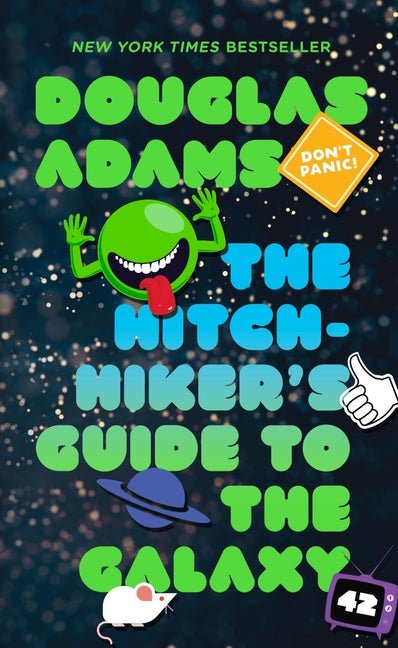
The Hitchhiker’s Guide To The Galaxy never appealed to me, beyond the opening sequences where a human (Arthur Dent) is pulled from our planet which is soon to be pulverized to make way for a galactic freeway. I like that concept, but then was turned off by the various space creatures that come next in the television and movie adaptations of this story. I don’t think I ever made it through to the end of even one of these. They were just too weird So I never bothered to read Douglas Adams’ novel. I assumed I knew all that it had offer: a pleasing narration, a great premise, and oddball characters that eventually consume the best of what the story has to offer. Of course, I was wrong. Where the moving picture versions allow the director to explore one vision of this tale, my mind can create many alternate ideas. My imagination soared into space this time as I read the story, following along with Arthur and Ford Prefect. The aliens as described in the book don’t overwhelm the story, but instead complement the adventure. The novel still has that fantastic setup, plus the wit of narration, but the book also maintains a focus on the plight of the humans that I didn’t encounter in the film adaptations. This story is one of the most pleasant that I have ever read, although it builds towards surprising profundity as we experience the frailty of human existence. Adams tosses deep and complex ideas into the mix much more often as we near the end of this adventure and, as many other reviewers have pointed out, it all ends too soon.

"The Hitchhiker's Guide to the Galaxy" is a thoroughly strange book, that at the same time is oddly charming. It starts in a really weird way, with the demolition of Earth (yes, our planet) in order to build a interestellar highway. Only one man survives the end of our world: an Englishman, Arthur Dent. Arthur is saved from sure death by one of his friends, Ford Prefect, that also happened to be an alien doing some research for "The Hitchhiker's Guide to the Galaxy" (an electronic book that "tells you everything you need to know about anything", and that specially highlights the need for a towel).Ford got a lift for them with a Vogon spaceship, where they would soon be subjected to a danger worse than death: Vogon poetry. Anyway, as nothing bad last forever, there were soon ejected into space to suffer certain and painful death, only to be rescued again just in time to begin their adventures.Both Ford and Arthur are interesting characters, but I found Arthur's whining particularly funny. For example, and in his own words to Ford: "you are talking about a positive mental attitude and you haven't even had your planet demolished today. I woke up this morning and thought I'd have a nice relaxed day, do a bit of reading, brush the dog... It is now just after four in the afternoon and I am already being thrown out of an alien spaceship six light-years from the smoking remains of the Earth!".There are other characters and things you will find interesting, like an eternally depressed robot (life, "loathe it or ignore it, you can't like it"), Zaphod Beeblebrox, and the Babel fish (capable of translating any language in the galaxy if you put them in your ear). There are also some scenes that appear out of the blue, but that are quite enchanting. For instance "Arthur blinked at the screens and felt he was missing something important. Suddenly he realized what it was. - Is there any tea on this spaceship?-he said".On the whole, I highly recommend this book. Its premise is extremely original, and you will have lots of fun reading it. If you can, buy it know, and be ready to meet the mice * :)Belen Alcat (* = you will understand that phrase only after reading this book!!!)
'The Hitchhiker's Guide To The Galaxy,' by Douglas Adams, is a spontaneous comic adventure. To bring out the humorous characters and events, Douglas Adams uses a lot of satire to attract the reader's attention. A scene that brings out much of the satire is at the beginning of the book. Arthur Ford lies in front of bulldozer to stop the demolition of his house so the city can build a bypass. Arthur, having just found out the day before, is annoyed because the plans were buried from the public. To emphasize the satire, Adams destroys Earth to build an intergalactic bypass whose plans were also buried. This is all going on while the construction workers are trying to find a way to get more money out of their union for working with insane people. Adam uses this satire throughout the entire book to give it an added flavor and to persuade changes on earth with certain situations. As Arthur and Ford start hitchhiking their way around the galaxy to find the ultimate answers to life and the universe, they encounter worlds full of trouble. The story starts out with Arthur Dent protesting his house from being torn down for a bypass, when his friend Ford Perfect, an alien who has been posing as an out-of-work actor on earth for the past fifteen years, drags Arthur away to tell him the world is going to be destroyed. He warns his disbelieving friend Arthur that the planet is soon to blow up, and rescues both of them seconds before its destruction by hitching a ride from the Vogons. After Ford and Arthur are tortured by hideous poetry, Zaphod Beeblebrox, the president of the galaxy, and Trillia, the only other surviving human being, save them. Together they travel the galaxy to lead to the ultimate answers to life.I would say this book is Random. Sinister. Funny. 'The Hitchhiker's Guide to the Galaxy' covers everything from galactic space monsters to far-off planets no one has ever of. This completely random book has the reader on his toes from the very first page to the last. Totally unpredictable. If you want a joyful, whimsical ride through space, then read 'The Hitchhiker's Guide to the Galaxy
The Hitchhiker’s Guide to the Galaxy is a a classic and often humorous work of science fiction. The book is a quick read and well written. While I believe that it might be slightly over-hyped by its fans it is still a must read.
This was a gift, they loved it. Such a great funny story.
One of my favorite books of all time. I bought this version because the only other one I have is all 6 stories in one and I don't much feel like carrying 1000 page book around. Still an amazing book, now on to why I gave it 3 stars.The quality of the physical book itself is garbage. Print margins all over the place, faded text, text bleeding from one page to another. I guess you get what you pay for at this price, but yeesh, should have just looked for a used copy of something more decent somewhere else.
Beautifully bound and illustrated. Maybe my kids will finally understand why 42 is the answer.
This book is a must read according to Elon Musk. Although I’m admittedly not a science fiction fan, there some parts that are amusing. A quick enjoyable read.
I read this classic because I needed the explanation on to why the answer of the question of life, the universe and everything, is what it says it is. And I agree. And how could I not, is it worth to spend another let’s say 1.5 million years to reconsider the answer to all things?The only thing I had maybe an issue with is, that certain dialogs were a bit confusing and hard to follow (reading beginner plus I’m not native English).Also isn’t it amazing, how certain things are detailed in the book precisely what 30 years prior to their invention..(Touchpads and such | thought it’s a fun fact)I like his writing style and mostly his humor, however, some pov narrator moments brought me out of the story when he makes a weird side fact joke. Yea it’s funny but yea.Not sure if I need to read the second book I shall see.
This book is not for everyone. Try the Kindle teaser though. If you like the teaser, you will almost certainly enjoy the book.The book itself defies description, but an earthling and three aliens escape earth just before it is destroyed and proceed on a fast paced tour of the galaxy where they encounter other aliens trying to decipher the meaning of life. It’s wacky, sometimes its stupid yet overall it’s very clever. Above all, its fast paced and very engaging for some strange reason.
This is a very quick read and I think anyone who has a chance should check it out. The author is incredibly imaginative and I don't know that I've ever read anything quite like it. It was fun and campy and ridiculous all the while managing to make the reader think. For example:"For instance, on the planet Earth, man had always assumed that he was more intelligent than dolphins because he had achieved so much-the wheel, New York, wars and so on-while all the dolphins had ever done was muck about in the water having a good time. But conversely, the dolphins had always believed they were far more intelligent than man-for precisely the same reasons."I have to say, I'm with the dolphins on this one. Though this was my favorite quote I think the author snuck a few other thought provoking questions in there about the meaning of life, the possibility of higher powers, etc.The book itself was entertaining and funny. I only gave it four stars because I didn't feel there was every really a plot at hand (we're hitchhikers discovering information about the galaxy I suppose) but this is a seriously minor complaint.I'd recommend this to anyone who needs a quick pick me up kind of book. This is a good one to bust a reading slump or cleanse your palate so to speak.
Give “Hitchhikers” a Read *****THIS REVIEW CONTAINS MINOR SPOILERS THAT ARE RELATIVELY INSIGNIFICANT TO THE PLOT LINE***** The Hitchhikers Guide to the Galaxy invites you to hop aboard the “Heart of Gold” (an interstellar spacecraft) and fly away from the protective bubble that is our Earth. It will take you across the galaxy spanning from Vogan Destroyer Ships to the ancient planet manufacturing world of ___. Technically the invitation aboard is more of a demand as the Earth ends in a fiery explosion towards the beginning of the book which forces one man, Arthur Dent, to escape with an alien named Ford Perfect. The blowing up of the Earth represents a common theme within the book, being that Earthlings are dumb and insignificant. From beginning to end, the alien species consistently reference how stupid Earthlings are and how ignorant they are to the happenings about the galaxy. For instance, when the “Heart of Gold” landed on ___, the aliens ventured into the interior of the planet, leaving Arthur Dent to stand guard outside, protecting them from life that doesn’t exist on the planet and hasn’t for 5,000,000 years. “Er, hey Earthman . . . ” ”Arthur,” said Arthur. ”Yeah could you just sort of keep this robot with you and guard this end of the passageway. Okay?” ”Guard?” said Arthur. ”What from? You just said there’s no one here.” ”Yeah, well, just for safety, Okay?” said Zaphod.” (Hitchhikers 95) This exchange pretty much sums up what aliens think of Earth people. Good for nothings.-AK
Your Guide To The Hitchhiker’s Guide to the Galaxy(SPOILER ALERT) Arthur Dent is an ordinary man. He lives in a small house in England, and goes through the same dreary routine every day. However, all of that changes when he learns his friend, Ford Prefect, is an alien, the Earth is destroyed, and Arthur and Ford are picked up by a passing ship called the Heart of Gold. Also in the Heart of Gold are another human named Trillian and Zaphod Beeblebrox, the President of the Galaxy. After this initial encounter, the motley group embarks on a series of adventures that eventually lead them to Magrathea, a legendary planet in galactic folklore. On Magrathea, they learn that the Earth was manufactured by mice, which are in fact “hyperintelligent pandimensional beings” (Adams 134). Earth was meant by these beings to be an elaborate computer program to produce the Ultimate Question, but was destroyed moments before its purpose came to fruition. As a result, the mice attempt to extract Arthur’s brain; however, Arthur manages to escape, and the group sets out for “a quick bite at the Restaurant at the End of the Universe,” ending their adventurous journey through the galaxy, for now… (Adams 171). The Hitchhiker’s Guide to the Galaxy is an altogether incredibly clever and revolutionary work of literature that has changed for me the very definition of what a book can be. This work is a comedy, a satire, a commentary on the universe at large, and a profound reflection of our own beliefs all rolled into one incredible package. The book presents countless instances of dry humor, such as the fact that Ford Prefect accidentally named himself after a car because he believed that cars were the dominant lifeform on Earth. Furthermore, the satire of the book is perfectly illustrated when it is revealed that the President of the Galaxy has no power, and is instead meant to distract from those who actually have the power, mirroring beliefs about our modern-day democracy. Moreover, the book gives us a commentary on the universe as we see it, presenting an astounding image of a universe filled with exotic locales, advanced spaceships, and altogether strange beings. Finally, the book reflects the beliefs of the human race as a whole in that it shows our narcissistic nature; nearly all of the beings encountered by Arthur, Ford, Trillian, and Zaphod have some semblance of human appearance, and much of the universe has the same perception of emotion and happiness that humans do. This is most evident in the features found in the Heart of Gold, which include human-sized doors, human-accessible controls, and, most importantly, a happy demeanor programmed into the ships computer to help promote happiness, a uniquely human (or perhaps broadly alien) emotion. While The Hitchhiker’s Guide to the Galaxy breaches many controversial issues, it does so at such a breakneck pace and with such a matter-of-fact tone that it has not been banned in many circles that may have beliefs that conflict with those in the Guide or even directly contradict the book. It has made its way into the hands of people in every walk of life, and changed their world outlook in the process. This book helped me to profoundly change my own philosophy. When I first began reading the book, I proceeded to attempt to point out any inaccuracies that I could under the belief that the absurdity of the book rendered it irrelevant. However, as I continued to read, line by line, page by page, the book began to shift my outlook. It helped me to realize that the only thing we truly know about the universe is that we know nothing, and that however much we theorize and speculate and philosophize, it means nothing if we do not act on it. This book has inspired me to become more active in my life, and has convinced me that what I do matters in the grand scheme of things. I would recommend this book to anyone and everyone, of any age, race, creed, or ethnicity. This book changed the world, and it has let me know that so can I.-DEC, Jr.
“But the story of this terrible, stupid Thursday, the story of its extraordinary consequences, and the story of how these consequences are inextricably intertwined with this remarkable book begins very simply. It begins with a house.” The Hitchhikers Guide to the Galaxy by Douglas Adams is the first in it’s series, also made into a movie. The sheer weirdness of this book is unexplainable for one to understand without reading it. It plays with the kind of humor where everything is so random that your mind feels it is comical. Also, this book is truly not the Hitchhikers Guide to the Galaxy itself, but rather, as it explains in the exposition, a book about the Hitchhikers Guide to the Galaxy and those who are using it.The story, at first, seems normal as a narrator tells us about a man getting his house knocked down. The reality slowly fades, as random names and phrases that the narrator uses are seeming very un-Earth like. It is present day, or around this time, and first set in London, England. Soon after, the setting turns into a fantasy, yet not impossible, world of aliens around our galaxy that we never knew. It jumps into this turn fairly quickly, and persuades you to keep reading with the constant action and suspense. Then, there are the characters. “The thing that used to worry him most was the fact that people always used to ask him what he was looking so worried about.” Our main character; Arthur Dent. Arthur is the one real character in the story that can be related to or understood by us, the human people of Earth. A stubborn, normal, fed up human that is always confused or questioning things in all the madness of the plot. Ford Prefect, Zaphod Beeblebrox, Marvin-all know what is going on in this crazy world since they are a part of it. A women named Trilian brings a mother character to the book, being human aswell but always caring and responsible during the adventure. These main characters are the protagonists, and the entirety of their journey is the antagonist. They all seem to be in search for something, but each character doesn’t really understand what it is or how to find it.In the beginning, all Arthur cares about is his house. Shortly after, his house and everything around it aren’t his biggest problem. His home planet of Earth went through a dramatic change, from full of life to non-existent. His best pal Ford, who was secretly not from Earth himself, decided to rescue Arthur from his death. This spirals to extreme coincidences and near death-experiences as they hitchhike their way through space. They later get picked up by the president of the Universe, Zaphod Beeblebrox, and his two helpers Trillian and Marvin. They are now searching for the legendary planet of Magrathea, which was told to have been creating planets as luxury items. The ship searches, and discovers, the hidden planet, but finding the true treasures are harder than they appear. The randomness of their adventures and the narrations throughout the novel show a genius way of connecting these facts and instances into one story that captivates the reader. The erratic events somehow create a normality. It brings the reader into the story, teaches and explains all the events and ideas, and gives flashbacks so all the facts come together into one plot. While reading this, every chapter has something that would make me laugh or force me to press forward in the book. Adams achieved his goal, finally bringing us a children’s book for adults. When explaining this to someone, it sounds like you are reading a kindergarten’s story. But when actually reading it, the elements of description and hidden pieces of the story somehow make the overall book feel more mature and more deep. I loved the sudden and random way he would explain, almost over explain, all the details in the story. Though you could say he was droning on and on, the way he does this helps the story seem more clear through the insanity. I enjoyed the comical way that Adams used to describe who people are without even the character itself knowing about it. Mr. Prosser, the man trying to knock down Arthur’s house, was shown to us as this; “Curiously enough, though he didn’t know it, he was also a direct male-line descendant of Genghis Khan..” The story later tells that the stubby male called Mr. Prosser gets very vivid, but violent, war scenes in his memory every now and then. Adams later uses this to explain Mr. Prosser’s thoughts and feeling about what he does or how he lives. Interesting ways that Adams shows his characters are far from normal, but far from normal is perfect for me and I appreciated it immensely. My favorite thing about the characters was having Arthur as the main focus. Arthur is the rock, the glue, the sanity of the entire story. I related to him myself, and he keeps you in focus during the book. Though I was thrilled with these parts of the book, sadly not every story is perfect. Compared to the roaring events of the rest of the story, the ending...
Douglas Adams’ bestselling book The Hitchhiker’s Guide to the Galaxy published in 1979 is witty, occasionally complex, and accessible to the average reader. The protagonist, Arthur Dent, is a befuddled Englishman and his friend, Ford Prefect, is a hitchhiking alien doing research for the latest edition of The Hitchhiker’s Guide to the Galaxy. The two narrowly escape destruction with the rest of planet Earth when Ford catches wind of its impending demolition by intergalactic civil servants and beams them to the nearest accessible spaceship--the Vogon demolition fleet’s mothership. Inside, they encounter murdered mattresses, ruthless bureaucrats, and torture by poetry. They are soon ejected into space and twenty-nine seconds later (one second short of death), the president of the universe and his girlfriend rescue them in their recently stolen state-of-the-art spaceship, The Heart of Gold. In the remaining pages, Adams prioritizes unpacking the absurdity of bureaucracy, politics, and religion over a strong plot and whimsically manipulates grammar and rhetoric to inspire in the reader a sense of his disregard for the possibility of any sense or meaning to life. Entries peppered throughout the book from the “real” The Hitchhiker’s Guide inform the reader of non-essential historical, cultural, and always humorous tidbits about the universe and its inhabitants. For example, the popular drink the Pan Galactic Gargle Blaster makes the drinker feel like their brain is being “smashed out by a slice of lemon wrapped round a large gold brick” (Ch 2). Ford hopes to update the electronic guide with how one can see the wonders of the universe for 30 Altarian dollars a day, but due to being stuck on Earth for 15 years his signature contribution remains his description of Earth as “mostly harmless”. Arthur Dent is more the butt of every joke than the hero of the story and simply plays the role of baffled human encountering the unknown. The president, Zaphod Beeblebrox, who happens to be Ford’s cousin, has two heads, three arms, and the ego of a true politician. He steals almost everyone’s thunder, but that’s probably because, while only six people know it, he’s succeeding phenomenally at his presidential mandate of distracting everyone’s attention away from power instead of wielding it. Zaphod is accompanied by his human girlfriend, Trillian, who acts as the token female character in the typically male-dominated sci-fi tale. Smart and sexy, she is mostly disregarded by her boyfriend while dutifully following him into every folly. Marvin is a pet robot of sorts with a serious depression problem which proves to have tremendous utility. On account of the Heart of Gold’s Infinite Improbability Drive, the serendipitous crew encounters and escapes from a series of unthinkable situations, the most notable being the discovery of the fabled planet of Magrathea. Believed to now be dead, it supposedly designed and constructed luxury planets at the behest of ultra-wealthy clients until closing up shop with the collapse of the intergalactic economy some ten million years ago. At this point in the book a loosely coherent plot begins to emerge. After narrowly evading the planet’s automatic defense missiles, the crew land the Heart of Gold on the surface and Zaphod leads the bunch on a hunt for the unfathomable riches he is certain must be hidden there... somewhere. Instead, he comes to a shocking realization about the key to his wildly successful career of misconduct, Arthur learns of the mysterious nature and fate of his late beloved Earth, Trillian loses her two pet mice, and Marvin unwittingly saves everyone’s lives just by being himself. Adams playfully goads the reader closer and closer into agreeing that “The Universe is almost certainly being run by a bunch of maniacs” (Ch 31) by poking fun at bureaucracy and politics with amusing analogies. Much like the local bureaucrat trying to tear down Arthur’s house, the Vogons respond to Earthlings’ protests before imminent destruction by stating, “All the planning charts and demolition orders have been displayed in your local planning department in Alpha Centauri for fifty of your Earth years” (Ch 3). Zaphod Beeblebrox is the posterchild for theatrical two-faced politics. His wild antics make him the most successful president in history and he possesses two heads, and therefore two faces, one of which is more popular than the other (Ch 4). Adams then picks apart religion and philosophy without being overtly insulting due to his use of their very own arguments. A small but exceedingly sophisticated fish proves God’s existence and is therefore the final and clinching proof of his nonexistence. God “promptly vanishes in a puff of logic” because “without faith I am nothing” (Ch 6). Philosophers protest the creation of a supercomputer they fear will put them out of a job if it is able to answer the questions of the Universe, thus they demand the “total absence of solid facts” (Ch 25). Ad...
This is another one of those books that gets recommended a lot on forums I frequent. A not-too-old classic that got turned into a movie, I finally decided to give it a shot because the rumored humor aspect to it all.And I got to say, at times, this book was damned clever and funny.It was funny in a subverting tropes kind of way. Only, instead of subverting tropes about genre fiction, it instead subverted the very tropes of life and existence in general, poking fun at a lot of the things most people take too seriously and doing a fine job at it. There were even especially unique ideas that were placed in the book, such as The Heart of Gold, a ship that travels through space by manipulating the odds of things occurring. Truly, if I hadn't seen the movie already, I would have been 100% lost as to what, where, or how the book would turn at every page. I've never read a story less predictable than this one!That said, this book was short and in its effort to pursue the humor and crazy twists and turns, a lot of things that I love about fiction were left stranded. There was little-to-none descriptions of setting, placement, movement. This book was closer to a movie script with countless lines of witty dialogue occasionally doted by "so-and-so enters, so-and-so leaves," that left me able to listen to the book but unable to picture the book, if that makes any sense. Unique characters were presented, but they felt a tad flat and somehow cliche. They felt less like characters and more like prop pieces in a romance-comedy.Loved the witty lore stories that dropped in for a bit of fun by the way. I feel there could be a whole book just containing those entries.All said and done, the Hitchhiker's Guide was a unique-as-all-hell read that had me grinning most of the time, occasionally chuckling, and completely baffled as to what would happen next. I thoroughly enjoyed the ride, but I am not hooked on the series. This book missed too much of my old favorites, so although I'll be giving it the good rating it deserves, I won't be moving on to read more of the series. This hitchhiker's ride stops here.
I was very late reading this book. When it became the popular thing to do, decades ago, I was too busy with the curse of making a living. Now there are so many reviews here (almost all positive) that I feel it would be redundant for me to do one. So I will just make a couple of brief comments. First, I enjoyed the book and found it funny, but not as funny as I would have at age 30, whether because of age or because the times have changed so much, I am not sure. It is a parody on the science fiction books that were so popular when it was written (and for some, still are). And as I read, I began to think, "This sounds like Michael Palin's Monty Python - and indeed Douglas Adams was connected with the show and appeared in some episodes. More amazing to me was that he was also a writer and editor for several of the Dr. Who series ( which still has it's fans and fanatics). This probably is enough to give a tenor of the book. I found a couple of things of special interest. 1) The best means of transportation across the Galaxy was the Improbability Drive. Since there is an infinite improbability that the space ship can be at all points in the universe at once, the Drive creates that condition, the destination point is chosen, and the Drive is set back to normal probability - it kind of made me dizzy just reading about it. The other item of great interest to me was the Ultimate Answer - which was 42. The harder part was determining the Ultimate Question. They developed the first Earth as a massive computer to determine it and were about to have success just before Earth was destroyed by the Vogons to make way for a galactic freeway. Unable to extract the Ultimate Question from the brain of Arthur, who had escaped the destruction of Earth by hitching a ride with the Vogons, the Mice ( who were quite smart and at one time controlled Earth) decided to make up the Ultimate Question. After trial and error they came upon "How many roads must a man walk down?" Like this sort of review, the book does not make sense - but is a lot of fun.

