
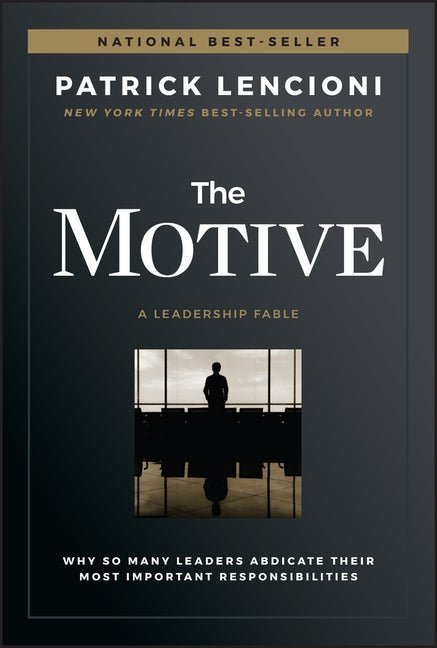
The Motive: Why So Many Leaders Abdicate Their Most Important Responsibilities
Couldn't load pickup availability
Shay was still angry but shrugged nonchalantly as if to say, it's not that big of a deal. "So, what am I wrong about?"
"You're not going to want to hear this, but I have to tell you anyway." Liam paused before finishing. "You might be working hard, but you're not doing it for the company."
"What the hell does that mean?" Shay wanted to know.
Knowing that his adversary might punch him for what he was about to say, Liam responded. "You're doing it for yourself."
New York Times best-selling author Patrick Lencioni has written a dozen books that focus on how leaders can build teams and lead organizations. In The Motive, he shifts his attention toward helping them understand the importance of why they're leading in the first place.
In what may be his edgiest page-turner to date, Lencioni thrusts his readers into a day-long conversation between rival CEOs. Shay Davis is the CEO of Golden Gate Alarm, who, after just a year in his role, is beginning to worry about his job and is desperate to figure out how to turn things around. With nowhere else to turn, Shay receives some hard-to-swallow advice from the most unlikely and unwanted source--Liam Alcott, CEO of a more successful security company and his most hated opponent.
Lencioni uses unexpected plot twists and crisp dialogue to take us on a journey that culminates in a resolution that is as unexpected as it is enlightening. As he does in his other books, he then provides a straightforward summary of the lessons from the fable, combining a clear explanation of his theory with practical advice to help executives examine their true motivation for leading. In addition to provoking readers to honestly assess themselves, Lencioni presents action steps for changing their approach in five key areas. In doing so, he helps leaders avoid the pitfalls that stifle their organizations and even hurt the people they are meant to serve.
Share
Book Details
- ISBN
- 9781119600459
- Binding
- Hardcover
- Authors
- Patrick M Lencioni
- Publisher
- Jossey-Bass
- Published Date
- February 26, 2020
- Language
- English
- Pages
- 192
- Physical Info
- 0.9 in H x 8.4 in L x 5.5 in W (0.75 lb)

Many of us want to be the leader for the wrong reason. Lencioni challenges us to be motivated by the right reason for being a leader. Caring and developing the people that we lead. Great and easy read
Found deep resonance with Patrick's fable; thought provoking and helped me to revisit my reasons for why I want to lead and what good leadership looks like or should look like. Most leadership teams likely suffer with this problem; are they truly in it for the right reasons and then working in unison to create a thriving environment for their teams. This little, regular introspection can go a long way to fixing this.Quotes:- The primary motive for most... pick and choose how they spend their time and energy based on what they are going to get, rather than what they need to give to the people they’re supposed to be leading.- Too many people have come to tolerate, even expect, leaders to be self-centered. Too many employees are resigned to executives in their company who take action only when it is in their own interests.
This was to the point in the best kind of way. The narrative story did a great job illustrating the concept.
This book is so interesting that i had to finish it in one sitting. I have found myself abdicating on more than one of the 5 most common responsibilities from the book. I’m starting to re-read and to take notes, and have a feeling that this book should be learned and taken to heart and not just read.
Having worked on Alan Mullaly's team developing the 777, and having some technical responsibility for two of the top five program problems, I've seen how this approach excels.
- 5 stars: 16 (80%)
- 4 stars: 3 (15%)
- 3 stars: 1 (5%)
- 2 stars: 0 (0%)
- 1 star: 0 (0%)
Many of us want to be the leader for the wrong reason. Lencioni challenges us to be motivated by the right reason for being a leader. Caring and developing the people that we lead. Great and easy read
This was to the point in the best kind of way. The narrative story did a great job illustrating the concept.
Found deep resonance with Patrick's fable; thought provoking and helped me to revisit my reasons for why I want to lead and what good leadership looks like or should look like. Most leadership teams likely suffer with this problem; are they truly in it for the right reasons and then working in unison to create a thriving environment for their teams. This little, regular introspection can go a long way to fixing this.Quotes:- The primary motive for most... pick and choose how they spend their time and energy based on what they are going to get, rather than what they need to give to the people they’re supposed to be leading.- Too many people have come to tolerate, even expect, leaders to be self-centered. Too many employees are resigned to executives in their company who take action only when it is in their own interests.
This book is so interesting that i had to finish it in one sitting. I have found myself abdicating on more than one of the 5 most common responsibilities from the book. I’m starting to re-read and to take notes, and have a feeling that this book should be learned and taken to heart and not just read.
Having worked on Alan Mullaly's team developing the 777, and having some technical responsibility for two of the top five program problems, I've seen how this approach excels.
This is honestly one of my favorite authors. I really enjoy the way he can tell a story that can really draw you in while still teaching you dozens of leadership lessons. Then drives it home with notes in the back.
There are two parts to this book - a story called “the fable”, and following that is a section called “the lesson”. I really enjoyed reading “the fable”. I would have given the book four stars if it had ended there. I could barely get through “the lesson”, though. So - three stars. Four if you quit after “the fable” :)
Probably the best book Patrick has written. Would have been great if it had been his first book, providing a great context for his other great books.
I have only read 2/3's of the book, but I am past the parable and into the meat of the education / philosophy that is at the end of the book and I can't contain my emotional response of anger, validation and even bitterness at the spate of awful leaders who don't understand the punchline of this book. I just put in my notice at a company I have worked at for 15 years and I am leaving because of my management and the many years of failing. I am blessed to have gotten a new job, in leadership and I pray I learn this lesson (and many others) well. I don't think words alone are sufficient to express how powerful the lesson of this book is for those aspiring to be a leader or who are already a leader and are struggling.
Good for innovators and entrepreneurs trying to figure out how to build and maintain relationships and while keeping a growth mindset.
Patrick Lencioni's 'The Motive' is an absolute game-changer! This book delves deep into the heart of leadership, offering invaluable insights that have the power to transform both individuals and organizations. Lencioni's storytelling prowess makes complex concepts easily understandable and actionable. 'The Motive' isn't just about leadership; it's a roadmap to discovering your true purpose and igniting passion within your team. A must-read for anyone looking to elevate their leadership skills and drive meaningful change. Highly recommended!
Well written and easy to digest. Read this book over 2 flights. The lessons are spot on and reminded me of the patterns of my past good and bad leaders. More importantly it shaped my view of my personal areas of improvement
This short book gives so much insight into why we, as leaders, get it wrong so often. If you know deep down that you, as the leader of an organization, are the biggest obstacle to growth and success, this book might be for you.
The reasons behind peoples' motivation for obtaining a position in leadership are two fold; you see it as a reward to yourself, or you see it as a privilege to serve others. We may flow in and out of these motivations but it comes down to your ultimate motive for why you are striving for a leadership role.In Patrick Lencioni's latest book The Motive, he delivers a concentrated version of how those two motives look in action, what the results of a reward mentality look like, and what we can do to make sure we are in it for the right reasons.Lencioni is one of my most favorite authorities on organizational health. He has introduced me to some fantastic perspectives that have helped me to identify dysfunctions of a team as well as the qualities that identify the ideal team player.This was a very quick read, but had a lot of substance! Read it and do some introspective work to find out if your ideals are lining up with your efforts...or lack thereof.
I have served in non-profits for 25 years, and I can testify that what Patrick is teaching WORKS. When direct reports know you have their back and when you make sure you're caring for them personally, they will give their best for you.This book really resonated with me because this kind of "servant leadership" that Patrick Lencioni describes is how Jesus led His disciples. Patrick's principles could have all had Scripture references to back them up—so I wasn't surprised to see him give credit to Jesus in the acknowledgements.Patrick wrote: "Most leaders today don’t generally see their role as a privilege or a duty. They see it as a right and a reward" (pp. 130-131, Kindle Edition). Jesus said it this way: “You know that those who are recognized as rulers of the Gentiles lord it over them; and their great men exercise authority over them. But it is not this way among you, but whoever wishes to become great among you shall be your servant; and whoever wishes to be first among you shall be slave of all. For even the Son of Man did not come to be served, but to serve, and to give His life a ransom for many.” (Mark 10:42–45)I have a card on my desk with the question written: "What is your motive?" I try to read it often and refocus my reasons for doing what I do.
I love Lencioni's books. Most of the time I come away with pages notes and loads of ideas to try. 5 Dysfunctions, The Advantage and The Ideal Team Player are all books that have created a common language around my workplace. And The 3 Big Questions for Frantic Families was a great challenge to my home. I thought The Motive would be likewise inspiring. Well, it isn't. I have never been more ready to quit after reading a book. In all of the other books, there were things to do, lessons to communicate and other people to help. This book go right to the heart of WHY someone wants to be a leader. It is a book that is very introspective and will either make you want to work harder than ever at what is truly important and what only you can do. Or you just need to quit.Conviction of near biblical proportion.By the way, I didn't quit. But I know what my job is and why I do it.
I recently heard Patrick Lencioni give a speech about his latest book: The Motive: Why So Leaders Abdicate Their Most Important Responsibilities and immediately the book! It is, by far, his shortest book with the main premise centered around the "why" one chooses to be a leader. Is it for the glory, prestige, or "rewards" for achieving the pinnacle of success OR is it for the responsibility of leading a successful organization? Those "reward- centered leaders" believe they can pick and choose what they want to do, abdicating five core responsibilities that cannot be delegated:1. Developing the leadership team. Often delegated to HR or an external consultant, the leader has to spend time developing their team members' interpersonal dynamics and collective behaviors.2. Managing subordinates. We are not talking about micromanaging highly paid executives! The leader needs to set the general direction of the work ensuring that it is aligned with and understood by their peers and stay informed enough to identify potential obstacles and problems as early as possible. And the leader needs to make sure their subordinates one level below are managing their people too.3. Having difficult and uncomfortable conversations. While having difficult conversations is certainly one part of managing a team and subordinates, the leader must confront difficult, awkward issues and behaviors quickly and with clarity, charity and resolve. Left unaddressed, these issues eventually degrade the organization's performance.4. Running great team meetings. Meetings are one of the most unpopular and underestimated activities in business. Yet this is where leaders make critical decisions and set the tone for all of the meetings within the organization. If team meetings are boring and a chore to get through, the fault rests squarely on the leaders' lap!5. Communicating constantly and repetitively to employees. Just because a leader has expressed themselves once or twice, doesn't mean that people heard it or understand it. Employees have to hear a consistent message at least seven times before they believe executives are serious about it. Leaders need to have a consistent drumbeat - and if they get bored saying the same thing, they need to get creative in their messaging.These five areas are not a list of the key responsibilities of the leader of an organization (that would be in his book, The Advantage), yet they are good reminders of specific situations and responsibilities that leaders avoid all too often.
Several years ago I started a new church. I was a very young, and very immature, leader. So, I began studying as much leadership material as I could get my hands on. Not long after I began the search, I was at a Catalyst event in California and heard Patrick Lencioni speak. After that, I bought all his books. They have been game changers for me, and have really helped me along in my leadership journey. As soon as the Motive came out, I bought it. All of his books are excellent, but this one is special. It addresses the heart of what it means to be a leader. I can't recommend this one enough, but I'll try by giving it a 5-star! Do yourself a favor, and just go ahead and buy a case of this book and distribute it to your team. You won't regret it.
In this book there is good primers for how to be better leader and with righteous motives. In the end this felt like primer for some consultancy because you don’t really get anything else than idea that you are thinking it wrong way. But I think that was in the end right way to write it so it would be sort enough to anyone to pick up. You cannot really say that you don’t have 2.5 hours to read in whole year or you ARE REALLY DOING IT WRONG WAY as CEO. ;)You have to remember that without knowledge you cannot have curiosity and for this bit of knowledge I thank for Mr. Lencioni because I see this book to change many life’s. (If leader start to look coach after getting the Aha moment and not trying to change by himself). This book can have exponential effect because of nature of leading.Thank you and with you with the last acknowledgment
Another great book by Lencioni! The fable is short and to the point, which is nice, and the learning section is detailed and practical. It turns out too many leaders got into it for the rewards - attention, status, power, money - thinking they now have earned the right to avoid the difficult and uncomfortable work that only the leader can do. We need people who aspire to be responsibility-centered leaders instead, understanding they have "the most painful job in the company".Lencioni takes you through the five omissions of reward-centered leadership, including questions to ask yourself to determine if your focus is rewards or responsibility:1) Develop the leadership team2) Managing subordinates (and making them manage theirs)3) Having difficult and uncomfortable conversations4) Running great team meetings5) Communicating constantly & repetitively to employeesWe all stray towards reward-centered leadership at times, but this book will help you identify if that is your primary tendency, & help you refocus or even decide to move out or down.
)
)