

The Perks of Being a Wallflower
 )
 )
Couldn't load pickup availability
"A timeless story for every young person who needs to understand that they are not alone." --Judy Blume
"Once in a while, a novel comes along that becomes a generational touchstone. The Perks of Being a Wallflower is one of those books." --R. J. Palacio, #1 New York Times bestselling author of Wonder
This #1 New York Times bestselling coming-of-age story with millions of copies in print takes a sometimes heartbreaking, often hysterical, and always honest look at high school in all its glory.
The critically acclaimed debut novel from Stephen Chbosky follows observant "wallflower" Charlie as he charts a course through the strange world between adolescence and adulthood. First dates, family drama, and new friends. Sex, drugs, and The Rocky Horror Picture Show. Devastating loss, young love, and life on the fringes. Caught between trying to live his life and trying to run from it, Charlie must learn to navigate those wild and poignant roller-coaster days known as growing up.
A #1 New York Times bestseller for more than a year, adapted into a major motion picture starring Logan Lerman and Emma Watson (and written and directed by the author), and an American Library Association Best Book for Young Adults (2000) and Best Book for Reluctant Readers (2000), this novel for teen readers (or wallflowers of more-advanced age) will make you laugh, cry, and perhaps feel nostalgic for those moments when you, too, tiptoed onto the dance floor of life.
Book Details
- ISBN
- 1982110996
- Binding
- Hardcover
- Authors
- Stephen Chbosky
- Publisher
- MTV Books
- Published Date
- September 24, 2019
- Language
- English
- Pages
- 240
- Physical Info
- 1 in H x 8.5 in L x 5.6 in W (0.75 lb)

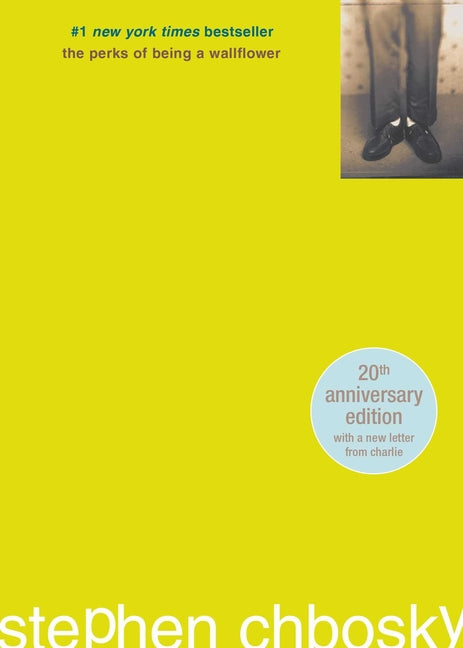
Book cover came a little damaged and the box I received it in wasn’t taped shut at all but other than that book it’s self looks fine

I found this book's cover what my design and technology teacher would comment as 'aesthetically pleasing'. A nice fresh cover of grassy green that I could almost smell! But something else had also caught my attention, it's title. And the first thing that came to mind came in the form of a question: "What is a wallflower?"I had an idea it must not be anything too glorious for the title included the word 'perks' and did not fail to suggest 'a wallflower' is something that lacks anything good in the first place. So I did what any rational person would do and looked it up in my Oxford study dictionary. I didn't expect to find the word deep down, it sounded new and 'slangish' but I found it on page 783. But I'm not very logical or rational to be honest with you. I actually read the book before looking up the word. I suppose I hoped the book might explain its title better than a dictionary but we all know that not many books explain their titles. They just base themselves around the titles. And this book wasn't much different to my great and satisfactory relief, when I finally realised that if it had then it would have been one very boring book. Charlie is your average 'Adrian Mole' except he's just a little more of a 'Charlie' than he is 'Adrian'. And of course very intelligent (that's what his English teacher said, he got straight A's all through the year he wrote the letters so I really don't have anything to say to the fact I didn't feel he was completely interllectual). This book is about "Growing Up" and goes on for a year whilst lacking two days. At fifteen years old, Charlie has few friends, generally close family members and a painful past of losing his closest friend: Aunt Helen. Basically, Charlie just has a life. That is until he gets into high school. After Aunt Helen died on his seventh birthday he probably didn't think anything worse could happen. He was right, nothing worse happened. A catch though, things happened that were just as bad. His friend Michael, commits suicide and Susan who was a friend too decides to become popular. The lights go out and Charlie is alone. But he meets new friends older than him and grabs his English teacher's attention. His family has their crisis' and become closer and everything that seemed as if it was going to make things worse make life better. He falls in love, he breaks hearts, he breaks his own and he starts to understand and learn how to be a true friend. That he must give as much as he is giving now but also speak for himself and have a voice, that he decides later is a true friend. And he realises that his life from the moment of Michael's death or maybe even earlier from the moment of his Aunt's death had become one of those very old and slow, ancient records. By the last letter he sends he throws away the record and starts living again. This is the clearest pocket encyclopedia of high school divided into four parts and decorated with a soothing epilogue. Maybe it's because I read ANTHEM by AYN RAND before this book but Mr. Chbosky's book seemed almost relaxing. I felt I was reading from a regular diary belonging to a friend and as time passed I felt that I was reading real letters. By the end of the book Charlie becomes a true human being in reality. And yet you don't grow too fond of him that by the time you finish you feel that empty surge of lonliness cover you steadily. But if you do as I did then Charlie writes something at the end that relaxes you. Relaxes you because he assures you he'll be OK and that he'll make it through in one piece and make living worth it and most of all that he knows you will too. And somehow you know he's right-because he's Charlie. Oh..by the way, I looked it up and this is what it said:wallflower n.1 a garden plant blooming in spring, with clusters of fragrant flowers. 2 (informal) a woman sitting out dances for lack of partners.but I didn't bother to ask anyone for the real meaning that I was looking for. I already knew it without the book having to explain it to me. I had Charlie explain it to me instead. Of course I didn't really need one, I don't think you will either.
]
great book and movie
This is a must read for people who works closely with children. Sometimes their pain and shame are pushed so deep within themselves, they don’t know how to share.
It’s a classic! Every high schooler should read this one.
I actually really like this book watched the movie right after and liked the book better but the movie was still good
I've never read a book like this (with drugs, violence, sex, stuff like that) and really felt like it had an impact on me. After I would be done with it, I'd be like, "Okay, that was a good book," but then I'd go back to my life, and I would never think about it again. The Perks Of Being A Wallflower really opened my eyes to reality, and in a good way.Being an early teenager, I am often lectured about the effects of drugs and gangs and sex and how it would destroy my life if I participated in any of these categories at a young age. Looking through the eyes of someone like me who experienced them made me realize how much those three categories can affect a teenager.This book also helped me see the importance of friendship. When Charlie, Sam, and Patrick were willing to help each other, physically and emotionally, no matter what they needed help with (relationships, fights, drugs, etc.), I began to really understand why we need friends. They help us engage in society and support us, no matter what we do. I don't think I ever really appreciated that until after I read this book.I, as an introvert, really don't like talking to others. I just can't bring myself to be the one to start a conversation or talk to someone if I think they could be a possible friend. I have something that I sort of consider a 'talent' that, depending on the person, I change the way I speak and act to mold to their personality. I'm not even sure what my own personality is anymore because it changes so much. After seeing Charlie change over the messages he writes, I understand how it's not really a talent. It's just me trying to blend into the crowd. That's not really me. I need to let my personality SHOW. Know when to say no. Know when to stop. Know when someone is hurting. Know when someone NEEDS me to be there for them.This is what I want to leave you with: The only thing that affects you is you. If you feel like something's blocking you, its just you in your own way. If you feel down, its because you're pushing yourself down. If you feel like you're hurting, it's because you're hurting yourself. So fight back. Push yourself out of the way. Pull yourself out of your maelstrom. Fight back against your pain. I've also learned that we need friends. You can't do things alone. It's just not humanly possible. Sometimes, you need someone to fall back on. Someone to trust. Someone who knows just what to say. Someone who you can tell your crush to. Someone you can share your secrets with. Someone you can be yourself around. That's what I've learned from reading this book.Charlie went through a lot of ups and downs in his book, yet I think that he's grateful for all of it. The hate. The love. Feeling dead. Feeling alive. The fights. The hugs. You know why? Because it teaches us, as the human race, to be better. To be braver. To be smarter. To have sympathy. To feel love. And really, what could possibly be better than that?
The protagonist tells the story via letter he (Charlie) is writing to someone but we don’t know who. He starts his letter off with the date and Dear Friend. He explains in his first letter why he’s writing the letters but doesn’t give a clue as to who the person is. Even at the end of the book we don’t know how the person is he’s writing to, but it doesn’t matter. By the mere fact that he starts each letter with Dear Friend we become that person he is confiding in, and that’s what he’s doing in each of these letters, confiding in us.We follow Charlie through a year of school (freshman year when we meet Charlie). He introduces us to his friends Patrick, Sam (Patrick’s sister), Bill (Charlie’s English teacher who thinks the world of Charlie), Charlie’s sister, brother and parents and those he comes in contact with. We learn secrets of these people, things that happen to them that only Charlie can share with us and things that happen to Charlie that he can only share with us. There are somethings he won’t tell us, which is fine-Patrick (high school senior) is gay and having a secret affair with Brad, the star quarterback of the school-Charlie’s sister (high school senior) gets pregnant and has an abortionCharlie has a crush on Sam (but you’ll have to read the book to find out what happens with those two)-Charlie takes LSD, has taken up smoking cigarettes and weed and drinks at times-Charlie gets a girlfriend and loses that girlfriend and his friends in the process (you have to read the book to understand it more)We learn how dysfunctional Charlie’s family is but not in a disturbing way. More in a normal dysfunctional way, where the sister hates the brother at times. Father ignores the son at times. No likes Charlie at times. But mostly, we grow to like Charlie right away and hope for the best for him.Although Charlie is a wallflower by nature, he still remains a wallflower in his own way throughout the book when he’s with his friends at parties or at Big Boy. He becomes part of the party while still sitting on the sidelines. He is apart of the many conversations while still sitting on the sidelines. Not physically of course. His letters are detailed that it’s like he was watching everything go down as well be apart of everything.Charlie has a way of staying positive throughout the letters even when things are going really wrong for him, because he has us to talk to. These letters are a way for him to remain sane through it all the best he can.Perks reminds me of my high school days and how simple things really were then. Charlie begins realizes this too through the book.There were some things I didn’t understand since the book is written between 1991 and 1992. For instance, the time Charlie comes home to find his sister watching Gomer Pyle. Gomer Pyle was in the 70’s. The author fails to tell us if the sister is watching via TVLand or another station that plays old shows. Doesn’t it matter? Yeah, it does to me, but then again, I’m probably being too particular. Charlies bring up VHS tapes, but I had remember this was the early 90’s and that’s what we had then. He talks about writing letters; again, the 90’s and email was not known or used widely then.I don’t find the 90’s as being that long ago and reading this book really made me realize how primitive (compared to today’s standards) we were. In essence, pen and paper were the tools of the day. Not Facebook, not emails, not Twitter, but pen and paper. There is a point in the book that Charlie is given a typewriter by Sam..a typewriter. Again, it’s the time period. I still think typewriters are great.Some have Said that Charlie is this generation’s Holden Caulfield from Catcher In The Rye and I strongly disagree. Holden was a rebel from the beginning; Charlie was a loaner and never did become a rebel in my opinion.This book will resonate with anyone of any age and I feel it will become a favorite among those that are teenagers now when they get older, like Judy Blume books are with us adults now.
"So this is my life. And I want you to know that I am both happy and sad and I'm still trying to figure out how that could be."I know that I'm about 15 years late reading this, but I finally got around to reading The Perks Of Being A Wallflower. I made the mistake of watching the movie first, back in 2012, but I always figured I'd eventually get around to reading it once I started to forget specific details about the movie. To be honest, I didn't like this book as much as I was expecting to, but I think that's mainly due to the fact that a lot of people consider this their favorite YA book of all time, and everyone praises this book non-stop, so maybe I was expecting more. The greatest thing about this book are the quotes. This is probably one of the most quotable books I have ever read and I will probably fill this review with so many quotes. I tabbed the hell out of this book while reading it. I thought at times Charlie was a little immature, but I guess he is only 15 so I'm not really sure what to expect. Sam and Patrick were great side characters, and really amazing friends to Charlie. I think it's so important to have people like that in your life."You see things. You keep quiet about them. You understand. You're a wallflower."I have always considered myself to be a "wallflower", which is probably why I enjoyed this book as much as I did. Throughout high school I was always a loner, I didn't really have any friends. Freshman year of high school was one of the hardest years of my life due to the fact that I felt completely alone, and this made me feel really nostalgic for that time. This book got to be very depressing at times and it was really hard to read because it took me back to the times in high school where I was really depressed. I felt a lot of the same loneliness and hopelessness that Charlie feels throughout the book. I haven't felt like that in a long time, so at times this book was difficult to read. This book deals with a lot of strong subject matter; rape, abuse, molestation, sex, suicide, and depression in general."I don't know if you've ever felt like that. That you wanted to sleep for ten thousand years. Or just not exist. Or just not be aware that you do exist. Or something like that."The scary thing is I actually do know what he means. I used to feel that way all the time. Sometimes I still do. I relate so much to when he talks about seeing a couple and if you feel happy for them, it's good because it means you're happy too. If it makes you sad to see other couples, it's not because you're jealous, or you want them to be unhappy, but because you crave that same kind of happiness that is missing from your life. I just understand the things that Charlie goes through in this book. He was an extremely relatable character and this brought back so many not so great memories about high school, and things I absolutely hated about high school (especially freshman year)."Have you ever done that? You feel really bad, and then it goes away, and you don't know why. I try to remind myself when I feel great like this that there will be another terrible week coming someday, so I should store up as many great details as I can, so during the next terrible week, I can remember those details and believe that I'll feel great again.I think the reason why this book became so popular was because this book was the first of its kind. Now-a-days, it is not unusual to see these intense themes like rape, molestation, depression, and suicide in YA books. In fact, it's almost common. But back in 1999 when this book was published, I really do believe this book was pushing the limits and boundaries of Young Adult and has created something new. Reading this in 1999 would have been a completely different reading experience than reading this in 2015, because there was nothing this controversial in the 90's. Also, this book has quotes that are iconic, and connects with everyone in so many ways. One of my absolute favorites is; "We accept the love we think we deserve." It's just such a powerful quote and it's so true, and it still stands true 16 years later. This book will always be iconic and it will go on to become a classic, I'm sure of it. I'm happy that at the end of the day, this book does have a positive vibe. It was a long and depressing journey, but this book is definitely worth a read."And in that moment I swear, we were infinite."
Today, friends, I must start with a confession: I tried to read The Perks of Being a Wallflower during high school and immediately loathed and DNFed it. As such, I’ve not tried again until 2014, at least ten years after my first attempt. I also went for a format change, because I had a vague memory of the writing being a problem, and switching formats can help with that. It’s funny, because I completely understand why my teen self loathed this book, but I can also appreciate it now and admire what it’s doing on top of enjoying the story.The writing in The Perks of Being a Wallflower probably would have been a struggle for me still, at least at the beginning. There’s a sort of Catcher in the Rye-ness to the book, but, unlike Catcher, there’s personal growth throughout the book. Perks is a full year in Charlie’s life, his freshman year of high school, and he learns a lot during that year. He grows emotionally and intellectually. For this reason, I’d say you should push through, even if you don’t like Charlie or his narration at the outset.In case you do struggle, I highly recommend this audio version narrated by Noah Galvin. Perks is one of those books written in the way that someone talks, and so it lends itself really well to the audio format. Plus, Galvin sounds like he could be 15, which is actually a really difficult thing to find in YA audiobooks. He reads with great emotion too. This was really a perfect book for the audio format.Charlie’s a really great and unique character, something which I couldn’t appreciate back when I tried to read it as a teen. At the time, I read a lot of romance, classics, and various adult fiction. YA wasn’t my thing, and I wasn’t used to reading about teen characters. Plus, Charlie’s a very unusual boy. He’s highly emotional and cries a lot, something I’ve never really done. I didn’t get him back then. Now, though, I’m so glad to see a book about a boy who cries, because our culture teaches guys to repress their feelings, and repression is not healthy. The novel’s all about learning to accept and understand yourself.There were two things I didn’t like about Perks. The first is all the drug use and smoking. Realistic, sure, but also it made me uncomfortable that smoking wasn’t shown in an unflattering light. This is one of the things that I just cannot abide personally. Then there’s Sam. She’s a full-blown Manic Pixie Dream Girl, which is a term I really don’t use often. She’s got very little personality, aside from being fascinating, gorgeous, mysterious, and sexy. I’m pretty positive John Green read this book and was greatly influenced by it. Sam’s character just isn’t interesting to me, and whenever he went on and on about her, I was rolling my eyes.The ending of The Perks of Being a Wallflower threw me for a bit of a loop. It was completely perfect and well-established by the text and at times I even wondered if something like that was coming. Still, the epilogue knocked my feet out from under me. I just am not used to epilogues containing any actual plot. Well, this one does and that plot packs a brutal punch. If you’re the sort of person who cries at books often, the epilogue should be called Sob City. It’s dark and painful, but also inspiring somehow, which is pretty damn impressive. It also brings the journey of the rest of the novel into stark relief.I’m sort of at a loss for what to say about this one without spoilers, so I guess I’ll just exhort you to give this book more of a chance than teen Christina did. This is a YA classic for a reason.
I enjoyed this book immensely. I found it compelling, sweet, interesting, well-written, and an overall great book. It deals with hard topics that aren't commonly written about, and it deals with them in a very realistic way.The protagonist is a young man named Charlie. He is beginning high school, while his brother begins his freshman year in college, and his sister begins her senior year in high school. Charlie starts off by addressing you, the reader, in a letter, as "Dear Friend". It is uncommon to find books written in the form of letters, and is not my absolute favourite way of writing to read. However, Chbosky wrote these letters in a clear way that didn't distract from the novel at all.Charlie tells you of his only friend, Max, who had committed suicide the previous year. I enjoyed how the book jumped straight into a difficult topic for many readers. The book continues on to show how Charlie had reacted to the news, and it explains a fair amount about how Charlie acts in the present.Charlie is a wallflower- that is, he observes the people around him. That is the majority of his high school career for a while, before he meets "Nothing"- Patrick- and Sam, who are half siblings. Both have had a difficult time, and are in their senior year of high school. They take Charlie under the wing, and introduce him to their other friends, whom he gets to know quite well over the course of the story.As the novel continues on, Charlie describes his family, the problems within them, in a almost childlike manner. He talks to his English teacher frequently, who gives him books to read and some excellent advice.I found one of the biggest themes in the story to be how people accept the love that they believe they deserve. Those that believe themselves to not be worth much at all, that believe that don't really "deserve" someone sweet and kind to love them, most often will not date sweet and kind people. People who don't believe they're families love them for who they are will have a hard time accepting any time of help or condolences or anything similar from their family.The novel goes through several difficult topics for a diverse selection of people, dealing with topics such as child abuse, domestic abuse, suicide, and homosexuality. It handles each situation in a realistic manner, with care, and with almost childlike innocence from the eyes of Charlie.I recommend this book to teens, young adults, and adults alike. I do, however, warn against having younger or more innocent readers from reading this. Teens that don't have an accurate sense of the difficulties in the world would most likely find this book boring, or dislike the themes and discussions within its pages. I do believe that you should read this book at some point in your life, as it is truly an amazing read.
This book is well written & an enjoyable read from start to finish. I find the epistolary style to be a refreshing & inventive way to convey the 1st person narrator position. In fact, I think the style really allows the reader to access the consciousness of the character/narrator in a unique way, giving the reader access to the story in a way that makes the reader assume the POV of the narrator himself, which opens up so many different avenues for interpretation while at the same time limiting the amount of preconceived baggage the reader can bring to the interpretation. While some may feel that this gives the author more control of the narrative than they like, since the style tends to limit access to the narrative through Freudian Critical Theory, I personally feel that being inside the book in this way gives you a real, honest insight as a first-hand experience. This isn't normally the way most literary criticism has been approached for the better part of the last 50 years with post-Modernism, Structuralism, post-Structuralism, & the various theories of language espoused by Foucault et al, originally articulated by Russell, Husserl, et al. I know this review tends toward the pedantic, but I hope that doesn't deter other potential readers. This really is a fantastically emotional & accessible work, beautifully crafted & open in so many ways that other novels of our time just aren't. Basically, if I break it down to its simplest terms, don't let preconceived notions & your own experience to color your understanding of the work until you've at least read it through once. The first time is the best, as it really allows you to open yourself to this experience in a way that hasn't really been possible since Salinger's "Catcher in the Rye." Just sit back, take it in, & don't put too much into figuring out what it means--just let the experience of this boy's life wash over you as you go through the journey as he does. It really is a beautiful experience that allows you to truly step outside yourself, to leave your life at the door as you enter Charlie's world--experience sight & sound, color & shape as he does & enjoy being someone else for a little while.
Dear Friend,I literally just finished reading this book, and felt compelled to write a review. Not because I'm some sort of intellectual who just loves to hear myself and show people how smart I am, or how well (or not well) I write. I am not even attempting to persuade anyone to purchase this book. I am writing this because I feel inspired. Mainly I feel inspired because at times I feel that the central character and I share many of the same attributes. Mainly the ability to watch and absorb, but not actively participate. Like Charlie, I am participating by writing this review because believe it or not, something as small as writing a simple review on Amazon can make a "wallflower" feel like a participant and not just a quiet observer. This is something I have taken from this book. This is not so much me explaining my inner battle, not like being a compulsive liar, or a maniac depressive or something that can actually be considered a battle from within that can have life changing results. Simply, this is a characteristic that I am aware of that I would like to change to a certain extent "because it's okay to feel things. And be who we are about them", and expressing oneself is the best way to feel things, even in the smallest ways.Kurt Vonnegut once said "to practice any art, no matter how well or badly is a way to make your soul grow". I have never written a review, the last time Ive done anything similar to this was probably a million years ago when I had to do my last book report ever. Bare with me, I'm sure my thoughts and opinions will become a jumbled up mess at some point. But I must remind myself that this is NOT about perfection. So here goes nothing..........."The Perks of Being a Wallflower" is a story of a young man named "Charlie", he makes it known he rather be anonymous to his audience so throughout the book he uses this particular fake name for his anonymity reasons. His audience is a person he has never actually meet, but knows through other people and feels comfortable enough to write letters to (you get the feeling very quickly that Charlie does not have many outlets for his feelings, so anything seems acceptable and helpful). These letters contain his days, his thought, his opinions, and mainly his raw feelings. Charlie is pleasant boy with a gentle presence and a sensitive soul. He is a bit odd in his feelings and has some troubles, troubles that throughout the book are a bit hard to pin point. You soon learn that he has lost two very important people in his life and figure that he has had a really hard time dealing with these losses. He is a lonely young man getting ready to start his freshman year of high school. He loves his family but has a disconnect from them mainly because of his quiet nature and sensitivity, which no one understands, but his mother is the most patient with him. He doesn't have many friends and would be considered a loner until Sam and Patrick come along. With them comes a light that is shone into charlies gloomy world that gives him a new found hope and happiness. He feels less alone now that he has found two people who have genuinely taken an interest in him. Sam and Patrick are older, but when getting to know Charlie while reading this book you start to see that him being friends with older people is actually better for Charlie, as opposed to being friends with kids his own age. Because of Charlies over-sensitivity I believe it could've only been tolerated by people with a certain amount of maturity. They see Charlie as not just a sweet kid, but a person with a lot to contribute; whether he believes this quality about himself or not. Sam and Patrick are both very interesting people, both seniors and consider themselves to be very cultured and individualistic. Charlie takes notice of this and gravitates towards them and there circle of friends very quickly because they are so interesting, fun, honest, and forgiving.Throughout this book through the letters Charlie sends his anonymous reader, you feel Charlies love for everyone in his life including his siblings, parents, his teacher who takes a special interest in Charlie, his deceased aunt, and mostly his friends Sam and Patrick. Through the book you feel Charlies highs and his lows, but you also feel the dark cloud that seems to never be too far from Charlie. This sadness and guilt haunts Charlie regularly and just when it seems his has shaken it, it appears over his head gloomier and sadder than ever. You come to love Charlie very quickly when reading this book, he reminds us what it meant to be a timid teenager with a vulnerability and sensitivity that at times is indescribable. You also see how fiercely loyal Charlie is. When the tables turn and his friends start having hard times, Charlies love and devotion to his friends never changes, even when they "turn" on him, it never changes. Through his experiences you become invested in Charlie because there is a longing that you hope he gets better, with a ...
To be clear, I actually saw the film before I read the book, but I'll discuss the novel first as its the original. Perks is a teen coming of age novel set in 1991.This is a compulsively readable book. Casually, before picking at the flaws, this is the kind of book you read in one sitting. Every time I run across something this engaging, I feel an intense relief -- pleasure really -- because so much of what I read is a bit of a chore. Probably just me being jaded. So while I'm going harass Chbosky on a few fronts, any criticism should be framed in context: This is a novel that really sucks you in and holds you.As to voice. Technically, the book is epistolary. The protagonist, Charlie, writes letters to some imaginary friend. It's a gimmick that neither adds or subtracts. This is basically a first narrative with a slightly confused back and forth between past and present tense. The writing is deliberately clunky. Chbosky is trying to sound like a 15 year-old boy -- and a gifted one at that -- but he does it by being wordy and stilted. I'll give an example:I am trying now to practice not to do that. He also said that I should use the vocabulary words that I learn in class like "corpulent" and "jaundice." I would use them here, but I really don't think they are appropriate in this format.My inner editor would rewrite this as:I'm trying to practice not to. He also suggested I use the vocabulary words from class like "corpulent" and "jaundice." I would, but they might not be appropriate in this format.This clunk-factor lessened after the first third, and I'm not sure if it was because I adapted or because the character was maturing. Either way, it does provide a bit of youthful feel and the frank honesty of the voice is highly engaging. Charlie is a straightforward reporter, cold even, rarely leaping to extreme judgement. He is most definitely not snarky.For me, the early 90s setting was a big plus, as it's free of some of the annoying distractions of the post internet age (cel phones, Facebook, etc). It's also nostalgic, being closer to my own high school era, even if Charlie is a good seven years younger (my Freshman year was 1984, his 1991).The character development is very good. Charlie, Sam, and Patrick are all very well crafted and distinct. Likable too.In retrospect, after finishing the book, I feel several elements of the story construction are a little forced. It seems unlikely that two seniors like Sam and Patrick would take a Freshman under their wing and into their social circle quite so easily. Not impossible, just a bit contrived. More substantially, the major "twist" in the story feels a bit forced, unnecessary even. This is a book with a clear theme. The writer even states it, several times: "We accept the love we think we deserve." Fine. But there sure is a lot of abuse flying around. Like 90% of the major characters experience it at some time or another in their lives. I don't mind these themes, but to have the same "startling" thing happen to not one, not two, but many characters feels forced. All this thinking was only in retrospect. While reading, the novel just draws you in from start to end.Having seen the film first, which is sexually rather tame, I was pleasantly surprised to find quite a bit of frank sexuality in the novel. I'm not sure why it was removed, and it's presence provided punch. Nevertheless, it's pretty incomprehensible that a smart well read 15 year-old like Charlie wouldn't already know about masterbation. Again, a little forced. This book has a lot of forced moments, they just play off well.So I must reiterate, these are intellectual nitpicks on a compulsively readable novel. One last observation: It's odd that Chbosky published this in 1999, went on to sell a bundle, yet has never published another novel.Andy Gavin, author of Untimed and The Darkening Dream

