

The Poet X
 )
 )
Couldn't load pickup availability
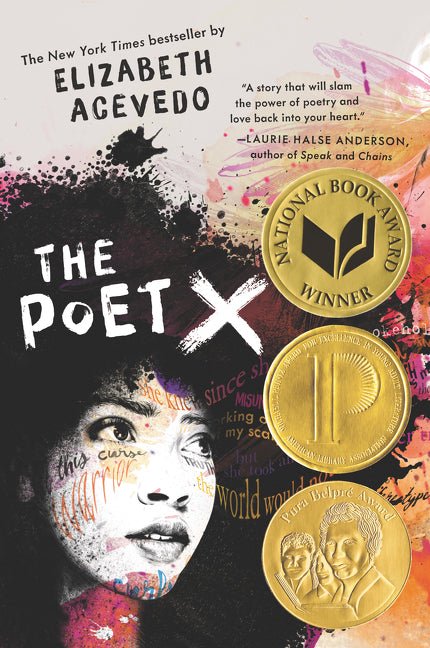
Winner of the National Book Award for Young People's Literature, the Michael L. Printz Award, and the Pura Belpré Award!
Fans of Jacqueline Woodson, Meg Medina, and Jason Reynolds will fall hard for this astonishing New York Times-bestselling novel-in-verse by an award-winning slam poet, about an Afro-Latina heroine who tells her story with blazing words and powerful truth.
Xiomara Batista feels unheard and unable to hide in her Harlem neighborhood. Ever since her body grew into curves, she has learned to let her fists and her fierceness do the talking.
But Xiomara has plenty she wants to say, and she pours all her frustration and passion onto the pages of a leather notebook, reciting the words to herself like prayers--especially after she catches feelings for a boy in her bio class named Aman, who her family can never know about.
With Mami's determination to force her daughter to obey the laws of the church, Xiomara understands that her thoughts are best kept to herself. So when she is invited to join her school's slam poetry club, she doesn't know how she could ever attend without her mami finding out. But she still can't stop thinking about performing her poems.
Because in the face of a world that may not want to hear her, Xiomara refuses to be silent.
"Crackles with energy and snaps with authenticity and voice." --Justina Ireland, author of Dread Nation
"An incredibly potent debut." --Jason Reynolds, author of the National Book Award Finalist Ghost
"Acevedo has amplified the voices of girls en el barrio who are equal parts goddess, saint, warrior, and hero." --Ibi Zoboi, author of American Street
Book Details
- ISBN
- 9780062662804
- Binding
- Hardcover
- Authors
- Elizabeth Acevedo
- Publisher
- Quill Tree Books
- Published Date
- March 6, 2018
- Language
- English
- Pages
- 368
- Physical Info
- 1.3 in H x 8.2 in L x 5.7 in W (0.88 lb)

The Poet X is an incredible debut that showcases Elizabeth Acevedo’s gift for blending poetry with storytelling. This novel-in-verse tells the story of Xiomara, a fierce young woman finding her voice amid cultural expectations and personal struggles.Acevedo’s writing is raw, rhythmic, and deeply emotional, you can feel every word hit with real weight. The book beautifully captures the complexity of identity, family, and self-expression in a way that’s both intimate and universal.What makes this book special is how it gives space to voices often unheard, making it a must-read for teens and adults alike who crave authentic stories that speak to the heart.If you love powerful poetry and stories about discovering your true self, The Poet X will resonate long after the last page.


The Poet X by Elizabeth Acevedo is a fascinating and thought-provoking story, told entirely through snapshot poems, focusing on Xiomara Batista, a young girl from Harlem with an extraordinary talent for writing poetry. The novel explores themes of family, religion, love, and self-discovery. The author uses vivid descriptions and rich language to paint a vivid picture of Xiomara's world.Acevedo's writing style is powerful and evocative. She uses sensory details and metaphors to create an immersive reading experience. The novel is filled with complex characters, each with their own unique motivations and struggles. Xiomara’s parents, for example, are portrayed as deeply flawed individuals struggling with their own issues. The author handles these complexities with nuance and empathy, making the characters feel real and relatable. I certainly resonated with Xiomara's frustration with her Mami not listening to her, with being forced to a religion she felt she'd outgrown, with having to hide the truth of who she is. All things I grew up with.The Poet X is a coming-of-age journey of self-discovery that is inspiring and empowering, especially for young readers, and deals with issues such as racism, sexism, and homophobia. Overall, The Poet X is a wonderful novel that will leave a lasting impression on its readers. Recommended!***Read for my enjoyment

5/5 Stars"She tells me words give people permission to be their fullest self." ~ Elizabeth AcevedoI won't lie, I am not a poetry person. I have read more poetry than I care to think about. It just wasn't really my thing. Except for the Pre-Raphaelite Poets. I like them a lot. They talk about love and everyone dies. Anyone who has read my writing knows that's sort of my brand. But other than that, I'm not someone who is going to pick up a book of poetry. Except I did, in this instance. And I'm really glad I did.The reason I picked up this book was because it won the National Book Award and also because everyone is raving about it. Additionally, I haven't read near enough books by Latinx authors and if you follow this blog, you'll know I'm trying to make an active effort to read more diversely. Anyway, it's a good thing I did pick up this sharp, smart, emotional not-as-little-as-I-was-expecting book of poetry because it was mind blowing, and it's now going to give me a reason to introduce you to another one of my automatic 5-star rules.A couple weeks ago, I talked about how if a book makes me cry, it gets an automatic 5-star review from me. I have a few of these rules, and THE POET X, a stunning book of poetry by Elizabeth Acevedo, brings me to another: If the book makes me want to create, it gets an automatic 5-star review.This book made me want to write. Just the titles of the poems if read by themselves could tell an emotional story. It was clear to me that the author, as well as her main character, were head over heels in love with the written word. The book felt like a winding, twisting experiment in verse. It was a kind of playful, unabashed exploration in writing I haven't felt since before I went to college, since before a "serious" pursuit of craft. When I put that book down, I sat in silence for a long while. Then I took a shower, and while I showered, all I could think about was how desperate I was to write. How much I wanted to redefine myself, to reconnect with the love I'd once felt. Until then, I hadn't even realized I'd lost some of my passion. But I had. And this book made me want to get it back, to pursue it with the same reckless abandon I had before. It made me want to fall back in love with the written word, and there is literally nothing more powerful than that.In a reading slump? Try this book. Writing slump? Give it a read. Haven't painted or drawn or written a new song in a bit? Pick it up. It is a quick read and well, well worth the effort.
Beautiful book. Absolutely amazing and totally worth it! I enjoyed every page!!
My daughter love books 📚
I loved that the whole story was poetry!! I really enjoyed the story too!! I recommend it!! A couple of chapters in I couldn't put it down and finish the book!!
This book really hit me hard. The story is about a girl finding her voice through poetry, and I felt like I was right there with her. The writing style is raw and real, which made it easy to connect with the main character. It’s a quick read, but the themes it explores—identity, family, and self-acceptance—stay with you long after you finish. I couldn't put it down.
I highly recommend this book! Emotional and deep on so many levels! I cried more than once while reading. Such a fantastic story !
This was an excellent book. Xiomara and her twin are opposites. Their mother favors "Twin", Xiomara's brother. He goes to a school for the gifted. Xiomara has spent her entire life looking out for her brother, fighting his battles for him. How do you survive when it seems no one knows you exist? you write poetry. Xiomara's mother speaks limited English. To make matters worse, she never wanted to get married, she wanted to be a nun. This makes life more difficult for Xiomara. She is required to go to confirmation classes. She isn't even sure what she believes about God. She has ignored the boys who like to make comments about her larger, curvy body. Aman is the first boy she has given any attention to. But she isn't allowed to do anything except go to church. She learns about performance poetry from her English teacher, who sees something special in her. She avoids the invitations to join the poetry club because it doesn't fall into line with her mom's church life. But just because her mom wouldn't agree doesn't mean that she can't write poetry. That is what she does until her mom takes that away. Something breaks inside and it will take someone her mother trusts to help mend their family.I love this book. I would recommend it to high school students because of some of the more mature themes.
Up until 85% of the way through this book I thought I was going to give it a glowing five stars. The through-line of X, Eve, and the apples was lovely. The way she pushed away and then forgave her boyfriend seemed realistic and I loved how he was described and his unique traits. The high school slam poetry club was exactly what I experienced in high school and was very nostalgic. All through the book Acevedo didn’t shy away from hard things like abuse, misogyny, and religious trauma, or try make her characters saints. My only critique was that I wanted to see which poems X was performing, not just hear she had performed one.And then, the ending. It felt fake and rushed and I hated how we went directly from her mother physically abusing her and burning her notebook to the priest somehow making it better, like God could give his stamp of approval, even though it was stated that her mom did not apologize. The mom was suddenly okay with not only X’s writing, but performing personal poems, and having a boyfriend. I was incredibly frustrated that the only wrap up to her twin being gay we got was him looking at one of her friends (nothing has changed)/saying he’s going to escape away from his family. This is not a happy ending for the characters as written in the rest of the book.However, I cannot fault the majority of the book. The writing was great and the audiobook was amazing.
Fifteen-year-old Xiomara Batista doesn’t share her words with anybody. Not her highly religious mother, who wouldn’t understand that she thinks in questions and doubts. Not her brother, who keeps some poorly concealed secrets of her own. Certainly not with the eager hop-heads around her Harlem neighborhood, who’ve noticed how attractive she’s become. No, she keeps her words locked inside a leather-bound journal. But even she is beginning to realize she needs to share with somebody.It’s tempting to comb through Elizabeth Acevedo’s first novel for clues about exactly how autobiographical this story is. Much certainly jibes with Acevedo’s story: an Afro-Latina teen, raised by Dominican immigrant parents, who moves away from her childhood religion and embraces performance poetry at New York’s legendary Nuyorican Café. But as with most autobiographical fiction, that misses the point. It matters because it’s ultimately about us, and the struggles we and the author face together.Xiomara collects her thoughts about Harlem life and adolescence in the journal her brother bought her. She never intended to create literature; her thoughts just coalesce into poetry. She desperately wants to live peacefully and be normal. But such desires don’t gel when she’s pulled between two poles: the working-class Manhattan which measures success in outcomes, even for teens, and her mother’s devout Catholicism, which manifests in an urgent desire to see Xiomara finish confirmation.An English teacher at Xiomara’s high school is organizing a performance poetry club. Xiomara feels vaguely tempted. But meetings happen on Tuesday afternoons, directly opposite Confirmation Class, which Mamí explains is not optional. Poetry gives Xiomara some level of control which her working-class home life doesn’t allow. Still, throughout the fall semester of her sophomore year, she prefers to avoid conflict, and attends Confirmation with her BFF, even as she feels tension building up inside.Acevedo, in creating Xiomara’s poetic voice, avoids the most common mistakes teenage poets make: the deliberate obscurantism of Shakespeareanism, or way-cool fake Beatnik patter. Xiomara instead has a natural, easy voice, one clearly designed for stage performance. Some of the poems which comprise this novel-in-verse have a hip-hop rhythm, and others resemble more a free-verse tide. But we never feel, as with some apprentice poets, like we’re reading a crossword puzzle clue that needs decoded.Instead, as slam poets do, Xiomara simply invites audiences into her experience, which she’s heightened through poetry. Slam, if you’ve never participated, tends to reward personal confession and the tentative investigation of personal struggle. It also discourages pat answers, which this novel does too, never reaching for the simple moral often favored in schoolbook poetry. Like slam poets everywhere, Xiomara exposes personal struggles, baring her heart. She wouldn’t dare shut that book after opening it.Her struggles will seem familiar to Acevedo’s teenage audience, or adults who’ve been teenagers. Xiomara’s parents have visions for her: her aggressive Mamí has scripted a religious homemaker life, while her more passive Papí wants… something, nobody knows what, since he never speaks up. Xiomara herself has the first glimmerings of interest in boys, an interest piqued when her biology lab partner, Aman (the symbolism is unsubtle), becomes the first non-relative to encourage her poetry.So Xiomara performs her first and second acts of teenage rebellion: she starts seeing Aman on the sly, while ditching Confirmation Class to attend poetry club. That’s two activities which violate her mother’s tightly written script. We know trouble is brewing, but Xiomara starts discovering some components of her own identity. As anybody who’s ever passed through teenage rebellion already knows, Mamí will eventually discover Xiomara’s hastily organized ruses. It’s only a matter of time.By writing in poetry, Acevedo permits Xiomara to speak from the heart. No time spent describing physical environment or other characters’ facial expressions, unless she wants to; instead, Xiomara cuts directly to the emotional freight of each moment and each encounter. That’s what poetry does, or anyway should do: it strips off everything except what matters, here and now, turning every experience into the purest form of language to convey what’s happening, inside, right now.Sadly, this verse novel probably deals too directly with controversial topics for actual classroom use: public schools are notoriously conflict-averse. It also has some intermittent PG-13-rated language and mild adolescent sexuality. But for home study and for ambitious readers, Acevedo has created a story that teenagers, and their parents, will find wholly relatable. I’d recommend pairing it with Walter Dean Myers’ Monster, which deals with similar themes and settings. Strongly recommended for bold, independent-minded teens.
I'd forgotten how much I love books told in verse. I used to read verse books back in the day but haven't picked up one in a while. The Poet X was so good. I highly recommend it.I love Acevedo's writing and how she portrays Xiomara. It is like I was transported into her head and I could feel everything she was feeling. It was so refreshing to get a new perspective while I was reading this book. I could relate to many of the things Xiomara goes through. I definitely understand the questioning of her religion. There were many things I can't relate to but getting to see the struggles of a young woman growing up in a very religious household and who has to deal with how she can explore who she is was very eye opening.I loved the poetry aspect of the story. I have never been big into poetry but this book was so beautiful. You can tell that Acevedo is a true master at it. I did wish we would have gotten to see some some of the poems that Xiomara actually wrote or performed at poetry club or the slam sessions. But none the less, it was an integral part of who she was and her character growth and I loved seeing that blossom.Overall, I loved this book and getting to know Xiomara and her family. It was so incredible and revitalizing to read. I am so glad I picked this book up. I am not always the biggest fan of contemporary reads, but this one is a must read. If you haven't picked this one up yet, you definitely should.I also wanted to mention that I did a combination of reading the physical book and listening the audio book. I think it is amazing that Acevedo narrates her own audio book. I thought it gave another layer to the story that you wouldn't have gotten otherwise. I will definitely be checking out her other books.
4.5 starsI never knew I liked poetry.I’ve never been drawn to it. I have only ever read it in school, where it often left me bewildered. I would stretch my brain to search for the meaning behind the words of Dickinson, Whitman, and Frost. It was such a struggle. And not a very enjoyable one, at that. I would silently hope that the teacher would not call on me, knowing that I didn’t have many, or any, thoughts to contribute to the class discussion.But that no longer is the case. Now, I get it. With “The Poet X,” Elizabeth Acevedo has opened my eyes and mind. I see poetry in a different light. And it is a warm, luminous, enveloping light.“I only know that learning to believe in the power of my own words has been the most freeing experience of my life. It has brought me the most light. And isn’t that what a poem is? A lantern glowing in the dark.”“The Poet X” is a Young Adult novel-in-verse. Through free verse slam poetry, Acevedo tells the story of 15-year-old Xiomara Batista, as she comes of age in Harlem. Her parents are Dominican and her mother, especially, is devoutly religious. So desperate is her mother to force Xiomara to conform to the laws of the Church that she often employs emotional and physical abuse as punishment for Xiomara’s transgressions.There are many, many thoughts swirling in Xiomara’s head -- a multitude of emotions, questions, and frustrations. She feels ignored and unheard by her parents. She doubts Christianity, as she feels it is being forced down her throat by her mother. She fights her developing body and the unwanted, harassing attention it brings her from boys and men. She has newfound feelings for a boy in her class at school, even though she knows her parents will not approve.With having so much to say and no one who will listen, Xiomara turns to her writing journal. And she writes poem after poem after poem. She writes all that she cannot speak. She refuses to be silenced.One of my reasons for reading “The Poet X” is that I desired a challenge. I wanted to step outside the box, outside my comfort zone. And I don’t know if I am even qualified to write a review of this novel. This is my very first novel-in-verse, and I have read nothing else to which I can compare it.But I do know I loved it. Truly loved it. Acevedo’s writing is just so powerful.Her poetry is raw and razor sharp. Her words are fiery and blaze across the page. They cut like a knife, straight into your soul. The language is spare. Clear and concise. There is no excess. No filler.Every.Word.Counts.We feel Xiomara's rush of first love, and the headiness it brings her. We feel her anger towards her mother and her internal confusion about religion. We feel her rising indignation from being repeatedly sexually harassed at school and in her neighborhood.“When I’m told to have faithin the father the sonin men . . . and men are the first onesto make me feel so small.”We feel it all. And it is a beautiful thing.Had it not been for the quick ending, “The Poet X” would have garnered a full five stars from me. But the story is too easily and tidily wrapped up. Particularly, the resolution of the story line regarding Xiomara’s relationship with her mother. It just doesn’t ring true, what with the speed of it all.If “The Poet X” calls to you, answer the call. If you feel any pull to read it, allow yourself to be pulled. Challenge yourself. Try something different. For --“There is power in the word.”
I really give this book a 4.5. When I first started reading it I felt lukewarm about it. It was fine and it had my attention, but it absolutely had my rapt attention around the middle of the book. Things just accelerated and I couldn’t put the book down! I’ve never read a novel written in verse before. Frankly, I’ve been intimidated by poetry since AP Lit so going into this book I was unsure about how I would like it. But it’s written a way that isn’t to abstract but is still very poetic and imaginative. I could feel Xiomara’s anguish and frustration and joy. Her relationships with her mother and my brother are so compelling and she wonderfully expresses them through her poetry. Xiomara’s uphill struggle to discover her autonomy was really touching and it made me feel privileged for the leeway that my mother has allowed me. I had a thought while reading this that everyone in Xiomara’s family is repressed in some way. Xiomara being forbidden from exploring her own girlhood, Xavier’s expressing his sexuality, their father not engaging in his love of music and dance for the sake of his family and their mother’s religiosity was squandered when she had to marry instead of joining a nunnery. Even Aman’s passion for skating was discouraged because it doesn’t fit gender expectations. I felt a sadness for each of these characters because they had to suppress are out of themselves for the sake of social expectations.Another part of the book that I liked was that Xiomara’s relationship with Aman wasn’t the crux of her development. She leaned to love herself through her poetry. She learned that her words hold value and deserve to be heard. I thought this moment was illustrated beautifully when her mother heard her poem and told her to speak up. The progression of the story made sense and was compelling and I loved Xiomara’s character development. I’m interested to know what her and her mother have agreed upon moving forward in their relationship and I wonder if they’ll ever reach the point where they can say I love you.The reason I didn’t give this 5 stars is because their were moments where I wanted to have more details. Like I wanted to know what the conversation was after the (spoiler) explosion with her mother. And I wanted to know what poem did she perform at the Youth Speak our event and what were the results (not that it really matters, it’s was the people who supported her). And I want to know more about what the family discussions are like with Father Sean. Also, does Xiomara still have to attend confirmation classes or have they allowed to skip them? I’m also curious about Xavier’s trajectory. When will he find his voice and speak up/defend hisself. All of that so say there is just more that I want to know! I feel like I have more that I want to say but I can’t think of them off the top of my head right now. I’ll need a couple more days to fully gather my thoughts. I’ll definitely read With the Fire on High next! So far I enjoy Elizabeth Acevedo’s work.
Have you ever read a book and literally read every single word? And focus on every single word? Maybe you have, but I haven’t. I read really fast, I mean, fast, and so I go through words like... Pop Rocks. You don’t just eat one Pop Rocks piece at a time, you pour the package into your mouth and get the experience that way. I take in full sentences like that, not word over word, but full sentences at a glance.It’s really hard to explain. I understand everything I read, with amazing clarity but I’ve never focused in, really looked at the words used in every single sentence in a book until The Poet X.Of course I’ve analyzed literature and poetry for school work, and I read words out loud of course, but if I think about words on the page, The Poet X, made me think about the economy of words, and the precision with which to use them.The whole book is poetry, told in narrative, about Xiomara, a Dominican girl growing up in a strict home, trying to find her voice. She uses this book as her journal so readers gain insight to her as she writes her feelings down about her family, religion, growing up, boys, and poetry.Acevedo has a powerful way of expressing the thoughts and feelings of a girl growing up in a stifling home. Of a girl growing up in a body she has no control over. She’s got so many powerful poems in this book.My favorite is “Unhide-able” because Xiomara is trying to come to terms with her body in a house that wants her to cover up her body, in a neighbor that wants to catcall her body, in a generation that wants to speak out about her body and the jealousy that comes along with it. She writes:“I am I unhide-able.Taller than even my father, with what Mami has always said / was “a little too much body for such a young girl.” / I am the baby fat that settles into D cups and swinging hips / so that the boys who called me a whale in middle school / now ask me to send them pictures of myself in a thong.The other girls call me conceited. Ho. Thot. Fast. / When your body takes up more room then your voice / you are always the target of well-aimed rumors, / which is why I let my knuckles talk for me. / Which is why I learned to shrug when I name was replaced by insults.I’ve forced my skin just as thick as I am” (7).So many women go through this same thing. So many teenagers and women alike just have to take this kind of criticism and this kind of rumor gossip mill stuff and Xio captures it perfectly here in this one poem. Xio learns to shrug the gossip off, like many of us do, but at 16 --- what kind of message is she internalizing?At the climax of the book, Xio writes, “The world is almost peaceful / when you stop trying / to understand it” (223). It’s so powerful, right? Acevedo has such a gift for language. If you’ve never heard any of her actual spoken word, please do yourself a favor and go now. She’s so amazing.The story Acevedo weaves through her poetry is one about self acceptance more than anything but it takes a huge family detonation to come about. That hit home for me. I think it does for a lot of people. It’s so relatable and honest. It’s hard to find out what we’re meant to be when we aren’t allowed to be ourselves, right? I think Acevedo captures that so well in this book.Do yourselves a favor. Get this book. Binge it. You’ll thank me.
Words can not describe how The Poet X made me feel. It took the breath right out of me. My heart was beating like a drum. I felt heaviness in my chest, but also felt like I was flying. Even now that I’ve finished reading, I’m left with an emotional weight in my heart.How did this amazing, beautiful author manage to capture such power and raw emotion with so few words? How have I never found the beauty of a story told through verse before? This book was everything! It was beauty. It was power. It was a sensational Own Voices story, and it was incredibly poignant, moving and thought provoking!Xiomora was fierce! She was strong, and she fought. She fought through her questioning her faith, she fought for her independence, she fought for her freedom of expression, and she fought for herself! She was brave and intelligent, and she was beautiful!Though I never really grew up embracing, or being taught, my Mexican culture, I know my mother and her sisters and brother did. You could say I didn’t have much I could relate to with Xiomora, except for the expression of herself through her poetry, but, I did feel like I could still relate to her home, and neighborhood life, slightly in knowing that my mom’s family was raised Catholic and knowing what kind of neighborhood she grew up in (and had to walk home from school through) where my grandfather and the neighborhood gang members had a mutual respect and understanding with each other. I also remember being taken to church (and completing communion) as a child because it was what grandma had wanted.And, though there was still very little I could personally relate to with the story (I could very much relate to writing poetry to express my feelings, as it was an outlet for me during a bout of depression in high school), or see as a reflection of my own life, I realized how important it was that there are readers out there who could. This story was so powerful, and it really showed how important it is to have Own Voices representation.The Poet X was a coming of age story. It was a story of self-discovery, self-love, and the importance of family, friendship, and standing up for those you love. It highlighted issues of rape culture, body acceptance, abuse, forced religion, and homophobia. It was powerful, beautiful, and poetic.
5 stars!“Late into the night I write and the pages of my notebook swell from all the words I’ve pressed onto them.It almost feels like the more I bruise the page the quicker something inside me heals.”Well, I completely understand why this book is winning all of the awards. It is absolutely magnificent.Poet X a story, told in verse, about Xiomara a teenage girl from a religious background who has poetry bursting from inside her. Xiomara finds herself at odds many times with her mother who wants her to be a devout and innocent young girl, while her father and brother wish she would be silent and become invisible.When a poetry club forms at school Xiomara is dying to join but it conflicts with her confirmation lessons and she knows her mother will never approve. Will Xiomara ever be able to express the words she keeps locked deep inside?“The world is almost peaceful when you stop trying to understand it.”This is a book I’ve been meaning to read for a while but kept putting it off for some reason. I figured I would like it, I didn’t expect to be blown away by it and fall in love with Xiomara’s voice and story. I devoured this book in a matter of hours, completely sucked in with Acevedo’s words. I ended up crying while reading this book, my heart bled for Xiomara and all that she had to face.An unforgettable read that I highly recommend. This is a story that needs to be heard and one I won’t ever forget.“I only know that learning to believe in the power of my own words has been the most freeing experience of my life. It has brought me the most light. And isn't that what a poem is? A lantern glowing in the dark.”

