

To Kill a Mockingbird
 )
 )
Couldn't load pickup availability
Harper Lee's beloved Pulitzer Prize-winning classic, now available as a beautifully designed collector's edition with sprayed and stenciled edges and gold foil. And look for The Land of Sweet Forever, a posthumous collection of newly discovered short stories and previously published essays and magazine pieces by Lee.
Voted America's Best-Loved Novel in PBS's The Great American Read
"One of the most--if not the most--beloved of American novels." --The New Yorker
Harper Lee's Pulitzer Prize-winning masterwork of honor and injustice in the deep South—and the heroism of one man in the face of blind and violent hatred
One of the most cherished stories of all time, To Kill a Mockingbird has been translated into more than forty languages, sold more than forty million copies worldwide, served as the basis for an enormously popular motion picture, and was voted one of the best novels of the twentieth century by librarians across the country. A gripping, heart-wrenching, and wholly remarkable tale of coming-of-age in a South poisoned by virulent prejudice, it views a world of great beauty and savage inequities through the eyes of a young girl, as her father—a crusading local lawyer—risks everything to defend a black man unjustly accused of a terrible crime.
Book Details
- ISBN
- 0060935464
- Binding
- Paperback
- Authors
- Harper Lee
- Publisher
- Harper Perennial
- Published Date
- March 5, 2002
- Language
- English
- Pages
- 336
- Physical Info
- 0.9 in H x 7.9 in L x 5.2 in W (0.55 lb)


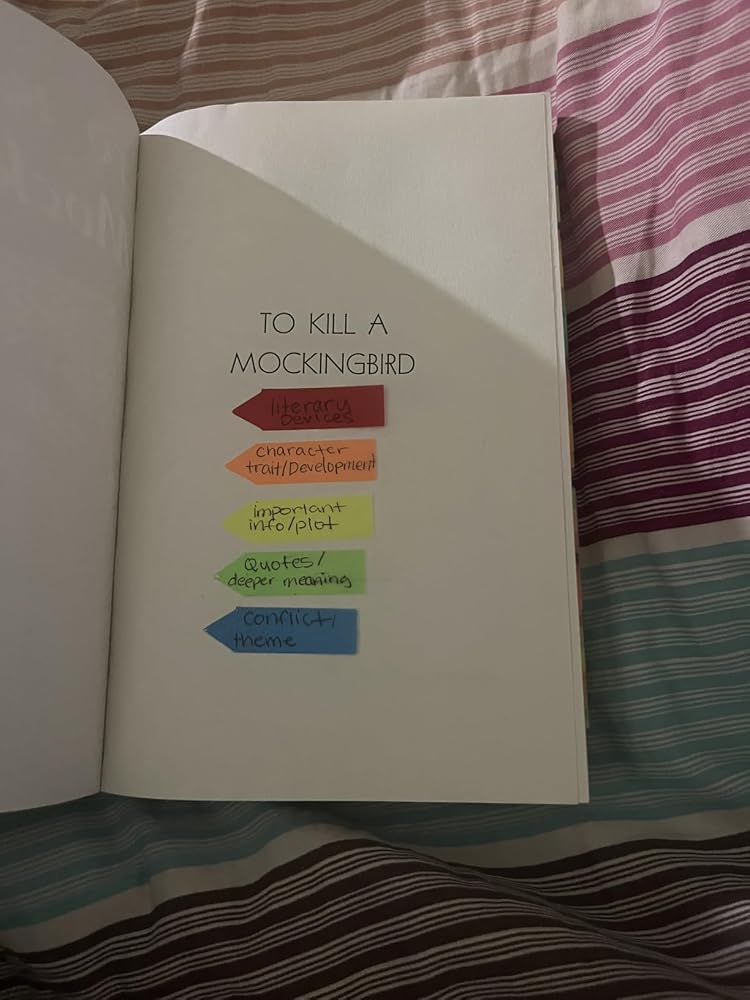
came in EXCELLENT condition I was surprised it came in good condition because once I ordered a book from Amazon and a whole page was ripped out. I thank whoever packed me this order because it came in a nice bubble wrap bag so it ensures that no harm will come to it. I ordered this for my high school class cause it’s a required book, I was pleasantly shocked that I actually enjoyed reading this. You can see that I annotated it but only got done halfway because I haven’t finished reading… BUT I did finish the 1st part and let’s say woah THAT was a rollercoaster.



Very interesting read.
The book? A literary gem. The delivery? Guilty of tardiness. Was meant to be a gift, but the timing made it more whoops than thoughtful.
Good book bought for a school assignment.
Good price, excellent condition and edition as advertised, quick shipping. Thanks!
Sometimes people are treated differently because of the way they are perceived, and people don't know them at all. It happens way to much, never pre judge a person until you know them
If it’s on the abanned Book List - it’s a great book, and this is a classic. One of my all time favorites.
Exceptional book to read !!!
Gift book that was well received.
I'm not going to say much on this classic other than everyone should read it at least once in your life.After all "It's a sin to kill a mockingbird"
A classic book to read at a good price.
To Kill a Mockingbird by Harper Lee is a timeless classic that masterfully combines a coming-of-age story with a deep social commentary on racism, morality, and justice. Set in the 1930s in the small town of Maycomb, Alabama, the novel follows Scout Finch, a young girl, and her father, Atticus Finch, a principled lawyer who defends a black man, Tom Robinson, falsely accused of raping a white woman.One of the strongest aspects of the book is Harper Lee’s portrayal of complex, multifaceted characters. Scout, with her youthful innocence, sees the world through a lens of curiosity and confusion as she witnesses the injustices around her. Atticus, on the other hand, serves as a moral beacon, showing unwavering courage and compassion even when faced with overwhelming prejudice. The portrayal of Tom Robinson’s trial offers a heartbreaking reflection on racial inequality and the moral struggles of the era.The novel’s narrative style is another strength. Through Scout’s perspective, we see the growth of empathy and understanding, and as readers, we are invited to question the structures of society. The writing is both accessible and profound, making it approachable for a wide range of readers, while still offering deep layers for more critical analysis.The only downside is that some may find parts of the story slow, especially for younger readers unfamiliar with the historical context. However, the novel’s themes are still incredibly relevant today, making it an important and thought-provoking read.Overall, To Kill a Mockingbird is an essential book that offers profound insights into human nature and the complexities of moral courage in the face of injustice. It’s a must-read for anyone interested in exploring the enduring struggles for equality and the power of empathy.
Having watched the movie many times over the years. I chose to read To kill a Mockingbird for the first time this year. (2025 as a part of my endeavor to read all greatest works in literature.) During my education as a Dyslexic the reading requirements were very lax, therefore Harper Lee's works weren't introduced. Today the same district has banned this book from all students. Both of which I view as a travesty; that any educator would think to do this. After reading this book.Without spoiling the story for others. I was struck many times with how relevant a book written so long can be today. In technology speaking we have come along way. In contrast it doesn't seem like we have come far enough in how we view and treat our fellow human beings. Based upon race, gender, and social economics.Although I didn't grow up in the South or in this era. I could recall instances in which I knew someone or had experienced a similar ( modern parallel.) In my opinion this relatable manner of writing of Harper Lee. Is what makes her book so powerful. As she enables readers to "Get In their skin and walk around in it awhile" As Mr Finch tells Jem and Scout.Would highly recommend this book to others.
Intangible things are powerful. We don’t see them, but they can steal one’s peace of mind, bring trouble, and they can also kill. Prejudices are invisible. Yet, they root deeply in people’s minds and it takes years or even decades to pull them out. It is easier to destroy a physical thing, no matter how durable. To pull out a prejudice that was nurtured and encouraged for a long time is practically impossible.“To Kill a Mockingbird” by Harper Lee is about the power of intangible things. At least that’s what I saw in this story. People are prone to cultivating prejudices. It begins in childhood when the imagination runs wild, having no guide marks of experience to rely on. When we are little, we see the world as a mysterious place full of enigmas. And we are still completely fearless, having not experienced failure, pain, disappointment, and true fear, and jump head first into solving them.The book begins with three children trying to solve the mystery of their neighbour’s house. Scout, Jem, and Dill are fascinated by ‘Boo’ Radley whom no one in the town seems to have seen for years. And since grown-ups are reluctant to shed light on what happened in that family, children become obsessed with unravelling this secret. They do silly things and end up in pseudo-dangerous situations, which seem frightening only when you are little. Adults scold them, but it doesn’t stop them from persisting in their investigative pursuits.As the story progresses, another mystery comes to the forefront. A man is accused of rape. The court has to determine if it is true. Yet, it seems that for everyone in Maycomb, Alabama it isn’t a mystery at all. They aren’t waiting for a verdict. They are expecting the accusation. Because of the deeply rooted prejudice, the trial is a form without content. Everyone knows the result, but still, cannot resist attending. The folk of Maycomb don’t need the law, the system, or the procedures of a fair trial to tell them what to think. The prejudice ingrained in them has already issued them all the answers.And against this predictability, which hangs grim and pressing as a dark cloud which will inevitably bring thunder and a devastating downpour, Atticus Finch’s character stands out like a ray of light, too bright to look at without hurting one’s eyes – and readers’ hearts.It was heartbreaking to follow a decent man’s struggle which was lost before he began fighting. It is especially painful, for, sadly, similar stories repeat across the decades and continents, with their participants belonging to different groups but with the gist remaining the same. One can fight for justice, but one can never win against prejudice.A black man accused of raping a white woman could never be justified in the Southern Alabama in the 1930s. The elements vary across times and places, but the result of such situations remains the same. I find the real power of this novel in this truth, which can be fully conceived only if one looks at the story from a wider angle.Only one moment in the book fell flat for me. I can’t explain it. I understood what the author wanted to show with it. It is logical and works well for the story. Yet, it didn’t ‘get under my skin,’ for the lack of other explanation. Maybe because I was a participant in a similarly acute episode, involving people similarly blinded by a similar prejudice. The outcome of that incident was also favourable as it is the book. But the reasons for me getting away unharmed were different. I don’t think there is any added value to trying to analyse it in a book review. It did make me think again about certain things I’ve gone through in my life. And still, for some reason, the episode as it is narrated in the book didn’t work for me.It would be a futile effort to retell the plot of the book so much talked about and which millions of people have read. Besides, like any great story, it gives something different to every person who reads it. To me, “To Kill a Mockingbird” by Harper Lee is about the things that stretch far beyond its story and its characters. To me, this book is about a sad truth that doesn’t change despite all the efforts made to change it. Blinded by prejudice, people know without learning, judge without trial and investigation, and issue a death sentence without remorse or mercy.
You're familiar with the basic story and maybe you read it long ago. You know the book is a classic and you remember seeing the movie as a child. But have you ever sat down and just appreciated this novel for the wonderful story that it truly is? This is story about racism, culture and societal expectations. But, most of all, it is a story about integrity and doing the right thing.The story is set in the South: the town of Maycomb, Alabama in the 1930's. A place where white people have roles and black people have rules. This is where the great Atticus Finch is raising his two children - Jeremy (Jem) and Jean Louise (Scout). Although he is a widow, he does have the help of a servant named Calpurnia who is a cherished part of the family. Atticus is a public defender and serves on the State Legislature. He is a highly-educated and thoughtful man dedicated to his town, his neighbors, his family - and justice. His motto: "You never really understand a person until you consider things from his point of view - until you climb into his skin and walk around in it."The story, however, is not told from his perspective, but from that of his daughter, Scout who is around 5 or 6 when the story begins and about 10 or so in its closing scenes. Through her eyes, we get innocence mixed with a precociousness and the wry sense of humor she has inherited from her dad. He's a lawyer and he asks a lot of questions. Sometimes he asks them when he already knows the answer and so does Scout. Atticus is always straight-forward about answering her. Jem tries his best with her, but he is also very young at the time and trying to find his way of fitting in as well.The first few pages introduce a cast of characters and are somewhat challenging to get into. Best to relax and just enjoy the ride - it will all come clear as the story unfolds. Remember you are being introduced by a small child. The action starts soon enough, as Atticus is assigned to defend a black man accused of raping a white woman. The scenes leading up to and within the courthouse during the trial are brilliant and evoke so much emotion as you "climb into another's skin and walk around in it". The writing is so vivid and the characters really come alive. Your heart wants one verdict even though your head knows it's going to be another. The town gets past the trial and life goes on; or does it? Unfortunately, not for everyone. The ending is incredible and will not leave you for a long time to come.I read this book as part of a banned book project and I thoroughly enjoyed it! I fell in love with Atticus Finch and Scout and I hope to become a better person for it! I'm glad when young people review this book and are shocked by what the world offered in 1935. That helps me understand that times are indeed changing despite still having a way to go!
‘You never really understand a person until you consider things from his point of view... Until you climb inside of his skin and walk around in it.’Harper Lee’s To Kill A Mockingbird is an undisputed classic that few will avoid having read in their lifetime, and those few are to be pitied. As I habe presentation of the novel coming up this weekend, a discussion group that I am lucky enough to be allowed to lead as part of the The Big Read here in Holland, Michigan, I felt it necessary to revisit this timeless classic (and I figured I’d review it to help collect my thoughts on the subject). The experience was like returning to a childhood home and finding it warm and welcoming and undisturbed from the passage of time, like walking the streets of my old neighborhood and hearing the calls of friends as they rode out with their bikes to greet me, of knowing the mailman by name and knowing where all the best places for hide-and-seek were, the best trees to climb, and feeling safe and secure in a place that is forever a part of yourself. Though some of the mechanics of the novel seemed less astonishing than my first visit more than a decade ago, the power and glory was still there, and I found a renewed love and respect for characters like Atticus, whom I’ve always kept close to heart when wrestling with my own position as a father. Harper Lee created a wonderful work that incorporated a wide range of potent themes, wrapping class systems, gender roles, Southern manners and taboos, and an important moral message of kindness, love and conviction all within a whimsical bildungsroman that no reader who has been graced by its pages will ever forget.‘The one thing that doesn't abide by majority rule is a person's conscience.’Before dipping into the novel itself, I’d like to take a moment to speak about Atticus Finch, one of my favorite characters in all of Literature. Atticus is a pillar of morality, a man of honor, integrity, and most importantly, conviction. He is humble and honest, even admitting to his children that yes, indeed they are poor. In a novel about society, with its tumultuous mess of morals and class, Atticus is like an authorial deus ex machina, being Lee’s method of inserting moralizing and an example of what constitutes a ‘good man’ into the book through character and not authorial asides. I’ve always idolized Atticus and tried to think ‘what would Atticus do?’ when it come to being a father and undertaking difficult moral conundrums (I even named my second cat Catticus Finch). Atticus takes the unpopular position of defending a black man in a rape case when assigned to him despite the town nearly ostracizing him. Atticus does his duty, and does it well, as a man of conviction that believes in doing what is right and honorable regardless of the consequences, living up to his statement that ‘Real courage is when you know you're licked before you begin, but you begin anyway and see it through no matter what’. In fact, Lee originally intended to name the novel Atticus before deciding it would stifle the broad perspective of Macomb by drawing too much attention to one character. Atticus remains steadfast throughout the novel, sure of himself and fully developed, whereas those around him undergo more a sense of change and development. This is a novel about personal growth and a broader understanding of those around you, and Atticus is the anchor to integrity and morality keeping his children centered in the violent storm of emotions and violence that befalls Macomb.‘When a child asks you something, answer him, for goodness sake. But don't make a production of it. Children are children, but they can spot an evasion faster than adults, and evasion simply muddles 'em.’There is a childlike innocence spun through a novel of such weight and seriousness, executed brilliantly by Lee’s choice of Scout as the narrator. We are forever seeing a larger world through the eyes of a young girl still trying to find her place in it while making sense of all the hustle and bustle around her, and this creates an incredible ironic effect where there are large events going on that the reader understands but are delivered nearly through defamiliarization because the narrator cannot fully grasp them¹. The narration allows Lee to balance the coming-of-age hallmarks with the weightier themes, allowing the reader to maintain an innocence from the rape and racism while still able to make sense of the society functioning at large, and retreating from the darker themes into the fun of the children’s comings and goings. What is most impressive is how everything blends together, and the lessons learned in each aspect of their life are applied to all the other elements they come in contact with. The fates of Tom and Boo Radley are emotionally and morally linked in the readers mind, heart and soul.All the standard bildungsroman motifs that make people love the genre are present in To Kill a Mockingbird, from schoolyard quarrels, to le...
In the 1930's, Jean Louise Finch, also known as Scout, lived with her brother Jem and father Atticus in the sleepy little county of Macomb County, Alabama. Scout and Jem spent the summer playing with their friend Dill, who spends time with Jem and Scout because things are unsettled at home. They also spend much of their time trying to get a look at Boo Radley, a quiet man, who stays inside his house all the time. The kids make up wild stories about Boo, and dare each other to knock on his door.Atticus is a lawyer and neither Scout nor Jem are too impressed with his job early on because he is unlike the regular folk in Macomb County. As spring stretches into fall, Scout goes to school, she’s eight, in the third grade, and never afraid to talk back to a teacher, talk back to her maid Calpurnia, or fight a boy if they speak ill of Atticus. Jem, who is 12, is more interested in playing games with Dill, but he also keeps a tight rein on Scout, and because he’s older, she begrudgingly listens to him.Things are far from idyllic in this Southern county, a black handyman named Tom Robinson is accused of raping a white girl named Mayella Ewell, Tom insists he’s innocent, and Atticus is the only one in Maycomb County who will defend Tom. Two nights before the trial, a mob appears in Atticus’ yard, threatening both Atticus and Tom Robinson. It’s Atticus himself who talks the angry mob down from their violent intentions. Despite their tender years, Jem and watch the trial. How does the trial go? Does Atticus get Tom acquitted? Or does the bigotry of the county foretell the verdict?I love this book. There are so many interesting aspects to this book. Because it is told from the point of view of the children, specifically Scout, it makes the racism more horrifying, because the kids can’t quite understand what all the anger is all about and why some of it is directed at Atticus. Atticus is the moral conscience of the book, always giving his children lessons on how to treat people well, even some of the more despicable characters in the book, and living those beliefs. When the kids wish that Atticus was more like the other fathers in the county, Lee introduces a chapter where Miss Maudie, Atticus’ neighbor tells the kids that Atticus is the finest shot in Macomb County, and then he proves it by shooting a rabid dog. That gives the kids a respect of Atticus that they never had before. Lee also introduces Tom Robinson in an ingenious way, though Calpurnia, and soon Jem and Scout are going to Calpurnia’s church regularly, and sat in the balcony with the Reverend Sykes and the rest of the black people in the courthouse as the trial begins.The maturing of Jem is another interesting aspect of the book, before the trial he is a happy go lucky kid, after the trial, he is a wholly different person, Scot doesn’t quite comprehend the change, but hopefully the reader can understand what has happened to Jem Finch. Perhaps the most interesting character is Boo Radley, Boo is a symbol, a metaphor. Jem and Scout don’t understand him, so they think he’s evil, just like most white people in Maycomb county don’t know any blacks and therefore think the worst of them. The last few chapters lull the reader into a false sense that the major events of the book are over and then, bam another surprise, and the book ends.It is ironic that I finished this book in the wake of the shootings of nine black parishioners in South Carolina by a white supremacist. It’s hard to argue that we live in a post racial society in the wake of an event like this. 55 years after this book was written issues of race unfortunately still resonate in the U.S. That is reason enough to read this book, or read it again, like me. But there are many more reasons to read this book. I hope you do.For more thoughtful reviews, please visit my blog reviewswithatude.wordpress.com
If ever there were a book I would consider voting for as the “Great American Novel”, Harper Lee’s To Kill a Mockingbird is the one…the only one. It is hard for me to say that there is a one great anything. Times change, technology improves, and social views evolve. In short, we are never the same from one generation to the next and trying to pick anything that spans the gap and the differences as the greatest of all is difficult, if not a complete waste of time.When it comes to literature, there are so many fine books and so many great writers that trying to narrow the selection to the “one great one” interferes with valuable reading time…generally. But then there is To Kill A Mockingbird.Harper Lee’s story takes place in the small southern Alabama town and county of Maycomb during the depression era 1930’s. She paints a picture of the community and the people populating it through the eyes of Scout (Jean Louise Finch) the daughter of a prominent local attorney, Atticus Finch. As the book opens, Scout is preparing to begin her first year in grade school.She and her brother Jem and friend Dill pass the summer doing the things children did before the age of video games and twenty-four hour television. They played. They entertained themselves. They went on adventures. They told stories about the frightening, recluse who lives on the corner. They were children.They did all of this under the watchful eyes of Calpurnia, the black woman who is housekeeper and surrogate mother to the family. Scout describes her as “all angles and bone…with a hand as wide as a bed slat and twice as hard…”In the Finch household, Cal is treated as an equal, a partner in the upbringing of the children and an indispensable member of the family. That is in the Finch household. Outside their small world, things are different in the community of Maycomb.I find Calpurnia to be one of the most interesting of characters in the story. She is a strong and independent black woman who makes her way in the world dominated by whites. Scout is amazed on one occasion when visiting at Cal’s church that she spoke differently to other blacks, using their particular colloquialisms and dialect. It was very different from the way she spoke with Scout and Jem in the Finch home. Scout had no idea that Calpurnia lived this “double life” relating differently to the two cultures in Maycomb.In short, racial prejudice reigns, as was common in the time. Blacks, Negroes as polite members of the community called African Americans in that day, are second-class citizens with a place in the universe of Maycomb that is always inferior to the whites. Even the most white-trashy, ignorant, slovenly of whites holds a place in the community superior to any of the blacks.As a southerner who grew up in the south in the 1950s, I remember the “Jim Crowe” days. I went to schools that were not desegregated. I saw white only water fountains and restrooms. Black children were to be treated kindly, but we did not associate as a rule. They had their world. We had ours.As Scout paints a picture of Maycomb through the experiences she shares with Jem and Dill, it begins as a sort of “Mayberry-esque”, idyllic memoir of her childhood. But events open her eyes to the underlying darkness of their culture. Maycomb is not the perfect little world she thought.She is guided by her father, Atticus, through the twisting cultural maze she inhabits. He teaches her not to judge others, but to get in their shoes and walk around a while to see how the world looks from their perspective. Most importantly, never kill a mockingbird because all they do is sing and bring happiness without harming anyone else. Atticus is the rock in Scout's world, giving her rope to explore and float about on the sea, but always there to anchor her safely.Brother Jem (short for Jeremy) and friend Dill are her conscience and mentors in a way. Dill, rambunctious but sensitive, opens her eyes to things she had missed in their small community. Jem, sees and struggles with the contradictions around them...white people they have known all their lives as good people, doing things and saying things that they know to be wrong.Through her innocence and confused effort to understand what is happening around her, we see that things are socially complicated. Whites harboring racial prejudice are not all evil as Scout describes their interactions. Instead, you get the feeling that they are ignorant, not seeing the contradictions in their lives, one instant treating a black member of the community in a courteous friendly manner, the next making sure they understand their place in the community…second class.Some, however, are evil. The Ewells are the evilest of them all. Their conflict with Atticus and his defense of a black man, Tom Robinson, accused but innocent of a terrible crime leads to a chilling climax in the concluding chapters.In the event that there is someone who has not read the book or seen the movie, I will not include any...

