
The Afterlife Project
by Tim Weed
Couldn't load pickup availability
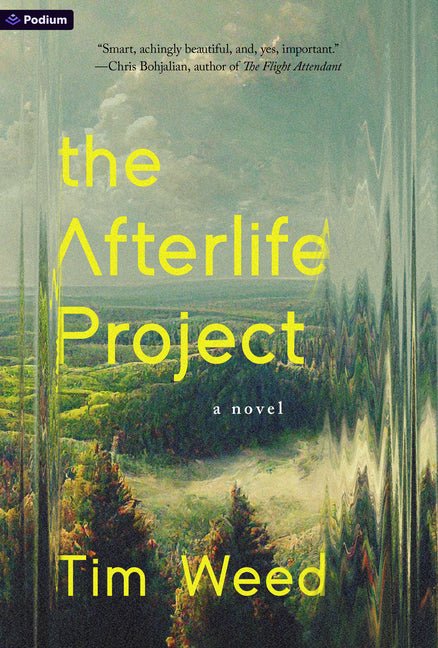
Separated by ten thousand years, a team of scientists and their test subject must work together to save the human species--before it's too late . . .
With humanity facing imminent extinction, Centauri Project scientists use technology originally designed for interstellar travel to send a test subject ten millennia into Earth's future. Marooned in an uninhabited wilderness, microbiologist Nicholas Hindman searches for evidence of remnant populations. He has a protocol to follow and is determined to do so to the bitter end--though he knows he's probably searching in vain, stranded on an empty planet silently orbiting the sun.
Meanwhile, back in 2068 AD, a devastating hyperpandemic has quelled all talk of interstellar travel and thrown the future of humanity into grave doubt. Four surviving members of the Centauri team board a vintage solar-powered sailing yacht for a harrowing journey in search of a second test subject. Their destination is a small volcanic island north of Sicily rumored to harbor that rarest of creatures: a woman capable of getting pregnant, thereby ensuring this generation of Homo sapiens isn't the last. But first they must make it halfway across the post-apocalyptic globe, risking heatwaves, oceanic megastorms, murderous gangs, deranged cult leaders, a volcanic eruption, and the dangerous microbes that continue to circulate through the planet's atmosphere.
A finalist for the Prism Prize for Climate Literature, The Afterlife Project encompasses a desperate quest for the key to the future of humanity, an impossible love story, and a search for meaning across the inconceivable vastness of geological time.
"Smart, achingly beautiful, and (yes) important: a gripping novel of climate cataclysm with a cast of characters I cared about deeply." --Chris Bohjalian, #1 New York Times-bestselling author of The Flight Attendant
"A super-smart, super-fun page-turner about a scientist trying to survive alone on Earth in the deep future--and the love of his life trying to travel through time to find him. I can't think of a single page that didn't make me pause to admire a sentence, an image, or a particularly fascinating idea. I loved this book." --Angie Kim, New York Times-bestselling author of Happiness Falls
"The Afterlife Project isn't just a story about the end of the world as we know it--it's an exploration of beauty, and love, and hope in the darkness. If you were a fan of Cloud Atlas, you won't want to miss this one." --Janelle Brown, New York Times-bestselling author of What Kind of Paradise
"This beautiful and heartbreaking book reminds us of what we have, and what we stand to lose. Unforgettable." --Danielle Trussoni, New York Times-bestselling author of The Puzzle Master
"A brave and brilliant imagining of Earth in the years just after a megapandemic has killed almost everyone, and ten thousand years hence, when a test subject emerges from suspension to explore a wilderness echoing with solitude. . . . Riveting and wrenching and suffused with beauty--the haunting and intimate beauty of the natural world rendered by a master." --Peter Heller, bestselling author of The Dog Stars
"Weed is a fabulous storyteller working at the top of his game. I predict this novel will become a classic." --Joseph Monninger, author of The World As We Know It
"It's a relatively simple idea, but Tim Weed makes it into something special with first-rate nature writing and a story that underlines how connected we all are to our human and physical environment--which can be a source of resilience even as everything falls apart." --The Toronto Star
"The writing . . . is as lush and beautiful as the far-future Earth itself . . . The Afterlife Project provides a thought-provoking look at how beautiful the world could be without anyone like us in it." --Washington Independent Review of Books
"Rousing seafaring adventure . . . contemplative musings on life . . . [and] a compelling romance make this a fascinating tale that is difficult to put down." --Library Journal, starred review
"A tale that feels wholly original and movingly conveys the full weight of the circumstances while providing a riveting read in the process." --BookLife by Publishers Weekly
"This engaging dystopian tale deftly blends enthralling fiction with real-life fears." --Kirkus Reviews
"The dangers [the characters] endure along the way are set against an unfolding and impossible love story across the vastness of geological time, as the scientists work to keep humans in existence. It may sound like an end-of-the-world tale, but it defines the strength and bravery of human beings and what they will do to preserve this precious thing we call life in the face of overwhelming odds." --Middlebury Magazine (Editors' Pick)
"A dark yet hopeful story that is engrossing enough to be a beach read . . . Weed reminds us why cli-fi matters." --Seven Days
"A dystopian masterwork." -- The Brattleboro Reformer
"This genre-defying novel blends literary fiction, climate science, and speculative imagination in a haunting narrative that spans millennia." -- The Vermont Journal
Share
Book Details
- ISBN
- 9781039480452
- Binding
- Paperback
- Authors
- Tim Weed
- Publisher
- Podium Publishing
- Published Date
- June 3, 2025
- Language
- English
- Pages
- 272
- Physical Info
- 1.1 in H x 8.2 in L x 5.4 in W (0.55 lb)

This story was a lot. Be prepared to work your way through the start. The author is very descriptive, which is good for building the story and a bit hard to keep track of at the same time.Worth the effort and time to dig into this one.I received a free copy of this book and am voluntarily leaving a review.
This story really captured the impact that humans have had on the earth, while also telling a great story of hope and courage. A great environmental fiction story, something hard to find. And for invasive species nerds, props for the references to knotweed and European frog it, for they will outlast us all!
What if humanity gets things so wrong that, within the next 40 years or so, we destroy civilization and obliterate our species? What if we could send someone to see how the Earth's recovered 10,000 years from now, and whether, against all odds, some humans survived and built something new? The premise predicts just how dark the story will be; the bits of joy are small and emotional, like requited love and the pleasure of a cat's purr, plus the beauty of a natural world that thrives again, mostly, once freed from our destruction. But if you recall KSR's The Ministry for the Future, imagine the emotions you felt in the first section persisting chapter after chapter. I can see this as a Lars Von Trier film or an HBO series; it'll be gorgeous either way, and you'll want to drink yourself numb afterward.
Tim Weed’s The Afterlife Project is one of the best books I’ve read in a long time. It is a surprising blend of science fiction and nature writing, page turner and literary novel, plot-driven, but also character-focused, examining broad societal issues as well as intimate matters of the heart. It is a tragic love story, an exploration of what it means to be human, and an adventure story all in one.The way that the chapters alternate between the two time periods--2068, when civilization has collapsed, and 10,000 years in the future, helped the pacing of the story. Just when I began to feel weighed down by the bleak descriptions of the post-apocalyptic world of 2068, where the earth is ravaged and the remaining humans wage a barbaric fight for survival, I would come to another chapter 10,000 years in the future, full of fantastically lush descriptions of the natural world, where plants and animals are flourishing once again in the absence of human civilization. These chapters are like taking a peaceful walk in the woods after reading the calamitous news of the day. They are a breath of fresh air, despite the struggles Nick confronts surviving and finding meaning and purpose all alone in the world.Weed provides just enough scientific premise for time travel, the hyperpandemic, etc., to help readers suspend their disbelief without getting bogged down in jargon. But it is his deep knowledge and love of nature and his exquisite writing that makes this novel breathtaking. I could not put it down.
This was a book I could easily have read in a single sitting, but forced myself to spread over a few days so that I could prolong the enjoyment. I felt so invested in the people in this story and the world(s) they confront. The prose is exceptional. The world needs more fiction like this.
- 5 stars: 16 (80%)
- 4 stars: 3 (15%)
- 3 stars: 1 (5%)
- 2 stars: 0 (0%)
- 1 star: 0 (0%)
This story was a lot. Be prepared to work your way through the start. The author is very descriptive, which is good for building the story and a bit hard to keep track of at the same time.Worth the effort and time to dig into this one.I received a free copy of this book and am voluntarily leaving a review.
This story really captured the impact that humans have had on the earth, while also telling a great story of hope and courage. A great environmental fiction story, something hard to find. And for invasive species nerds, props for the references to knotweed and European frog it, for they will outlast us all!
What if humanity gets things so wrong that, within the next 40 years or so, we destroy civilization and obliterate our species? What if we could send someone to see how the Earth's recovered 10,000 years from now, and whether, against all odds, some humans survived and built something new? The premise predicts just how dark the story will be; the bits of joy are small and emotional, like requited love and the pleasure of a cat's purr, plus the beauty of a natural world that thrives again, mostly, once freed from our destruction. But if you recall KSR's The Ministry for the Future, imagine the emotions you felt in the first section persisting chapter after chapter. I can see this as a Lars Von Trier film or an HBO series; it'll be gorgeous either way, and you'll want to drink yourself numb afterward.
Tim Weed’s The Afterlife Project is one of the best books I’ve read in a long time. It is a surprising blend of science fiction and nature writing, page turner and literary novel, plot-driven, but also character-focused, examining broad societal issues as well as intimate matters of the heart. It is a tragic love story, an exploration of what it means to be human, and an adventure story all in one.The way that the chapters alternate between the two time periods--2068, when civilization has collapsed, and 10,000 years in the future, helped the pacing of the story. Just when I began to feel weighed down by the bleak descriptions of the post-apocalyptic world of 2068, where the earth is ravaged and the remaining humans wage a barbaric fight for survival, I would come to another chapter 10,000 years in the future, full of fantastically lush descriptions of the natural world, where plants and animals are flourishing once again in the absence of human civilization. These chapters are like taking a peaceful walk in the woods after reading the calamitous news of the day. They are a breath of fresh air, despite the struggles Nick confronts surviving and finding meaning and purpose all alone in the world.Weed provides just enough scientific premise for time travel, the hyperpandemic, etc., to help readers suspend their disbelief without getting bogged down in jargon. But it is his deep knowledge and love of nature and his exquisite writing that makes this novel breathtaking. I could not put it down.
This was a book I could easily have read in a single sitting, but forced myself to spread over a few days so that I could prolong the enjoyment. I felt so invested in the people in this story and the world(s) they confront. The prose is exceptional. The world needs more fiction like this.
The plot was interesting enough to keep me reading until the end. With that said, the pacing was incredibly slow. There's only so much foraging and walking around that one can read about before becoming a bit bored. The summary made the book sound more exciting than it actually was. The alternating chapters from the perspectives of two of the characters frustrated me. Just when something pivotal was taking place, the chapter would end and we'd visit the other character for a while. (It was very distracting that the lead scientist, Natalie, ended most sentences with the word "dear" as it just didn't seem to fit with a woman who was considered a genius at age ten.) I was more interested in what the Centauri team was doing for most of the book, and then for the last portion, Nick's account started to become more interesting. The ending, for me, came abruptly and it wasn't a satisfactory one. I know that the technology posed in the book is fictional but based upon the extensive research the author did to write this story, thus the following confused me: I'm not a scientist, yet I kept wondering why a biologist waking up 10 million years in the future, would just start drinking from a stream without worrying about negative effects on his health. Wouldn't he have to test it first to ensure that it's safe? I suppose we're to assume that the Earth has totally been cleansed after that much time passing, and Nick could only bring the barest essential with him and that didn't include something that could be used to test the water. It was just a small thing that bothered me for a few chapters. It also seems implausible that only one person would be selected to wake up in the future. His mission seems important enough that a group of highly intellectual scientists would know to provide more than one or two individuals to ensure some level of success. One of them could have been a physician, perhaps an engineer to build a living structure of some kind, or a zoologist to assist with categorizing any new types of animals and to figure out if those animals could be dangerous or possibly domesticated. Overall, it was well written and I applaud the author for the amount of research and time he spent on the book. The references to a particularly deadly pandemic, and to advanced climate changes are certainly timely at this point in history. I would certainly give a future book by him my attention.
Tim Weed somehow managed to write a ripping time travel yarn that is also meditative, philosophical and touching. I didn't merely read The Afterlife Project but inhabited it. It's one of those books that you hope will never end...
One of the best books I’ve read lately. If you like dystopian sci fi, this is for you!
Tim Weed has crafted something extraordinary with THE AFTERLIFE PROJECT—a novel that operates simultaneously as hard science fiction, intimate character study, and philosophical meditation on humanity's place in the natural world. The dual timeline structure creates perfect narrative tension, following microbiologist Nicholas Hindman's solitary existence 10,000 years in Earth's future alongside the Centauri Project team's desperate 2068 sea voyage to find humanity's last hope. Weed's prose is both scientifically rigorous and deeply lyrical, particularly in his descriptions of a rewilded Earth that has healed from the wounds inflicted by humanity. What elevates this beyond typical climate fiction is its refusal to offer easy answers or false comfort. Instead, it presents a clear-eyed examination of human resilience that feels both devastating and oddly hopeful. This is climate fiction at its most sophisticated, avoiding didactic preaching to deliver something far more powerful: a story that honors both our species' capacity for destruction and its profound determination to endure.
This is hands down one of the most thought-provoking books that I have ever read. Which is saying something, because thought-provoking books are kind of my thing. The Afterlife Project is told in two timelines from two perspectives. The first is in the near future (the 2060s), where we read from a journal written by a doctor who is a team member on the project trying desperately to save a rapidly dwindling humanity. The second is from Nick, who finds himself waking up ten thousand years in the future, wondering what happened to not only his loved ones, but the planet as a whole.I mean. How can you even reconcile either position in your mind? Certainly, at first glance, Nick's seems the most mind-boggling. To be so far removed from everything you've ever known is too huge to fully comprehend to us. But likewise, being the group from the Centauri Project is no easier a position to imagine. How far do you go to save humanity? Is ever the cost too high? These are just some of the questions you'll be grappling with alongside the characters as you make this journey with them.I have so much to say about this book, but I equally want to tell you no more. Because this is the sort of story that needs to be experienced to be appreciated. The dual timeline provides a perfect balance between excitement and quieter moments, and there is so much exploration on topics of humanity, faith, science, memories, climate, and the entire lifespan of the planet. Truly, if you enjoy any of these existential topics, do yourself a favor and give this book a chance.Bottom Line: The Afterlife Project is the sort of book that burrows into your mind and will leave you thinking about it for a long time to come.
Laced with rich and knowledgeable natural descriptions. Optimistic characters waging war against the despairing collapse of human civilization against the backdrop of a reawakening earth. A ten thousand year old love story afloat in the river of time.
Tim Weed's “Afterlife” is a truly moving novel, a testament to beautiful writing, haunting imagery, and the enduring power of hopeful love. This isn't just a story; it's an immersive experience that draws the reader deep into its existential universe.For me, a singular fragment of thought lingered from the text: a brief mention of the ivory-billed woodpecker. While a minor detail in the narrative, it became a powerful metaphor for the profound emptiness of loss woven throughout the book, and perhaps, a whisper of renewal. This personal connection underscores the novel's ability to resonate deeply, allowing even a fleeting image to carry significant emotional weight.The narrative unfolds as a dystopian love story, where personal connections are tested against a backdrop of environmental elegy and an uncertain future. Weed masterfully weaves together various threads, creating a rich tapestry that feels both intimate and expansive. The reader doesn't merely observe the characters; they become a part of their journey, feeling their hopes, their despairs, and their yearning for connection in a world grappling with its own ghosts. Afterlife is a book that lingers long after the final page, a poignant exploration of what it means to find love and meaning in the face of profound loss.
Wow, I was really impressed with this book (would actually give it a 4.5 rating if I could). So interesting and well researched, I felt like I learned so much! But also exciting. Good job!
A deeply touching book that manages to be sobering and inspiring at the same time. I read this in 3 sittings - it was astonishing - and I'm recommending it to everyone I know. Including strangers on Amazon, it seems! Other reviewers have described it eloquently so I'll keep this short as your time is better spent within the pages of this book. Loved it.
Human extinction isn’t just on the table. It’s already being served. In the not-so-distant future, Earth is gasping for air. A hyperpandemic wipes out most of humanity, and with no known cure or hope, a group of desperate scientists puts their last plan into motion.Microbiologist Nicholas Hindman is launched ten thousand years into the future, tasked with finding proof that people still exist. But what he finds isn’t exactly comforting. Back in 2068, the remaining scientists board a solar-powered yacht on a dangerous journey through a climate-ravaged world, hoping to locate a woman who could be the key to human survival. It’s a brutal, beautiful race against time, filled with storms, cults, and crumbling remnants of the world we once knew.The Afterlife Project is a cinematic story about resilience, purpose, and what it really means to save a species. It’s also a love letter to the planet and a terrifying warning wrapped up in a page-turner.This book made me feel like I was dropped into a wild climate crash course, but one that never slowed down long enough to feel like a lesson. The story moved like a current, pulling me along with every twist and discovery.The imagery was unreal. I could feel the heat of the sun-scorched Earth and the weight of the silence in a world left behind. The science felt real without being overwhelming. You can tell the author did their homework, but they made it all part of the story instead of just info-dumping. It felt like being caught in a slow-motion disaster that you couldn’t look away from, like watching a house of cards and knowing it was about to fall, but hoping maybe, just maybe, someone would catch it in time.The characters each carried the weight of humanity on their shoulders, and the emotion bled through every scene. It was both heartbreaking and hopeful. I finished it feeling like I had just read something important. Big feelings, big questions, and somehow still a very personal read.The Vibes It Brings:🌍 Post-apocalyptic science fiction with an urgent climate twist📚 Feels like reading a survival journal mixed with a travel memoir🌊 Ocean journeys, volcanic danger, and relentless heat🧬 Science meets soul searching💔 Quiet heartbreak and quiet hope🧪 Near-future realism with just a touch of the surreal⛵️ Solar sailboats and crumbling civilizations🧡 Found family and unexpected connectionsThis audiobook hit every note for me. Bradford Hastings, Dawn Harvey, and Frankie Corzo brought such depth to their performances. Each narrator made their character feel alive, like someone I might know or have loved. Their tone felt natural and honest, like a close friend telling you a really wild story. There wasn’t a single moment that felt flat or forced. The emotion, tension, and hope in their voices made it easy to stay immersed from start to finish.Huge thanks to Podium for the free copy, because wow, this was one of those performances that sticks with you. If you're going audio, you’re in excellent hands with this one.
Wonderful story of the world ending. I have been waiting for this book and so glad I got to read it. Such a different type but very enjoyable. Group of friends and scientists put together a team to travel the country looking for the last of humanity. They have adventures and experiences that make this book well worth reading and maybe doing it again! Hope the author writes more. Try it yourself.
Where are we headed? What does the science say? What does the trajectory look like? Might it be of value to project out a bit, based on what we know today, and imagine? The last decade was the warmest on record since humans have been around and the rate of increased warming is faster, well, than ever. What else do we need to know? What’s to fight about other than the best solution forward?Climate fiction has been around since Jules Vernes’ The Purchase of the North Pole in 1989, but it’s really taken hold in the past 15 years. You could spend years reading climate fiction and never catch up. The climate is us. We are the climate. What 21st Century novel can go without mentioning the impact?And along comes The Afterlife Project, an astute and engaging dual-timeline saga that makes for fascinating conjecture. Tim Weed alternates between the right-around-the-corner future and a future so far out there it’s hard to conceive. Specifically, 10,000 years in the future. (Ten thousand years ago, for comparisons sake, us humans were just starting to move away from hunting and gathering to agricultural communities).Biologist Dr. Nick Hindman is the canary in the future coal mine. Well, he’s been shot there in a Time Dilation Sphere thanks to some mix of cold fusion and a pharmacological cocktail. He’s searching for any sign that humans managed to survive. And he is soon quite convinced that humanity is done.“The simple idea that everything he’s ever known could have been so fully erased by the passage of time. Computers, smartphones, the internet. Social media, Hollywood movies, any movies. The Stock Exchange, McDonalds and Starbucks. Coca-Cola, kombucha. NASA, plug-in hybrids, rock’n’roll, jazz. The Roman calendar. Days of the week. Politics. Blueberry scones. Every invention, every creation of the human society once known, not to mention his family and friends, and Natalie and the rest of the Centauri team. Everyone he’d ever admired, everyone he’d ever scorned. All the human beings he’d ever met, and the multitudes he never did. All of them, vanished and expunged. Never to be revisited, except in memory.”As Nick notes, having “landed” so far in the future, “it’s a lot to take in.”But there is a rich eco-system. And birds. Is there any sign of humans? It’s his job to find out and also to stop thinking about the aforementioned Natalie.The second timeline? Yes, Natalie. That is, Dr. Natalie Quist and the rest of the crew from the Centauri Project onboard a yacht heading to a volcanic island off the coast of Sicily called Stromboli. Their quest is to check the rumor that the island might be home to inhabitants who can reproduce. In these sections we are only 12 years after the big event that changed everything. It’s 2068. In 2047, international law prohibited the burning of any fossil fuels. But, too late.The planet is one big “grim reality.” Homo sapiens are about to die off. “The hyperpandemic was catastrophic on a scale beyond description and imagination The number of dead will ever be known, but it was the psychological changes that were discovered in the surviving population that truly rang the bells of doom for humanity across the planet. Because the microbe was an aerosolized component of the entire troposphere—and air itself—every single human being alive was exposed.”The result? Women don’t ovulate, men don’t produce sperm. Notes ship physician Alejandra Morgan-Ochoa, who “narrates” these sections through her journal, the world is “completely devoid of children.”Adds Morgan-Ochoa: “My plan is to be as diligent as possible with these entries from now on. To recount everything exactly as it unfolds, with the hope that by the time you finish reading these pages you will be in possession of the complete story of our unlikely quest. If we succeed, it will be a story for the ages. If we fail, then you, dear reader, are likely nothing but the fleeting construct of this long-dead woman’s overly optimistic imagination.”Using Morgan-Ochoa is a smart choice by Weed, because these journals explain for the record (and us) what happened in the buildup to the Big Wipe Out. And, it turns out, Morgan-Ochoa is a smooth writer. And we’re on a ship. And there’s uncertainty ahead.There is a lot of explaining to do, albeit about a plausible disaster scenario tied very much to what is happening here on Planet Earth in 2025. She gives us a tour of their ship (the Solar Basque) offers details about what they’re eating, introduces us to her shipmates, and describes various challenges and encounters as they sail on an occasionally “faintly chemical mid-ocean breeze.” And she recounts the process of strapping Dr. Hindman into his sphere and imagines him “whirling endlessly through the uncanny night of quantum-altered spacetime.”The sections with Dr. Hindman have a deep space Robinson Crusoe / Moby Dick / Call of the Wild flavor, buoyed by Weed’s rich, vivid writing. “The swamps are flooded lowlands filled with the sun-silvered skeleto...
Tim Weed’s latest novel is a gripping and emotional time travel/post apocalyptic adventure with a fair amount of science backing everything up. It’s also full of themes like found family and even a bit of romance, but mostly it’s an ode to our planet’s natural wonder and beauty, as well as a cautionary tale about humanity’s downfall. Weed masterfully tells his story in two timelines with a great deal of distance between them—more than 10,000 years!---and it’s surprisingly effective.The story takes place in the year 2068, twelve years after a hyperpandemic has decimated the population. Not only have billions died worldwide, but the virus has also left most people sterile and unable to have children. We follow a small group of scientists who are passionate about saving humanity, although their ideas are extreme and have a very low chance of success. Dr. Natalie Quist (“Dr. Q”) is the brilliant head of the Centauri Project, and along with her brother Tollie, pandemic survivor James Swamp and physician Alejandra Morgan-Ochoa (“Al”), she has come up with a bold plan. First, the team has devised a time travel pod that will send the occupant 10,000 years into Earth's future, with the hope that the planet will have recovered from the horrors of global warming. Natalie’s longtime lover Nick Hindman is a microbiologist, and he’s also the perfect candidate to send to the future—he just happens to be fertile. In the meantime, Dr. Q and the others will search for an equally fertile female to send to the future as well. Although the chances are slim, Dr. Q hopes this mystery woman and Nick will be able to save humankind and repopulate the planet.In alternating timelines, we follow Dr. Q, James, Tollie and Al on a thrilling sea adventure as they chase rumors of a group of fertile women in Stromboli, Italy, and 10,000 years in Earth’s future, we follow Nick as he awakens alone on a planet teeming with life and beauty. The chapters that take place in 2068 are journal entries, written by Al and transcribed by Dr. Q, so part of the story is written in epistolary format, which I loved. Al’s voice is a wonderful mix of technical science and wry humor, as she makes candid observations about her team members and injects quite a bit of drama into the story.And speaking of drama, their sea voyage was one of my favorite parts of the story. Imagine a post apocalyptic landscape where only small groups of desperate humans survive. Resources like food and clothing are in short supply, and infrastructures like hospitals, electrical grids, and even the internet are gone. Dr. Q and her team find themselves in several dicey situations over the months-long course of their journey across the Atlantic, and this made for a very exciting, tension-filled plot.Meanwhile, on a future Earth, we watch Nick’s adventure unfold as he emerges from his pod and realizes that he might well be the last human on the planet. Although he’s thoroughly versed in plant life and is able to forage for enough food to keep himself alive, he isn’t truly prepared for the intense loneliness that hits him. He’s surrounded by all sorts of animals and insects—it seems Earth has miraculously recovered from global warming—but he misses human companionship. Although there are dangers from predators and the elements, Nick’s storyline is mostly emotional and full of internal conflict, with many unanswered questions: was Dr. Q able to find him a suitable partner, and did she send her to the future? If so, where is she?And while The Afterlife Project often reads like an adventure story, it’s so much more. Weed has done lots of research on his subject matter and it shows. From scientific details about the hyperpandemic (and you thought COVID was bad!) to Nick’s ability to identify hundreds of mushroom varieties in the future, to the sad realities of global warming and the slow destruction of the planet, the story is infused with hard data to give it more heft. Weed also imagines what might happen to the planet if humans became extinct. His version is a lush world filled with diverse animals, birds, sealife and insects, an almost “Garden of Eden” scenario. Along with this vision of a possible future comes lots of food for thought. I was not able to stop thinking about some of the author’s more sobering ideas, although there are glimmers of hope. Mostly, I found it to be an honest, realistic story about humanity’s future. Weed doesn’t sugarcoat anything, and not everything goes to plan—or even comes close, in some cases. There are some heartbreaking moments in this story that brought tears to my eyes, but there are also wondrous scenes that show humankind’s tenacity and grit.I haven’t talked much about the characters, but each one is nicely developed. In flashbacks we learn how the members of the Centauri Project came together, how the pandemic started, and how Nick was chosen to be the guinea pig to possibly save humanity’s future. There’s also a wonderful love story between Nata...
If you’re a fan of Richard Powers, this novel is a must-read. Set against the backdrop of ecological collapse and societal ruin, it follows Dr. Nicholas "Nick" Hindman—an extremophile microbiologist—who awakens 10,000 years in the future as possibly the last human alive. Once part of the Centauri Project, a desperate initiative to preserve humanity through cryogenic suspension, Nick now finds himself alone in a world where nature has reclaimed the Earth and species once thought extinct thrive in humanity’s absence.Told in parallel timelines, the novel also follows Natalie Quist and her team as they set sail in 2068, searching for a pocket of humanity that is rumored to retain their fertility. They are desperate to find candidates to occupy the remaining cryospheres in a last ditch effort to save humanity. Their journey across a crumbling world is both harrowing and hopeful, captured poignantly through the diary of Dr. Alejandra Morgan-Ochoa. The writing is lyrical and immersive, blending science, philosophy, and survival into a story that is as thought-provoking as it is emotionally resonant.This isn’t just dystopian fiction—it’s a meditation on stewardship, resilience, and the fragile thread of hope. I found myself savoring every page, often rereading passages for their insight and beauty. At its heart, the novel asks: does humanity deserve a second chance? And if so, what must we become to earn it?
The Afterlife Project is a gorgeous work of speculative fiction that tells a sweeping and intimate tale of survival. Like Emily St. John Mandel’s Station Eleven, it stars a band of post-apocalyptic survivors scouring the world — and themselves — for signs of hope. Like William Gibson’s The Peripheral, it revolves around ingenious tech that connects our near and distant futures, as well as a cast of hyper-capable characters on whom everything depends.Two parallel plots generate the suspense, and they keep you guessing about how they’ll ultimately dovetail. A lot more in this brilliantly designed story turns out to be connected: humanity’s attempt to escape the planet with its best chance of making a future on it; its desperate ploy to stay alive with the cause of its ultimate end.The Afterlife Project invites many comparisons — in addition to St. John Mandell and Gibson, I thought of H.G. Wells, Henry David Thoreau, and Kurt Vonnegut. But ultimately it is Tim Weed’s own, beautifully written tale, as lush in its expansive terrarium of flora and fauna as in its web of human connections and craving for meaning. It takes you on a frightening journey into the future, but it gives you companions you won’t want to let go, and a vision of the beauty of the planet that will stay with you for a long time.(I received an advance copy of the book. This review reflects my honest opinion.)
)