
Black Folk: The Roots of the Black Working Class
by Blair LM Kelley
)
Shop All Audiobooks
*When you open this audiobook on Libro.fm, be sure to select Aveson as your bookstore so that your purchase supports local literacy programs and tree‑planting.
Couldn't load pickup availability
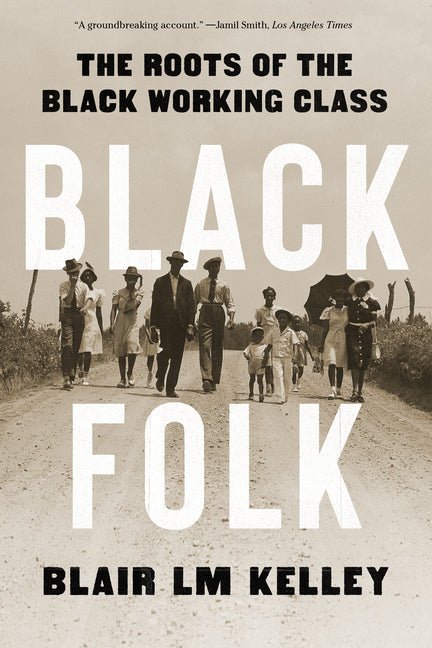
There have been countless books, articles, and televised reports in recent years about the almost mythic "white working class," a tide of commentary that has obscured the labor, and even the very existence, of entire groups of working people, including everyday Black workers. In this brilliant corrective, Black Folk, acclaimed historian Blair LM Kelley restores the Black working class to the center of the American story.
Spanning two hundred years--from one of Kelley's earliest known ancestors, an enslaved blacksmith, to the essential workers of the Covid-19 pandemic--Black Folk highlights the lives of the laundresses, Pullman porters, domestic maids, and postal workers who established the Black working class as a force in the late nineteenth and early twentieth centuries. Taking jobs white people didn't want and confined to segregated neighborhoods, Black workers found community in intimate spaces, from stoops on city streets to the backyards of washerwomen, where multiple generations labored from dawn to dusk, talking and laughing in a space free of white supervision and largely beyond white knowledge. As millions of Black people left the violence of the American South for the promise of a better life in the North and West, these networks of resistance and joy sustained early arrivals and newcomers alike and laid the groundwork for organizing for better jobs, better pay, and equal rights.
As her narrative moves from Georgia to Philadelphia, Florida to Chicago, Texas to Oakland, Kelley treats Black workers not just as laborers, or members of a class, or activists, but as people whose daily experiences mattered--to themselves, to their communities, and to a nation that denied that basic fact. Through affecting portraits of her great-grandfather, a sharecropper named Solicitor, and her grandmother, Brunell, who worked for more than a decade as a domestic maid, Kelley captures, in intimate detail, how generation after generation of labor was required to improve, and at times maintain, her family's status. Yet her family, like so many others, was always animated by a vision of a better future. The church yards, factory floors, railcars, and postal sorting facilities where Black people worked were sites of possibility, and, as Kelley suggests, Amazon package processing centers, supermarkets, and nursing homes can be the same today. With the resurgence of labor activism in our own time, Black Folk presents a stirring history of our possible future.
Share
Book Details
- ISBN
- 9781631496554
- Binding
- Hardcover
- Authors
- Blair LM Kelley
- Publisher
- Liveright Publishing Corporation
- Published Date
- June 13, 2023
- Language
- English
- Pages
- 352
- Physical Info
- 1.4 in H x 8.9 in L x 6.2 in W (1.4 lb)

Back cover badly damaged. Is this why it was on sale?
Bought the book as a birthday present for my son, well worth it.
You can change many things in your life, but race is not one of them. We’re born into a race and culture, and we often see the world through that lens. That’s one of the reasons I’ve been drawn to books by black authors since I was a teen and wondering why I happened to be born white. Was it chance? Luck? Or were the Black people the lucky ones because they shared a culture and history that ran throughout their community? They had things in common that outsiders might never understand. I wanted that sense of belonging, and I searched for it in Black Literature, so when I had a chance to read Blair LM Kelley’s Black Folk: The Roots of the Black Working Class, I happily said yes.Reading the book, I was embraced by the same joy of discovering another culture that I used to feel—years ago—in sociology classes. I got to be a fly on the wall and experience the life of a blacksmith, a laundress or washerwoman, a pullman porter, a postal worker and more. I cheered both the author and the washerwoman when I read, “…the washerwomen continued to work on their own terms,” then sighed as she continued, saying, “…but there were limits to their autonomy.”I got an inside look at the struggles that Black people endured and the way they adjusted their attitude when they were around whites while at the same time fighting for the rights they were entitled to. I’ve never been black, but the book encouraged me to imagine what my life might have been like if I lived in their circumstances.In this well researched and thoroughly documented exploration of the black working class, Kelley presents hard-working, entrepreneurial people determined to overcome ridiculous obstacles imposed by whites who believed they were superior. “They wanted a fair shot at better jobs, a life away from the boundaries of segregation and subjugation.” They lived in a society that set them up as second class and inspired them to fight back.She includes stories from her own family, beginning with Henry, an enslaved blacksmith from Elbert County, Georgia and ending with her grandmother, Brunell, who she remembers holding her hand whenever they went out. “Her handhold soothed her worry and kept my young mind and thin body from roaming away. I learned that her tight clasp was protective, confirmation that I was right there.”As a reader I was right there with the people, the culture, and the struggles that Kelley describes and analyzes. They say that those who don’t remember history are doomed to repeat it, so if you want to learn the history of the whole country, including the parts that aren’t included in textbooks, this historical, factual, lively account of Black folks in a white world is worth your time.Blair LM Kelley, a 2022-23 National Humanities Center Fellow, is the Joel R. Williamson Distinguished Professor of Southern Studies, co-director of the Southern Futures Initiative, and the Director of the Center for the Study of the American South at the University of North Carolina at Chapel Hill.Black Folk: The Roots of the Black Working Class (Liveright–W.W. Norton and Company, June 2023), was awarded a 2020 Creative Nonfiction Grant by the Whiting Foundation. Her first book, Right to Ride: Streetcar Boycotts and African American Citizenship (UNC Press), was awarded the Letitia Woods Brown Memorial Best Book Prize from the Association of Black Women Historians.She holds both a M.A. and Ph.D. in History from Duke University and earned her B.A. from the University of Virginia in History and African and African American Studies.
This is a well-written history of Black working-class groups including domestics, Pullman porters, postal workers, and more. I was surprised by how much I didn't know about the history of working conditions and discrimination against Black people in this country because I've read a lot of historical nonfiction about the Black experience. This had some eye-opening and maddening information.
The author of this outstanding book, and her readers, have been badly treated by the publisher, Liveright Publishing Corporation, a Division of W.W. Norton & Company. The author's picture on the dust jacket is terrible. It is so dark her face can barely be made out. I have never seen anything like it. Also, every image in the book, most from national collections, has been so poorly reproduced that faces and other details can hardly be made out. I cannot imagine the reason for this shoddy photo reproduction in an otherwise handsome, well built volume. Professor Kelley is an attractive woman with an engaging personality and a beautiful smile. She deserved a handsome picture of herself, not the dark, barely visible image that appears on the book jacket of her important book.
