
Black-Owned: The Revolutionary Life of the Black Bookstore
by Char Adams
)
Shop All Audiobooks
*When you open this audiobook on Libro.fm, be sure to select Aveson as your bookstore so that your purchase supports local literacy programs and tree‑planting.
Couldn't load pickup availability
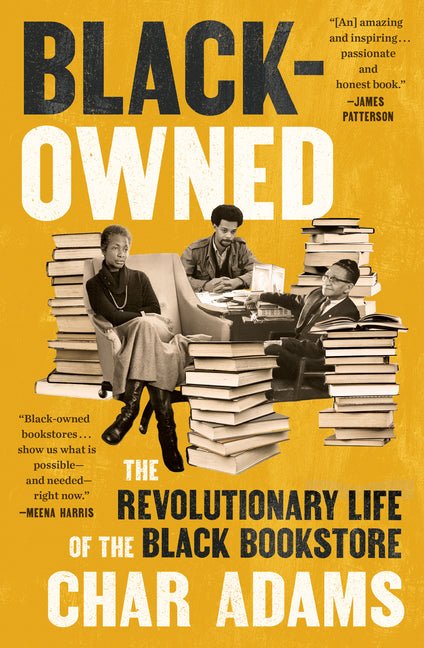
Longtime NBC News reporter Char Adams writes a deeply compelling and rigorously reported history of Black political movements told through the lens of Black-owned bookstores, which have been centers for organizing from abolition to the Civil Rights Movement to Black Lives Matter.
In Black-Owned, Char Adams celebrates the living history of Black bookstores. Packed with stories of activism, espionage, violence, community, and perseverance, Black-Owned starts with the first Black-owned bookstore, which an abolitionist opened in New York in 1834, and after the bookshop's violent demise, Black book-lovers carried on its cause. In the twentieth century, civil rights and Black Power activists started a Black bookstore boom nationwide. Malcolm X gave speeches in front of the National Memorial African Book Store in Harlem--a place dubbed "Speakers' Corner"--and later, Black bookstores became targets of FBI agents, police, and racist vigilantes. Still, stores continued to fuel Black political movements.
Amid these struggles, bookshops were also places of celebration: Eartha Kitt and Langston Hughes held autograph parties at their local Black-owned bookstores. Maya Angelou became the face of National Black Bookstore Week. And today a new generation of Black activists is joining the radical bookstore tradition, with rapper Noname opening her Radical Hood Library in Los Angeles and several stores making national headlines when they were overwhelmed with demand in the Black Lives Matter era. As Adams makes clear, in an time of increasing repression, Black bookstores are needed now more than ever.
Full of vibrant characters and written with cinematic flair, Black-Owned is an enlightening story of community, resistance, and joy.
Share
Book Details
- ISBN
- 9780593474235
- Binding
- Hardcover
- Authors
- Char Adams
- Publisher
- Tiny Reparations Books
- Published Date
- November 4, 2025
- Language
- English
- Pages
- 304
- Physical Info
- 1.3 in H x 8.4 in L x 5.5 in W (0.83 lb)
In all times we need spaces that feel safe.Spaces where we can safely browse books on all subjects, of free thought, of courage and bravery.Where we can converse about politics without judgment or condensation.A place of learning and progressive thought.A space that fosters community, unity and entrepreneurship.This was my understanding of Black Owned by Char Adams, the history of black book stores and their place in the fight for equality.This book accomplished what I know Adams set out to do; it not only educated me on a 90% unknown history of black entrepreneurs but it renewed my interest in small book stores. I was pleasantly impressed when she mentioned book stores I HAD heard of over the years and the shocked by a few unknowns. I cried for those loss and cheered for the ones that are still here.This book was a great read - that had me gasping, shaking my head and fist at the government antics and took honor as a Philly native in reading out loud to my children the the parts on Philly historical book store @hakimsbookstore .I highly recommend this book for anyone interested in history and good storytelling and cannot wait to read more from Char Adams.#bookrecommendations #bookreviews #charadams #blackowned
I loved this book. It's beautifully written, highly readable, carefully researched and an incredibly important addition to Black history and literary history. Author Char Adams shows us how Black-owned bookstores have connected, empowered and nurtured Black readers, writers and communities, and they've done it against all odds. They've survived despite harassment by police, city agencies, the FBI and the IRS, and they've prevailed in the face of competition from mainstream and discount booksellers who cashed in on Black literature only when there were profits to be made — while otherwise ignoring Black writers and Black audiences. Adams also shows us the passion, commitment and personal sacrifices made by the individuals who have founded and sustained these bookstores in Harlem, Denver, Washington DC, LA, Texas and elsewhere. Their stores have provided forums for Black writers and scholars to cultivate audiences, and they've served as safe spaces for kids, for activists, and for entire neighborhoods across the country. I especially love the subtitle — because for a Black bookstore to exist in any way, shape or form, is truly in and of itself a revolutionary act.
A rigorously researched history, past and present, of black-owned bookstores in the US. Intertwined, of course, with stories of the civil rights movement and various trends in the greater book selling world. Black owned bookstores faced many more problems than their white-owned counterparts including racism, vandalism, interference from local law enforcement and the FBI, difficulty in obtaining merchandise, and finding capital. All bookstores want to be part of their communities and a center for their neighborhood, but this is even more true of the black owned bookstores. Additionally they faced the same challenges as conventional bookstores in that ebooks and social media changed some of their core mission. A fascinating account. received an advance review copy for free, and I am leaving this review voluntarily.
Black bookstores and Black-owned bookstores struggle, like many other small businesses, but also in different ways. Adams walks us through the decades and hints a bit at the morphing edge of future outlook for these businesses in his book. (Black bookstores are not only Black-owned but also focus on works about Black culture, roots, history, systemic racism and the like.) The book clearly gives you a sense of the bookstores, the owners, their dreams, visions for their businesses and the neighborhoods they inhabited and served. Some were rallying points and educational centers for their communities. Some got more involved in movements towards more equity, liberation (freedom from oppression and prejudice—my definition).So, we learn that in the 1940s through and into the 1980s, as Black bookstores tried to counter prevailing dominant culture thinking, law enforcement often got nervous and took actions that created hindrances for profitable operations. It’s hard enough to operate a small business, watching costs, trying to increase sales through marketing in a broad sense, as well as having dependable, good employees. Black-owned bookstores also had to deal with a lack of culturally relevant product. The author documents the paucity and then the growth in published works and printing houses. And the continued struggle even into the 2020s from the business-operations standpoint. There is no immunity to the retail trends in the last two decades. But there have been some successes.This is not just story-telling about people and places. There are some statistics, though the author acknowledges (frequently) that there is no single database to determine how many bookstores, when they were launched and when they ceased operating. But you still get a good feel that, relative to the larger publishing and selling industry, there are many but still a sliver of the overall pie.This book is not a recitation of all the systemic obstacles. There are other books that would describe the environment in which these bookstores operated. The same cultural inertia that affects all Black businesses and Black life are documented very well in other books. Adams spends some time noting that Black-owned bookstores are susceptible to the same apathy and antagonism that infuses the dominant culture.But here in this book: Come meet the movers and shakers in this business sector. Cheer them on. Empathize with their business struggle. Moan as cultural warfare tries to just ignore the racial issues and flow around these businesses isolating them like islands in a retail river. But most of all try to pay attention to what has worked and what hasn’t as the decades go on. There are lessons here for entrepreneurs and activists.I'm appreciative of the publisher for providing an advanced copy.
