

Braiding Sweetgrass: Indigenous Wisdom, Scientific Knowledge and the Teachings of Plants
 )
 )
Couldn't load pickup availability
"I give daily thanks for Robin Wall Kimmerer for being a font of endless knowledge, both mental and spiritual." --RICHARD POWERS, NEW YORK TIMES
A New York Times Bestseller
A Washington Post Bestseller
Named a "Best Essay Collection of the Decade" by Literary Hub
As a botanist, Robin Wall Kimmerer has been trained to ask questions of nature with the tools of science. As a member of the Citizen Potawatomi Nation, she embraces the notion that plants and animals are our oldest teachers. In Braiding Sweetgrass, Kimmerer brings these two lenses of knowledge together to take us on “a journey that is every bit as mythic as it is scientific, as sacred as it is historical, as clever as it is wise” (Elizabeth Gilbert).
Drawing on her life as an indigenous scientist, and as a woman, Kimmerer shows how other living beings—asters and goldenrod, strawberries and squash, salamanders, algae, and sweetgrass—offer us gifts and lessons, even if we've forgotten how to hear their voices. In reflections that range from the creation of Turtle Island to the forces that threaten its flourishing today, she circles toward a central argument: that the awakening of ecological consciousness requires the acknowledgment and celebration of our reciprocal relationship with the rest of the living world. For only when we can hear the languages of other beings will we be capable of understanding the generosity of the earth, and learn to give our own gifts in return.
Book Details
- ISBN
- 1571311777
- Binding
- Hardcover
- Authors
- Robin Wall Kimmerer
- Publisher
- Milkweed Editions
- Published Date
- October 13, 2020
- Language
- English
- Pages
- 408
- Physical Info
- 1.3 in H x 8.6 in L x 5.8 in W (1.45 lb)


Those of us who have been raised in Western cultures believe that we humans are separate from, and superior to, the natural earth. This philosophy is descendant from the Ancient Greeks who were the first to differentiate us humans from plants and animals and who first began questioning why we are the superior beings on the planet. These same thoughts (the importance of the individual) were strengthened mightily by Enlightenment philosophy and centuries of European “progressivism.”Across the ocean, in a land that white men would eventually call ‘the new world’ was a different way of thinking: we humans come from, and are inferior to, the earth. This is the way of the indigenous peoples that have had their land and their culture slowly and torturously stripped from them. Despite these hardships, many have spent their lives trying to capture and restore indigenous knowledge for the benefit of us all, our author adding her ecological and native expertise to this endeavor.It all starts with how we relate to the plants and animals of this earth. “In the Western tradition there is a recognized hierarchy of beings, with, of course, the human being on top” but “in Native ways of knowing, human people are often referred to as ‘the younger brothers of Creation.’” Native cultures recognize that plants and animals have been on the earth far longer than we humans, and because of their tenure they have accumulated immense knowledge that we can learn from them. The biggest difference is evident in the way that each culture relates to plants: Western culture sees a plant as an ‘it;’ Indigenous culture sees a plant as a ‘person.’ “Imagine seeing your grandmother standing at the stove in her apron and then saying of her, ‘Look, it is making soup. It has gray hair,’ Kimmerer writes. We would never refer to a person as ‘it’ because that would be a profound act of disrespect. “‘It’ robs a person of selfhood and kinship, reducing a person to a mere thing. So it is that in Potawatomi and most other Indigenous languages, we use the same words to address the living world as we use for our family. Because they are our family.”Out of this familial philosophy blossomed the practice of gratitude for the gifts of nature. When the Indigenous people sought to cut down a tree in order to make a canoe, for example, they would first ask the forest which tree might be available. They would fell a tree for use only if there was one available and willing. When harvesting grass and bark to weave into a basket, they will offer a gift to the forest first—they believe that anything taken should be reciprocated for. They believe that if we take care of the land, the land will likewise take care of us, and everyone can live together in harmony.In the wake of centuries of Western thought dominating current culture, global society has come to a point of seriously harming the planet. It’s not just the raising global temperature, but also the toxins in the air and water, the acid rain, the heavy metals and synthetic hormones in our water, the destruction of forests and ecosystems, and the general way that we relate to nature as something to be dominated and manipulated for our benefit. If we want to save our planet, Kimmerer says, we must change our relationship to the nature world.“People often ask me what one thing I would recommend to restore relationship between land and people,” she writes, “my answer is almost always, ‘Plant a garden.’ It’s good for the health of the earth and it’s good for the health of people.” In this simple statement we can see the urgent message she expresses in her book: the earth and the people are meant to live harmoniously for the benefit of both.
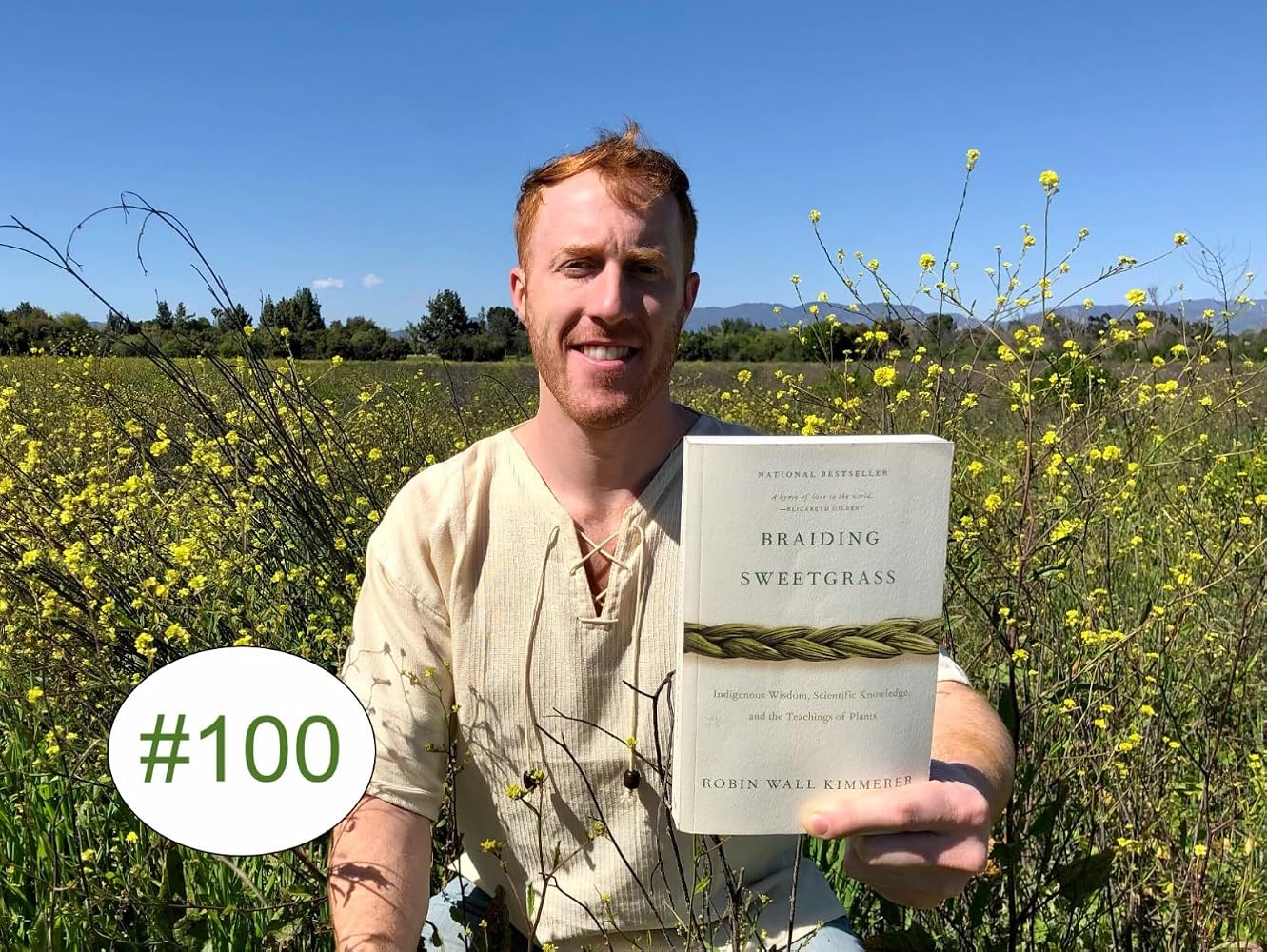
In a world plagued by environmental degradation and a growing disconnect between humanity and nature, "Braiding Sweetgrass" emerges as a beacon of hope and a powerful call to action for the next generation. Written with passion, connection, and root deep understanding of the urgent need for change, this book serves as a guidebook for all minds seeking to live harmoniously with the earth and restore our planet to the home she once was.From the very first page, the author's love for Mother Earth shines through, captivating readers with her heartfelt words and unwavering belief in the power of connection and action. The book's central theme revolves around the restoration of both our hearts and the environment, emphasizing the intrinsic connection between the two. It beautifully weaves together like a native basket personal anecdotes, scientific research, and inspiring stories of environmental leaders, creating a compelling narrative that resonates with the hearts of all who read this book.One of the book's greatest strengths lies in its ability to engage and inspire the next generation. The author's writing style is accessible and relatable, making complex environmental issues and solutions easily understandable for all readers. By presenting heart felt, connected solutions and highlighting the impact individuals can have, the book instills a sense of empowerment and encourages readers to take action in their own lives by building a sense of responsibility and reciprocity with the world around them.Moreover, "Braiding Sweetgrass" goes beyond mere environmentalism, delving into the emotional and spiritual aspects of our relationship with nature. It delves into the profound connection between our own well-being and the health of the planet, urging readers to cultivate a deep sense of empathy and responsibility towards the Earth. This holistic approach sets the book apart, as it recognizes that true change begins within ourselves.The author's passion for the subject matter is contagious, and her unwavering optimism shines through even in the face of daunting challenges. She skillfully navigate the fine line between raising awareness about the severity of the environmental crisis and inspiring hope for a better future. By emphasizing the importance of collective action and the potential for positive change, the book leaves readers feeling motivated and ready to make a difference."Braiding Sweetgrass" is a timely and essential read for anyone concerned about the future of our planet. It serves as a whisper from our past, reminding us that we hold the power and responsibility to heal and restore our environment. Through its powerful storytelling and thought-provoking insights, this book has the potential to ignite a generation of passionate environmental stewards who will work tirelessly to protect and preserve our Earth Mother.In conclusion, "Braiding Sweetgrass" is a remarkable book that not only educates but also inspires and empowers readers to take action. It is a must-read for elders, parents, educators, and anyone who believes in the transformative power of this generation and the next generation. Let this book be the drum beat for change, as it restores our hearts and renews our commitment to heal and restore our environment.

An incredible book speaks to my heart.
I learned so much from this book
This book has helped me define my relationship to the world around me. It has changed how my husband and I care for our land and the gratitude we feel for what it provides.Thank you Robin.
I have this on audible but I wanted to write some stuff down and starting and stopping all the time, not to mention getting the spelling right. Anyway. I'm pleased to have it and plan to get alot of use out of it. For those wanting to read it for the 1st time; it is a well written book with lots of references anyone can appreciate.
Great! In good condition.... but took a long time to get to me....
What a wonderful experience reading this book. Like Toni Morrison her prose alone is gift. Each sentence crafted carefully and poetically. I almost wish I hadn’t read it so I could enjoy it again for the first time.
This book made me feel deeply ashamed about how I have treated the earth and about how indifferent I have become to the fate of the earth. But this book also put forth hope that people can change and they can learn to care.
This is a must-read for anyone who cares about the environment and our role in the natural world. I can't say enough good about the book and the author. She must be a great teacher in person too. While the stories are heart-breaking sometimes, the book is ultimately joyful and uplifting. You will be glad you invested the time in this excellent volume.
This book changed my life. I wish this is how I had learned science… as art. I so appreciate how her passion for the natural world is steeped in both science and native knowledge. She demonstrates that wisdom is all around us if we just pay attention. We have so much to learn from plants.
I read this wonderful book with others in a book group and everyone learned a lot and grew in appreciation for ecological/environmental knowledge and preservation. The author shares her early life experiences with her children and then continues with her professional and personal messages of conservation and respect for the environment and the Native American people. I live in northern NYS and have had the honor of having been welcomed by a community of Native Americans with others in my circle of contacts and friends. I feel this book speaks to the native commitment to the environment, which should be our commitment as well, which is to sustain our natural world and the nurture of a healthy future for all forms of life.
Beautiful, eloquent, captivating stories imbued with wisdom. Kimmers ability to eloquently weave science, indigenous wisdom and personal heart-centered storytelling makes for a moving and enlightening read.I do warn the reader, however, this book will make it harder to weed the garden, buy things you don’t truly need, be a consumer or excess, and walk in the woods without crying for what we have done to our brothers and sisters of the Earth.This book should be required reading of every high schooler in the US.
Eye-opening, provides a different view on how we can relate to nature. Chapters are written succinctly and easy to digest and awe-inspiring / moving as you learn something new about how nature works.
I’m in a Facebook group that is what they call a “safe space.” It’s intended to be free from anything offensive, and I’ve genuinely learned quite a bit about how to be a more safe person. I was unaware of the term “ableist” prior to this group and I had no idea that there was anything called a “closed religion” or a “closed culture.” In one heated discussion thread, a member of the Orthodox Jewish community left the comment: “My religion is not for your entertainment.” Those words have stuck with me for a while. The remainder of the thread was an argument amongst two member of different Native American tribes, and the aforementioned Jewish person. One woman commented that, closed religion/culture or not, education goes a lot way to clear the path towards understanding, acceptance, and thus end discrimination and hatred towards any groups. That whole conversation has been taking up space in my brain for a long time. It’s not up to me to decide whether either of those points are correct. I think they both have value. However, I am an intensely curious human, so I struggle with the idea that closed religions or cultures should remain shrouded in mystery, but again, none of that is up to me. I do, however, sincerely appreciate the information I can find on closed religions and cultures, because I feel like I can be a better human by understanding others. Diversity is powerful, and a path to embracing diversity is forged through understanding and acceptance. When my co-admin of my online book club suggested this book for one of our selections, I jumped at the chance to read it. I was completely impressed that this woman decided to marry her love for botanical science with the Indigenous knowledge she grew up learning and continued to learn along the way. I will never underscore the importance of education, but as a former educator, I will also never underscore the importance of knowledge learned through lifetimes of doing. The Indigenous of North America have a vastly different relationship with the land than others, with the key being the word “relationship.” The view is that it has to be symbiotic, not one-sided, and it makes far more sense to me than the idea the land is simply there for humans to take from. Kimmerer’s book is like a series of vignettes; short stories, if you will, that illustrate how the Indigenous live with the land. I personally noticed that simply observing and appreciating the natural world can provide an abundance of insight that she was eventually able to apply to her institutional studies. Throughout this book, it is easy to see that she has a deep appreciation for all things “nature,” and I loved every part of it. I would recommend this book to anybody. There is a lot of knowledge contained within the stories in this book, and anybody with a heartbeat could benefit from reading it.
Rating this book was difficult for me because I think the book has so many worthwhile aspects to it as well as some significant weaknesses. The author, Professor Dr. Robin Wall Kimmerer, is a botanist and environmental ecologist and a member of the Potawatomi Nation, a northern tribe whose ancestral lands are in New York and around the Great Lakes. The book is divided into 32 chapters beautifully written in a somewhat poetic way. She is mixing native American folklore, musings and science. There is no question that she is a good and interesting author.I could relate to some aspects of the book. I grew up in northern Sweden, in a northern climate, and when I was a child, I spent most of my waking hours in the forest, often alone. In northern Sweden it was normal for a six-year-olds to walk around deep in the forest by themselves at that time. She writes a lot about wild strawberries, which I ate a lot. Like she implies, wild strawberries have a much more intense flavor than regular strawberries. When my daughter and I visited northern Sweden, she was astounded by how delicious they were. She said she had never tasted a better tasting berry. The author also writes about blueberries, other berries, trees, plants mushrooms, lichens, wildlife and her love for all of that as well as the interesting, related botany. I recognized myself in most of that, even though the Swedish flora and fauna is different. I should say my field is physics and engineering not botany, which gives us different perspectives.She speaks about loving earth, and she says that earth can love you back if you treat it right. She writes about taking from the earth without gratitude and without concern for the natural world or others. She writes about selfishness, wastefulness, environmental degradation, climate change and a twisted sense of property rights, and I agree with her about all of that. She explains the Potawatomi Thanksgiving Address, and the mystical word Puhpowee, and she speaks of an honorable harvest in contrast to a greedy and wasteful one. She makes a good case for the restoration of Onondaga lake and for the protection of the environment, and a different way of looking at "land", which I found very interesting.She explains that the Potawatomi language uses verbs much more extensively than English and often replaces nouns with verbs. She explains that the Potawatomi are not afraid of anthropomorphism, and why it is important to see the natural world, the animals and the plants as having personhood, and I really appreciated that. She explains about the three crops, three sisters providing most of the nutrition we need, corn (carbohydrate), beans(protein), squash/pumpkin(vitamins). These three crops also sustain each other. Beans create nitrates/ammonia (fertilizers) and Squash protects (insecticide). I learned a lot from reading this book. She says, “What better model for a sustainable economy do we need", but she does not address whether we can feed 8 billion people this way. Modern high-tech agriculture can easily feed 8 billion people, organic agriculture cannot, and old ways of doing agriculture cannot.On page 173 she says about the Maple “they will be exiled from their homelands for the price of cheap gas. We do not pay at the pump for the cost of climate change, for the loss of ecosystem services provided by maples and others….call me crazy but I’d welcome the tax that would resolve that question.” I agree with her 100%. In economics this is referred to as a negative externality, a type of market failure. Where she goes wrong is that this leads her to condemn the market economy / capitalism.Denying or ignoring externalities is market fundamentalism, a naïve folly taught by talk show hosts and politicians, not by most economists. The market or the free market does not exist by itself. It is a societal construct created by demand and supply, society and laws. One of the most important components of modern capitalism is the limited liability corporation. However, the “free market” has flaws but they can be addressed. I think we can use market forces to address environmental destruction effectively. Destroying the natural world and our children’s future cost nothing because the “free market” didn’t put a price on it, it’s an externality, but we could correct that.On page 139 she wishes that “the intellectual monoculture of science will be replaced with a polyculture of complementary knowledges.” The author knows botany and its intellectual culture and its methods for gathering evidence. She does not know the often quite different intellectual cultures and methods of physics, astronomy, cosmology, archeology, computer science, economics, etc., and yet she is slapping it all together as an “intellectual monoculture”. They are united by falsifiability and the scientific method, but you don’t want “complementary knowledge” without that. I think she really wants to speak about an alternative culture for society, how we think an...
Braiding Sweetgrass is one of the most profoundly moving and illuminating books I’ve read in a long time. Kimmerer is a distinguished professor of Environmental Biology and an enrolled member of the of the Potawatomi Nation, a northern tribe whose ancestral lands are around the Great Lakes. Broken treaties with the US Government finally forced them to move to Indian Territory in Oklahoma.Sweetgrass is translated as the “sweet smelling hair of Mother Earth” and represent the union of mind, body and spirit. In the preface, Kimmerer describes the book as “a braid of stories to heal our relationship with the world.” She weaves together science, spirt and story “that can be medicine for our broken relationship with earth.”Each chapter is to be savored and read slowly. Her prose is achingly beautiful, moving me to tears of wonder as she describes the interrelationship of various plants, such as the brilliant symbiosis of 'The Three Sisters,' beans, squash and corn. Or – the amazing life cycle of the pecan tree or the many uses of cattails; who knew?I was also moved to tears of grief when she describes the horrible legacy of the Indian Boarding Schools in the late 1800’s. The schools were a form of cultural genocide, but the stories, wisdom and knowledge of native lifeways went underground and endured, a testament to the resiliency of native peoples.The basic premise of the book is reciprocity and an ‘I – Thou’ relationship with all of creation, to borrow a phrase from Martin Buber. The land gives back to us when we care for the land. Plants, animals, insects, etc. – are all ‘family,’ and one is much less likely (or at least, think twice) about inflicting harm when the relationship is personal, heartfelt and genuine.Gratitude is the other overarching theme, which is strongly rooted in Native cultures. She describes the Thanksgiving Address of the Haudenosaunee Confederacy, which begins a school day or before an important meeting. It is gratitude directed to all of the earth’s species on land and water (including water itself.) The entire address can take up to an hour, as thanks is bestowed upon each element. Each segment ends with “Now our minds are one.” If you don’t read the book, I recommend looking up the Thanksgiving Address. It can be shortened to incorporate into a daily gratitude practice.In my view, this book is a masterpiece of ecological, historical non-fiction. It is inspiring and hopeful; a call to action. As Kimmerer says…”we are the ones who will bend to the task of putting things back together to rekindle the flames of the sacred fire to begin the rebirth of a nation.”
Robin Wall Kimmerer is a botany professor and enrolled in the Potawatomie nation. She calls herself a poet, and her prose is indeed poetic. While reading, I felt like I was sitting and listening to an elder tell stories. In the Ashininaabe origin story (the tribe by which Kimmerer lives in upstate New York), Skywoman fell to earth landing on the back of a turtle, which carried her to dry land. In her pocket were sweetgrass seeds, and thus, sweetgrass became the founding plant of the people. Sweetgrass becomes the metaphor for how the people are to care for the land and in return, be sustained by it, because sweetgrass has to be tended by humans for it to thrive. In return, it provided many tools to sustain the people: sustenance and material to use as survival. The book is divided up into five sections in the care and use of sweetgrass: planting, tending, picking, braiding, and burning. Since sweetgrass is so important to the life of the people, it can never be sold: it must always be a gift. A gift is given, w/ no expectation of reward. You've done nothing to earn it. Your role is to be "open-eyed and present." (pp. 23-24) "From the viewpoint of a private property economy, the 'gift' is deemed to be 'free' b/c we obtain it free of charge, at no cost. But in the gift economy, gifts are not free. The essence of the gift is that it creates a set of relationships. The currency of a gift economy is, at its root, reciprocity. In Western thinking, private land is understood to be a 'bundle of rights,' whereas in a gift economy property as a 'bundle of responsibilities' attached." p. 28. Therein lies the fundamental conflict between colonizing and indigenous peoples throughout time.I particularly enjoyed Kimmerer's chapter on restoring a pond on her property. It had silted over, grown over by strangling plants. She worked for years on this pond, losing and winning different battles w/ the invasive species. The passage of time was marked by the growth, aging, and finally, death, of her pup, whom she buried beside the restored pond. "The pond built my muscles, wove my baskets, mulched my garden, made my tea, and trellised my morning glories. Our lives became entwined in ways both material and spiritual. It's been a balanced exchange: I worked on the pond and the pond worked on me. and together we made a good home." (p. 95) What a metaphor for reciprocity! "...reciprocity is imperative for long-lasting, successful restoration. ... Humans exercise their caregiving responsibility for the ecosystems that sustain them. We restore the land, and the land restores us." (p. 336) "It's our turn now, long overdue. Let us hold a giveaway for Mother Earth, spread our blankets out for her and pile them high w/ gifts of our own making" - books, poems, paintings, compassionate acts, clever ideas, and "perfect" tools. "The fierce defense of all that has been given. ... Whatever our gift, we are called to give it and dance for the renewal of the world.In return for the privilege of breath." (p. 384)What a lovely - and sobering - book. 5 full stars.
"Braiding Sweetgrass" is a profound and enchanting book that weaves together indigenous wisdom, scientific insights, and poetic storytelling into a rich tapestry of knowledge and wonder. Robin Wall Kimmerer's work celebrates the sacred relationship between humans and the natural world and invites readers on a transformative journey that leaves a lasting imprint on the soul.The book's structure, beautifully divided into three braids - "Tending," "Native Wisdom," and "Restoration," - invites readers to immerse themselves in a range of experiences and perspectives. Kimmerer shares her personal encounters with nature, traditional stories, and reflections on ecological restoration, all while seamlessly integrating scientific facts that deepen our understanding of the natural world.Throughout "Braiding Sweetgrass," the author's profound love for the Earth shines through, igniting a fire within readers to rekindle their own connection to nature. Her writing evokes a sense of gratitude and responsibility towards the land, encouraging us to become more mindful stewards of the gifts it generously bestows.This book is more than just a collection of essays; it is a lifeline to wisdom passed down through generations, a bridge between cultures, and a beacon of hope for a more sustainable future. "Braiding Sweetgrass" will awaken your senses, fill your heart with awe, and empower you to be an active participant in the world's restoration.

