
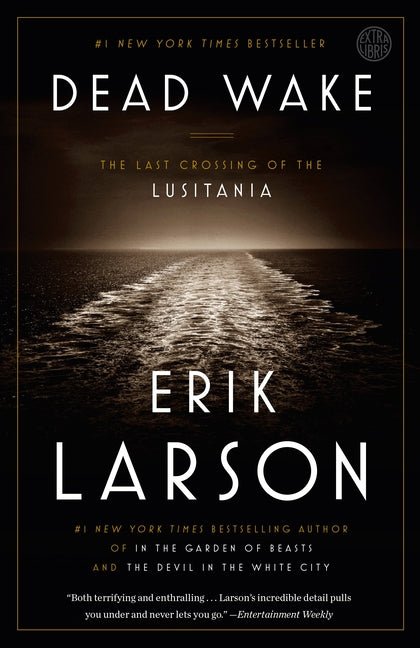
Dead Wake: The Last Crossing of the Lusitania
by Erik Larson
)
Shop All Audiobooks
*When you open this audiobook on Libro.fm, be sure to select Aveson as your bookstore so that your purchase supports local literacy programs and tree‑planting.
Couldn't load pickup availability
#1 NEW YORK TIMES BESTSELLER - From the bestselling author and master of narrative nonfiction comes the enthralling story of the sinking of the Lusitania
"Both terrifying and enthralling."--Entertainment Weekly
"Thrilling, dramatic and powerful."--NPR
"Thoroughly engrossing."--George R.R. Martin
On May 1, 1915, with WWI entering its tenth month, a luxury ocean liner as richly appointed as an English country house sailed out of New York, bound for Liverpool, carrying a record number of children and infants. The passengers were surprisingly at ease, even though Germany had declared the seas around Britain to be a war zone. For months, German U-boats had brought terror to the North Atlantic. But the Lusitania was one of the era's great transatlantic "Greyhounds"--the fastest liner then in service--and her captain, William Thomas Turner, placed tremendous faith in the gentlemanly strictures of warfare that for a century had kept civilian ships safe from attack.
Germany, however, was determined to change the rules of the game, and Walther Schwieger, the captain of Unterseeboot-20, was happy to oblige. Meanwhile, an ultra-secret British intelligence unit tracked Schwieger's U-boat, but told no one. As U-20 and the Lusitania made their way toward Liverpool, an array of forces both grand and achingly small--hubris, a chance fog, a closely guarded secret, and more--all converged to produce one of the great disasters of history.
It is a story that many of us think we know but don't, and Erik Larson tells it thrillingly, switching between hunter and hunted while painting a larger portrait of America at the height of the Progressive Era. Full of glamour and suspense, Dead Wake brings to life a cast of evocative characters, from famed Boston bookseller Charles Lauriat to pioneering female architect Theodate Pope to President Woodrow Wilson, a man lost to grief, dreading the widening war but also captivated by the prospect of new love.
Gripping and important, Dead Wake captures the sheer drama and emotional power of a disaster whose intimate details and true meaning have long been obscured by history.
Finalist for the Washington State Book Award - One of the Best Books of the Year: The Washington Post, St. Louis Post-Dispatch, Miami Herald, Library Journal, Kirkus Reviews, LibraryReads, Indigo
Share
Book Details
- ISBN
- 9780307408877
- Binding
- Paperback
- Authors
- Erik Larson
- Publisher
- Crown Publishing Group (NY)
- Published Date
- March 22, 2016
- Language
- English
- Pages
- 480
- Physical Info
- 1.13 in H x 8 in L x 5.25 in W (0.8 lb)

Larson’s prose strips away the inevitability that history seems to present as. He describes the many missteps that led to this tragedy and humanizes the subject.
Love the author and Historical Fiction. Highly recommend his books.
Of all Larson’s books, this one has been the most spell-binding, the moments before the torpedo emerging in heartbreaking detail. It pulled me in so deep I am almost relieved it is over. The U-boat captain Schwieger is strikingly monstrous; Turner, on the Lusitania, is described as a man badly misused by the Admiralty who lived his life nevertheless with dignity.
So this is the 3rd book I've read of Erik Larson in the last 4 months. I stumbled upon Devil In the White City, loved it, and went looking for others.Thunderstruck was good, but not great. Not at the top of my recommendations unless you're really into early wireless history and the patent wars that came with it.Dead Wake was great, not good. Obviously I've come to enjoy Mr. Larson's style, but I also had almost no knowledge of the Lusitania incident.I found it to be a suspenseful page-turner as other reviewers have said. Also as mentioned in previous reviews, the segueway into President Wilson's love life at the time sticks out like a sore thumb, and I don't know why this was included. It is mercifully brief, however, and doesn't really take away from the rest of the book, which is expertly crafted.Those who know the story backwards and forwards from both sides probably won't find new info, but true buffs on the incident will likely read it/have read it anyway.Those that don't know much about it, and enjoy narrative historical nonfiction, are in for a treat.And although the incident itself was a tragedy of significant scale, none of it ever depressed me, and was written in a way that you can appreciate the depth of what happened without feeling weighed down by heavy emotions.
“Travellers intending to embark on the Atlantic voyage are reminded that a state of war exists between Germany . . . and Great Britain . . . and that travellers sailing in the war zone on ships of Great Britain or her allies do so at their own risk.”The notice that ran in U.S. newspapers on May 1, 1915, ten months after the outbreak of World War I and three months after Germany declared a submarine blockade of the British Isles, was insufficient to prevent RMS Lusitania, the largest of the Cunard line, sailing from New York to Liverpool. Instead of remaining safely in New York Harbor, the ill-fated Lusitania departed for the North Atlantic and entered the waters off the southern coast of Ireland, a veritable killing field for German unrestricted submarine warfare. U-boats operating catlike in British shipping lanes merely waited to pounce.Unterseeboot (undersea boat) U-20, commanded by Kapitänleutnant Walther Schwieger, lurks as predator to Lusitania’s prey in Erik Larson’s epic disaster story. The author brilliantly captures the reader’s attention by depicting what the U-20's crew experiences as it realizes it is about to become a willing participant in sinking the largest British commercial vessel (nearly 45,000 tons) to this point in the war. Additionally, readers experience what the Lusitania's unwitting passengers experience on the receiving end of one of U-20’s torpedoes. The damage resulting from a direct hit is staggering. Lusitania sinks in 18 minutes, losing 1,198 passengers (including 128 Americans) and crew.“Dead Wake” is a masterpiece of historical nonfiction and offers an exciting and highly suspenseful read. Larson’s gift is in animating a major historical incident by bringing the most significant actors and lesser players to life and then infusing their story with little-known detail. What makes “Dead Wake” so enjoyable is Larson’s vivid portrayal of life onboard the luxurious Lusitania prior to the attack and, in contrast, the tightly packed, confined living conditions of a German U-boat as the crew awaits confirmation of the 'kill.' As an example, there is this passage:“Linking all this apparatus was an array of pipes and cables as densely packed as the tendons in a human leg. ‘More dials and gauges than one might ordinarily see in a lifetime, one crewmember said.’”Larson also quite ably develops the primary characters in the story, including Captain William Thomas Turner, Lusitania's wise and experienced, if not convivial, captain. For instance, the author portrays Turner as aloof, preferring to retire to his private quarters and a book to socializing with the ship's passengers. Similarly, Larson provides Schwieger, the U-20 commander, with a personality, depth, and motivation for his workmanlike efficiency in torpedoing freighters and ocean liners alike.Schwieger’s ruthlessness seemingly knows no bounds. One example: “On February 1, he [Schwieger] fired a torpedo at a large ship painted white and marked with large red crosses, the hospital ship Asturias. He missed. But the attempt was considered a new low in German callousness. Even his superiors seemed surprised.”One may question the morality of the Imperial German Government's targeting of British commercial shipping to interdict the flow of military materiel such as ammunition into the war zone. Yet, it issued repeated warnings to nations disposed to continue such activities. Stunningly, “Dead Wake” reveals how much British Naval Intelligence was aware of U-boats’ plans and operations. The author’s discussion of the impact of ‘Room 40’ and its eagle-eyed but eccentric codebreakers is spellbinding and perhaps best summarized by the following passage:“[Knowing that U-20 was in the North Atlantic and heading south to Liverpool] was like knowing that a particular killer was loose on the streets of London armed with a particular weapon, and certain to strike in a particular neighborhood within the next few days, the only unknown being exactly when.”Equally fascinating, Larson makes much of Lord of the Admiralty Churchill’s comments regarding the need to induce American involvement in the war. By so doing, he implies that senior-ranking members of the British government may have welcomed the attack on Lusitania but stops short of implicating them in Lusitania's demise. It is an objective fact that the British sought to end American neutrality. However, the lengths the government would go to secure American entry into the war remains an open question.Further, while it is also never quite clear in “Dead Wake” how much the British knew of Schwieger’s propensity for indiscriminate predation in 1915, it is abundantly clear that they sought to divert blame for the tragedy to Imperial Germany and Captain Turner. If guilty of anything, Turner underestimated the U-boat threat and, ironically, placed too much trust in the British Royal Navy to safeguard the Lusitania. Despite extensive research and numerous investigations after the incident, no on...
)