

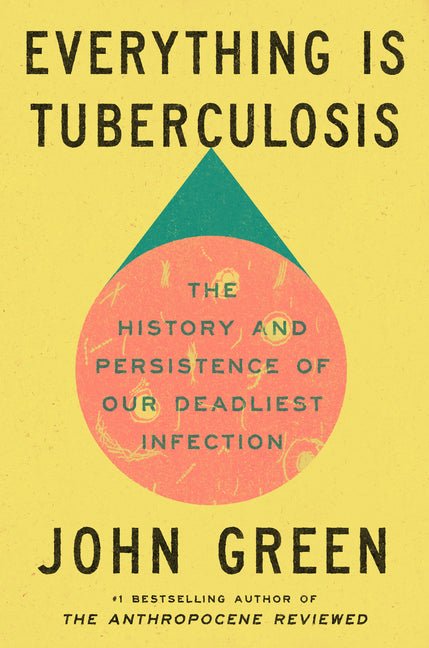
Everything Is Tuberculosis: The History and Persistence of Our Deadliest Infection
 )
 )
Couldn't load pickup availability
#1 New York Times bestseller - #1 Washington Post bestseller - #1 Indie Bestseller - USA Today Bestseller
John Green, award-winning author and passionate advocate for global healthcare reform, tells a deeply human story illuminating the fight against the world's deadliest infectious disease.
AN ACCLAIMED BEST BOOK OF 2025: NPR, Scientific American, Science News, Booklist, BookPage, Chicago Sun-Times. Goodreads Readers' Choice Nonfiction Winner.
Tuberculosis has been entwined with humanity for millennia. Once romanticized as a malady of poets, today tuberculosis is seen as a disease of poverty that walks the trails of injustice and inequity we blazed for it.
In 2019, author John Green met Henry Reider, a young tuberculosis patient at Lakka Government Hospital in Sierra Leone. John became fast friends with Henry, a boy with spindly legs and a big, goofy smile. In the years since that first visit to Lakka, Green has become a vocal advocate for increased access to treatment and wider awareness of the healthcare inequities that allow this curable, preventable infectious disease to also be the deadliest, killing over a million people every year.
In Everything Is Tuberculosis, John tells Henry's story, woven through with the scientific and social histories of how tuberculosis has shaped our world--and how our choices will shape the future of tuberculosis.
Book Details
- ISBN
- 0525556575
- Binding
- Hardcover
- Authors
- John Green
- Publisher
- Crash Course Books
- Published Date
- March 18, 2025
- Language
- English
- Pages
- 208
- Physical Info
- 0.94 in H x 8.51 in L x 5.89 in W (0.78 lb)
I won't lie: I ordered this book because I am personally affected by TB. I got TB after COVID wiped my immune system so low that the 2, full-time retail jobs I was working (because in 2022, no one had money or resources to pay me for my JD skills) sniped me. I was repeatedly misdiagnosed with RSV, the common cold, and flu--all without testing--and no one thought to test me for TB despite my symptoms. I had walking pneumonia for 6 months--not bad enough to treat because, as the ER docs reminded me constantly, I "wasn't dying," so I needed to follow up with the PCP I didn't have because the healthcare system was at the tail "end" of the COVID pandemic (which is still going around, still harming the same number of people, still mutating) and all of the PCPs in my insurance had jumped to another insurance so I was on a waiting list for over two years to get one.At the time, I wasn't good enough to be well and ended up losing my second job, which fully fixed me into poverty. I remember consciously gulping air like a prisoner who hadn't had water in days for those 6 months, being forced to wear a mask to keep the rising tides of my bills just touching my nostrils such that if I skipped meals and slept in parking lots between shifts I could tread a little higher the next month, and not seeing a single person I lived with for over 2 years to keep things going because if I got them sick, the entire house was going to collapse in on itself. We could only afford 2 people to be unemployed (theirs due to addiciton, so not a recoverable situation without their consent and participation) and the other person working had lifelong respiratory problems so I did what I had to do to keep them well. That meant presenting as homeless to the ER every time I got sick and being told to, simply, not have the life conditions I have because it was "making things worse" and "prolonging the illnesses" but still had no treatment and no tests despite how long I had been sick.So, inevitably, I ended up back in the hospital for over a month. I had to have the paramedics shut down the store because I thought I had a severe kidney infection, and the ambulance drivers thought I had cardiac problems. Once cleared of all of that, I sat in an ER waiting room for almost 48 hours while they ran tests that cleared my heart, kidneys, and lungs. Once I finally got into the back of the ER, they wanted to check my gallbladder but because it was a weekend, the guy couldn't come in to run the test so I was in the ER bay for another 48 hours without food or medicine while they tried to get that arranged--only for them to bungle it because they couldn't "spare a tech" for the literal 10 minutes of the scan when the guy came in on his day off (a Sunday NIGHT). to do it.They ended up taking my gallbladder out after doing the scan--which, after being given the PKs to incite the billiary functioning of the entire area, took 4 hours because they couldn't give me the pain medication to stop the side effects which meant I had to control my pain iwth breathing and my oxygen was so low at times they coudln't parse out the different symtoms. My hands were so blue from the time they took me into the ER bay through then that they were worried about my lungs so they took an x-ray...and it was clear. It was just that I only had the one tool to try and control my pain and remain still enough for them to do what they had to do.But things didn't improve. Every 3 days a doctor would try to come in and convince me that what I was feeling was normal and that I just needed to get out of the ER and get some rest at home. By the third meeting, I had already lost my job because Sedgwick--the company that controls leave for almost every major employer in the U.S.--didn't receive the documents or they didn't receive the right documents or the documents didn't say what they thought or an of a hundred excuses I heard to endy my FMLA claim.While Googling the different things that could potentially be wrong with me--Sphincter of Oddi Dysfunction being the one I remember the most--John Green came across my screen with his new series on Tuberculosis: how it kills millions a year despite the treatment being widely available and cheap to produce and distribute; how my State was a refuge for the afflicted back in the day and how that literally shaped New Mexico; and how more people have it than they think.After you spend a certain amount of time in the hospital, they have to run labs for easily communicable diseases. I didn't have community-acquired pneumonia. I didn't have COVID, flu, RSV, etc. But my blood did come back positive for Tuberculosis and the way I found out was the charge nurse very nervously came and shut my door while on the phone with the labs. The "golden standard" blood tests take 3 days to do in the hospital so, by their standards, I had spent over 2 weeks being the easily transmitted communicable disease spreader between nurses having to pick me up of...

This is a deliberately disturbing book, but the author’s unapologetic moralizing is never scolding, just firmly encouraging. As a comfortable American I have had no direct experience with TB, so I am grateful for this chance to learn about the all-time #1 killer disease that still wreaks so much death and destruction in poorer nations simply because the well-to-do nations haven’t bothered to eliminate this scourge that no longer affects them.
If you like John Green books, this is a great read. Different than his other books but written in his own style. This is a signed copy. Something to hold onto, for years to come.
Book is much more interesting than the title suggests. Interesting history of TB and current status. Adds human interest by weaving in the personal story of someone having TB, near death, and survives. An easy read.
This book is such a great read. There’s so much valuable information in this book, and I learned so much. Every John Green book is written so well.
I loved reading his books growing up but this blows my expectations out of the water!! I love his style of writing and his ability to tell a story while giving you historical facts interwoven between each major point makes it all the more enjoyable! This is a must read for anyone who studies modern pandemics/endemics!
I purchased this book for a book club reading. It's not something I would probably have picked up otherwise, but I learned so much. The history, and current day reality, of tuberculosis is so much more than I was aware of. And contrary to what I previously thought, TB is very much alive in our world today. The author does a great job of covering TB from different angles - historical, scientific, socio-economic, and personal. It's an easy read and not an overly long book to cover so much territory. John Green is an accomplished author ("The Fault in our Stars" and many other works), and this is a passion project for him. Definitely recommend!
What I didn’t know about TB but needed to be better informed. I had no idea what I was getting into when I bought this book. I went in thinking a book by John Green usually makes me laugh a little and cry a lot but what I got was many tears and reminders of how blessed I am to live where the access to medical care is on every corner and the soul searching feeling of “Why me?” And “Why not Henry?” Thank you Mr. Green for opening my eyes!
I love John Green, so this is definitely a biased review. I found it an absolutely fascinating mix of personal story and educational content. The narration by the author was fantastic, and I felt like I learned a lot! I would have preferred a slightly deeper dive, but I definitely came away from this book with a lot to think about.
I just finished this book and I cannot recommend it enough. It is quick and easily digestible. It is the perfect combination of personal stories, statistics/scientific background, and politics. Most importantly, it is an amazing call to action that highlights how systemic injustices CAN be overcome. I will likely be writing some of my law school applications on how I want to be one of the lawyers who works to make medication more accessible to the Global South. Shreya’s story was especially inspiring to me.As a fan of Crash Course, it does not surprise me that John Green has taken up this noble mission.-Nico Reyes
This didn't "read" quite as I expected, but it full of stories and links about TB and how much it effected life around the globe. You could probably do the same for Spanish flu or various STDs, but this is a well thought out link throughout times and shows one of the way history interconnects.
In the kind of weird coincidence that would seemingly come out of film adapted from a John Green story, on the very day I was winding down my time with Green's "Everything Is Tuberculosis: The History and Persistence of Our Deadliest Infection," I received word that a longtime friend of mine had, in fact, been diagnosed with TB.The good news for this friend, I suppose, is that she lives in the United States where both prevention and treatment for TB are both readily available. In all likelihood, she will easily survive this disease.As is stated over and over again throughout "Everything Is Tuberculosis," many others will not survive the disease despite the fact that testing and treatment have been available since the 1950s and increasingly common and effective.In Green's simplest terms, we have the ability to cure TB. We don't have the political will to do so.For an author long recognized as one of the most popular YA novelists, it may seem surprising that Green would tackle a book on tuberculosis. I can't help but think those surprised have never really immersed themselves in Green's world, both literature and social media, as Green has long immersed himself in the ways that we're interconnected and the power that we have to change lives.It's a theme that is common throughout "Everything Is Tuberculosis," a book that finds its heart-and-soul in the story of young Henry Reider, whom Green met at Sierra Leone's Lakka Government Hospital. Green avoids the saccharine romanticizing of Henry's story, instead constantly maintaining Henry's humanity as he fights to survive TB in a nation with only the barest minimum of treatments. In similar books, the author would dare to draw a connection between themselves and the character's outcome - Green is far too wise and has far too much integrity to do so. Instead, Green paints a vivid portrait of the struggle and the doctors working to do something about it against seemingly insurmountable odds.We get to know Henry and we come to admire his fiercely loyal mother Isatu, a woman who works hours upon hours upon hours to raise funds for Henry's care. It's their story that serves as the emotional foundation for "Everything Is Tuberculosis," however, it's Green who tells the story with insight, intelligence, and compassion.Green's approach to this story is surprisingly simple. Green focuses his storytelling lens on Henry and the various people he encounters, both other patients and medical professionals, along the way. However, Green also paints an engaging and convicting portrait of how TB became a disease associated with those who are economically poor and why no one is now doing anything about it despite the ability to do so."Everything Is Tuberculosis" is a weaving together of deep compassion, historical analysis, and rich yet accessible scientific analysis. Green's "Everything Is Tuberculosis" leans not just into the way things are but how they could be using the STP (Search, Treat, Prevent) framework. As a writer who's long used his social media presence for good (as a footless guy, I sure wish I needed socks), Green creates a framework for change and then gives us accounts of those who are slowly and frustratingly but most definitely creating that change.As a creative and an activist who lives in Green's adopted hometown of Indianapolis, I think perhaps no statement in "Everything Is Tuberculosis" sums up Green as both writer and human being than a statement he makes in the book - "How can I accept a world where over a million people will die this year for want of a cure that has existed for nearly a century?"Indeed, "Everything Is Tuberculosis" is a book about tuberculosis. It's also more. It's about who we are as human beings. It's about how we're connected and how we choose to disconnect. It's about the simple wonder of being human and the big and small ways we can make the world a better place if and when we choose to do so.To his credit, though Green would likely be hesitant to take such credit, "Everything Is Tuberculosis" ultimately makes us want to do so.
John Green nos enfrenta a la realidad que tratamos de no ver: los crueles problemas de falta de acceso a servicios de salud, particularmente en los países más pobres, no se deben a la existencia o no de tratamientos médicos, sino a la posibilidad real de los más vulnerables para acceder a ellos. Nos describe que las causas raíz nacen del sistema social mismo, pero que es precisamente allí donde subyacen las soluciones también.
Historians sometimes contend that before the fall of the Roman Empire, Western society possessed enough knowledge that our civilization could have advanced directly to the Enlightenment and the Industrial Age. Instead, the advent of the so-called Dark Ages reminds us that history does not always progress. We must seize the opportunities; our collective will and choices matter in history’s long arc. Novelist John Green has a self-described “obsession” with the disease of tuberculosis, or what was formerly known as consumption. In this book, he transforms this deep interest into a well-worded plea advocating for additional attention and money to crush this infectious disease.Tuberculosis (or TB) used to affect everyone in society – both rich and poor. Those in crowded urban settings tended to suffer more, but everyone was affected. Today, rich countries are relatively free of tuberculosis while the disease continues to plague poor countries. We know about good treatments; even multi-drug resistant TB is relatively treatable. The main problem is economic. Most countries inundated by TB have weak healthcare systems because of financial limitations. Those limitations took place because of colonization systems that served the rich in other countries and depleted the country’s resources. To be blunt, the rich exploited the poor and now won’t share their cures with them.Green makes an eloquent case that today’s TB situation stems from injustice. He advances his point by describing a few individual stories and how, with a few changes and society’s collective will, we might live in a different world. He avoids sentimentality and instead focuses on critical thinking. He also makes the case that rich countries’ collective neglect of global health might end up making them – us – relapse into illness.In an era where the world’s richest nation will not fund even continued efforts to mitigate HIV, Green’s pleas can seem like a pipe dream. However, steady organization and awareness can expand our horizons. While many use society’s abundance and excess wealth to fund frivolous adventures, perhaps we should instead consider serving our fellow humans with global health. This book is aimed to the general population and especially pertinent to those in public health. Reading it can be a start in that trajectory to a more just world, a world with less TB and more social flourishing.
Everything Is Tuberculosis by John Green is an incredible and thought-provoking book. As someone who studies microbiology, I found it both refreshing and deeply meaningful to see complex topics like tuberculosis presented in such an accessible and engaging way. Green strikes a rare balance between storytelling and science, offering a narrative that not only educates but also fosters empathy and awareness around public health issues. Books like this are vital in bringing scientific discussions into the public eye, and I truly appreciate how well it was done.
I'm going to review this in two sections - the book as a physical artifact, and the content.First, the content - it is written in a breezy 'blogger' style, with some humor, and you can feel the author's passion for the subject matter come through. I'm learning things on every page, and although some of the information is deeply disturbing, I find all of it interesting, especially the science and technical aspects. Some of the 'political' commentary seems a bit out of place and overblown.Next, the book itself, the physical artifact - it is probably the worst book I've held in my hands in years. The page are a flimsy newsprint, and the printing is highly uneven. Some pages are so lightly printed as to be nearly unreadable. Some pages contain many weird artifacts and glitches like overprinted words, blobs, incomplete coverage like missing ink in the letters, etc. It is extremely distracting and unpleasant to read because of these issues.
John Green’s Everything Is Tuberculosis is a clear-eyed, deeply human, and at times mordantly witty examination of one of humanity’s most enduring killers. It serves as a reminder that tuberculosis is not a quaint affliction of bygone poets and coughing Victorians, but a still-rampant global threat—particularly in regions of the world we in the First tend to overlook until the microbes come knocking at our own sanitized doors.Green skillfully traces TB’s arc through history: from its macabre glamorization as the “romantic disease” to its modern entrenchment as a marker of inequality, underfunded healthcare, and political apathy. The book excels in illustrating how society’s attitudes toward tuberculosis have shifted, often in lockstep with who the disease was affecting at the time. When TB struck the rich, it inspired poetry. When it settled into the lungs of the poor, it inspired silence.Interwoven throughout are poignant personal narratives—individuals living with tuberculosis in the present day, largely ignored by the global North but very much at the mercy of the disease’s evolving strains and the systems (or lack thereof) meant to treat them. These stories ground the historical and scientific content in human experience, providing the book with emotional heft that statistics alone never could.One of the book’s most striking themes is the dangerously short-sighted assumption that tuberculosis is a problem of the past or of somewhere else. Green warns of the consequences of that hubris: as drug-resistant strains of TB continue to develop in the Global South, they pose an ever-growing risk to the Global North. Diseases that were once beatable, or at least controllable, are mutating under the pressure of neglect, half-finished treatment courses, and inconsistent drug access. They are poised, Green suggests, to return more resistant and more lethal than ever. The microbial world is watching—and it has a long memory.The book also steps into broader territory by raising questions about patient advocacy, global health priorities, and what it really means to declare a disease “solved.” Green is at his best when pointing out how the forgotten often stay forgotten—until their suffering becomes contagious in ways that threaten the powerful.That said, one limitation of the book lies in its portrayal of pharmaceutical companies. While Green is right to criticize the profit-driven structure of modern drug development—particularly the neglect of diseases that mostly affect the poor—his framing sometimes veers into caricature. The book offers little acknowledgment of the immense time, risk, and capital required to bring a new drug to market, including the many failures that never result in a viable treatment. By painting Big Pharma solely as profit-hungry, Green risks overlooking the complexity of the system, including the real scientific innovation and legitimate economic challenges involved in drug development.Still, Everything Is Tuberculosis remains a powerful and timely work. It’s a call to attention—and action—for a world too ready to forget that the battle against infectious disease is not won with one victory, but maintained with vigilance, equity, and an honest reckoning with the uncomfortable truth that some diseases persist simply because the people who have them don’t matter enough to those who don’t.In sum, Everything Is Tuberculosis is informative, compassionate, and sharper than expected. It’s a wake-up call masquerading as a history book—a reminder that infectious disease is never truly in the past, only hiding in the places we’ve chosen not to look.
I am a Biology Professor who has been teaching Microbiology and Infectious Diseases for over 20 years; I found this book brilliant. It highlights a teenage boy, hanging on by a thread with tuberculosis in an African TB hospital, and Green seamlessly weaves his life into the narrative. "Everything Is Tuberculosis" summarizes this deadly infectious disease of poverty, forcing the reader, who has more than adequate healthcare, to look deeply into the inequities and hopefully ask, "Why am I so lucky?"Neither Green nor I believe that TB will be the next pandemic. However, we are not safe from the ravages of this disease. Multi-drug resistance is a real problem, and the lack of progress in this area is because "the cure (and the ability to research and develop that cure) is not where the sick are, and sick do not live where the cure is."Do not be afraid of this book because of its title. It is incredibly readable and thoroughly explains why we need to care for the most vulnerable on our planet. TB is on the rise again in first-world countries, and "superbugs" have emerged. The lack of R&D in the US will only serve to haunt us.
I’ll be honest- I don’t like John Green’s books. I don’t think he’s a bad writer, but ever since I was a young Jewish teen and I read the “Fault in Our Stars”, I could never move on from the main character romanticizing kissing in Anne Frank’s attic and saying it’s what she would have wanted (instead of you know, surviving genocide).So I’ll admit I came into this with a big bias.But I also work in public health for the state of Texas. Just a few feet away from my desk are people administering DOT for TB patients across the state. I’ve spent a summer volunteering at an elephant sanctuary with TB infected elephants. Even though it has never directly impacted me, TB has always been there, waiting in the wings. Hearing that John Green, an author whose books I vowed never to read again, wrote a book on the topic piqued my interest.And it was so, so good. While I know a lot about modern treatment for TB, I was unaware of just how pervasive it’s been in world history. Green’s begging for more people to take action- or to even just care, are devastating and rightfully motivating.Will this book make me turn around and give his fiction works a try again? No, probably not. But I will recommend this book to everyone I work with, and am friends with, and am related to- basically everyone I know.
An excellent primer on all things tuberculosis, written for those of us who aren’t in medicine. Approachable. Caring. You’ll meet patients and hear stories both from John’s life and from history. You’ll understand what tuberculosis does to the body, how, and why that should be treated like a global emergency.It’s an easier read than, say, Epidemics and Society, because it’s not a textbook, but it does give up some of the depth that a textbook-level publication will drag you into. The perfect tone for its goal: to get us to care at least a little bit about solving the problem of tuberculosis.

