

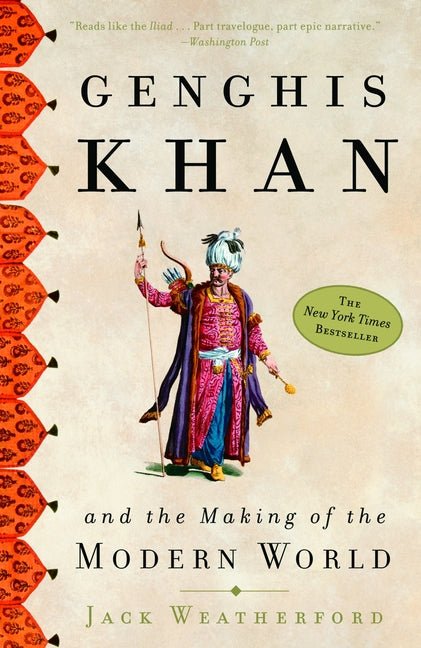
Genghis Khan and the Making of the Modern World
Couldn't load pickup availability
NEW YORK TIMES BESTSELLER - The startling true history of how one extraordinary man from a remote corner of the world created an empire that led the world into the modern age--by the author featured in Echoes of the Empire: Beyond Genghis Khan.
The Mongol army led by Genghis Khan subjugated more lands and people in twenty-five years than the Romans did in four hundred. In nearly every country the Mongols conquered, they brought an unprecedented rise in cultural communication, expanded trade, and a blossoming of civilization. Vastly more progressive than his European or Asian counterparts, Genghis Khan abolished torture, granted universal religious freedom, and smashed feudal systems of aristocratic privilege.
From the story of his rise through the tribal culture to the explosion of civilization that the Mongol Empire unleashed, this brilliant work of revisionist history is nothing less than the epic story of how the modern world was made.
Share
Book Details
- ISBN
- 9780609809648
- Binding
- Paperback
- Authors
- Jack Weatherford
- Publisher
- Crown Publishing Group (NY)
- Published Date
- March 22, 2005
- Language
- English
- Pages
- 312
- Physical Info
- 0.9 in H x 7.9 in L x 5.2 in W (0.6 lb)
As an avid fan of military history, I have read this book and deeply appreciate the groundbreaking impact this work has made towards filling a gaping hole in our awareness of the course of global history. So it seems oddly funny to come across a review on this website that claims the book made a "glaring false claim" that Genghis Khan's tactics "inspired" the Soviet strategy of overextending the enemy in WWII. First of all, the author of the book pulled no punches in what he wrote. Weatherford wrote that the "Soviets followed their own version" of the Mongol tactic of drawing out the enemy and picking them off one by one. That is an objective statement of fact. It did not say that the Soviets were necessarily "inspired" by the same Mongol tactics or copied what the Mongols had done, although the reviewer who made the allegation seemed to have incorrectly interpreted it that way. Even if the reviewer could justify his belief (which he did not), is it such a stretch of the intellect to merely imply a connection between the aforementioned similar strategies used by two groups of people that shared much of their histories and experiences?Further, the same reviewer made a leap in logic by claiming that since there's one such "false claim", then there must be others as well in this book. Where's the evidence? The reviewer provides none. It looks like that reviewer far outdid the author in wild speculations and unsupported claims. Then, the reviewer wonders out loud whether the Mongols really "invented the cannon, the Enlightenment, and the printing press," which was a very strange question because it was entirely irrelevant to anything written in this book! The author of this book had made in very clear that the Mongols did not invent the cannon or the printing press, but they assimilated these Chinese technologies and employed them effectively and widely for the first time. The Mongols, who were a people that did not even have rubber at the dawn of their rise to power, practically adopted almost all of their military and civilian technologies from the peoples and nations that they conquered. I don't mean to insult the previous reviewer, but anyone who has even an adequate, just adequate, reading comprehension ability would have picked up those important points in this book.But, alas, it was the reviewer's mentioning of "the Enlightenment" that won the most-laughable-comment-of-the-day award. In the aforementioned question posed by the reviewer, if you noticed, he implied that the author attributed the "invention of the Enlightenment" to the Mongols. WHAT???!! Haha!!! The reviewer must have mistaken the Renaissance for the Englightenment. The case that the book DID present was how the Mongol influence kindled the Renaissance, but the significance of the case was lost on the reviewer for he could not even distinguish the Renaissance from the Enlightenment. For the record, the Enlightenment took place in the 19th century, hundreds of years after the Renaissance! This much should be common knowledge to anyone who comments on history, one would think. Given the shoddy quality of the previous review and its misleading banter, I just felt compelled to set the record straight for those who are interested in learning something from this book.The ironically titled "grain of salt" was exactly what I was thinking when reading the previous review, because that review was the equivalent of the heaviest grain of salt yet. In the best of cases, the previous reviewer just did not know how to read, for he imagined things that did not exist in this book. In the worst case, as it probably seems, this guy deliberately made blatantly false representations because he has a big chip on his shoulder. As a general caveat to reviewers like him: don't read any book with a chip on your shoulder or you won't learn anything.
I was unaware of the many innovations instituted by Genghis Khan. I was only aware of his conquests that were extensive. A great read!
An eye opening story of a man who accomplished so much and left a lasting impact on civilization only to be subjected to racism and fear even in death. A must read.
The book is written in a very enjoyable and storybook format. I recommend this book to anyone who wishes to learn about how Genghis Khan shaped our world.
Overall an excellent look at what made the Mongol Empire one of the greatest forces in all of human history. It definitely does put the Mongols at the intersection of Chinese, Middle Eastern and European history, and corrects major misunderstandings of Genghis, his successors and the Mongols themselves. However, it also goes overboard in making the Mongols the determine factor in the origins of the Renaissance and places too much emphasis on the Mongols at the expense of other historical forces, such as Islam’s expansion and Europe’s emphasis on relearning its past, leading to the Renaissance. The author also seems to indicate that modern Europeans reflexively disliked the Mongols, when in fact there is a great deal of evidence that they admired much of what the Mongols created. Overall a good - but not great - read.

