
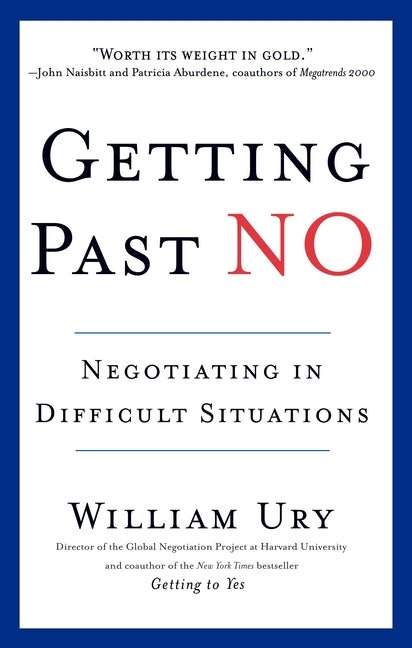
Getting Past No: Negotiating in Difficult Situations (Revised): Negotiating in Difficult Situations
by William Ury
)
Shop All Audiobooks
*When you open this audiobook on Libro.fm, be sure to select Aveson as your bookstore so that your purchase supports local literacy programs and tree‑planting.
Couldn't load pickup availability
"Getting Past No is the most elegant handbook on the challenge of difficult negotiation and difficult people."--Leonard A. Lauder, president, Estée Lauder Companies
"Bill Ury has a remarkable ability to get to the heart of a dispute and find simple but innovative ways to resolve it."--President Jimmy Carter
WINNER OF THE BOOK PRIZE OF THE CENTER FOR PUBLIC RESOURCES
We all want to get to yes, but what happens when the other person keeps saying no? How can you negotiate successfully with a stubborn boss, an irate customer, or a deceitful coworker?
In Getting Past No, William Ury of Harvard Law School's Program on Negotiation and author of Possible, offers a proven breakthrough strategy for turning adversaries into negotiating partners. You'll learn how to:
- Stay in control under pressure
- Defuse anger and hostility
- Find out what the other side really wants
- Counter dirty tricks
- Use power to bring the other side back to the table
- Reach agreements that satisfies both sides' needs
Getting Past No is the state-of-the-art book on negotiation for the twenty-first century that will help you deal with tough times, tough people, and tough negotiations. You don't have to get mad or get even. Instead, you can get what you want!
Share
Book Details
- ISBN
- 9780553371314
- Binding
- Paperback
- Authors
- William Ury
- Publisher
- Bantam
- Published Date
- January 1, 1993
- Language
- English
- Pages
- 208
- Physical Info
- 0.6 in H x 8.2 in L x 5.2 in W (0.4 lb)

Do you remember the last time you put to use anything you read? How many books are interesting but not useful, or useful but not interesting, or useful and interesting but too complicated or impractical. This book suffers from none of those dysfunctions, but is wholly interesting, wholly practical and wholly usable.If you are in the fortunate position of having the opportunity and motivation to put what the book teaches to use as you read it, you will undoubtly find that it dramatically increases your ability to 'let others have your way' and reduces the stress of negotiating (or selling, or whatever else you want to call trying to get, or give, something to or from someone else). The steps and principles are short and simple enough for even the shortest and least focused memory to remember and employ, and despite [sic] being based on research at the Harvard Negotiation Project, you will find them consistent with your past experience and immeasurably valuable for your future.Get this now and start getting past no.
I have read extensively on negotiation, including everything written by folks affiliated with the Harvard Negotiation Project. I think that _Getting Past No_ is the best of all the books.Its conciseness is deceptive. The concepts expressed are profound. For example, I cannot count the number of clients to whom I have explained the concept of BATNA (best alternative to a negotiated agreement, i.e. what you do if the negotiations fail) before we head into a session of mediation or other negotiation. I have reread this book several times at widely spaced intervals and have found it better than I remembered each time.I think this particular book is also much more helpful to those who participate in negotiations that are less structured than labor or arms negotiations that are highly choreographed than was _Getting to Yes_, which at times seemed to assume that all players in the negotiation would be using the same text.
This book doesn't claim to be a book on LISTENING, and yet it subtly explains and beautifully uses the key elements of listening.This book doesn't claim to be a book on DIALOGUE, and yet it deftly explains and elegantly uses the key elements of dialogue.This book doesn't claim to be a book on APPRECIATIVE INQUIRY, and yet it reviews the basics and explains and uses the key elements of appreciative inquiry.This book doesn't claim to be a book on ASSERTIVE COMMUNICATIONS, and yet it identifies and uses the key elements of assertive communications.This book doesn't claim to be a book on SYSTEMS THINKING, however, it uses examples to explain and effectively uses the key elements of systems thinking.This book doesn't claim to be a book on MENTAL MODELS, and yet it explains the pitfalls of not understanding mental models.This book DOES claim to be a book on NEGOTIATION, and is clearly the best of the best. The book beautifully shows how one can effectively use all of the above skills during everyday communications AND negotiationsAll the examples are crystal clear and convincing. Read it, refer to it often and profit from it.
In his superb book, William Ury builds on the pricipals first put forth in his first book with Roger Fisher, "Getting To Yes." In "Getting Past No" Ury discusses the nuances and niceties of negotiating using a joint problem solving approach which is "interest based" rather than being "rights based" or "power based." Ury explains that the challenge is to convert a confrontational situation to a cooperative creative problem solving process, that integrates the parties in a negotiation into a cooperative mode, that results in the best long term agreements.The specific wonder of this book, is its focus on what to do, when you don't know how to get past a problem. Ury calls his method the "Breakthrough Strategy" and is virtually totally as applicable for mediators as it is for negotiators. In fact, several times, Ury mentions that a mediator may assist the process.Simply put, Ury contends that there are basically 5 things that one needs to do to preserve smooth negotiations and to break through an impasse if it occurs. He calls these 'steps' by the following designations: "Go To The Balcony", "Step To Their Side", "Reframe", "Build Them A Golden Bridge" and "Use Power To Educate." These simple concepts are extremely useful tools for negotiators and mediators alike.There is no disappointment in this book. The approach and the writing style are just superb. Once again, the Harvard Group, especially William Ury, have produced a book that anyone can gain from and is almost a must for those in dispute resolution and negotiation on a day to day basis.
Good book to acquire and good information, but the quality was not as expected!
)