
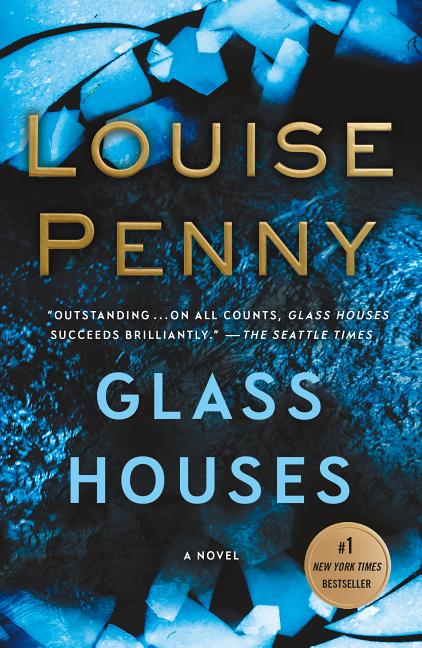
Glass Houses
by Louise Penny
 )
 )
Couldn't load pickup availability
An instant New York Times Bestseller and August 2017 LibraryReads pick!
“Penny’s absorbing, intricately plotted 13th Gamache novel proves she only gets better at pursuing dark truths with compassion and grace.” —PEOPLE
“Louise Penny wrote the book on escapist mysteries.” —The New York Times Book Review
“You won't want Louise Penny's latest to end….Any plot summary of Penny’s novels inevitably falls short of conveying the dark magic of this series.... It takes nerve and skill — as well as heart — to write mysteries like this. ‘Glass Houses,’ along with many of the other Gamache books, is so compelling that, for the space of reading it, you may well feel that much of what’s going on in the world outside the novel is ‘just noise.’” —Maureen Corrigan, The Washington Post
When a mysterious figure appears in Three Pines one cold November day, Armand Gamache and the rest of the villagers are at first curious. Then wary. Through rain and sleet, the figure stands unmoving, staring ahead.
From the moment its shadow falls over the village, Gamache, now Chief Superintendent of the Sûreté du Québec, suspects the creature has deep roots and a dark purpose. Yet he does nothing. What can he do? Only watch and wait. And hope his mounting fears are not realized.
But when the figure vanishes overnight and a body is discovered, it falls to Gamache to discover if a debt has been paid or levied.
Months later, on a steamy July day as the trial for the accused begins in Montréal, Chief Superintendent Gamache continues to struggle with actions he set in motion that bitter November, from which there is no going back. More than the accused is on trial. Gamache’s own conscience is standing in judgment.
In Glass Houses, her latest utterly gripping book, number-one New York Times bestselling author Louise Penny shatters the conventions of the crime novel to explore what Gandhi called the court of conscience. A court that supersedes all others.
Share
Book Details
- ISBN
- 1250066298
- Binding
- Paperback
- Authors
- Louise Penny
- Publisher
- Minotaur Books
- Published Date
- May 1, 2018
- Language
- English
- Pages
- 400
- Physical Info
- 1.2 in H x 8.2 in L x 5.4 in W (0.9 lb)
It’s brilliant
Good book a lot of twist and turns.
At the end of Glass Houses I was in tears. Such good, noble people are at the heart of Louise Penny’s books! This one was written in 2016 and I read it three months into Trump’s second term as President of the United States, a time when the notion of wise, virtuous, noble leadership is in short supply.“We’re used to the film versions of psychopaths. The clearly crazies. But most psychopaths are clever. They have to be. They know how to mimic human behavior. How to pretend to care, while not actually feeling anything except perhaps rage and an overwhelming and near-perpetual sense of entitlement. That they’ve been wronged. They get what they want mostly through manipulation.…“Unlike most of us, who tend to be transparent, people rarely see through a psychopath,” she continued. “He’s masterful. People trust and believe him. Even like him. It’s his great skill. Convincing people that his point of view is legitimate and right, often when all the evidence points in the other direction. Like Iago. It’s a kind of magic.”My heart appreciates the people of Three Pines and Louise Penny’s extraordinary literary talent more than ever.
It started very slow, and I didn’t think I could through it. Louise Penny knows how to finish a book. The ending was super awesome
This particular story in the series is one that has more twists and turns than a maze! Inspector Gamache will once again bring you to the edge and leave you screaming for him to stop the incredible suspense! More tears go with this story, but so much love and respect, it will make your heart skip beats. All the wonderful people in Three Pines grow stronger in their understanding of each other and commitment to each other too. This series is unlike any I've read before, I feel as if I've actually been to Three Pines. Thank goodness for Miss Penny, an author extraordinaire!
- 5 stars: 13 (65%)
- 4 stars: 5 (25%)
- 3 stars: 1 (5%)
- 2 stars: 0 (0%)
- 1 star: 1 (5%)
It’s brilliant
Good book a lot of twist and turns.
At the end of Glass Houses I was in tears. Such good, noble people are at the heart of Louise Penny’s books! This one was written in 2016 and I read it three months into Trump’s second term as President of the United States, a time when the notion of wise, virtuous, noble leadership is in short supply.“We’re used to the film versions of psychopaths. The clearly crazies. But most psychopaths are clever. They have to be. They know how to mimic human behavior. How to pretend to care, while not actually feeling anything except perhaps rage and an overwhelming and near-perpetual sense of entitlement. That they’ve been wronged. They get what they want mostly through manipulation.…“Unlike most of us, who tend to be transparent, people rarely see through a psychopath,” she continued. “He’s masterful. People trust and believe him. Even like him. It’s his great skill. Convincing people that his point of view is legitimate and right, often when all the evidence points in the other direction. Like Iago. It’s a kind of magic.”My heart appreciates the people of Three Pines and Louise Penny’s extraordinary literary talent more than ever.
It started very slow, and I didn’t think I could through it. Louise Penny knows how to finish a book. The ending was super awesome
This particular story in the series is one that has more twists and turns than a maze! Inspector Gamache will once again bring you to the edge and leave you screaming for him to stop the incredible suspense! More tears go with this story, but so much love and respect, it will make your heart skip beats. All the wonderful people in Three Pines grow stronger in their understanding of each other and commitment to each other too. This series is unlike any I've read before, I feel as if I've actually been to Three Pines. Thank goodness for Miss Penny, an author extraordinaire!
The beauty of Louise Penny more than anything else (and there is plenty to praise) is her character development. It’s as in-depth as you can go without forcing it. She’s taken characters and made them as familiar to me as my own family.Another complex and beautifully written story. A privilege to read.
Some of the story just seemed a bit hard to believe. Still the same great suspense, and great twists and turns. I’m probably 7 books into the series, and still having a blast. I can’t give her 5 stars on everything!
Drugs and their proliferation play a large role in this addition to the Chief Inspector Armand Gamache series, but so also does the trial whose judge is certain that something is going on between the prosecutor and his first witness, Mr. Gamache.Even as the trial proceeds by fits and starts. so also does the plan to stop the drug runners and their leaders that Inspector Gamache is insistent on achieving. But will his plan work or will he lose what he wants to get accomplished? Then there's the gunfire that lays low Isabelle LaCosta. Will she come out of this still able to work as head of the homicide division? After all, she's been shot in the head!More trials for Inspector Gamache, more uncertainty for him now that an investigation will begin of his and his second-in-command's actions through all of this. What's next?
After discovering Louise Penny's books only a few months ago, I find that I'm addicted to her writing! I watched the "Three Pines" series on Prime, and when I saw that it was based on her novels, I immediately began reading them. So far, I've read 13, and I thoroughly enjoyed each one. I've always subscribed to the notion that books should be read before watching a show or movie, but this one was an exception. If I had not seen the series, I would likely have missed out on this great novelist and her wonderful books. Each one is different with a completely different plot. The only things the same are the characters and Three Pines, both of which I feel as if I know. Her writing is beautiful prose with vivid descriptions, which allow the reader to become immersed and integrated into the story. The poetry interspersed throughout the books is an added treat. I always find bits of inspiration and lessons learned, or to be learned. I just have a few more to read, so please keep writing. Your readers love you!
I'm a huge fan of Louise Penny's Three Pines, CI Gamache novels. This one is #13 in the series, and I've read them all. Amazon Prime even has a TV series based on the book series and characters, as well as the primary location, but it just didn't work for me. I much prefer Penny's novels.Every novel is a balancing act between plot movement toward resolution and the background of and for it. That is the setting? Why is it the setting? What is the history that brought the characters to this point in their lives? What are their emotions and motives for what they do? All of this is balanced against what happens next in the storyline.In the overwhelming majority of Penny's novels, she maintains a fairly well-balanced narrative. I hate to say it, but on "Glass Houses" the wheels came off. The plot is excellent, and the story itself is a balance between what's happening, now, and flashbacks to what brought the characters to their present circumstances. However, the author seems to get bogged down in psychoanalysis of the characters. I understand that we need to feel the motivations of the characters, but at times Ms. Penny seems to be beating a dead horse.That's really unfortunate, because at its most basic level, it's a great story. Chief Inspector Gamache has come out of retirement, and he's no long the Chief Inspector, and not the Commandant of the Surete Academy. Armand Gamache is the Chief Superintendent of the Surete du Quebec. Simultaneously with his appointment, a crime wave is heating up throughout the Province. It has all the appearance of incompetency, as the police have lost their way, and lost the war.Behind the scenes, Gamache knows it's drug cartels--Canadian and American--behind the escalation, and he's been working with a select team of trusted police agents to set a trap. In order to spring the trap, Gamache and his agents must convince the Cartel's leaders that the Surete hasn't a clue about their movements. In order to do that, Gamache must violate some of his own standards and principles.The storyline unfolds in a series of flashbacks and side-steps, and reconnects to the present. The changes in setting and timing are relatively easy to follow, and enhance the novel elements of suspense and intrigue. We don't know what Gamache knows until the climax and conclusion. That holds our interest.This would have been another Five Star rating for me, if it hadn't been for the over-writing. One could argue that the nature of the plot required it. Not for me.
When a person dressed in black cape and black hood appears in the town square of Three Pines, standing as still as a statue and speaking to no one, people are initially curious. As time goes on and the mysterious statue remains, people grow suspicious, then angry. They demand that their newest resident, Armand Gamache, “do something’. Gamache also feels the darkness and fear, but what is he to do? No laws are being broken. He can only watch and wait along with everyone else. On the day the statue like figure disappears, a body is discovered in the church.Armand Gamache has come out of retirement and has been appointed to the highest position at the Surete, Chief Superintendent. Having previous cleaned out the corruption within the Surete, he is now looking at crime statistics and what he sees is more than worrisome. It is clear, he says, that they are losing the war on drugs in Quebec as in the States. They cannot keep up with the pace of drug sales. New dealers arrive faster than they can be arrested and newer, more powerful, more addictive drugs hit the streets seemingly every day. Superintendent Gamache meets with his top, most trusted department chiefs and asks: is there any way to beat the cartels at their own game? He offers an idea but it will require deep sacrifices, on the part of his staff and many others. Can they do it? Will they?In a hot courtroom with no air conditioning the trial of the person accused of murder begins. As the first witness for the prosecutor, Gamache is forced to face his own conscience as he feels that it is he who will ultimately be judged.This book is #13 of the series and represents the very best of Louise Penny. You will enjoy the Inspector Gamache mystery series even more if you read them in order. ⭐️⭐️⭐️⭐️⭐️
SPOILER ALERT -- SPOILER ALERTI waited a while to read this book after A Great Reckoning because I knew that it would be impossible to recreate the greatness of that book. If you haven't read it -- it's a masterpiece. I was prepared to be disappointed, but I can't begin to express how really dreadful I found Glass Houses. It is the worst thing Louise Penny has ever written, and in many ways it is a ridiculous book filled with pretensions that it doesn't fulfill. The best I can say about it is that it is elegantly written with Penny's beautiful prose.This book is supposed to be about conscience and the existence of a higher law that conscience must not violate. It is a great theme that's wasted in this novel. Instead the book is filled with gimmicks - the cobrador [the external conscience] being the most obvious, and the author's usual tics are particularly annoying and prevalent in this book - the worst being her build up to a big reveal only to switch to another totally unrelated topic leaving you hanging. This is okay now and then, but Penny does it constantly in this book - it's really annoying.In the book Gamache is trying to solve a murder in Three Pines while also trying to bring down a major drug cartel operating in Quebec. The murder in Three Pines is a smoke screen for the author to hide the bigger issue of the drug cartel, and though they are related, the murder feels like a sub text only. I think it's really only there as a way to introduce the cobrador. Gamache has decided that the war on drugs is lost but nonetheless believes that the only way to get any control of it is to bring down this cartel he has discovered. In pursuit of this he drags his senior officers along with him in this quest. He poses as an incompetent head of the Surete to lull the cartel into coming in the open. This pose results in many deaths and a rising crime wave in Quebec. Large drug shipments are ignored and allowed to pass into the United States unhindered causing, by Gamache's own reckoning, hundreds, perhaps thousands of deaths. To support his inaction he quotes Gandhi and the higher court of conscience, he notes that Churchill probably knew about the bombing of Coventry before it happened but didn't intervene because if he did the Germans might figure out the British had Enigma. This is ridiculous and unbelievable. The comparison is meaningless since the war against the Axis could be won whereas the war on drugs will be with us as long as people need to escape reality and pain. So the ends are not really comparable. If Gamache [or Penny] believes this comparison they are both out of touch with reality. Let's suppose Gamache brings down the cartel - in a month, or something like it, the drug trade will be re-established. The head of the cartel tells him as much at the end of the novel. So hundreds, perhaps thousands die for nothing because Gamache was obsessed with the war on drugs to the extent that the people who would die because of his obsession didn't really matter - they were the people of Coventry - collateral damage as it were. Again, this might have been acceptable if his actions could actually stop the flow of drugs, but he can't and no rational person would believe that he could. This is a huge hole in the novel. I could not suspend disbelief to accept it. It made no sense at all. Finally, Glass Houses creates irreparable damage to the character of Gamache as Penny has so lovingly developed it in previous novels. Gamache, in this novel, is neither wise, competent nor kind. He is foolish and dangerous.Don't get me started on the conduct of the trial of the murderer of Katie Evans. The whole thing is laughable. The Crown prosecutor, who is in on Gamache's plan with regard to the drug cartel, treats Gamache, his chief witness, like a criminal. This doesn't make sense. The two men don't like each other, but should be professional enough not to make everyone in the courtroom aware that something is going on that stinks to high heaven. It becomes so obvious that the judge finally intervenes and almost blows the whole plan. To me it is all unnecessary and another one of those gimmicks that don't make sense. The entire trial is unnecessary to the plot. It seems to be there specifically so Armand Gamache can commit perjury. But again this doesn't make sense. The question that he perjures himself on is irrelevant to the case, or at least the question didn't have to be asked in such a way that Gamache had to lie. Penny might have set it up so that asking this question was a malicious act on the part of the prosecutor, but that isn't what she did -- the question was set up by Gamache and the prosecutor together. This is a ploy, and not a very good one, to play to the idea of a higher court and how brave Gamache was to follow his conscience and lie to the court.Finally, in so many of Penny's previous books, the sub plot was Gamache's crusade to clean up the Surete. In this b...
Louise Penny has written another mystery in her series of Chief Inspector Armand Gamache novels and it’s a good one. Gamache, if you don’t know, is head of Quebec’s provisional police force and the hero of some 13 books. In Houses, Gamache, as usual, gets himself in trouble by taking a position that appears to be both illegal and immoral, and the reader wonders throughout the story how he’s going to weasel out of the predicament.Gamache is the very image of always doing the right thing, using intelligence, morality, and common sense in his dealings with criminals. He resides in the fictional tiny Canadian town of Three Pines and is surrounded by quirky old friends and, in this book, some new and sinister crooks involved with the smuggling of deadly opiates. It’s also time for a shout out for his wife, the wonderful Reine-Marie, who is both his muse and his refuge, whose long-suffering presence keeps Gamache under control.The upright inspector makes the decision to allow a huge shipment of the deadly drugs pass over the border into the United States, even though he knows thousands of deaths will likely occur. He also commits perjury during a murder trial, implicating a judge and the prosecutor in his wrongdoing. It appears that, this time, he will be unable to extricate himself from his own malfeasance. You’ll only know if you read the book, because I’m not going to tell you.Penny uses her usual magnificent writing skills to keep the reader involved. Yes, there are a lot of characters and many different stories weaving through the narrative. Yes, it is sometimes confusing keeping things straight. But the author, using Agatha Christie summation techniques, will pull it all together by the end, with clarifying ah-hah moments and startling dramatics. Don’t miss this one and, as a public service, I recommend you read earlier Louise Penny works to get a real look at innovative mystery writing.Schuyler T WallaceAuthor of TIN LIZARD TALES
I’ve never reviewed one of Louise Penny’s books so let me start by saying that I adore the Gamache series for the well-drawn, quirky ensemble of characters, the vibrant descriptions of the physical surroundings that transport me to the exact spot where the action is occurring, the breadth of the historical and cultural references, the layered psychological insights that motivate, and, of course, the beauty, ease, and fluency of Penny’s prose. All considered, the Gamach series is an excellent exploration of the human condition wrapped up in some pretty good mysteries.In “Glass Houses” Penny seamlessly interweaves the events of the past and present to bring us to the climax and denouement that, although not entirely unexpected, is satisfying and moving nonetheless. I’ve always believed the cliché that it is the journey, not the destination, that forms us and that our conscience on that journey is our guiding star. Penny plays on that last part by incorporating the interesting concept of the medieval Spanish Cobrador into the action.One day a stranger, whose identity is completely shrouded in a black medieval type of costume, makes an appearance on the village green where he stands totally unmoving and silent. At first the villagers think this person is just playing a belated Halloween prank, but as the days go by, this specter soon has everyone on edge. When the villagers learn that this mystery person is called a Cobrador, they start wondering who this “conscience” has come to haunt and why and what sort of retribution it is seeking.. As the plot unfolds, these questions become a central clue to a complex chain of disastrous events that lead us far beyond a murder investigation. But, at the core, we keep coming back to the Cobrador that makes us increasingly aware of the importance of conscience (or, in some cases, lack of) in determining the characters’ actions. I won’t say more about the actual mystery as I really dislike spoilers. I will add, though, that Clara’s art exhibit at the end of the novel is especially uplifting and gave me a serious case of the warm fuzzies—especially as it concerned Ruth who is one of my favorite characters.
It's easy to think of the Inspector Armand Gamache mystery novels by Louise Penny as character-driven. Her dominant character, Inspector Gamache of the Quebec Surete, spans some 13 novels and has survived ambushes, shootings, nefarious plots and betrayals by his own police force, and more. His presence looms large in each of the Penny novels. But even her lesser characters are strong ones - Jean-Guy Beauvoir, Gamache's son-in-law and second-in-command, Gamache's wife Reine-Marie, and the residents of Three Pines - Myrna, Clara, Olivier, Gabriel, and especially Ruth Zardo the crazy poet with her duck Rosa.Penny draws her characters so well that it's easy to miss what truly drives her stories - and that is the story itself, what each novel is about. "Glass Houses,"her most recent book (published in 2017), exemplifies the power of Penny as storyteller. She alternates her story between a murder trial in which Gamache is being questioned by the prosecutor and six months earlier when the murder actually took place.The story centers in Three Pines, the small (very small) village in Quebec, close to the Vermont border and not far from Montreal. This is where the Gamaches have made their home (Gamache has retired once, and then agreed to come back as the head of the Surete). It is here that one November day a cobrador appears on the village green, staring at Olivier and Gabriel's bistro. Dressed in a body-long cloak and hood, wearing a mask, the cobrador says nothing. He, or she, or it, simply stares.A few people in the village recognize what is going on. A cobrador is a myth-like figure known is Spain, someone hired to follow a debtor who won't pay his bills, or really anyone who has done something wrong and won't atone. A cobrador is a conscience. The question is, who is the figure staring at?Then there's a murder. The body is found in the basement of the town's small church. The victim has been beaten to death with a baseball bat, and the victim is wearing the clothes of the cobrador.Back and forth Penney weaves the story, first in the courtroom and then in Three Pines. Slowly we come to see that the prosecutor's badgering of Gamache has a purpose; there is a plan behind it, and Gamache is part of that plan. Something besides a murder trial, something far greater and more important, is going on. And that "something" is what drives the story of "Glass Houses."It says a great deal about the author that her stories continue to get better and better, when they began somewhere near the level of outstanding.
Louise Penny's latest book featuring Armand Gamache, now Chief Superintendent of the Sûreté du Québec, is a meditation on the role of the conscience in human affairs, as, in fact, all of her books are. It seems only incidental that there is a murder to solve.Gamache's team from the Sûreté is intact, as are his friends and supporters in the little anonymous village of Three Pines where he and his wife Reine-Marie had moved after his initial "retirement" from the Sûreté. Of course, that retirement didn't take.Now, Gamache must face the fact that his team is losing - or has already lost - perhaps its toughest battle: the war on drugs. Drugs pass almost freely through the province of Québec on their way south to the huge market in the United States. The porous border between the province and Vermont, much of it heavily forested, makes it almost impossible for the police to interdict the traffic.People are dying in great numbers on both sides of the border from the effects of these drugs. The market has long since moved on from marijuana, cocaine, heroin, to opioids. The latest thing is fentanyl. (Coincidentally, as I was reading this book, a story appeared in The New York Times that reported that nationwide deaths from fentanyl had risen by 540% in three years.)Obviously, the strategy of the Sûreté in fighting these drugs and their distributors has failed. What can Gamache do?The answer comes to him as he brainstorms with his handpicked head of the homicide division. They must throw everything out, "burn the ships," and start over. And so they devise a bold plan that will likely get him and all of his lieutenants fired but one that may just work.But then a little thing called murder rears its ugly head.A woman who is visiting the village with friends is found dead, beaten by a baseball bat, in the cellar of the church. Before she is killed, the peace of the village had been disturbed for days by a figure in black robes and mask which simply stood on the village square and stared. A little research revealed it to be an incarnation of a Spanish figure called a cobrador, a figure representing conscience that was sent to extract retribution for an evil committed or, in modern times, a debt. Now the cobrador has disappeared and the body of the dead woman was found dressed in his costume.Who had the cobrador meant to confront? Was it the woman who was killed? If so, what great evil had she committed, this architect who designed glass houses? Is the death somehow related to the traffic in drugs?Penny has set up her plot to travel back and forth between the time of the murder (chilly November) and the time of the trial (in sweltering summer) for the person accused of the murder. It gets a bit mind-boggling and difficult to follow at times, but, on the whole it works.What I found a bit more distracting was the frequent repetitions of conversations and interactions between colleagues and villagers meant to emphasize just what a kind, humane, strong, courageous, upright, just but merciful man Armand Gamache is. By now, we know that he is a paragon of virtue. We don't really need to have it shoved in our face on every second page.Also, there is this animal that Armand and Reine-Marie have adopted which is so ugly and ungainly that no one can quite figure out what it is. Is it a dog or a pig or...? As an animal lover, I just found that irritating. Of course, it's a dog! Surely the great detective can figure that out!These are minor quibbles, of course. Following along with Penny/Gamache as they explore the nature of evil and the role that conscience plays in combating it makes for a thoughtful and thought-provoking read. There is much to digest here and solving the murder is really secondary.
Several years ago ~ I had just finished a mystery novel and was seeking my next read. While perusing Amazon Kindle ~ I stumbled upon the Gamache series. The only things that intrigued me was the setting and the excellent reviews. I was, and am, a fan of the Canadian TV series "Murdoch". Fortunately ~ this led me to take a chance on "Still Life". The reviewer's who gave this novel, indeed this series, high ratings were entirely correct. I am not fond of series, with very few exceptions, the author tends to move further and further away from what initially attracted me to the novels. In the beginning ~ I thought this had happened again. There are several things that ruin novels, or series, for me: hanging endings (Lady and the Tiger is way overdone), endings that leave a book incomplete or blatantly set up for a follow up book, and "flash back" plots. I kept reading but increasingly with the feeling that I would not finish "Glass Houses". Then things changed. This was not the normal "flash back". There were several sub-plots both in the present and in the past. I was hooked!I went from Louise Penny you have blown it ~ to Louise Penny this is the most intricately developed plot that I have encountered in quite a long time. I realize that any of the last two or three books could have satisfied the reader as having completed the series. I am aware that this could easily end the Inspector Gamache novels. Louise Penny, you have set a high bar should you choose to continue. But, I sincerely hope that you are working on the next "Three Pines" novel.I am a believer that superlatives ~ i.e. 5 ~ should be given with great caution. I do not write many reviews ~ usually when a book has been good enough to finish, but contains sufficient flaws that a low rating is indicated.I read fiction for pleasure. There have been a couple of books in this series that I did not particularly enjoy ~ but they managed to keep my attention to the finish. In my estimation, all of the books in the Inspector Gamache series are easily worth a rating of 4 ~ and "Glass Houses" deserves the 5 that I am indicating.
While I felt that in many ways Penny was repeating her effects - a massive disaster looms once again, Gamache is the single person whose leadership can guide the ship of law and order through the iceberg- and mine-infested murky waters of mortal danger to a kind of safety, Three Pines is a magical refuge isolated from the world yet key to the world's survival, eating really well with good friends will get you through, the true artist reaches the emotional heart of things, a group of eccentrics makes a great story better - what is WRONG with repeating these effects, exactly? I certainly read this novel with all the attention and intensity I've given its predecessors.No, it is not the 'best' in the series, or even quite as good as its immediate predecessor, but it is effective and well done and also in some interesting ways acutely original. First, the appearance of an unsettling figure on the village green is a brilliant evocation of karma and consequence - as spooky as the 'stone guest' who drags Don Giovanni down to hell at the end of Mozart's opera. The point of this symbolic figure is actually symbolic rather than merely allegorical, too. Penny calls upon us to imagine retribution, guilt, and consequence in many ways. I admire her writing particularly for this ability to use something unusual to multiply meaning, focus tension, and add layers of significance to the mere exposition that goes on in most mysteries. Once again, she reminds us that Three Pines is a somewhat enchanted space in which moral meaning and human emotion are likely to become embodied in the oddest ways.Using both a jury trial form of narrative and a flashback technique, Penny ventures into new narrative structure - one that challenges her as well as her readers. One reviewer reports being very angry at the information withheld in order to uphold suspense. Every writer of mysteries does this! Sleight of hand is the trick of the trade on which the whole genre depends, and 'fair play' only means we are given enough information to get near to the solution ourselves if that is our only pleasure in reading a mystery. I had little difficulty figuring out whence the murder was likeliest to have come, but enjoyed the slow working out anyway. Using seasonal information (the trial is in hot weather, the events that precipitate the trial are set in a cold season) Penny keeps us well located in time, and her transitions are graceful and sometimes pleasurably clever. Its true, some expository information is trotted out close to the end that explains everything awfully neatly. But so it is in real life, when crimes or mysteries can remain unresolved for a long time until some previously unknown piece of information 'happens' to be the thread which - when pulled - unravels all.The moral question most reviewers aren't troubled by is the one that troubles me: what happens when we do evil that good may come? In this novel, Penny puts the up-to-now incorruptible Gamache into a situation that requires him to ACTIVELY do something that is against his principles and his oath of office in order to overcome forces of great evil. Like his deputy and son-in-law Jean-Guy, I am deeply troubled by this, and feeling troubled doesn't just go away when the situation is resolved the way all hoped it would do. I hope MANY book clubs are talking about this issue, and not just giving Armand Gamache a pass because they love him so much. Maybe Penny by this time needed to endow her hero with feet of clay and the belly of a murderous beast for at least a moment to keep him from becoming quite a God. It's a conundrum.

