
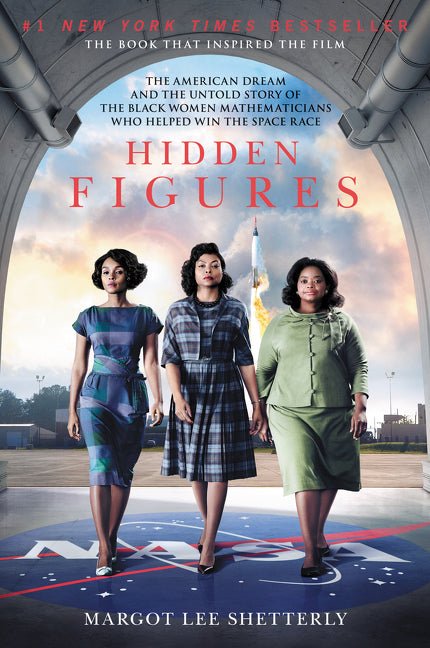
Hidden Figures: The American Dream and the Untold Story of the Black Women Mathematicians Who Helped Win the Space Race
by Margot Lee Shetterly
)
Shop All Audiobooks
*When you open this audiobook on Libro.fm, be sure to select Aveson as your bookstore so that your purchase supports local literacy programs and treeβplanting.
Couldn't load pickup availability
The #1 New York Times bestseller
-WINNER OF ANISFIELD-WOLF AWARD FOR NONFICTION
-WINNER BLACK CAUCUS OF AMERICAN LIBRARY ASSOCIATION BEST NONFICTION BOOK
-WINNER NAACP IMAGE AWARD BEST NONFICTION BOOK
-WINNER NATIONAL ACADEMIES OF SCIENCES, ENGINEERING AND MEDICINE COMMUNICATION AWARD
The phenomenal true story of the black female mathematicians at NASA at the leading edge of the feminist and civil rights movement, whose calculations helped fuel some of America's greatest achievements in space--a powerful, revelatory contribution to African American history that is as essential to our understanding of race, discrimination, and achievement in modern America as Between the World and Me and The Immortal Life of Henrietta Lacks. The basis for the smash Academy Award-nominated film starring Taraji P. Henson, Octavia Spencer, Janelle Monae, Kirsten Dunst, and Kevin Costner.
In this riveting piece of NASA history, before John Glenn orbited the earth, or Neil Armstrong walked on the moon, a group of dedicated female mathematicians known as "human computers" used pencils, slide rules and adding machines to calculate the numbers that would launch rockets, and astronauts, into space.
Among these problem-solvers were a group of exceptionally talented African American women--pioneering women in STEM and some of the brightest minds of their generation. Originally relegated to teaching math in the South's segregated public schools, they were called into service during the labor shortages of World War II, when America's aeronautics industry was in dire need of anyone who had the right stuff. Suddenly, these overlooked math whizzes had a shot at jobs worthy of their skills, and they answered Uncle Sam's call, moving to Hampton, Virginia and the fascinating, high-energy world of the Langley Memorial Aeronautical Laboratory.
Even as Virginia's Jim Crow laws required them to be segregated from their white counterparts, the women of Langley's all-black "West Computing" group helped America achieve one of the things it desired most: a decisive victory over the Soviet Union in the Cold War, a foundational moment in space exploration history, and complete domination of the heavens.
Starting in World War II and moving through to the Cold War, the Civil Rights Movement and the Space Race, Hidden Figures follows the interwoven accounts of Dorothy Vaughan, Mary Jackson, Katherine Johnson and Christine Darden, four African American women who participated in some of NASA's greatest successes. It chronicles their careers over nearly three decades they faced challenges, forged alliances and used their intellect to change their own lives, and their country's future.
How did these brilliant women overcome the barriers of segregation and sexism to help win the Space Race?
- Pioneering Mathematicians: Follow the incredible careers of Dorothy Vaughan, Mary Jackson, Katherine Johnson, and Christine Darden as they break new ground at Langley Memorial Aeronautical Laboratory.
- Cold War Victory: Discover the true story behind the calculations that helped America achieve a decisive victory over the Soviet Union and launched astronauts like John Glenn into orbit.
- Segregation and Science: Witness their struggle and triumph as they navigated the injustices of Jim Crow laws, working in segregated facilities even as they contributed to America's greatest scientific achievements.
- An Inspiring True Story: A powerful narrative of resilience, intellect, and achievement, this book is a vital contribution to understanding the intersection of race, gender, and science in twentieth-century America.
Share
Book Details
- ISBN
- 9780062363596
- Binding
- Hardcover
- Authors
- Margot Lee Shetterly
- Publisher
- William Morrow & Company
- Published Date
- September 6, 2016
- Language
- English
- Pages
- 368
- Physical Info
- 1.4 in H x 9.1 in L x 6.3 in W (1.25 lb)

I was telling my husband about the book I was reading, and he said he saw some videos on YouTube that resembled the plot I was describing. I checked my Kindle and found out that, indeed, there was a mention of the film on the cover. The book was published, and the movie was released in 2016. I guess it illustrates how disconnected I am from current trends perfectly. I was glad, though, to see that the actress whom I liked at the time when I was still watching movies and tv series on a regular basis played one of the leading roles. Both my husband and I loved Joss, played by Taraji P. Henson in βPerson of Interest,β and yes, we havenβt overcome the trauma. No spoilers!βHidden Figures: The American Dream and the Untold Story of the Black Women Mathematicians Who Helped Win the Space Raceβ by Margot Lee Shetterly was an eye-opening reading experience. I love nonfiction that teaches rather than preaches. And this story was right up my alley.Before computers had become what we know them to be β machines that control all aspects of our lives (sorry, a bad joke) β they wereβ¦people. It was a huge revelation that a βcomputerβ used to be a person, a mathematician, who performed calculations βby hand.β βHidden Figuresβ tells the story of a group of human computers who, in a way, have changed history.World War II had a vast impact on everything. Apart from the obvious β a lot of people losing their lives β it had changed the basis of economics around the globe. Even before the United States sent soldiers to fight, the country had entered the war in other ways. Demand and supply had changed drastically. Suddenly, the world needed planes. Lots and lots of them. And since those planes werenβt needed to spray the fields with fertilizers but to participate in battles, they had to be effective, fast, and reliable. Peopleβs lives depended on their performance. This change of demand led to the increased importance of the government agency called NACA (National Advisory Committee for Aeronautics), the one that would in a while become the legendary NASA.To satisfy the rapidly growing military needs, NACA had to expand. And expand it did, both physically by constructing new buildings for research and testing and by hiring new personnel. They quickly realised that to ensure the latter, they had to become more flexible. Thus, the βfor whites onlyβ policy was put aside, and the first African-American women mathematicians signed their contracts with NACA. For them, who knew that becoming a school teacher was the only way they could apply their mathematical skills, it was an opportunity of a lifetime. And they had done everything to use it to the fullest.Another revelation was to learn that it was one of those African American women mathematicians who performed the calculations for the legendary landing on the Moon mission in 1969. Katherine Johnsonβs job was to check and re-check the computer-generated calculations so that the astronauts wouldnβt die because of the mistakes made by machines. Reading about that was especially touching.Sometimes the book was challenging to read because of the abundance of details, and also, after new characters were introduced. I admit, I mixed people and timelines, and as to technical issues, alas, it was hopeless to hope that I might understand them. Still, I guess that itβs a curse, for the lack of a better word, of good nonfiction. You cannot expect it to be solid while lacking details.βHidden Figuresβ by Margot Lee Shetterly is an exceptionally well-researched and adequately presented account of a fascinating page in history. I recommend it to all those interested in lesser-known facts, which, although not advertised, made a significant impact.
Author provided compelling story, but struggled to edit it to a logical flow. Often too much information was included which was distracting.
Great book
Hidden Figures was truly a heroic novel about the women of NASA who went unrecognized for their tremendous efforts towards air exploration and travel. I have mixed views on this novel, but I think it should be read widely amongst African American children, teens, and young adults as it is an inspiring story about hardworking people who sought to become more than what society duped them to be because of their race. This novel is empowering and is a good read in my eyes. The way Shetterly can educate the reader on the social issues during the 20th century and display its impact on African Americans through specific characters is very impressive, yet trivial. As it is a groundbreaking novel, it does have some cons. The piece was a bit too heavy to read because the author tries to focus on so many aspects during this period. She makes so many references towards history, the book starts to become a history book in a sense, but it is essentially a book about history. That was a difficult concept for me to grasp as I read and wrote an assignment on it. Shetterly, unfortunately, bites off more than can chew as she switches from characters while trying to include historical events. Her constant back-and-forth methods made it difficult for me to interpret what was happening at some moments. She did pull it off, but the transitions made be harder for others. I feel like she tried to fit too much information into a small frame. She elaborated on Jim Crow, Brown vs. The Board of Education, World War 2, the space race, and many other events in only 265 pages, so the plot had some holes and was convoluted. Some characters like young Christine were irrelevant to the plot and I saw no significance in those people. Another reference was the woman from Star Trek and her story, which I thought was not important to the plot. Shetterlyβs depiction of African American men and women in racist America was so puissant, I do not think she needed to include some small pieces like the ones I mentioned. On the other hand, her ability to captivate the characterβs emotions through text was incredible. An example would be Mary Jacksonβs predicament with the bathroom and her journey to become an engineer at NASA. She moves the audience through her distressful tone as she illustrates the struggle the women at NASA and African Americans faced while trying to avoid being devoured by the country that prayed on their downfall as racism still lingered. African Americans often felt βangry and humiliatedβ because of the treatment they faced as βnegotiating racial boundaries had become a daily fact of negro life.β (Shetterly 108) Shetterlyβs novel gave an insiderβs look at the status of African Americans in America during the 20th century. They were caught in a crossfire as the country relied on them to fight in WW2, which was a war against racism, but wouldnβt call it upon themselves to solve the racial problems in their own country. βAmericaβs inadequacyβ and hypocrisy came to the forefront with the lives of Dorothy, Katherine, and Mary being emphasized. (Shetterly, 152) These individuals were part of a black movement of individuals who sacrificed everything they had to become more than their color. America asked so much of these people but gave them nothing. Shetterly beautifully elicits the power that African Americans had in the workforce that America bothers to show or care about and this is why I believe this piece is worth reading. This book was different because it displayed success in many different ways instead of one. This is what demonstrates black excellence at its finest. Given that this book was a little too heavy and convoluted in the plot, I would give it 4 out of 5 stars. It goes to show that black voices can be heard no matter the predicaments we face. In a stagnant country, we will prosper. These successful women βmirrored the aspirations and philosophy of the surrounding black communityβ and that is why this novel should be read by others seeking to become pioneers of a new age of black progression. (Shetterly,95)
The women of this book, black and white, were never actually βhidden.β There was no conspiracy to cover up the fact that they had worked at the laboratory or the other entities that it morphed into over the years. But as is the case with lower level employees of almost any organization, no great fanfare was made about them either. So, we owe Margot Lee Shetterly for unearthing their story and sharing it with us.In 1943 the Langley Memorial Aeronautical Laboratory was suffering from a shortage of qualified personnel to fill such positions as Junior Physicist, Mathematician, and Assistant Computer. The demands of the military for young men for World War II took up so many young men that the people in charge of the laboratory found themselves looking for women β even black women β who could do these jobs.In those days a βcomputerβ was a person who operated a calculating machine (an older, clunkier and mostly mechanical version of a calculator) to perform the calculations needed to make sense of the research being done at the laboratory.In 1943 they began to hire some exceptionally talented and mathematically inclined black women. Many of these women had been teaching school. Some had been teaching at the college level. The mission of the laboratory at that time was to study things like airflow over the bodies of different types of airplanes trying to discover how to increase the efficiency of different parts of the plane. The engineers studied these problems in wind tunnels and sent the data they collected to the computers for analysis. Throughout the war, these women helped to provide the solutions that allowed for the creation of ever more efficient airplanes, and in the process proved their worth to the laboratory.At the end of the war, there was a change in the mission of the laboratory, and some of the people who had started there during the war left for various reasons, but there was still plenty to do. Now the focus was on designing and testing improved airplanes and airplane parts for civilian use. The move from propeller planes to jets and the quest for supersonic flight was assisted by these same women.Sometime in the late βfifties, the mission began to change again, and so did the way computers did their work. The focus now began to be on winning the space race, and the Russian launch of their satellite, Sputnik, inspired a big push to build rockets and send a man into space, with the ultimate goal being to put a man on the moon. Electronic computers began to replace the human computers, but they needed somebody to program them, and at that time there were no schools already set up to train computer programmers. The National Advisory Committee for Aeronautics (NACA), which was rapidly becoming the National Aeronautics and Space Administration (NASA) set up classes for their own people to train them on how to use the new electronic computers, and many of the women computers signed up to take the classes so they could continue to do their jobs. Meanwhile, some of the women had already made the transition to becoming Mathematicians and Engineers and kept right on solving the problems and checking the data that allowed for the success of the Mercury and Gemini missions, and finally sent several Apollo missions to the moon.While all this was going on, changes were also happening in the world outside the laboratory. When the women first came to Langley, segregation was still in full swing in Virginia. When they rode the bus to work, they had to ride in the back of the bus. There were separate restrooms for black women. The schools their children went to were still segregated. Whole housing areas had to be built for them alongside the housing areas being built for whites.The military and the federal government were some of the earliest workplaces to become integrated. By small steps (like removing the sign in the lunchroom designating the separate table for them) and larger steps (finally getting rid of the separate restrooms), they gradually made the workplace more hospitable. Much was owed to the fact that many of the people they worked with were from places outside the South and were less hostile to black people. Much was also due to the fact that the women did their jobs well and respected and were respected by their coworkers.In the outside world, things went more slowly. Eventually, the segregated schools and buses became things of the past. It became possible to move into areas that had not been built specifically for blacks.
)
