

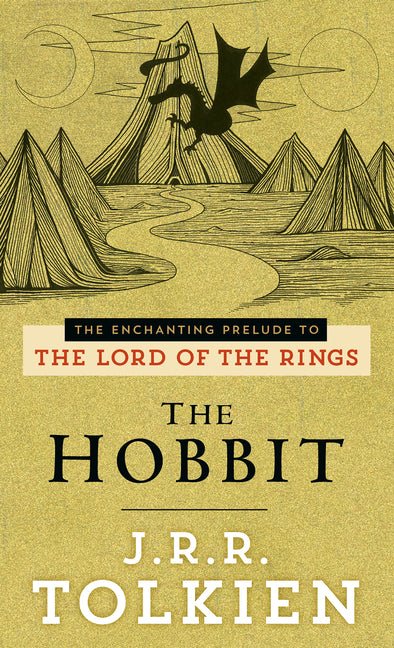
The Hobbit: The Enchanting Prelude to the Lord of the Rings
 )
 )
Couldn't load pickup availability
Sauron has returned. . . watch The Lord of the Rings: The Rings of Power Season 2 on Prime Video.
The journey through Middle-earth begins here with J.R.R. Tolkien's classic prelude to his Lord of the Rings trilogy.
"A glorious account of a magnificent adventure, filled with suspense and seasoned with a quiet humor that is irresistible... All those, young or old, who love a fine adventurous tale, beautifully told, will take The Hobbit to their hearts."--The New York Times Book Review
"In a hole in the ground there lived a hobbit." So begins one of the most beloved and delightful tales in the English language--Tolkien's prelude to The Lord of the Rings. Set in the imaginary world of Middle-earth, at once a classic myth and a modern fairy tale, The Hobbit is one of literature's most enduring and well-loved novels.
Bilbo Baggins is a hobbit who enjoys a comfortable, unambitious life, rarely traveling any farther than his pantry or cellar. But his contentment is disturbed when the wizard Gandalf and a company of dwarves arrive on his doorstep one day to whisk him away on an adventure. They have launched a plot to raid the treasure hoard guarded by Smaug the Magnificent, a large and very dangerous dragon. Bilbo reluctantly joins their quest, unaware that on his journey to the Lonely Mountain he will encounter both a magic ring and a frightening creature known as Gollum.
Share
Book Details
- ISBN
- 0345339681
- Binding
- Mass Market Paperbound
- Authors
- J R R Tolkien
- Publisher
- Del Rey Books
- Published Date
- July 12, 1986
- Language
- English
- Pages
- 320
- Physical Info
- 0.9 in H x 6.8 in L x 4.1 in W (0.35 lb)
MY FAV!
The book looks like new even though it said used.... Great deal and my kid is enjoying the book.
The Hobbit by J.R.R. Tolkien is a rollicking journey that hooked me with its sweeping adventure and left me smiling at its heart. With a 4-star rating, it’s a solid win for anyone craving a tale that’s equal parts thrilling and soulful. The story’s scope is massive, carrying Bilbo Baggins from his cozy hobbit-hole through perilous mountains and dragon-guarded hoards, delivering the epic stakes I love. The world of Middle-earth—brimming with misty forests, glittering caves, and bustling towns—feels alive, every step packed with wonder and danger. What stood out most was the adventure itself: a grand quest that blends humor, heart, and high stakes. Gandalf’s unwavering belief in Bilbo, nudging him from comfort to courage, was a highlight, making their bond a quiet anchor in the chaos. Bilbo himself, with his reluctant bravery, and Gollum, hissing over his “precious,” are characters that stick with you—vivid, flawed, and unforgettable, even if they don’t quite hit the deepest emotional chords I crave.The audiobook brought the story to life, especially the dwarves’ lively songs, which added a playful spark to the journey. That said, the book’s childish tone and slow pace, clearly aimed at younger readers, sometimes dragged, making parts feel like a slog despite the narrator’s charm. A tighter pace or less whimsy might’ve elevated it further, but it never lost its grip on me. Tolkien’s prose, while not always lyrical, paints vivid scenes and carries a warmth that suits the story’s spirit. The darker moments—battles and betrayals—carry weight but always serve the story’s hope, never sinking into pointless gloom.Overall, The Hobbit left me satisfied and charmed, a testament to why it and The Lord of the Rings sparked the fantasy genre. It’s a fun, meaningful ride that had me cheering for Bilbo’s growth. The line, “There is more in you of good than you know, child of the kindly West. Some courage and some wisdom, blended in measure,” captures its core: a belief that even the smallest heart can rise to greatness. For fans of epic adventures and characters who find strength in unexpected places, this is a journey worth taking.
A wonderful adventure and a great opening to Tolkien’s real treasure - the Lord of the Rings trilogy - the grandest adventure of them all. An adventure you will not soon forget
I've read this book at least 20 times. Never gets old. Please give it a read if you haven't. You won't regret it.
- 5 stars: 16 (80%)
- 4 stars: 4 (20%)
- 3 stars: 0 (0%)
- 2 stars: 0 (0%)
- 1 star: 0 (0%)
MY FAV!
The book looks like new even though it said used.... Great deal and my kid is enjoying the book.
The Hobbit by J.R.R. Tolkien is a rollicking journey that hooked me with its sweeping adventure and left me smiling at its heart. With a 4-star rating, it’s a solid win for anyone craving a tale that’s equal parts thrilling and soulful. The story’s scope is massive, carrying Bilbo Baggins from his cozy hobbit-hole through perilous mountains and dragon-guarded hoards, delivering the epic stakes I love. The world of Middle-earth—brimming with misty forests, glittering caves, and bustling towns—feels alive, every step packed with wonder and danger. What stood out most was the adventure itself: a grand quest that blends humor, heart, and high stakes. Gandalf’s unwavering belief in Bilbo, nudging him from comfort to courage, was a highlight, making their bond a quiet anchor in the chaos. Bilbo himself, with his reluctant bravery, and Gollum, hissing over his “precious,” are characters that stick with you—vivid, flawed, and unforgettable, even if they don’t quite hit the deepest emotional chords I crave.The audiobook brought the story to life, especially the dwarves’ lively songs, which added a playful spark to the journey. That said, the book’s childish tone and slow pace, clearly aimed at younger readers, sometimes dragged, making parts feel like a slog despite the narrator’s charm. A tighter pace or less whimsy might’ve elevated it further, but it never lost its grip on me. Tolkien’s prose, while not always lyrical, paints vivid scenes and carries a warmth that suits the story’s spirit. The darker moments—battles and betrayals—carry weight but always serve the story’s hope, never sinking into pointless gloom.Overall, The Hobbit left me satisfied and charmed, a testament to why it and The Lord of the Rings sparked the fantasy genre. It’s a fun, meaningful ride that had me cheering for Bilbo’s growth. The line, “There is more in you of good than you know, child of the kindly West. Some courage and some wisdom, blended in measure,” captures its core: a belief that even the smallest heart can rise to greatness. For fans of epic adventures and characters who find strength in unexpected places, this is a journey worth taking.
A wonderful adventure and a great opening to Tolkien’s real treasure - the Lord of the Rings trilogy - the grandest adventure of them all. An adventure you will not soon forget
I've read this book at least 20 times. Never gets old. Please give it a read if you haven't. You won't regret it.
I remember reading this as a child and I have loved it for decades now. I do not doubt that I shall love this for many more years to come.
I’d never spent a min w Tolkien until I opened this book but basically cannot put it down now. What masterful storytelling!
Bring back the conversation style of story telling, please! All the uncomfortable parts were made so much nicer by the comfortable, friendly style of writing. It's taken me many years to read Tolkien, but I'm so glad I finally started.
How this is a children's book, I do not know. Children these days would struggle with half of the words!
I bought a classroom set for my high school students. This has been a blast! This book is the perfect size, the pictures inside perfectly align with the story and are not distracting. This feels like the original book design, and I would be shocked if it was not. Whether you have read the book or want to find out what the hype is all about, this is the perfect copy to do so with!
Tolkien is an amazing author. The way he writes captivated me from start to finish. What a beautiful piece of art. I wish he’d be alive to see what has become of his work. Although, I know that he may have not liked the fame and all that, I wish he’d received the honors he deserves.Wish I could shake his hand. For now, I will just share my love for the book and his work with my students and family.
Okay, okay, so I’m a little behind the Lord of the Rings phase, but I’ve been interested in reading the series for quite some time, so why not start with the prequel, The Hobbit?I suppose it is fairly difficult to add anything new to the scores of reviews and critiques of this famous work, but I will echo the sentiments and merits of The Hobbit and its classic long-standing status.This book works perfectly as a prelude of the series because while it does set up elements like themes, symbols, and characters that we will come to know in the famous trilogy, it still has its own story to tell as well.Tolkien writes in such a way to allow the novel to be geared towards a younger audience, for even in the moments of the direst peril for our characters there is still a light-hearted approach and quality. But this is also a novel that the older crowd and fantasy enthusiasts can enjoy through its themes of courage, honor, loyalty, friendship, valor, and the imaginative level of storytelling.The basis for our story here is the journey over dangerous terrain and areas to recover a treasure that is stowed away by one formidable dragon, Smaug. Bilbo Baggins, a hobbit at the center of this quest, is our main character and although one would not readily call him a hero, his ingenuity and cleverness surely at points are crucial and surely of a heroic nature. (I also liked how there is a natural, yet subtle, character progression for Bilbo from beginning to end). Along with him are a band of dwarves and a wizard we all know named Gandalf, who makes intermittent appearances to aid in this journey.Tolkien does take a leisurely route (even at a respectable three hundred pages) to get to our destination, but, to me, this was totally fine because the fun of the book was “the quest.” It is the prevailing factor. The most entertaining episodes were the ones where we see Bilbo and his company get into trouble and then have to maneuver their way out somehow. (My favorite chapter involved Bilbo and the dwarves having to outwit a king and his elves and also involved a group of barrels and some liquor).And they face plenty of trouble with creatures of all sorts: wild wolves, elves, trolls, goblins, giants, spiders all are a part of this perilous adventure.There is such an imaginative and creative level of story building that progresses and utilizes elements of myth, legend, fantasy, and adventure. As stated earlier, even in the formidable moments, there is a light-hearted mood, and the songs incorporated through the characters add to this and add a nice dimension to what is taking place:“Roads go ever ever onUnder cloud and under star,Yet feet that wandering have goneTurn at least to home afar.Eyes that fire and sword have seenAnd horror in the halls of stoneAnd tree and hills they have long known.”Perhaps the only “knock” is that the ending does get a smidge anticlimactic (it actually feels like there are two “endings,” truth be told).However, overall, this was a highly entertaining experience, a wonderful way to kick off the Lord of the Rings, and now I look forward to tackling the trilogy in the near future.
The media could not be loaded.
Through The Eyes Of A ChildNo one is really going to read a review from some random dude about a story beloved for so long by so many. If I said I loved it, I’m just one voice in a chorus of others. If I said I hated it, I would be chided for a lack in taste or understanding. If I said there were parts I liked and others I didn’t – I’d be lost in the middle ground of it all and attacked by both fans and detractors of the story.However, one thing I can offer is the review of at the time of this writing a newly-crested 7-year-old girl in the year of our Lord 2023 as we read the story together and offer up her perspective as someone coming brand new to a work that really kicked off the fantasy genre. While the review may lack detail and wordiness, I can tell you there was no push by her father to like or not like any part of it and the review is an accurate take prompted only by the questions asked by a loving father. (Although this father might interject observation from time to time in parentheses)This was actually a “take two” reading as dad had only read the story and forgot that voices and inflections are what drives children to get invested in the story. We did not make it very far even for a kid who is pretty patient with a learning-as-he-goes-parent and enjoys a world of fairytales and princesses. So this second attempt was assisted by a narrator with a British accent who could sing the songs and change inflections for the characters.Characters – Indeed!The Hobbit definitely has a lack of female characters but this didn’t phase our reader too much – although adding one girl would have been okay with our reader. She enjoyed both Bilbo and Gandalf the most. She loved that Bilbo went on his journey even though he didn’t really want to and in the midst of all his trials in the story – he wanted to do the right thing. (A note here – it’s interesting that “doing the right thing” here is seen instead of “continuing the adventure” or “getting out of the situation”. It seems that the reader got Tolkien’s desire and Bilbo’s role immediately.). With Gandalf, one might think the fact that he was a wizard and did wizardly things at times would be the draw for our reader. In fact, she enjoyed that Gandalf was with the troop of heroes for half of the story and returns just when it seemed like the group needed his help at the end. She enjoyed that Gandalf followed Bilbo back from the great mountain back to the Shire and completed Bilbo’s journey with him.The JourneyAction isn’t devoid in the enjoyment of the reader. The battle of Smaug and the ending of the menace was her favorite part. She liked that the bad guy was defeated and peace would reign. Although, the end of the story doesn’t happen here as she thought it was interesting that the selfishness of King Thorin ruined the peace and what could have been a good time. (Just like a good child asking “are we there yet?” this was mirrored with “when are they going to get to Smaug?” but it seems the building in anticipation was worth it in the end).Tolkien is known for building his world and if a tree needs a history, by Joe, that tree will get a full backstory. Our reader agreed that there was too much detail at times and the desire to get on with the adventure was forefront. However, she also agreed that it allowed her to imagine the world of our characters to a better extent. (It’s interesting to think about how many fantasy stories she’s exposed to and how figuring out the world and the rules of the types of magic encounters occurs. This probably gets lost of us big kids who know these stories or story types and forget we need to sometimes start fresh with our assumptions to get more out of the story). The details in the action parts were fun and added to lengthening of that enjoyment. Even with the times of travel and rest, our reader liked the characters talking with each other and interacting. So even the “boring parts” were good for our reader.Themes & TakeawaysOur house is not unexposed to British humor although sometimes the subtlety of a joke is lost due to our reader’s age or life experience. Yet, the humor and Brish turns-of-phrases in Tolkien’s story were not lost on her. While many readers, I believe, tend to overlook the songs; our reader found these to be the funniest parts. One reason is that we don’t make up songs for the stuff we do in our day-to-day travels like it seemed our characters did. (This is probably a sad telling of our current state of culture and one that Tolkien probably bristles at).When questioned on what was not enjoyed about the story, our reader thought for several minutes before coming away that there was nothing that she didn’t like. When asked about Golem being a mystery, she was okay with not knowing more about him. She liked that we would see him again in the next books after it was r...
I am 35 years old and this is my first time reading The Hobbit. I have seen all of the films, so that is the only aspect impacting my review.I found The Hobbit to be a "complete" and easy-to-read adventure. There was lore, various races / species of creatures, unique cultures, mystery, action, and plenty of endearment. The main protagonist experienced character development and the way Tolkien wrote, allowed readers to feel it, too. The book is written in a style like C.S. Lewis' Chronicles of Narnia, with some "fourth-wall" asides and would be fun to read aloud to children about 8+I thought the book would be much more "dense" and "complex" than it was. Instead, it was a very simple read. The story-arc and pacing were on point. It is just a good story. It stands on its own without need for a sequel in any way. However, there is so much in the world of Middle-Earth we are introduced to, it would be a shame not to write further. On that note, I write further at the end of this review (The relationship with The Lord of the Rings).Something I thought I disliked at first, I realize I now appreciate is the lack of developing some characters. For instance, Gandalf, The Necromancer, and Elrond are not very developed. They are quite one-dimensional, or simply not described in detail. However, I now realize I am more enamored with these characters due to my many questions. "Where did they come from? What are their powers? What are they doing when they fade in and out of the main story?" These are the kinds of questions we are left with, which at first caused frustration, but later a greater imaginative experience.My only dislike:It is a bit confusing on "who" is the author of the book. At times, there are hints the book I am reading are the Bilbo's memoirs mentioned at the end of The Hobbit. However, the fourth-wall asides are obviously a modern-day author ( not to mention allusions to modern day things like trains ). So, I'm not sure if Tolkien had half-an-idea, or whether I am making more of it than is there.The relationship with The Lord of the Rings ( which has nothing really to do with how I rated this book ):It is difficult not to say something about The Lord of the Rings. I am only a bit into The Fellowship of the Ring, but I have seen the films and know enough to say there a couple of things which bother me.First, the ring is not the main deal of The Hobbit. The adventure itself is the main thing, communicated from Bilbo's perspective. The ring is just part of the story. However, it becomes so much more prominent and I think it is easy to tell it was never meant to be such a foundation to all that came after.Second, I don't like all the changes of things like goblins being changed to "orcs" when The Hobbit talks about there being differences between these races. There are a few things like that. The Necromancer, for instance. I am guessing it will end up being Sauron or something. So, what I am saying is that The Hobbit is its own book, and I like it as its own book, and I don't think I am going to love the retconning it will take to connect the stories together.
Wow, this was amazing! I liked The Hobbit more than Lord of the Rings, because The Hobbit had a much more reasonable amount of setting description, imo. The setting descriptions were still fantastic and impressive in The Hobbit. I especially enjoyed the word paintings of the Misty Mountains goblin tunnels and the scary Mirkwood.The character development of Bilbo was pretty good. He really grows as a person, and from reading his internal monologues, I find it easier to connect with and understand him, which I couldn’t do as well in the movies, since we don’t get a direct look into Bilbo’s mind on the silver screen. Thorin Oakenshield seems different in the book; he was overall politer and more considerate than the Thorin in the movies.Yes, I already know that Tauriel and Legolas are not in the book, and that Tauriel is purely a movie character. But the addition of Tauriel is one of the rare instances where I appreciate the director/ scriptwriter’s artistic liberty. There was also not a single named female character in the book!It was a delight to see Gollum. He was so creepy yet portrayed so vividly. Tolkien is very good at conveying characters in an evocative way, with dialogue and descriptions of their behaviors.Furthermore, I enjoyed the humor throughout the book. It was so cute and humorous! The lightheartedness of these funny moments, stood in stark contrast with the darker parts of the story.I’ve heard some people complain that the Lord of the Rings/ The Hobbit characters tend to be too flat and black-and-white, either all good or all bad. Well, that is in itself a black-and-white statement. I already mentioned the character development of Bilbo. Not only does he change and grow, he also shows both noble and less glamorous sides. Thorin is more complex than he may seem too, but I won’t spoil the plot here. In fact, I would argue that even Gandalf and the Elven king are not single-faceted characters; they have more than one side to them.I actually got Beorn and Bard mixed up, due to the similarity in their names. Bard was more developed as a character in the movie than in the book, though. Radagast was only mentioned once in passing in the book, so I was glad that he made some significant appearances in the movie!It was in addition nice to see the less noble sides of the elven race. Even elves can be petty, impulsive, rude, etc. I doubt that we would ever meet a benevolent troll, goblin, or orc, though.One notable quote in this book, was where Tolkien said that there was one flaw in Bilbo’s plan, and you might have seen it and laughed at him for it. But if you were in his desperate situation, you might not have done half as well yourself. Wow, I loved Tolkien’s quote here, because it underscores what many folks who like to pick at “plot holes” miss. If you’re cool, collected, have no personal involvement in the situation, and have all the time in the world to think, of course you can think of some ingenious strategies that may render the entire journey, quest, or story unnecessary. But do you believe that a person deep inside that situation can think so clearly and come up with such a smart plan in such a short time (often just a few seconds)?People who poke fun at “plot holes” can sometimes be unrealistic too. I’ve heard of many people say that Frodo and co should have ridden on the great eagles to go to Mount Doom. But in The Hobbit, you see that the eagles were not even willing to fly to Lake Town, lest the men shoot at them. If these great eagles can’t even bear to fly that distance, do you think they would be inclined to go all the way to Mount Doom? And would the eagles be willing to risk being attacked by Saruman or Sauron? Plus, great eagles though they are, Rivendell to Mount Doom is a pretty long distance. Would the eagles want to expend so much time and energy for them? It’s one thing to be in favor of a noble cause (like saving the world). But it’s quite another to offer to spend tons of time, energy, and resources to help people, especially if there’s a chance they can be killed by a dark wizard.Furthermore, I think the point of having a fellowship of the ring, was not merely to dunk the ring into the fire at Mount Doom. It was also about building character for the adventurers, and having them learn to get along with people of other species. (Most notably, Legolas the elf and Gimli the dwarf become good friends.)All in all, this was a wonderful, enjoyable book. I hope to read some of Tolkien’s other works, and especially want to learn more about Radagast.
Some may wonder if J.R.R. Tolkien's story, The Hobbit will still be worth reading now that the movie adaptation by Peter Jackson is complete. Others may want to know if its worth sticking this book within their reading list when compared to all the other great fantasy writers out there like R.A. Salvatore, William King, J.K. Rowling, or George R.R. Martin. I believe the answer is a humongous YES, but I will break this tale down and give out what I view are the pros and cons to delving into this novel; as well as occasionally comparing and contrasting the novel to the movie. Characters: While Bilbo Baggins and Gandalf are well rounded characters, I personally feel that the dwarves are mostly lacking in individuality and personality. Balin, Dwalin, Oin, Gloin, Dori, Nori, Ori, Bifur, Bofur, Bombur, Fili, Kili, and Thorin Oakenshield feel like nothing more than foggy sketches to me. While the film has given the dwarves the necessary traits to make them stand out amongst each other, such as Bofur's stiff hat and Oin's ear trumpet, the book leaves out pretty much anything that would make the dwarves stand out from one another. An example: "`Kili at your service!' said the one. `And Fili!' added the other; and they both swept off their blue hoods and bowed" (10). And that is pretty much it. We now know that Kili and Fili have blue hoods, and now the reader is left to add their own ideas to try and distinguish the dwarves from each other. While later on the dwarves do do things to separate themselves from each other, the issue never really goes away because by the time the dwarves do start to try and stand out from each other, they are pretty much all one dwarf already. I even tried to get around this issue (I knew before I reread this book that I had an issue with this in prior readings) I tried to use my Kindle to keep notes on who each of them were, but that eventually involved too many back and fourths which was beginning to ruin the story. Not only are the dwarves lacking, but they are fired at the reader so rapidly that their introductions into the tale feel like a tidal wave of characters, drowning the reader in quickly arriving dwarves. Maybe Tolkien did this overload on purpose to cause the reader to feel closer to Bilbo, for he receives the guests pretty much the same way as the reader does--character overload. Other characters in the story are given much more description and stand out much better than the dwarves do, such as Gollum:"Deep down here by the dark water lived old Gollum, a small slimy creature. I don't know where he came from, nor who or what he was. He was Gollum--as dark as darkness, except for two big round eyes in this thin face" (63).See, to me that sounds terrifying, and gives the mental eye much more to look at than just blue hoods. A huge flaw when connected to the dwarves, the characters that should be standing out, but luckily, the rest of the characters in the book feel and act alive. One would think though that a book about thirteen dwarves and a hobbit would have the dwarves actually feel solid, and not, background fluff.Setting: Here we see one of the strong points for Tolkien, and that is Setting. Middle Earth feels alive within these pages, and maybe sometimes too alive. Not only does Tolkien write strong locations, but he really beats the reader over the head with it. I have read so many descriptions of trees that I may actually now be sick of them. In the epic Lord of the Rings this over description of setting is a bad thing, but while I originally hated it in The Hobbit as well, I have found that it is not as bad as I remembered it being here. "...leading into a gloomy tunnel made by two great trees that leant together, too old and strangled with ive and hung with lichen to bear more than a few blackened leaves" Tolkien writes about the entrance to Mirkwood (121). Descriptions like that really bring the reader into the story. If Tolkien had applied that same in depth writing to the dwarves, this would have been a five star tale instead of the four stars I am going to give it.Plot: In the interest of trying to keep my review spoiler free, I'm going to be a bit vague. Regardless, the story is excellent. The reader will meet disgusting creatures, horrific monsters, and travel to far away lands. The beginning is a little slow because the narrator has to establish his voice and explain what Hobbits are, but once the story gets going it is a real page burner. The climatic ending is a little lackluster though, for the event that the whole plot builds to is rushed through in a few paragraphs, and an epic scene that probably could have taken up a few chapters is condensed into one, once again, here and gone in a blink of a few pages.For those of you who have read the book and are going off to see the film, you will find many scenes and characters that do not appear in the book, or if they are mentioned in the book its like a sentence. For example, my favorite character in the...
*The Hobbit* is one of the most beloved books of all time. Though actually originally written as a children's story, it almost immediately transcended such a classification, and through the years many adults have read the delightful story of a small, but tough Hobbit named Bilbo Baggins.Most folks know the basic premise of the story. If not from reading it, then certainly they know part of it from the prologue to *The Lord of the Rings: The Fellowship of the Ring* movie, and likely went out to learn the rest of the tale. A wizard, Gandalf the Grey, goes and visits the son of an old Hobbit friend, and after spending time with him, surreptitiously marks Bilbo's door with a sign that is an advertisement of services for a professional burglar.The dwarves that Gandalf was helping look for a burglar promptly knock on poor Bilbo's door, and up he finds himself enlisted in an adventure to slay a dragon and find lost gold. Initially the dwarves belittle Bilbo, and this just makes him all the more determined to prove them wrong about him, which attitude he does, to put it mildly, regret more than once on their quest. Eventually he finds the Ring and the adventures are many, but that is too much of a spoiler for this review. Suffice it to say, it is one grand adventure after another.It is said that the Hobbit was published on the recommendation of the publisher's son, who heartily endorsed the tale. It also was published on the strong recommendation of Tolkien's friends, including C. S. Lewis. Tolkien was a man of a very exacting nature. The debt owed to Tolkien's close circle of family, friends, and a few close academic peers is incalculable. For their insistence that Tolkien merely "publish it already" ensured the book kept the whimsical tone it may otherwise have lost.*The Hobbit* is often criticized, to be sure, for not having the extremely "serious" tone and "complex" plot lines of its sequel, *The Lord of the Rings*. While this criticism is perfectly fair, it also greatly misses the point. Yes, Tolkien included fantasy elements in the story derived from the epic fictional history of Britain that he was writing. But that was all that these were, small derivatives. There was not a concerted effort when he wrote the *children's* story, to include all of these. Indeed, while Tolkien had to go back and rewrite the section "Riddles in the Dark" to make the story of the Ring and Gollum coincide with the overall story of *The Lord of the Rings*, that is as far that he was able to go. He realized that to make the tone and story of *The Hobbit* match that of it's sequel would effectively make it no longer the fun story that everyone loved.So the question is, what is *The Hobbit*? What kind of story is it? It is lighter, but with a sense of foreboding. It is the story of a fat, happy, contented age coming to a close in a devastating war that will change the face of the earth. It is the origin of a story that is an attempt to explain how a variety of myths can be true.To this, many may object that *The Silmarillion* is the beginning of the story, but this is untrue. *The Silmarillion* is the beginning of *all* stories, and only concerns the events of the later periods of Middle-Earth very faintly, and near the end of that epic narrative. It is the Creation myth, one that connects with the Christian faith of the author surprisingly well.In fact, the light-hearted tone of *The Hobbit* is the pefect bridge for the reader. It is the most "modern" in perspective, and introduces the reader to the peoples, geography, and events that they will find are connected from the First and Second Ages in *The Silmarillion* and the Third Age in *The Lord of the Rings*.J. R. R. Tolkien didn't like allegory, as he himself attested, but he did try to do "applicability", which is really just a way of saying that he didn't directly do "x = x" in the story, but allowed his Christian worldview to mesh with ancient epics in an effort to reconcile the two differing myths, or as he later convinced Lewis, to separate the "one, True Myth" to which the other myths copy and pay homage.Perhaps the most important link, however, to *The Lord of the Rings*, however, (besides the Ring itself, of course) is the importance of characters and the emphasis on certain truths and values. Among these are loyalty, the Providence of God, and the simultaneous righteousness and brutality of warfare.Before entering the military after the outbreak of World War I, Tolkien and his closest friends, who made up the core of a club that was likely the inspiration for the later Inklings and other clubs Tolkien loved to found at the various colleges at which he taught, had this notion of the glory of war, and how they would find renown for their deeds. This is shown in the perspective of Bilbo and the other heroes at the end of the story. While they were happy to have won the battle against evil, they also felt the horrors of war quite keenly.For the careful and patient reader,...

