
Homebound: A GMA Book Club Pick: A Novel
by Portia Elan
)
Shop All Audiobooks
*When you open this audiobook on Libro.fm, be sure to select Aveson as your bookstore so that your purchase supports local literacy programs and tree‑planting.
Couldn't load pickup availability
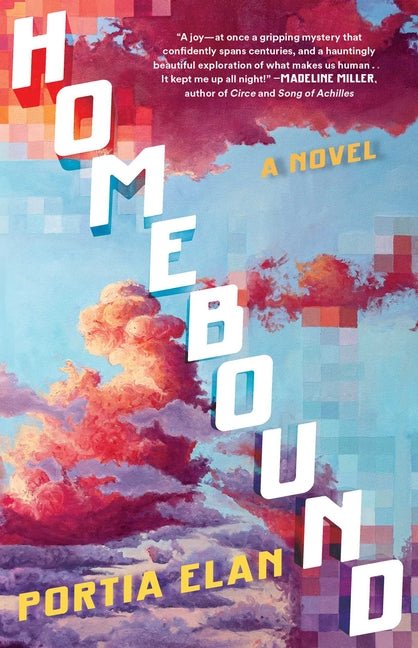
A NATIONAL BESTSELLER - A GOOD MORNING AMERICA BOOK CLUB PICK - In a dazzling ode to human inventiveness and desire for meaning, four lives are entangled across time by one unfinished story, saved to a floppy disk in the 1980s and destined to ripple across the centuries.
"A joy...and a hauntingly beautiful exploration of what makes us human. It kept me up all night!" --MADELINE MILLER, #1 New York Times bestselling author of The Song of Achilles
"A big, bold, ecstatic world--full of heart and wonder." --RUTH OZEKI, New York Times bestselling author of A Tale for the Time Being
1983. Becks is nineteen, blasting her Walkman, and hiding from the fact that her beloved uncle, and the only person who understood her, is dead. Luckily, he left her a half-finished video game to complete--one last collaboration to find her way out of loneliness.
2078. Dr. Portman is working at the intersection of artificial intelligence and robotics, wrestling with her responsibility to Earth's precarious future. But increasingly, it seems the results of her work may transcend everything she believed to be possible...
2586. After decades of life on the sea, Yesiko knows a scavenger's work is rife with moral compromise. Yet when a long-lost piece of technology walks aboard her ship, she is set on a path toward a sacrifice even she may be unwilling to make.
Linking these women across the centuries is a chain reaction of love, longing, and creativity that reveals our deep interconnectedness. Clear-eyed and hopeful, Homebound imagines how future generations will find meaning in the things we leave behind.
Share
Book Details
- ISBN
- 9781668201732
- Binding
- Hardcover
- Authors
- Portia Elan
- Publisher
- Scribner Book Company
- Published Date
- May 5, 2026
- Language
- English
- Pages
- 304
- Physical Info
- 1.27 in H x 9.07 in L x 5.92 in W (1.19 lb)

A genre-blending of three main storylines: 80s retro, near future somewhat-dystopian speculative fiction, and far future seafaring sci-fi, all flavored with Jewish culture. This recipe worked really well for me and kept me interested through this entire story.Main themes to my mind were about finding identity and belonging. Learning to move beyond loss, and finding what comes next. And finally storytelling itself, creation and imagination.My only gripe of the audiobook has specifically to do with the narration, and the mispronunciation of retro-80s computer jargon. Words like BASIC and Commodore PET were spoken as initializations instead of the acronyms that they are. Sorry. It’s tiny, but I had to say it.Overall I really enjoyed this book and will most likely purchase it again—in hardcover this time—in anticipation of a re-read down the road. My personal measure for a 5-star rating
This is one of those books you’ll need to have a good, long think over. Homebound is at once nostalgic and futuristic, an interweaving of strangers’ stories many years apart, tied together by a single thread of love. Becks’ story was my favorite, probably since she’s closest to my age and because she’s trying to find ways to keep her uncle’s memory alive. Like Becks, I see him everywhere, and it heals just as much as it hurts. Her story serves as a semi-catalyst for Yesiko’s and Root’s, Chaya’s and Tamar’s and Shula’s and Tov’s, so many years down the line. The game Homebound connects them all, and it connects the reader to each story. (It also made me oddly nostalgic for middle school technology class, on the days we got to play Zork all period. I forgot about that.)Elan is an author to pick up if you want to feel.
If you look back on the early text-driven computer games of the 80s with fond nostalgia, you’ll probably enjoy this book. Full disclosure: I do not, in fact, look back on the early text-driven computer games of the 80s with fond nostalgia. I was never that particular brand of nerd.That’s not to say that I didn’t enjoy the book, but I do think it loses something without that emotional hook. Containing themes of grief, belonging, self-discovery, and hope, it is in many ways a beautiful story.But it also consists of at least four non-linear interrelated plot lines that the story rotates through, and while I found this intriguing I also feel as though the author left far too much up to the reader to parse out. There’s a great deal that is never made clear here, and in fact I think there’s a good chance that casual readers will become frustrated with trying to figure out the point of it all. Given the title of the book I don’t think I’m spoiling anything when I say that it’s clearly the game that connects the various storylines, but how it does so is very subtle.This may be deliberate, but it makes the narrative feel scattered and disjointed, and in my opinion, it detracts from the book overall because it’s distracting. While I’ll be the first to admit that I enjoy an intellectual book, I want it to be more than an intellectual exercise. If Homebound was deliberately written to require that much thought to untangle, it leaves little room for the simple enjoyment of reading.The book put me very much in mind of games such as The Talos Principle, a philosophical game where the player is required to solve complex puzzles and every choice has consequences. It’s a fun game in small doses, but I wouldn’t want to read it in novel form.Once you figure out exactly how everything is connected – if you do – the book does make more sense, but there’s still a great deal that is never explained. And while it finishes on a hopeful note the reader is left with many questions when the story ends.It’s an unusual concept for a book, and each of the individual storylines were actually quite good. I would have liked to have read more about each of them, and my main complaint with the book actually lies in the fact that every one of them felt incomplete and surface level, as though there was so much more potential for all of them that the reader was missing out on.In short, Homebound is definitely a mood read, but if you’re in the right mood it’s an engaging one.I received an ARC of Homebound from the publisher via NetGalley and am leaving a voluntary review.
There are a lot of different parts to this story because really it’s multiple stories told throughout different points in time. This book is about stories and how we find our home and our purpose within them. In the first hundred or so pages, all of the stories felt somewhat jumbled & my mind kept trying and failing to find ways to put pieces of each of the stories together. Once I was able to settle into the writing style and the time jumps between different storylines, my attention was able to be held a bit more firmly and I was able to find some comfort in each of the narratives. This isn’t a high stakes, action packed thriller. It isn’t a linear narrative either. It is unlike anything I’ve read before. This is a story about stories and finding pieces of ourself within them, and by the end, I was able to do exactly that.
It’s hard to describe this book because it’s so unlike much else I’ve read. It’s told through multiple timelines and mixed media, and doesn’t have a linear plot so much as character development. The character development is the plot, basically. It’s a very quiet, intimate book, and one that will stay with me for a long time.The writing is understated and beautiful, with a lot of lines that hit like a punch to the gut. The very last paragraph PROBABLY would have made me cry if I weren’t in public.Also, I liked the robot? Unusual for me. I don’t normally like robots. The scifi worldbuilding was pretty light, very accessible and drip fed throughout the narrative.It’s the exact book I needed to read right now, with the world in crisis. This isn’t a “plot to save the world” book. It’s about people carving out a life for themselves anyway, because the most important things—stories, people, memories—will always be there as long as we are. It’s a book about how we love something we’re losing, or that we’ve already lost. It depicts a future world that’s not the greatest, but manages to feel hopeful nonetheless. Because of that, I think this book really earns its comparison to Station Eleven, and I DO NOT say that lightly.Highly recommend.
)