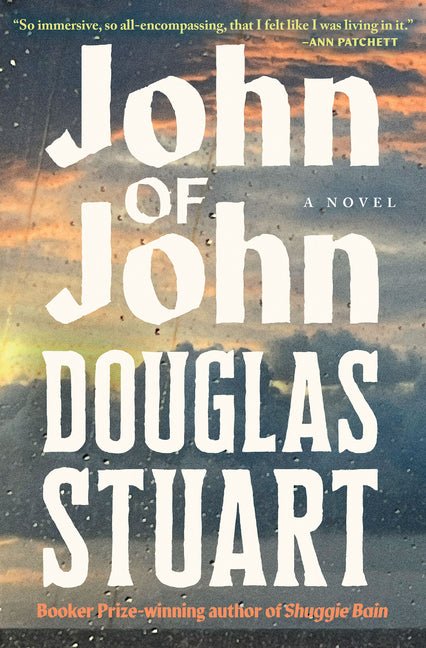
John of John (Oprah's Book Club)
Couldn't load pickup availability
NAMED A MOST ANTICIPATED BOOK OF 2026 BY THE NEW YORK TIMES, WASHINGTON POST, LOS ANGELES TIMES, TIME, OPRAH DAILY, AND VOGUE
"So immersive, so all-encompassing, that I felt like I was living in it."--Ann Patchett
From the Booker Prize-winning and New York Times bestselling author of Shuggie Bain and Young Mungo comes a vivid, moving novel following a young man returning to his Hebridean island home, a portrait of a father's expectations and a son's desires
Out of money and with little to show for his art school education, John-Calum Macleod takes the ferry back home to the Isle of Harris in the Outer Hebrides to find that little has changed except for him. He returns to the windswept croft and the two pillars of his childhood: his father John, a sheep farmer, tweed weaver, and lay preacher in the local Presbyterian church, and his maternal grandmother Ella, a profanity-loving Glaswegian whose steady warmth helped Cal weather the sudden departure of his mother.
Cal privately wonders if any lonely men might be found on the barren hillsides of home, while John is dismayed by his son's long hair, strange clothes, and seeming unwillingness to be Saved. But Cal isn't the only one in the croft house who is keeping secrets. As lambing season turns to shearing season, the threads holding together the community together become increasingly frayed, and nothing will remain as it was before.
John of John is a singular novel about duty, passion, and the transformative power of the truth. It is a magnificent literary work that cements Douglas Stuart's reputation as one of our greatest novelists working today.
Share
Book Details
- ISBN
- 9780802167194
- Binding
- Hardcover
- Authors
- Douglas Stuart
- Publisher
- Grove Press
- Published Date
- May 5, 2026
- Language
- English
- Pages
- 416
- Physical Info
- 1.8 in H x 9.4 in L x 6.4 in W (1.25 lb)

Wow! I am just back from Falabay, a small crofting community in the Outer Hebrides. It was the 1990s. I was staying with John, his son John-Calum (Cal), and his mother-in-law, Ella.That’s how it feels reading John of John, by Douglas Stuart, like you are actually there. Stuart’s writing renders the place and the people so real that you can feel the wind and the damp and love the characters as if you actually knew them.There is so much here. John of John is about family and love, but it’s also about how place, poverty, religion, and isolation shape people and their relationships. There is a constant pressure to keep up appearances, even as everything underneath threatens to break through. Even the landscape seems part of it. The wind, rain, and sea are constantly eroding the land, while time and change are slowly eroding an old way of life. There is so much to talk about that this would make a great book club book.John of John reminded me of Ann Patchett’s Whistler, although it’s grittier, because the story moves through the characters and their relationships rather than through plot. I would call it quietly propulsive. There is a sense of inevitability, of change coming whether these characters are ready for it or not. If you’re the type of reader who likes a fast-moving plot, this is probably not the book for you.If you love gorgeous writing, though, John of John delivers. There are lines like these: “Innes was never pushy, but he had the quiet determination of water – he could flow around a thing, coming at it gently, insistently, until he got his way.” And: “Without the mortar of women, the men came apart.” I could have highlighted the entire book.I couldn’t put it down. Five stars.
I have not one criticism of this wonderful book.The characters, the story, the descriptions and the ending were perfect.
I enjoyed this book immensely. The writing is carefully crafted and a pleasure to read. And the ending is perfect.
“John of John” is a beautifully-woven novel, with a writing style that is evocative and descriptive of time and place, rich with the colors, textures, and flaws of the characters and the locale, much like the weaving of the woolen fabric that is central to their employment and continued survival. The book portrays the lives of a small, tightly-knit and deeply religious Scottish community and the scandalous secrets held by many of the “righteous” families. The novel is set in the small village of Falabay, on a desolate island off the coast of Scotland. The inhabitants are often as hard and unyielding as the terrain they live on, but also colorful and warm and loving in doses, though small and infrequent as the amount of sunshine they get on their rainy, wind-swept land.John and his son, John-Calum (Cal) have a contentious relationship, made worse by Cal’s reluctant return home after graduating from art school on mainland Scotland, unemployed and rebellious. John’s anger and harsh treatment of Cal are exacerbated by John’s wife, Grace, who left him to go live with John’s brother and start a new life and family. Little do both John and Cal realize they are more alike than not and they share the same secret: they are both gay and both deeply closeted and deep in denial. Despite the serious subject matter, there are many heartwarming and humorous moments, most provided by Cal’s quirky maternal grandmother, Ella; and Isla, the daughter of a neighboring fisherman whom everyone expects Cal to marry, but he is unwilling to and can’t reveal why.While I enjoyed the novel, and gladly give it a high rating and recommendation, some of the family dynamics come across too much like “My Big Fat Scottish Wedding” and are forced by inexplicable and inconsistent behavior. John goes from tender and caring to cruel and violent with little to no provocation. Cal doesn’t want to be stuck on a tiny island with a dwindling population and no job prospects but does nothing to improve his situation despite a university degree and what appears to be exceptional talents as both a weaver and a fashion designer. Yes, like many 20-somethings, Cal spends much of his time pursuing alcohol, drugs, and sex, but at times it’s hard to empathize with a character who is his own worst-enemy.My main criticism of the novel, though, is the story-driver itself: John’s and Cal’s hidden homosexuality that leads to years of personal suffering and the infliction of emotional, and in one case, physical devastation, to those closest to them. This has become a frustrating trope, that of gay men living repressed, unhappy lives while marrying women to meet conventional expectations and family pressures. However, their hidden desires ultimately wreck the lives of their wives, children, and their secret male lovers, who are used to cover their homosexuality. This storyline has been used quite a bit lately in other recent bestsellers, and I found it frustrating to see it here as well. Both “Buckeye” and “Whistler” employ the same plot devices. In all three of these novels the main male protagonists’ whole personality and actions are based on having a respectable face they present to the world and a clandestine second gay life that has unintended but bitter consequences. In John’s situation it’s more understandable because of his strict faith’s condemnation and shunning of homosexuals, but personally as a gay man myself, it’s bothersome to see this portrayal played out again.The novel’s resolution felt a bit rushed with the sudden change of heart of both John and Cal to suddenly defy their convictions of self-abnegation, which seemed inconsistent with everything that came before. A somewhat hopeful but somewhat ambiguous ending gives both John and Cal their chance for love and a life they’ve always wanted but religious severity and potential social ostracization have previously denied them. Like life on the island itself, “John of John” is a well-told story of finding one’s place at home along with a yearning for more beyond the horizon.

John was a powerful character and was hard on Cal his son from time to time because of the unpredictable nature of life here. All of the supporting characters were three dimensional as the POV was Omnicom. Some of the dialogue was hard to understand at times, but over all this was an interesting read.
)
)