

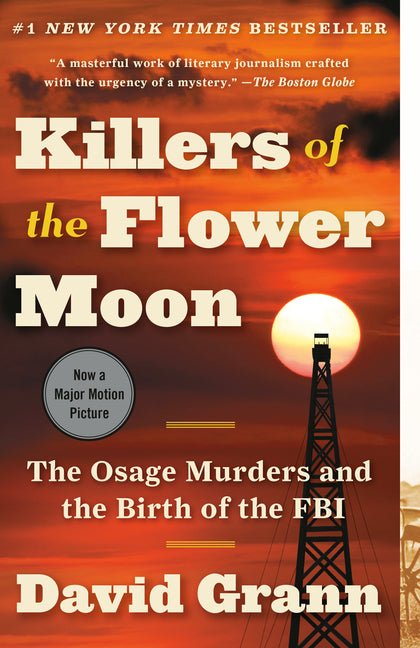
American history is loaded with episodes of shame. A large percentage of our less memorable moments, as a nation, have been swept under the rug, kept out of classrooms, and largely forgotten as time progresses. But these events are real and all it takes is a skilled author to bring the lost history back to life. Such is the case with Killers of the Flower Moon.I did not know anything about these murders against the Osage until I read this book, so this was a definite eye- opener for me. I had heard of the Osage tribe, yes, but I did not know they fell into tremendous oil wealth and, subsequently, saw their members slowly dying off, either through gunfire or poisoning, as greedy individuals tried to get their hands on some easy cash. The book details several of the known killings and the cold, callous, calculated murders are chilling and puzzling. Chilling, because of the gruesomeness of the murders; puzzling, because of the nonchalant behavior of those who plotted the killings. Even when confronted with the murders, most of the guilty individuals seem to have no remorse at all. They don’t even perceive what they did as immoral in any way.This book reads like a mystery thriller, however it isn’t a page- turner, like some mystery genre books. You do start to make guesses as to who is responsible, but rather than get wound up in the who- done- it, the book grips you more for its educational aspects. You learn all sorts of things about the Oklahoma region that the Osage called home. You learn about the newly formed FBI and its role in solving the mystery. You learn about the problems of racism and the feelings of superiority that people felt against Indians. And you learn just how evil people can be when vast amounts of wealth are at stake.There are several surprises in this book, and one is the book’s final section. The book leads you to believe that the mystery has been solved and it sounds like everything is coming to a close. Then suddenly, the book continues for dozens more pages as the author tries to solve more of the mystery on his own, with the aid of local Osage tribe members. No one will ever know exactly how many people were killed during this reign of terror but I like how the author took it on himself to investigate and try to answer more questions.This book is another solid, educational wakeup call on the prevalence of racism and superiority that pervaded society in the past and is rearing its ugly head once again today. I like how the book includes pictures so that you can get to know the many characters involved. With so many names and so many people involved, it’s easy to lose track of who is who. The pictures help you put a face with the name. But the most important part of this book is its educational value. It’s another sad, shameful episode from America’s past and one that we all need to know about and, hopefully, learn from.

The tragic history of the Osage murders reveals a deeply disturbing chapter of systematic oppression and calculated violence driven by unchecked greed. The descendants of those who suffered should receive comprehensive reparations, and the government must acknowledge and address this historical injustice. Our collective moral responsibility demands recognition of these heinous acts and meaningful steps toward reconciliation.Greed, greed, greed! Shame on us!
I never saw the film “Killers of the Flower Moon” - I worried that it would be too painful to watch. However the horrible pain caused by fellow Americans (White mostly) still resonates in these pages. David Grann is a formidable researcher and writer who documents decades of crime caused by envy and the desire for the riches of others they deemed unworthy.It caused me to wonder “has the world always been this brutal?” It think perhaps it has. Today is no less so with the slaughter of all thousands all over Palestine, the Ukraine, Africa, and still, in the USA.Weaving his tale, Grann writes about the flawed beginning of the FBI and the good its agents were able to do after years of seeking justice for Osage families. Glimpses of J. Edgar Hoover illustrate his primary goals for the new federal organization and the means to his ends. Fascinating reading. Filled with photos of the people from all walks of life, enhance the facts and stories.The most remarkable web of conspiracy and crime against one group of people was so complex and deep that it has never been completely solved, even by the author who added so much to the history of the Osage.
Excellent historical facts, well researched and written. Everyone should read this book to fully understand the depth of what evil people will go to gain power, money-and influence.
Sad how the Native Americans were treated.
Great book to add to your collection.
One of the best books I have ever read. It tells the story how we stole the oil fields and money from the Osage.
This book is actually made up of two completely separate stories. The first story is a careful analysis of the murders of hundreds of members of the Osage tribe from around 1905-1926. This is the more interesting portion and the biggest portion of the book. It is told in a more or less chronological manner and is quite powerful in its review of how and why these murders occurred.The second story details the actual writing of the book, in terms of the people who furnished the information as well as how difficult it was to obtain the full story.David Grann is quite a good writer, but overall this falls short of the Wager, which was the first of his books that I read and reviewed. In places, it gets bogged down in detail and repetitiveness.
Killers of the Flower Moon is an interesting chronicle of the early 20th century killings of oil-wealthy Osage Indians in northern Oklahoma. The case was instrumental in the rise of J.Edgar Hoover and the FBI, and the book was the basis for the movie of the same name starring Leonardo DiCaprio. Good reading for its depiction of life, law enforcement, systemic corruption and the treatment of Indians in the Southwest of the early 20th century. I now want to see the movie to see how the story was adapted for the theater.
The book starts well enough, going through the story of suspicious deaths that occurred during the Reign of Terror. The story stagnated about halfway through. Overall, an ok read
David Grann, “Killers of the Flower Moon: The Osage Murders and the Birth of the FBI” One of the dark chapters of American history. During the first third of the twentieth century an large number, perhaps hundreds, of Osage members were murdered by whites in Oklahoma in successful attempts to steal the Osage oil wealth. State and local law enforcement agents were usually complicit in the scheme and often destroyed or disordered evidence of these crimes. In the 1920s the gestating FBI intervened and uprooted one branch of the criminal enterprise, imprisoned some of the guilty, figured their work was done, and moved on. Subsequent research indicates that many of the crimes remained (and likely to this day remain) undetected. Many of the criminals got away with murder and theft. There are many parts to the horror:• The US government treated the Osage as essentially children in need of white court appointed guardians.• Racism and bigotry were endemic in the US. The better Oklahoma whites viewed the murder of an Osage as equivalent to cruelty to animals. Other Oklahoma whites saw such murders as no crime at all.• Oklahoma was the wild west with the rich, the criminals, and the legal establishment supporting each other.The prose is journalistic. As a book it is unremarkable; as history it is, alas, true and important.
I saw the movie, but the book “Killers of the Flower Moon” is different in a good way. The book is more about the criminal violence against the Osage tribe and how the FBI investigated and arrested some of those responsible and who were eventually found guilty by the courts.The FBI’s role in the Osage investigation reminded me of the 1987 movie “The Untouchables”. There are similarities with how the FBI dealt with the Chicago mobsters and those responsible for killing the Osage. The lead FBI agent-in-charge of the Osage investigation, Tom White, reminded me of Eliot Ness, i.e. his professionalism and integrity.The fact that the FBI, in the early 1920’s, interceded and succeeded in stopping the killing of the Osage is somewhat surprising to me. Hate, intolerance, jealousy, and racism were more the norm than the exception against the Osage.The “Killers of the Flower Moon” is an excellent example of investigative journalism. The tremendous amount of archived research that the author undertook to write this book is astounding and impressive. I am in total awe of the author David Grann.Unlike the movie, the book (author) does point out that the Osage killing was for a longer period, more Osage were killed, more Osage wealth was stolen, and more people were involved in the systematic killing of the Osage for their wealth. It was like reading the 1970 book “Bury My Heart at Wounded Knee” - which was a gut punch to me that so many native Americans were killed without remorse.
I ordered this book when I saw a deal on Amazon, plus I knew it had been made into a movie, though I had not seen it yet. The thing that intrigued me was not only the subject matter, but the location. My grandmother was born in Hominy, Oklahoma in 1898. She moved north while a teenager (around 1914) and settled in central Oregon, where she married. She did not live in Hominy during the reign of terror noted in this book. But I always found it fascinating that she was born on a reservation and yet, there is no Native blood in my veins. I remember her telling me that her family moved north in a covered wagon. Not everyone had cars in those days. She also told me that sometimes she would be teased and called a squaw. That's very interesting since I don't have Osage or Cherokee blood or a tribal affiliation of any kind. Since my grandmother died in 1996 at the ripe old age of 98 1/2 I will never know as my father also died in 2011. He knew precious little information when I asked him in the late 1990s about his mother's Hominy upbringing.That said, I found myself saddened when reading about what the people went through and how they were exploited and killed for their head rights. This place where my grandmother called home for most of her childhood was not a safe place for the Osage. I also find it interesting that the family moved away in the middle of the boom. But I will never know why. I do know they could not have been wealthy if they did not own a car. At any rate, I enjoyed reading this book. It sort of read like a novel and at the same time it reads like a non-fiction fact-based book drawn from trials, newspaper clippings and manuscripts. I did find it quite illuminating how deep the corruption went in those days and how rare it was to find an honest white person among the native people. Most were unscrupulous, it seemed, at least those related to murdered Osage tribal members with head rights. Prior to the murders they were a happy people despite being moved to a reservation and nearly starved to death by our government.I would recommend this book to anyone who is interested in history. It will be especially enjoyed by amateur sleuths who want to find out more about the origin of the FBI and how the Osage Murders created the need for a national investigative agency that is still in operation today. The history of this country is littered with many stories like this. I am glad someone took the time to carefully research documents that are the basis for this book.
This is an excellent true crime book. I would not place it in the same league as the best true crime books (The Onion Field, In Cold Blood, Sidney Kirkpatrick’s wonderful A Cast of Killers, e.g.) but it is very good. The problem is that true crime entails historical restraints. The key lesson (mini-SPOILER) of Killers of the Flower Moon is that there were a multiplicity of killers; the omnipresent examples of human cruelty and greed result in a judgment of human nature itself, one far more extreme than expected. The problem is that the actual narrative is compromised in the process. We think we know who did it; then we find out that someone else did it as well and someone else and someone else. The narrative becomes complicated and extended, the cast of characters grows; everything becomes a little confusing and the tidy outline of the Aristotelian plot is lost. Bottom line: the book is a little too difficult to follow and it becomes difficult to keep the characters straight.The subtitle suggests that the ‘birth of the FBI’ will be a key part of the story. It is, but only in the sense that one Bureau agent in particular is a key element in the investigation. The material on J. Edgar and his personality is common knowledge and ultimately the birth of the Bureau is tangential to the story of the Osage murders.The story of the black gold and how it is finally replaced by the windmills of an Italian energy company is, in some ways, more interesting. The horrific treatment of the Osage is well-known; what is not so well-known is its extent. In other words, the psychological/moral elements of the story are ultimately more interesting than the investigative ones.My bottom line: the story was chilling and moving but not riveting. Given the breadth of its readership and the resources invested in the film, I expected more. The book is essentially an examination of the depths of the darkness within the human soul; the murder investigations are less interesting.Four stars.
David Grann's "Killers of the Flower Moon" is an enthralling masterpiece that masterfully combines true crime and history to uncover a chilling and deeply disturbing chapter of American history. This impeccably researched and gripping narrative shines a light on a forgotten era and exposes a shocking conspiracy that will leave readers spellbound.Set in the early 20th century, the book revolves around the Osage Indian Nation, a prosperous tribe whose lands were discovered to be rich in oil. This sudden wealth attracted greed and ultimately led to a series of brutal murders targeting the Osage people. As the body count rises, the fledgling FBI, under the leadership of J. Edgar Hoover, is called in to investigate the mysterious and heinous crimes.Grann's meticulous attention to detail is evident throughout the book. He weaves together a tapestry of historical records, personal testimonies, and investigative journalism, seamlessly merging past and present to reconstruct the events of that dark period. His prose is both eloquent and accessible, making even the most complex aspects of the story easily digestible.One of the book's greatest strengths lies in its exploration of the characters involved. Grann presents a cast of individuals whose lives are intricately connected, showcasing the stark contrast between the oppressed Osage and the ruthless killers driven by greed and power. The author skillfully captures the fear and paranoia that consumed the Osage community as they grappled with an unknown enemy within their midst.The narrative unfolds like a meticulously constructed puzzle, with each revelation more shocking than the last. Grann's ability to maintain a sense of suspense and tension throughout the book is truly commendable. From the chilling accounts of the crimes to the intricate web of corruption and cover-ups, every page brims with intrigue and a sense of urgency.Moreover, "Killers of the Flower Moon" serves as a poignant commentary on the systemic racism and prejudice that plagued America during this time. The author deftly exposes the deep-rooted injustices and the devaluation of Native American lives that allowed the perpetrators to act with impunity. It serves as a reminder of the ongoing struggles faced by marginalized communities and the importance of seeking justice, no matter how long ago the crimes were committed.In conclusion, "Killers of the Flower Moon" is a tour de force that seamlessly combines true crime, historical investigation, and social commentary. David Grann's vivid storytelling and impeccable research make this book an absolute must-read for fans of true crime, history enthusiasts, and anyone interested in exploring the darker corners of America's past. Prepare to be captivated, outraged, and ultimately enlightened by this chilling and poignant tale of injustice and betrayal.
I buddy read this with my friend Ashley. When I first picked this up, I had no idea what it was about. My grandma said it was one of her "favorites", what I think she meant to say was it was one of the most powerful and heart wrenching reads. I picked it up thinking that I would learn more about the FBI. I've been watching Mind Hunter and reading about serial killers. This book is not about those things.Killers of the Flower Moon is a historic look at the Osage Murders that took place in Osage county, Oklahoma, during 1921-1926. But in reality the "Reign of Terror" lasted a lot longer and had more deceit and cover ups that I have ever heard of. Without proper evidence, we can not be sure if the "Reign of Terror" didn't start in 1918 and end in 1931. What the story does prove is that a lot of Native Americans, and when I say a lot, I mean in the hundreds, died at the hands of white men and women who coveted their headrights and wanted the black gold money for themselves. I spoke with my husband during the duration of this read and can not fathom the utter evil that some people are capable of. From a person that has never been greedy or gluttonous of others possessions its insane to me to murder someone to obtain their wealth. The fact that the Native Americans were considered "cruelty to animals" instead of murder is crazy talk! I was literally angry the entire time I read this.When I spoke to my grandma about this book ( she had asked me how I was "liking" it so far), I told her I was enraged. She said that she took a Native Americans course in college and after taking that class and reading this book she was embarrassed to be white. My grandmother's family came to the United States when Prussia was still a state of Germany. They crossed the midwest and settled in Southern California. My grandma was born in 1944, after this horrific time period. However, I have heard from her that my Great Grandpa was just as prejudiced against men "of color" as the next white man. He run my Grandpa off his property when my Grandpa asked for my Grandma's hand in marriage. My Grandpa is Hawaiian and Filipino.I can't believe the government, police, lawyers, judges, bankers, doctors, undertakers...everyone was in on this scheme to take from the Indians as much as they could. No one cared because Native Americans were less than. 100 year later in 2020 we are still having to fight for the rights of the underprivileged. It makes me sick to my stomach that as a nation we will never learn. We didn't learn about the massacres of the Black people or the Native Americans in school. All we learned is that Slavery existed and the Trail of Tears was terrible for the Indians. Why do our school cover up the truth of the past? Why even at 40 years old, do I not know more that happened in the country that I live in?I recommend this book because its a story that needs to be read, but be warned it is not a fun story to read. I did not get any joy out of reading this. I applaud David Grann for taking the time to research all of this and talk to the relatives of those slain during this time period. It was a lot of research with not that much gained. Most of the Native Americans murdered during this time frame were not recorded and no justice came of it. In Osage county the families of the fallen still grieve. There is no closure. And the government continues to bleed them dry.
This is a terrific read. Very compelling and thoroughly, exhaustively researched. David Grann does a truly masterful and heartfelt job of relaying this heartbreaking tale of murder, betrayal, and deceit. Grann has a unique and captivating way of telling this wrenching story of the Reign Of Terror on the Osage Indians to murder them and steal their 'headrights' on the massive mineral deposits (oil and gas) on their federal lands given them by the US government, finally in 1877. This came only after all the white immigrants and settlers had killed thousands of them, starved them, by disease, pushed them off, outright stole the bulk of all their other beautiful, lush, and rich lands, originally in what is now Kansas, Nebraska, and Arkansas, where their ancestors had lived for hundreds and hundreds of years. The US government broke one treaty after another until they were eventually moved to a portion of what is now Oklahoma."Osage: (Ni-u-kon-ska), "People of the Middle Waters", is a Midwestern Native American tribe of the Great Plains. The tribe developed in the Ohio and Mississippi river valleys around 700 BC along with other groups of its language family. They migrated west after the 17th century, settling near the confluence of the Missouri and Mississippi rivers, as a result of Iroquois invading the Ohio Valley in a search for new hunting grounds." - WikiThere were many more than the 24 innocent Osage murdered during the "Reign Of Terror" after oil was discovered on their Osage Reservation in 1906. Grann in his scrupulous research and interviews eventually discovers over 650 suspicious deaths, predominantly Osage tribal members, but also anyone white who attempted to help them or knew too much about the murderous gang of conspirators. Even after rich cattleman and Osage 'guardian', William K. Hale, his two nephews, Ernest, and Byron (aka Bryan) Burkhart, and their heinous fellow henchmen were finally proven guilty and locked up in Leavenworth from June 1926- June 1929, the murders and mysterious deaths went on, ignored, and uninvestigated by all local Oklahoma authorities. From sheriffs to mayors, judges, Representatives, Senators, governors, police, state and county officials, doctors, coroners, from the very rich and influential to the penniless down and outers, ruthless whites led and together participated in the entire travesty. The murders were carried out by various insidious means, be it shooting, blowing them up as they slept, beatings, countless chilling heartless methods, often by poison or morphine injections, and all by greedy whites time and time again. Their recurring method of marrying into the tribe was always only for one reason: to inherit their money. Unfortunately, it seems they never married for love. The betrayals are endless.I won't spoil it for you, but the disappointment over the lack of followthrough of the Oklahoma justice system left me disgusted. Let me know how you feel about Bryan Burkhart's marriage after you finish the book. It's a real shake your head, life can't get any stranger tale... or can it?It is my hope that one of my all-time favorite film directors, Martin Scorcese, and co-producer and exceptional actor, Leonardo DeCaprio, do justice to Mr. Grann's marvelous book in their upcoming film, but most of all I hope that they honor the Osage Nation, all their ancestors, and descendants that have suffered so deeply for generations of ominous, immeasurable, and callous cruelty.I find it both odious and telling that this story, the film based on Grann's book, the telling of mass murder and racial oppression, should come into the light on exactly the 100th anniversary of Tulsa, Oklahoma's Greenwood Massacre. The final injustice would be if these shameful and outrageous events in our American history continued to be removed from our history books. That would be a national sacrilege.One of my favorite lines from Killers Of Flower Moon is a quote of the Osage descendant and retired teacher, Mary Webb. At the end of her interview with the author, she said, "This land is saturated in blood." Then, she repeated a quote when God cried out to Abel after he killed Cain "The blood cries out from the ground."Good book, highly recommend.
A well researched, very well written (including organizationally) narrative history on a subject that has been given attention in the literature but remains relatively unknown by the general public. The murders of the oil rich Osage numbered over a couple dozen and for some brief period a mystery to Osage and authorities alike. I should say, federal authorities.While the murders were another reflection of the shameful treatment of the First Nation people in a historical context, in the instance the perpetrator was a local prominent white man living as a friend of the Indians in their midst. The book deals with how the murders were solved and involved a whole cast of characters including tribal members themselves, for several their lives well recounted.Were it not for the underlying disregard for their race and therefore worth as human beings, this story is very much the age old story about human greed. But thanks to the efforts of federal law enforcement as came to be embodied with the founding of the FBI, the perpetrators, largely Whites but not exclusively, were caught and prosecuted. It is how the author weaves together the story to solve the mystery and in the process ties in side stories about the Indian plight in America and how the Osage by virtually total accident came to reside in one of the richest oil reserves in the country and as a consequence became for a time, the richest Americans because of royalties from the mineral rights, that provides for compelling reading.A positive aspect of the writing is that while the author engages in a handful of side stories to add perspective, they are efficient and accretive to the story, not mini books in themselves that become tedious distractions to the story that characterize too many works of non-fiction. When the main story ended about three quarters through and the author embarked on an epilogue I began to fear his story discipline had broken down. But as it happened the author used the epilogue to tie together loose ends of the story post solving of the murders in the mid 1920s. Very satisfying.If the book has a shortcoming it regards the treatment of the rise of the FBI. It’s superficial at best and is limited to the role the Osage murders played in the evolution of the FBI as a national police investigative agency, the first in the country’s history. Whether that merits being included in the title is open to question.

