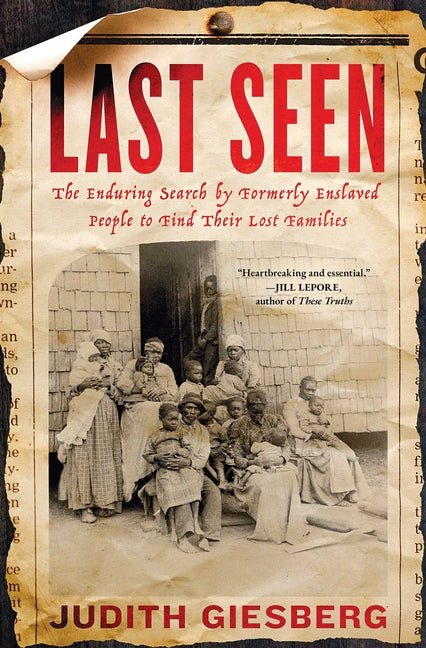

Last Seen: The Enduring Search by Formerly Enslaved People to Find Their Lost Families
 )
)
Couldn't load pickup availability
"[A] meticulously excavated tribute to the formerly enslaved mothers, fathers, siblings, and kin who published 'last seen' advertisements in search of loved ones stolen from them in bondage...a vital work of recovery." --Ilyon Woo, Pulitzer Prize-winning author of Master, Slave, Husband, Wife
Drawing from an archive of nearly five thousand letters and advertisements, the riveting, "heartbreaking, and essential" (Jill Lepore, author of These Truths) story of formerly enslaved people who spent years searching for family members stolen away during slavery.
Of all the many horrors of slavery, the cruelest was the separation of families in slave auctions. Spouses and siblings were sold away from one other. Young children were separated from their mothers. Fathers were sent down river and never saw their families again.
As soon as slavery ended in 1865, family members began to search for one another, in some cases persisting until as late as the 1920s. They took out "information wanted" advertisements in newspapers and sent letters to the editor. Pastors in churches across the country read these advertisements from the pulpit, expanding the search to those who had never learned to read or who did not have access to newspapers. These documents demonstrate that even as most white Americans--and even some younger Black Americans, too--wanted to put slavery in the past, many former slaves, members of the "Freedom Generation," continued for years, and even decades, to search for one another. These letters and advertisements are testaments to formerly enslaved people's enduring love for the families they lost in slavery, yet they spent many years buried in the storage of local historical societies or on microfilm reels that time forgot.
Judith Giesberg draws on the archive that she founded--containing almost five thousand letters and advertisements placed by members of the Freedom Generation--to compile these stories in a narrative form for the first time. Her in-depth research turned up additional information about the writers, their families, and their enslavers. With this critical context, she recounts the moving stories of the people who placed the advertisements, the loved ones they tried to find, and the outcome of their quests to reunite.
This story underscores the cruelest horror of slavery--the forced breakup of families--and the resilience and determination of the formerly enslaved. Thoughtful, heart-wrenching, and illuminating, Last Seen finally gives this lesser-known aspect of slavery the attention it deserves.
Book Details
- ISBN
- 9781982174323
- Binding
- Hardcover
- Authors
- Judith Giesberg
- Publisher
- Simon & Schuster
- Published Date
- February 4, 2025
- Language
- English
- Pages
- 336
- Physical Info
- 1.12 in H x 9.14 in L x 6.42 in W (1.08 lb)