

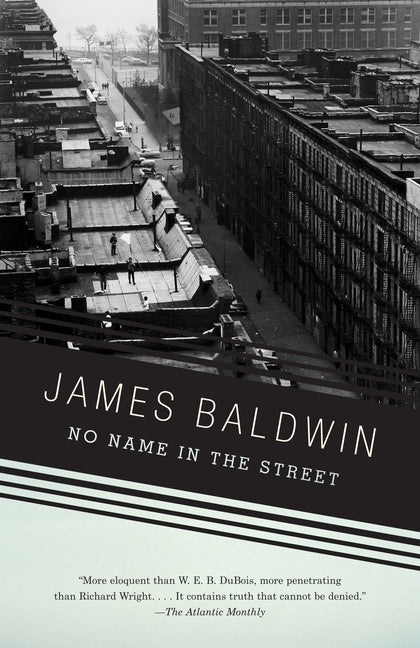
No Name in the Street
Couldn't load pickup availability
From one of the most important American writers of the twentieth century--an extraordinary history of the turbulent sixties and early seventies that powerfully speaks to contemporary conversations around racism.
"It contains truth that cannot be denied." --The Atlantic Monthly
In this stunningly personal document, James Baldwin remembers in vivid details the Harlem childhood that shaped his early consciousness and the later events that scored his heart with pain--the murders of Martin Luther King and Malcolm X, his sojourns in Europe and in Hollywood, and his return to the American South to confront a violent America face-to-face.
Share
Book Details
- ISBN
- 9780307275929
- Binding
- Paperback
- Authors
- James Baldwin
- Publisher
- Knopf Doubleday Publishing Group
- Published Date
- January 9, 2007
- Language
- English
- Pages
- 208
- Physical Info
- 0.56 in H x 8.02 in L x 5.28 in W (0.37 lb)
Part memoir, part essay, diving into the mind of James Baldwin has once again been a treat. What a mind he had! So much of what he said as a reflection of his time period speaks to the current nature of our society. What I wonder is if the prophecy of “sunset” he proposed at the end of his book will truly come to be.
I recommend this book to anyone who loves our country and despairs of it. Baldwin writes movingly and with grace and wit. Much of this book is true today; some predictions are on target, and some are not. He also refers to women rarely and seems not to know that men and women, Black and white, have different experiences. The idea of sexism doesn't exist for Balfwin. Despite this ommission, there is much beautifully expressed, painful truth in this book.
I've long been of the opinion that of all of James Baldwin's modes of writing, his non-fiction is my favorite, and that rule certainly isn't changed by No Name in the Street, a sprawling book-length essay (technically, two essays, but it feels very much like one idea separated into two sections) that covers the death of Malcolm X and Martin Luther King, Jr., Baldwin's dealings with Hollywood, the Black Panther movement, the Algerian war, and so much more. It's undeniably an angry, uncertain book, which makes sense; if you're writing about the state of race relations in the late 60s and early 70s, it would be shocking if your book wasn't devastated and fearful and feeling a bit hopeless and full of despair. That, combined with its length and somewhat loosely flowing structure, can make No Name in the Street challenging in different ways than other Baldwin works; it's emotionally tough to take at times, even as it's full of Baldwin's typically stunning prose, complex philosophy and thoughtfulness, trenchant insights, and nuanced perspective. But that difficulty is what makes No Name in the Street all the more essential to read - to read it is to see how one of the most brilliant minds that ever lived looked down the darkest times in history and tried to think about what would come next, and I spent so much of the book wondering what Baldwin would think of our modern era - what he would say about it, how he would see things, what insight he could offer about it all. No Name in the Street isn't a "beginner" Baldwin entry, and to read it is to plunge into a dark, dark time in our history; but to read it is also to expose yourself to one of the greatest minds in all of American history, one of the greatest writers who ever lived, and someone whose ideas have lost none of their relevance, punch, and truth in fifty years.
The highlights for me here were Baldwin's trip to the segregated South and his portrayal of Algerians in France. As always with Baldwin, his incredible honesty hits you right in the heart and the language is consistently compelling.Overall though this feels disjointed, not really focused, as if the author just needed a publication and wasn't sure what this book should be. Baldwin doesn't add any insights on Malcom X or Martin Luther King, besides telling us where he was when hearing about their deaths. The changing locales and lapses in time create loose ends that feel rushed and half-baked, to where the author's concluding "This book cannot be finished, not by me" feels a bit like a cop-out.More for Baldwin completists, which I am, but there is plenty by him to read before this.
WHAT A MASTERFUL WORK of NON-FICTION by SUCH AN OBSERVANT MASTER OF “WORDS & THOUGHTS_ KUDOS TO YOU Mr. JAMES BALDWIN FORSAYING ‘OUT-LOUD WHAT MANY OVER TIME KNEW & WERE AFRAID TO THINK LET ALONE UTTER IN SELECT COMPANY.

