

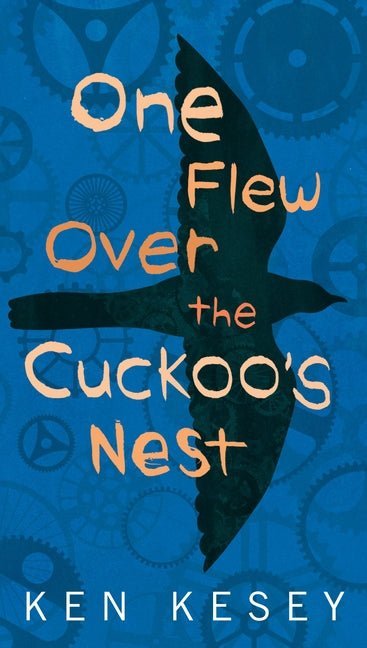
This particular book is small with an extremely small font. Not for the over 40 eye balls!

Gonna out myself by saying I can relate to this story on some pretty visceral levels, because I've been there.I don't know how this book would read for someone without at least some intimate, relatable life experiences. Probably wouldn't have the same punch.This book was about me, and everybody in world, in all our horrible, wonderful, destructive, glorious, perverse, and shattered existence.It's about getting big again, as Mack said. Taking a stand against the gears that grind you to dust til you don't know whether you're coming or going.It's brutal and brilliant in its honesty, takes you by the scruff of the neck and makes you take a long hard look in the mirror, if you want to or not.One of the best books I've read. Certainly one that will stay with me, rattling around in my brain for years, hoping I can find the strength to grow again.
Great book and I got a good deal on it. Ordered it from another website & they said it was out of stock.
I called my cousin—with her permission—“Nurse Ratched.” (She was my caregiver during recovery from the first 100 days of cancer). Neither of us have read this book, so I downloaded it to see what it’s all about. What a sad ending, but you can tell it’s coming. Worth reading.
The story is so amazing and I loved it start to finish but it can be a little hard to follow at times.
Ken Kesey is a fine storyteller, he knows how to spin a great yarn. He flèches out the characters so you can see them in full. I was surprised the story came from the perspective of Chief. As is usual, the novel was more vivid than the movie, being created within your mind’s eye. An enjoyable read, very entertaining.
The book just can’t do what Jack Nicholson can do. Actually the book is a bit depressing it lacks the humor of the movie.
What a magnetically charged story in One Flew Over the Cuckoo's Nest by Ken Kesey. Kesey writes a very dramatic and intriguing story with One Flew Over the Cuckoo's Nest. No wonder this is a classic title. Ken Kesey wrote so well, it is read for generations. Enter at your own risk, and you find yourself in the the middle of the ward. This ward has patients with many nicknames, depending on their mental health, such as vegetables, chronics, Acutes, and there are those who are in there voluntarily and others, like McMurphy, court-ordered. This book is one of those you don't want to put down. If you've haven't read this before, you should read it, and if you have, a long time ago, read it again. I have also watched the movie that stars Jack Nicholson, Danny DeVito, and other budding stars, and it is as intriguing as the book. The book tells more of its details, and you learn that the narrator, telling the story is Chief, who was always assumed to be deaf and dumb, but was a very large and intimidating man. However, he and McMurphy, the wards newest patient, who is determined to be crazy as to not go back to jail, but also to show he isn't crazy, but just loves to create chaos, as to get what he wants, and it is an added benefit that he gets under the skin of the Big Nurse, Nurse Ratched. From the patient's point of view, she is tyrannic and is set in her ways, and does not allow others to create chaos. If they do, they get sent to shock treatment, or are sedated. The story brings the reader on a superb journey. This is a magnificent story that kept this reader turning the pages. The is one book, where the movie is very close to what is written. I recommend reading the book, and then look for the movie, as it is still on DVD. This book is also one of those controversial books and sometimes banned because it's intimate look at mental health, and the era where shock treatment is a standard for treating mental health. I like that the book showed the various personalities of the patients, and even the staff, and how they are referred to, from the Chief's point of view. It's an amazing story, brining a spotlight on the treatment of those who are mentally ill, in one way or another. One Flew Over the Cuckoo's Nest is a definite recommendation by Amy's Bookshelf Reviews. I look forward to reading many more books by this author.
Although I’ve admired the movie for many, many years (it was one of the first “grown-up’ films I ever appreciated as a child), I had never made the time to read the novel on which it was based. Now that I’ve read it, I’m astounded by how accurately the film—in all its aspects—embodied the essence of Kesey’s novel.Randle Patrick McMurphy is a contemporary American tragic hero, doomed by his own lust for life (if one could consider that a tragic flaw). He is certainly the most memorable character in the novel, but I found myself wondering whether he or the Chief, who narrates the story, is the protagonist. In some ways, their relationship parallels Gatsby’s and Nick Carraway’s. However you choose to make meaning from this text, you will no doubt feel the sorrow, the futility, and the absurdity that permeates the tale.
The fog is usually a place of refuge for Bromden. He can’t see anyone and no one can see him, which makes the moments when he suddenly sees someone with enlivened clarity more startling. He is diagnosed as schizophrenic and has very vivid hallucinations of Nazi-style medical experimentation and green slime oozing out of the rooms where staff meetings take place. However, he has successfully fooled the orderlies, fellow inmates, and other medical personnel into believing that he is a deaf mute Indian who is left to just sweep the floor, earning him the nickname Chief Broom.However, that diagnosis only goes so far. His ability to observe and make reasoned and astute analyses of the patients and medical personnel on the ward indicate that he is quite perceptive. Any patient on the ward with the energy to resist or become uncontrollably violent is likely to be sent to the “Shock Shop,” the room where electroshock treatments are administered, resulting in a very passive patient, peaceful but also at least temporarily rid of his short term memory.Bromden also has a theory of the workings of the Combine, which he sees as the tool the medical people use to thresh, cut, and sort, which is what they’re doing with the patients. Most new patients on the ward would be considered Acutes. They can still communicate verbally with some degree of intelligibility, although if their disorder progresses they may become Chronic, which has happened to Bromden himself, although only as proof of how convincing his deaf act continues to be.Into this system of control appears Randall P. McMurphy, only there because he faked insanity to get out of his sentence for gambling and battery at a prison work farm. McMurphy is a loud grifter whose mission in life seems to be to puncture holes in any rigid system of authority he encounters. No one is a more rigid symbol of authority in this mental hospital than the head nurse, Miss Ratched. Her name sounds like “ratchet,” a tool for adjustment in Bromden’s Combine. Within a few minutes of being on the ward, McMurphy has started a card game and won a fair sum from the patients on the ward. He is a bundle of lively energy and even the most reticent patients, like Bromden, can’t help but respond. McMurphy wants to take a poll of how many of the patients want to see the World Series on TV in the afternoons. Bromden raises his hand and later worries if his cover is blown.McMurphy goes full speed ahead in his campaign to challenge Nurse Ratched’s authority until he learns from a fellow inmate who has been committed that the medical authorities—the head psychiatrist Dr. Spivey, but more likely Nurse Ratched—will determine when McMurphy can be released. He is shocked to discover that the majority of the Acutes on the ward—the articulate intellectual Harding, the stuttering young Billy Bibbit, and many of the others—have voluntarily committed themselves and can leave whenever they like as long as they follow the rules and don’t challenge authority. McMurphy puts the brakes on his rebellion after learning this but has already radicalized one inmate, Charlie Cheswick, into demanding access to his cigarettes whenever he wants. After McMurphy backs down from supporting Cheswick’s demand, Cheswick feels betrayed and drowns himself in the therapy pool.McMurphy has started a process he can’t reverse. As Bromden puts it:‘Nobody complains about all the fog. I know why, now; as bad as it is, you can slip back in it and feel safe. That’s what McMurphy can’t understand, us wanting to be safe. He keeps trying to drag us out of the fog, out into the open where we’d be easy to get at.’The McMurphy/Jesus symbolic parallels that Kesey sets in place can only smoothly align to an extent. McMurphy is crude, racist, sexist, and violent. He does energize the men on the ward, making them believe that they can take charge of their lives. By the conclusion of the novel, most of the Acutes on the ward have checked out of the ward, leaving a handful, including McMurphy, Bromden, and Billy Bibbit.Nurse Ratched has conducted therapy sessions for the patients on a schedule like every other planned activity on the ward. “Therapy” is hardly an apt description for what she carries out. She uses passive aggression to manipulate the patient to respond out of a sense of guilt. This approach has a very personal potency when applied to Billy Bibbit. Nurse Ratched is a close friend of Billy’s mother. She reminds him of this fact at every opportunity and uses it as a weapon of control. Billy’s extreme stutter probably originated from fear of his mother but Ratched, his surrogate “mother,” has kept it fresh, like an open wound.McMurphy has observed this and concluded that Billy, although over thirty, is undoubtedly still a virgin. He determines to rectify that situation. He arranges an after hours party with the night orderly Mr. Turkle in which liquor is brought in as well as a couple of young ladies, one of which, Candy, had been the ob...
From the eyes of a high school student, the novel One Flew Over the Cuckoo’s Nest, deserves a 3-star rating. I found that it was a difficult and disjointed read but it had many memorable moments and characters. The slow pace of the first half lost my interest but the second half picked up and was much more intriguing. I have no psychiatric background so the terminology such as lobotomy, electric shock therapy, electroencephalograph, etc… tended to be confusing. Along with medical phrases, I found many derogatory comments regarding minorities. For example, the men referred to women as either “ball-cutters” or “whores” with little in between. Although the time period may have been more lenient with those sorts of remarks, I believe it to be offensive and inappropriate to the targeted audience.Moving on to the structure of the novel, I was not a fan of the four large sections rather than chapters because it felt disorganized and prolonged. With the negative comments aside, I believe that Kesey did a satisfactory job developing the characters and providing vivid descriptions of the setting. Kesey conveys the importance of freedom against oppression with the relationship between Randal P. McMurphy and Nurse Ratched. His fiery passion and her icy demeanor created butting heads in the Ward. They both have their tactics of battle to keep the remaining patients on their side.Understanding the overwhelming life of an individual struggling with mental illness will give you a new perspective and appreciation for your life. I recommend this novel for adults or mature adolescents that can handle complex themes and language. If you are interested in mental illness or are looking for a complicated read, then this book is for you!
Ken Kesey’s “One Flew Over the Cuckoo’s Nest” was a fascinating book written from an interesting perspective. Kesey takes a unique approach to portraying omnipresent societal issues of the 1960s: he addresses marked issues including those of class struggles, race, and gender discrimination without an overt claim. He creates miniature conflict within the microcosm of the mental hospital between the characters. I found this approach quite fascinating; often books of such a nature, illustrating societal conflicts, turn out dreary and overly pedantic. However, Kesey’s sense of humor and ability to keep a plot flowing and unpredictable kept me on my toes, ready for the slightest rapid change in the interactions between the characters.However, as a reader, I did find it somewhat difficult to decipher the interactions between the characters at times. The narrator, Bromden, gives us insight into the deeper workings and politics of the characters as he pretends to be both deaf and dumb; the other characters do not mask their plots or inner thoughts in front of him, letting us understand the intricate plots within the microcosm. We are introduced to McMurphy, a boisterous, muckraking new patient who attempts to stir the ward into rebellion against the controlling Big Nurse. The shifting dynamic between the more important and powerful characters as observed by a relatively insignificant narrator through the course of the events in the ward is what keeps the reader eagerly anticipating every change. Do be ready to decipher obscure meanings in certain dialogue as well as somewhat outdated and raunchy humor. However, these make the book quite honest and relatable.
Ken Kesey's "One Flew Over the Cuckoo's Nest" was one of the most powerful books I have ever read. Although the story takes place mainly in a mental hospital, its ramifications can be felt in all of the broader society. The struggles depicted in the various characters, both internally and inter-personally, will give the reader pause and perhaps change your perception on life.The story at its core encompasses the struggle between the individual (portrayed by Randall McMurphy) and the establishment (Portrayed by nurse Ratched.) It is told through the eyes of the schizophrenic half-Indian known as Chief Bromden. Bromden has pretended to be deaf and dumb for so long that everyone takes this fact for granted. It also allows him to overhear comments from the staff that others would not. The Chief is an interesting choice as narrator, and at times it seemed like he was rambling on about nothing. Unreliable narrators can be a touchy thing, but Kesey is able to navigate his way through the Chief's mind, and in time we find his ramblings have a purpose. He views the establishment as a machine, which he refers to as "the combine." He speaks of fog machines, wires in the walls, and robotic people, and views them as part of the combine. Even the name of the nurse, Ratched, sounds almost like "ratchet," which is a common tool. The Chief sees the struggle between the Big Nurse, as he calls Ratched, and McMurphy, and even though he has a sense right away that McMurphy is different, Bromden doesn't hold out much hope. After all, the combine is a massive machine and the Chief knows what it did to him. Bromden tells McMurphy he "used to be big," but not any more. The Chief's mother, a white woman from town, along with the government, broke down both he and his father and became bigger than both of them put together.The antagonist is Ratched, an ex-army nurse who rules the ward with an iron fist. She preys on the weaknesses of the patients and attacks them in those areas. She is all about control and power, and over her long career has devised many ways of projecting this with a cold, machine-like efficiency. Ratched has hand picked her staff based on their cruelty and submissiveness. The Chief calls her "The Big Nurse," which reminds me of Orwell's Big Brother, and mentions early on that "The Big Nurse tends to get real put out if something keeps her outfit from running like a smooth, accurate, precision-made machine" (pg 24). Indeed the Chief sees her as a machine, part of the combine who's purpose is to make others small. Ratched represents the oppressive nature and de-humanization present in modern society.And then there is Randle McMurphy. Sent to the ward from a work farm (because it's "easier" time), McMurphy comes in loud and confident. His singing and laughter are something new for the patients so used to suppressing their emotions. And he is definitely not the kind of patient the mechanical and repressive Nurse Ratched wants. It only takes McMurphy one group session to see Ratched's method of exposing the patient's weakest areas and pecking them into submission. Harding, the subject of the group meetings earlier frenzy, explains that it was all therapeutic. McMurphy, however, gives Harding his perception: "what she is is a ball-cutter. I've seen a thousand of 'em...people who try to make you weak so they can get you to...live like they want you to. And the best way to do this...is to weaken you by gettin' you where it hurts the worst" (pg 56). So McMurphy, ever the gambling man, makes a bet with his fellow patients that he would be able to make Ratched lose her composure, and he accomplished this by using her own tactics against her. As he pulls Bromden and the others out of the "fog" and makes them big again, McMurphy unwittingly becomes the savior of his fellow patients. It did not go un-noticed that the electroshock table was cross-shaped with the patient restrained by the wrists and feet and a "crown" placed over his head. When McMurphy rips Nurse Ratched's tightly starched uniform and exposes her breasts, he is symbolically exposing her hypocrisy and breaking the power she had once wielded over the patients. Chief Bromden's final act of mercy cemented Nurse Ratched's fall as well as giving McMurphy the dignity that he had earned.Perhaps the largest piece of advice I pulled from this novel is to never let anyone or anything take your individuality. Society in general would like to have everyone fit into the same mold because then the people are easier to predict and control. However, we all need a McMurphy in our lives to show us that we can still be individuals and fit into society. And when The Combine tries to weaken you and make you conform, just throw your head back and laugh like McMurphy, "because he knows you have laugh at the things that hurt you just to keep yourself in balance, just to keep the world from running you plumb crazy" (pg 233).
This is an amazing book. I didn’t read this until I hit thirty; the reason for this being I thought less of it due to having seen the film. The film is not bad, but for me One Flew Over the Cuckoo’s nest was its film version, full stop. I eventually decided to read the book after learning about the interesting life its author Ken Kesey lived, including that he wrote much of this book while working at a mental hospital. One Flew Over the Cuckoo’s Nest deals with the relationship between freedom and power, and about how mental illness develops when the power of others dominates an individual to such a great extent that he/she can no longer act free. The individuals in the hospital are shown by Kesey to be lacking in courage and self-belief, and demonstrate an unwillingness to act without permission and approval. While the hospital should be making patients better it actually makes them worse by actively discouraging attempts to be assertive and by labelling any attempt to act free from the constraints of institutional power as symptomatic of a worsening of the underlying disorder. The book is told through the eyes of Chief Bowden: a part Indian man that has spent a long time in the hospital pretending to be deaf and mute. Through the subjective experiences of the Chief, Kesey presents the actual experiences of mental illness. Kesey in doing this dismisses the notion that mental illness is unreal but reveals how its treatment is sometimes abused to keep people in line. Chief Bowden experiences things through metaphorical hallucinations. For example, when speaking of the power held by the Big Nurse, he literally sees wires running from her office into the bodies of those that she controls. This conception of mental illness is similar to that found in R.D Laing’s book the Divided Self: the mentally ill person is someone that cannot face the pain of reality and retreats into their own realm, but reality still intrudes via metaphorical representations. Throughout the novel Chief Bowden focuses on the power struggle taking place between Randle McMurphy and the Big Nurse. McMurphy is not in hospital voluntarily but has committed an offence which landed him on a work farm. He is transferred to the mental hospital partly of his own design to escape drudgery. McMurphy immediately emerges as a threat to the Big Nurse due to his willingness to question process and act without fear. He is not scared of authority and does not censor himself when confronted with the subtle shaming techniques of the Big Nurse. The Big Nurse effectively runs the hospital. She is shown through the subjective eye of Chief Bowden to be solely concerned with maintaining her grip of power over the hospital. She is obsessed with process; she pretends to enforce process for the therapeutic value that the processes have on the patients, when in reality she loves the process because it is her process and provides her with a sense of security and power. The interactions between McMurphy and Big Nurse question the extent to which people can be free. Sartre once argued that individuals are totally free so that even if facing the death penalty we are free to defy the executioners by mentally not accepting their interpretation of events and the descriptions placed on them. McMurphy is a Sartrean hero as he does not allow the views of others and the subtle attempts to shun and devalue him dictate how he behaves. However, as the book plays out Kesey demonstrates that living in this manner may not lead to a life of pleasure or fame but may involve the free person being crushed by power structures and processes that do not appreciate the questioning of where power lies. I would argue that One Flew Over the Cuckoo’s nest offers a modern presentation of the story found in the New Testament. Like Christ, McMurphy questions the powers of his time: in this case psychiatry and bureaucratic process rather than the Jewish religious leaders. Like Christ he questioned the intentions of the powers that be and acted as a free human rather than someone embarrassed by their true nature. Moreover, like Christ, McMurphy suffers at the hands of an authority that pretends to be in place for the concern of the many when in reality it gives power to the few, and in suffering on the Cross gives the weak a lasting sense of freedom.See my other reviews at amateurreviewspace.blogspot.com
Don't know where to begin. I want to be able to articulate this brilliant book in big fancy words, but I can't. It's beyond my vocabulary. It's about the man against the system, and its written so eloquently, but the eloquence hides underneath the rough, the primitive, the every day stuff that doesn't hold much sophistication. And yet, it's poetry. At times entire passages in this book made me want to reread them again and again, they were so beautiful. Have you ever read a book that seemed to send a very important message and yet when you tried articulating it to someone, no sound came out, and all you could do is just feel? Feel this cocktail of emotions you couldn't explain? That's how I feel. The story itself is simple. Some guy gets committed into an asylum and tries to fight some nurse who has established a firm grip on her ward and isn't going to suddenly change things because of one stranger. It would be too simple to describe it like this. There are so many layers here, and yet all of them are portrayed so straightforward, they left me speechless. I think more than anything this book is about the poison of unhappiness and how it can infect everything around it, crushing life to death. The poison is the nurse, and one who tried to challenge her is Randle McMurphy. But I'm getting ahead of myself. Let me tell you what the story is about.The story is told by Chief "Bromden", a large man whom everyone thinks deaf and mute, whiling away his time as a committed patient in the nuthouse. Enter Randle McMurphy who pretends to be crazy to escape prison and lands himself in the same asylum. He is initially shocked at the atmosphere on the ward, the surgical cleanliness, the order, the lack of humanity in patients, who are afraid to even laugh out loud, all fisted in the firm grip of the head nurse. Randle takes it upon himself to challenge the order and bring life into the inhabitants, locking horns with the nurse, Ms. Ratched, except it's not her who is the enemy, it's the entire system of institutionalization. They engage in power struggle that gradually escalates to a heart breaking end. Along the lines, Randle manages to change the lives of those who have spent years and years thinking they couldn't toe the line chalked across the floor for them, except it comes at a price. I would say, this book accomplishes an astounding study into human psyche pigeonholed into a mechanical existence, processed and sorted and distributed like a thing, and various ways of escaping this oppression. There are, really, only a few, either to physically make a run for it, or to escape into madness, or, the most extreme solution, death, either by suicide or by succumbing to be crushed. I will be rereading this book, to pick up more layers, because I feel like I only scratched the surface and there is more, more to learn and to marvel at and to comprehend. Ken Kesey is a genius.
Everyone longs to be free and accepted for who they are. One Flew over the Cuckoo's Nest by Ken Kesey is an extraordinary novel that portrays this wonderfully. It all starts with a mental asylum; Chief, the narrator of the story, tells us about the atrocious nurse and the melancholy patients. Everyone just sits around all day, and follows the same schedule day by day until Randle McMurphy shows up. He would be considered the protagonist of the story. He doesn't have the same beliefs as the malicious, ancient nurse Ratched. He tries everything in his power, all day and every day to change her revolting rules. He does succeed some but you can only accomplish so much. She is the head of the asylum and he is just a measly patient. Who do you think would win? There are many themes in this novel. One of the main themes is freedom. It is what some of the patients long for and what others don't think they deserve. You will see the theme of freedom in this novel often. Another core theme would be rebellion. Rebellion is McMurphy's middle name, but in this novel that isn't bad. He is just trying to get everyone to be actual people again by showing them how to be normal. For example, he wants them to laugh, watch the World Series and play cards. Also, the ending was not my favorite, but I do believe it was an outstanding ending that shows us what our world has come to and what society can do to you. Other than that, I truly liked this book. You laughed sometimes, and wanted to cry sometimes, and occasionally you would want to yell at the nurse. Ken Kesey did a great job tugging at your emotions. I believe everyone should read this book. I believe this because it shows you how blessed you are to be free and it tells you to always be yourself; to stand you for what you believe in. Any book by Ken Kesey would be a winner. Furthermore, this book needs to be read and heard.
The seemingly oxymoronic title of my review, "A good bad book," is intentional. I can sum up this book quickly by saying that it is very well written, that Kesey was a literary genius, and that it is deservedly called a classic. So what's the bad news? Let's just say it's not a book I recommend for a first date! If you want a book that drips cynicism and psychological violence, this is the one. The subject matter is about a man who is in revolt against the very corrupt powers that be in a mental hospital. The problem for me is that he is as much a criminal as they are, but his criminality is glossed over against their greater violence, a common theme in literature. Randle McMurphy, to me, is not a sympathetic figure, but he is made to look that way because his "freedom" comes through attempts to defy an extremely oppressive power structure. Indeed it is mentioned that he once led an escape from a Chinese prison camp...but his behavior is still very much thieving and unexemplary. Among many other things, his stautory rape of a yong teenage girl is decidedly glossed over; but for me that one act robs his character of much of its sympathy. If you want a book that purports to be an expose' of mental hospitals in the mid-twentieth century, without a single redeeming quality, (personally I cannot and will not believe that all of them were such hell-holes) then this book is for you. I'm reading it because, again, it is very well written, and since I am in a production of it on the stage as my very first drama, I want to do my job thoroughly, and that's why I am reading it. Great reading, but for God's sake don't read it when you're depressed.

