
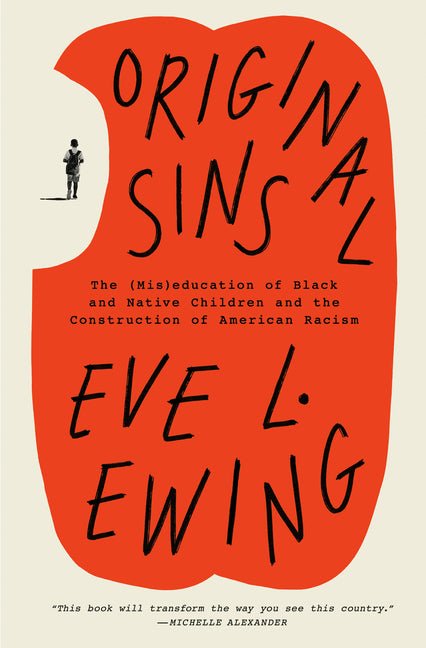
Original Sins: The (Mis)Education of Black and Native Children and the Construction of American Racism
)
Shop All Audiobooks
*When you open this audiobook on Libro.fm, be sure to select Aveson as your bookstore so that your purchase supports local literacy programs and tree‑planting.
Couldn't load pickup availability
NEW YORK TIMES BESTSELLER - "A fascinating and eye-opening look at how American schools have helped build and reinforce an infrastructure of racial inequality . . . a must-read for every American parent and educator."--Esquire
"Though the argument of this book is bleak, it illuminates a path for a more just future that is nothing short of dazzling."--Oprah Daily
"This book will transform the way you see this country."--Michelle Alexander, author of The New Jim Crow
A BEST BOOK OF THE YEAR: The New Yorker, Esquire, Elle, Chicago Public Library - LONGLISTED FOR THE ANDREW CARNEGIE MEDAL
If all children could just get an education, the logic goes, they would have the same opportunities later in life. But this historical tour de force makes it clear that the opposite is true: The U.S. school system has played an instrumental role in creating and upholding racial hierarchies, preparing children to expect unequal treatment throughout their lives.
In Original Sins, Ewing demonstrates that our schools were designed to propagate the idea of white intellectual superiority, to "civilize" Native students and to prepare Black students for menial labor. Education was not an afterthought for the Founding Fathers; it was envisioned by Thomas Jefferson as an institution that would fortify the country's racial hierarchy. Ewing argues that these dynamics persist in a curriculum that continues to minimize the horrors of American history. The most insidious aspects of this system fall below the radar in the forms of standardized testing, academic tracking, disciplinary policies, and uneven access to resources.
By demonstrating that it's in the DNA of American schools to serve as an effective and underacknowledged mechanism maintaining inequality in this country today, Ewing makes the case that we need a profound reevaluation of what schools are supposed to do, and for whom. This book will change the way people understand the place we send our children for eight hours a day.
Share
Book Details
- ISBN
- 9780593243701
- Binding
- Hardcover
- Publisher
- One World
- Published Date
- February 11, 2025
- Pages
- 400
- Physical Info
- 1.3 in H x 9.3 in L x 6.6 in W (1.5 lb)

I bought this hard back copy brand new, or so I thought. I opened it up and there are stains on the book throughout the pages.- some kind of dried substance that I don’t know what it is. Very disappointed.
Every teacher should read this book.
I agree with the author that the public education system is broken Other than that this book is totally racist garbage.
A phenomenal work on how American schools were shaped by slavery and colonialism, exacting a lasting toll on the descendants of Africans enslaved by white settlers, and the indigenous inhabitants of Turtle Island decimated by the settlers’ genocidal onslaught.
Ewing's work is seminal in the history of education - and the steps necessary to change our broken system.The text begins by outlining the history of education in the United States. From the beginning, the education system painted a clear picture for how Black and Native students would be treated: as laborers who lacked the intelligence and culture to be of any value to the white supremacist, capitalist society. For Black students, this met education in agriculture and labor; for Native students, it meant forced assimilation and the erasure of their culture. From the beginning, these ideas were reflected in education policies and the foundation of schools for these students.Then, Ewing discusses the way that these ideas continue to influence our education systems today. With "tracks" designed primarily for minority students seen as incapable, poorly funded Black schools, and a system designed to punish, exclude, and "civilize" Black and Native students, the United States's education system continues to perpetuate these ideas built into the education system centuries before.Ultimately, Ewing argues for a new system of education. The inclusion of Black and Native peoples - working together to address their shared struggles - could create a new education system designed to work for our children. Instead of centering on vocational training and punishment, it should focus on love, respect, and higher expectations for our children. While Ewing acknowledges that this will not be easy - and may look vastly different from the "schools" we have now - she makes it clear how vital it is to change before it is too late.Ewing's work is well-researched, clearly and concisely argued, and beautifully written. Her work is vital to the field of education. It forces all teachers to take a look at our education system to make radical changes to centuries of racism built into society.