
Skip to product information
1 of 1

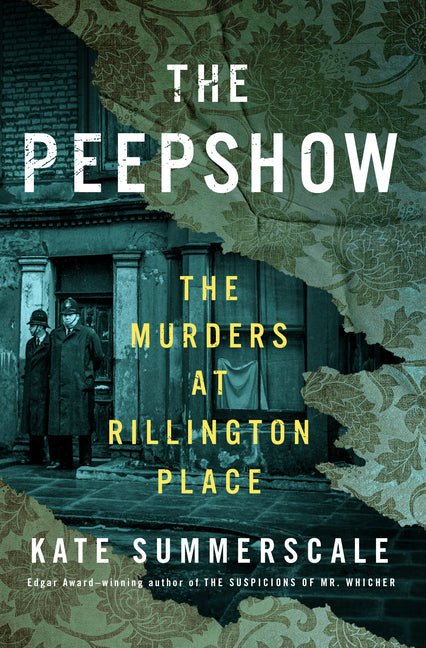
The Peepshow: The Murders at Rillington Place

by Kate Summerscale

Regular price $25.50 USD
Regular price $30.00 USD Sale price $25.50 USD
Sale Sold out
Book cover type
Quantity

"A trove of thrilling material . . . skillfully examines the racism, sexism, economic privation and class prejudices that permeated postwar England . . . There's so much to admire in this engaging, deeply researched book." --The New York Times Book Review

"An absorbing portrait of post-WWII London." --Booklist

*A New York Times Book Review Editors' Choice * Named a Best Book of 2024 by FT * Nominated for the Women's prize for nonfiction*

From the Edgar Award-winning author of  The Haunting of Alma Fielding, the tale of two journalists competing to solve the notorious Christie murders in postwar London

In March 1953, London police discovered the bodies of three young women hidden in a wall at 10 Rillington Place, a dingy rowhouse in Notting Hill. On searching the building, they found another body beneath the floorboards, then an array of human bones in the garden. They launched a nationwide manhunt for the tenant of the ground-floor apartment, a softly spoken former policeman named Reg Christie. But they had already investigated a double murder at 10 Rillington Place three years before, and the killer was hanged. Did they get the wrong man?

The story was an instant sensation. The star reporter Harry Procter chased after the scoop on Christie. The eminent crime writer Fryn Tennyson Jesse begged her editor to let her cover the case. To Harry and Fryn, Christie seemed a new kind of murderer: he was vacant, impersonal, a creature of a brutish postwar world. Christie liked to watch women, they discovered, and he liked to kill them. They realized that he might also have engineered a terrible miscarriage of justice.

In this riveting true story, Kate Summerscale mines the archives to uncover the lives of Christie's victims, the tabloid frenzy that their deaths inspired, and the truth about what happened inside the house. What she finds sheds fascinating light on the origins of our fixation with true crime--and suggests a new solution to one of the most notorious cases of the century.

Book Details

ISBN
0593653637
Binding
Hardcover
Authors
Kate Summerscale
Publisher
Penguin Press
Published Date
May 6, 2025
Language
English
Pages
320
Physical Info
1.3 in H x 9.2 in L x 6.4 in W (1.05 lb)
View full details
  • 5 stars: 5 (42%)
  • 4 stars: 2 (17%)
  • 3 stars: 4 (33%)
  • 2 stars: 0 (0%)
  • 1 star: 1 (8%)
m
mr aeburne

superb book fantastic reading could not put the book down was totally immersed BRILLIANT FIVE STAR READ.

S
Sherlock

This is not a definitive account of the Rillington Place murders; that aspect has been covered by previous authors. Instead this book describes the victims of Christie and those who had narrow escapes with a level of sympathetic detail not found in the earlier works on the case. The coverage of the case by Harry Procter, star reporter of the Sunday Pictorial, showed that the amorality of gutter journalism is not a new phenomenon. The more restrained writings of Fryn Tennyson Jesse, also covered here, provide a counterbalance.Above all, the book paints a drab, grey picture of post-war life in the slums of North Kensington. As such it is a valuable, well-written addition to the earlier books by Eddowes (senior), Kennedy and Oates. Recommended.

M
Martynrb

I'm afraid this book is all over the place and feels padded out. It's part social history of the 'how horrible the people of the past were' kind, often only loosely to do with the case if at all, and has a clear left-wing feminist slant.She even quotes the Socialist Worker, blaming capitalism for the murders, and of course there are no 'prostitutes', only 'street workers' and 'street walkers'. The people who were drawn to Rillington Place after the murders were ghouls - except a group of womern who tried to break in who are exempt from criticism because they just wanted to enter the killer's lair and see the scene of domestic horror.It's also part biography of two people: a sensationalist journalist who covered the story, and a random writer whose only link with the case is that she managed to blag a seat in court and only seems to have been included because she was a female. Nevertheless, you will end up knowing as much about her life as Christie's, if not more.It's a bizarre mix, but the Christie parts of the story are inevitably interesting because it's a fascinating case.

C
C. Hale

Summerscale efficiently tells a much told story which exposes the sordid underside of Britain at the dawn of the Elizabethan era. But the narrative is padded out - no doubt in recognition of its much ploughed nature - by sub narratives about the journalists covering and exploiting the case and trial voyeur Fryn Tennyson. The upshot seems to be that Evans was the provocateur of his wife and child’s murders at the hands of Christie. The peepshow theme is rather plodding, unfortunately.

r
robert armstrong

I ordered this book from AMAZON and it never arrived but Amazon took the money-not impressed.Items OrderedPriceThe Peepshow: The thrilling new page-turner from Britain’s top-selling true crime writer[Kindle Edition]By: Kate SummerscaleSold by: Amazon Australia Services, Inc.Qty: 1$16.29Item(s) Subtotal: $14.81----Total Before Tax: $14.81Tax Collected: $1.48----Total for this order: $16.29

J
Jim Bowen

The murders at 10 Rillington Place are some of the most infamous murders in British criminal history. Some were definitely committed by Reg Christie. The question is, were the 2 committed years before murdered by Christie or Timothy Evans, the husband of one of the earlier victims.This book reexamines the case anew, and does well taking the framing from Christie, and onto the victims, and sundry people observing the proceedings. At the end of the book Ms. Summerscale explains her point of view, trying to explain/address all the different issues have raised (alternatives to the “accepted wisdom we’re raised at the time, and later).To her credit, Ms. Summerscale raised an alternative theory that answered the issues she had with the other theories that have been raised during the years. Whether you accept her suggestions are down to you. They do seem to have some merit to them, given what’s written in the book.

K
Kindle Customer

Fascinating, detailed and evocative exploration of the notorious 10 Rillington Place case of the 1940s and 50s which on occasion brings it vividly and eerily to life.This case remains one of the great mysteries of British criminal history, perhaps second only to Jack the Ripper. What really happened at that notorious address in London's (at that time) run-down Notting Hill? This compelling book provides more detail about the people at the centre of this macabre case, and in particular the tragic female victims, than previous books and for that reason alone it's worth reading.But the conclusion it finally reaches is perfunctory and deeply suspect - that Evans may have 'hired' Christie to murder his wife Beryl. It doesn't stand up in terms of the characters involved, and their relationship, and also from a point of view of being at all believable. Part of the problem, of course, is that Christie and Evans were both pathological liars so you can barely believe a word either of them said as a 'confession'.When you look at the case, all the evidence, there's no doubt the clues point to Evans as the guilty party. Beryl's brother, Peter Thorley, who knew both Christie and Evans, is certain that Evans murdered her. But the case as a whole, exactly what happened and who murdered who, remains an intriguing mystery to this day. Nothing remains of Rillington Place now but the case haunts the human imagination!

S
Steven L.

It is a well written book that goes into the life of Christie and his murders. I thought the author wandered off the subject in some chapters. It could have done with some more photographs to enhance the book.

G
Giovanna Di Carlo

A brilliant written and researched book. I thoroughly enjoyed it, I took my time to savour it all. I've read everything available about this case. I still believe Christie guilty of both. It's SO obviously an inconvenience to the government of the time to re-open it and admit the miscarriage of justice and all it would entail. Just because Tim may have hit Beryl about, she also gave as good as she got, does not make him a murderer, rather a convenience to the prosecution to pin it on him.I'm stuck on the TIE that was not Tim's found around Geraldine's neck and Beryl's brother making much about her wedding ring she GAVE him to look after despite Tim selling it on...

G
Go Buy The Book

In 1953, residents in Rillington Place, Notting Hill, were filled with horror when the bodies of three women were found concealed in a wall at number 10. This was followed by the discovery of another body beneath the floorboards and human bones in the garden. While there appeared to be no doubt that the tenant of the house, Reg Christie, was the killer, those with longer memories felt a sense of unease: three years earlier there had already been a double killing at this property and a man was convicted and hanged. Did they get the wrong man?The story of 10 Rillington Place is one of the most well-known in British crime history yet in The Peepshow, Kate Summerscale has managed to tell the story from a whole new perspective, unearthing fascinating information in the process. This is not simply a retelling of what is already an infamous series of killings but instead, a look at the case from the eyes of others who were involved. By telling the story from the view of Harry Procter, a tenacious reporter, we see a completely different side of the case and also how determined he was to see justice for Timothy Evans, the man who was accused of the murder of his wife and daughter three years earlier.As in all of Kate Summerscale’s books, this is incredibly well researched, the author giving us a great insight into life in 1950s Notting Hill. What I found particularly fascinating was her research into prostitution at that time. Sex workers are traditionally portrayed as women compelled to sell their bodies out of desperation but here we see women in control of their own lives, earning more money than they would in other place of work. Of course, we also see the flip side with some of the women finding themselves never leaving 10 Rillington Place.If you are expecting a definitive answer as to whether Tim Evans did, indeed, kill his wife and daughter or whether their deaths were at the hands of Christie, you will not find in in The Peepshow. What Kate Summerscale has done is provide the evidence in a thought-provoking way, leaving you to weigh up the options yourself.Ever since reading The Suspicions of Mr Whicher, I have always eagerly anticipated anything else by Kate Summerscale and in The Peepshow, she has written another top notch book.

m
mjgman63

I have read quite a few books on the murders at 10 Rillington Place, including of course the classic by Ludovic Kennedy. So I was delighted to buy this one as soon as it came out, especially as it is written by an author with the record and reputation of Kate Summerscale. And I wasn't disappointed. There is loads of detail which was new to me, and a novel feature was the focus on Harry Procter, the famous/notorious crime reporter whom I've seen mentioned in so many other true crime books about the 1940s/1950s. I also particularly liked the way that the infamous crimes are put into the context of their times - times when casual racism and sexism was prevalent and life wasn't by any means as rosy as it is now sometimes portrayed. No one will ever now know the truth of who did what to whom at 10 Rillington Place, but the author's theory at the end is as convincing as any I have read.

C
Canada Dry

This is an interesting book for bringing to light the experiences of many people who to greater or lesser extent were touched by these grisly murders but who have not previously been acknowledged. Around those directly involved were a plethora of families, relatives, friends and eyewitnesses whose stories the author seeks to tell. There is, however, an element of contemporary feminist revisionism in focussing on women as perennial victims of men. Some may agree with that but there were and are other stories. To be fair the author recovers Christie's unfortunate female victims from near anonymity and it is surprising how young they were. Perhaps the most disappointing aspect of the book is the lack of photographs apart from the two inside covers with views of the infamous house. Not to be prurient about it, but the author describes many of those involved in physical detail without including photographs of any of them! Not even one of the murderer Christie himself or the newspaper reporter she weaves the story around. This seems an unfortunate omission in a book which seeks to, and succeeds, in bringing to life the rather grim atmosphere of late 1940s and early 1950s London.
