
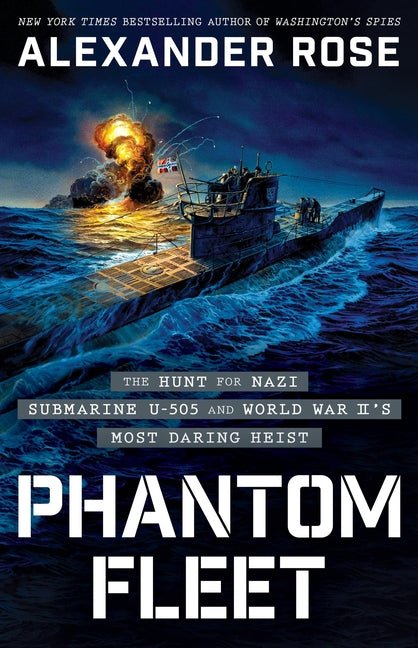
Phantom Fleet: The Hunt for Nazi Submarine U-505 and World War II's Most Daring Heist
Couldn't load pickup availability
From the New York Times bestselling author of Washington's Spies, "a page-turning thriller" (James M. Scott) about one of the greatest heists in history: the U.S. Navy’s clandestine capture of a Nazi U-boat at the climax of World War II.
Shortly before noon on June 4, 1944, the sonar operator on a destroyer prowling off the coast of West Africa heard a sharp, metallic ping. The sound could mean only one thing: The German submarine that their hunter-killer group had been tracking, U-505, was lurking somewhere below. The ensuing struggle between exhausted hunter and venomous prey would make history when American sailors boarded an enemy warship at sea for the first time since the War of 1812.
That day’s victory was the culmination of an unrelenting campaign against the Nazi submarine threat by the U.S. Navy’s “Tenth Fleet”—a mysterious unit that could predict the locations and movement of Hitler’s U-boats. Run by Commander Kenneth Knowles, Tenth Fleet had guided Captain Dan Gallery to U-505; to repay the favor, Gallery was going to steal an Enigma machine for him.
Now all they had to do was to make an entire U-boat, its crew, and its secrets vanish into thin air...
In this swashbuckling adventure story, bestselling historian Alexander Rose draws on long-classified encrypted documents and intercepted German transmissions to reveal in full, for the first time, how an owlish egghead and a glory-seeking buccaneer teamed up to score the richest prize on the high seas.
Share
Book Details
- ISBN
- 0316564478
- Binding
- Hardcover
- Authors
- Alexander Rose
- Publisher
- Little Brown and Company
- Published Date
- May 20, 2025
- Language
- English
- Pages
- 352
- Physical Info
- 0.96 in H x 9.41 in L x 6.38 in W (1.23 lb)

An extremely interesting and well-done book on the lesser-known area of the intelligence work done in WW2. We know of the code breaking done by the Allies, but the extent to which it was used was not widely publicized. The "Tenth Fleet" is an example of that work. The author does an excellent job of providing the background story and main characters and how they came together to capture the U505. While the book's main theme is this capture, it goes beyond to give you all of the story happening in the background. This book is highly recommended for the historical fan looking for hidden gems and stories from WW2.
Well-written with excellent detail, but not so much as to be boring. I wouldn't call it a thriller, but it was engaging. I learned a lot about sub warfare in WWII.
I joined the Navy to be on submarines. One of my first schools was near Chicago where I 1st saw the U505. That was over 50 years ago I knew some of the story, but not the full story. This book was very well written full pf historical facts.
I've heard bits and pieces of these stories of warfare on the Atlantic but could never find a book. Who knew Mr.Rose was reading my mindNow for the best part, U-505 is the submarine that's on display at the Museum of Science and Industry in Chicago (building was part of the White City)There are pictures and videos on the internet of the big move.Great book, more of a thriller than dry historyHighly recommend
During the war years, the German wolf packs were raising havoc with the upper East Coast on the United States. They then brought that war to the Atlantic, and the United States navy at large.U-Boat 505 was a game changer for the second Great War. With the Germans pressing their advantage of naval superiority, and having a code that was near impossible to break, the Allies were grasping at straws. They needed to break the stranglehold that the U-boats held on the oceans. As small bits of information became available, and cracking the Enigma code, the Allies and United States started to get a better picture of the German plans and how they were operating.As the war continues, the United States start to see some small cracks, and begin to exploit the information they have, much to the chagrin of Bletchley Park in England. As the war continues, it did become apparent that the United States was slowly passing England in military superiority.With information that was coming in, the United States that they knew they had to break the back of the U-boats, and gain the information that they hold on board. So began the mission to capture a U-boat, intact, to change the fortunes of war.This book was so fantastic. I really enjoyed reading through it, Submarine warfare has been one of my favorite topics for decades. Alexander Rose did a great job in bringing this chapter of military history to life. For those that really love military history, this book is going to be a top read for you this year.This is a highly recommended read!
- 5 stars: 6 (86%)
- 4 stars: 1 (14%)
- 3 stars: 0 (0%)
- 2 stars: 0 (0%)
- 1 star: 0 (0%)
An extremely interesting and well-done book on the lesser-known area of the intelligence work done in WW2. We know of the code breaking done by the Allies, but the extent to which it was used was not widely publicized. The "Tenth Fleet" is an example of that work. The author does an excellent job of providing the background story and main characters and how they came together to capture the U505. While the book's main theme is this capture, it goes beyond to give you all of the story happening in the background. This book is highly recommended for the historical fan looking for hidden gems and stories from WW2.
Well-written with excellent detail, but not so much as to be boring. I wouldn't call it a thriller, but it was engaging. I learned a lot about sub warfare in WWII.
I joined the Navy to be on submarines. One of my first schools was near Chicago where I 1st saw the U505. That was over 50 years ago I knew some of the story, but not the full story. This book was very well written full pf historical facts.
I've heard bits and pieces of these stories of warfare on the Atlantic but could never find a book. Who knew Mr.Rose was reading my mindNow for the best part, U-505 is the submarine that's on display at the Museum of Science and Industry in Chicago (building was part of the White City)There are pictures and videos on the internet of the big move.Great book, more of a thriller than dry historyHighly recommend
During the war years, the German wolf packs were raising havoc with the upper East Coast on the United States. They then brought that war to the Atlantic, and the United States navy at large.U-Boat 505 was a game changer for the second Great War. With the Germans pressing their advantage of naval superiority, and having a code that was near impossible to break, the Allies were grasping at straws. They needed to break the stranglehold that the U-boats held on the oceans. As small bits of information became available, and cracking the Enigma code, the Allies and United States started to get a better picture of the German plans and how they were operating.As the war continues, the United States start to see some small cracks, and begin to exploit the information they have, much to the chagrin of Bletchley Park in England. As the war continues, it did become apparent that the United States was slowly passing England in military superiority.With information that was coming in, the United States that they knew they had to break the back of the U-boats, and gain the information that they hold on board. So began the mission to capture a U-boat, intact, to change the fortunes of war.This book was so fantastic. I really enjoyed reading through it, Submarine warfare has been one of my favorite topics for decades. Alexander Rose did a great job in bringing this chapter of military history to life. For those that really love military history, this book is going to be a top read for you this year.This is a highly recommended read!
Nerds can do some really cool things. No, I am not talking about myself (but thank you for thinking about me!). Instead, I am talking about the nerds who fought the Battle of the Atlantic in World War II. The Germans had their nerds. The U.S. and U.K. had Ultra nerds. (Do you see what I did there?) Alexander Rose tells their story in Phantom Fleet.Sure, you may ask yourself why should we care about nerds? We want men of action! Don't you worry, dear reader. Rose's book culminates in one of the most ridiculous heists in warfare history. I should stress that the book is not a quick rundown of one day where a U.S. hunter-killer group tracked a U-boat down for a final battle. Rose takes his time setting up the board by giving the reader a deep look into naval intelligence and the men who were moving the pieces around. The Germans were winning until they weren't. The U.S. figured things out until they didn't. The U.K. was leading the intelligence war until they were left behind.There was a lot of one-upsmanship even among the Allies. Rose brings all of these men to life so the reader can understand who they are and why they acted the way they did. For some of them, their instincts would lead to ruin while others would be lauded for being the first Americans to board an enemy warship since 1812. I've read multiple books by Rose and he seems to get better with each release. There is no letdown with this one.(This book was provided as an advanced reader copy by Netgalley and Little, Brown and Company.)
What an informative and entertaining book! It read more like a thriller than a military naval history book. The depth of the research gave insight into the men and the mission to capture a German U-boat. It brought to life the efforts of the U.S. intelligence officers, their superiors, and their British and German counterparts as they played a cat-and-mouse game.Beginning in 1942, with German U-boats off the eastern coast of the United States disrupting supply shipments, to the capturing of a U-boat in 1944, this story unfolds from the perspective of the U.S. and German naval officers. Along the way, the book recounts the critical work done by the British to crack the German Enigma encrypting device and how the U.S. used the information to hunt down the elusive U-boats and break the back of the German Navy.I liked how Rose got into the personalities of the men involved, making it an intimate read with a depth not otherwise achievable. Owing to his conversational writing, the book is a captivating account of a single incident during World War II, highlighting its relationship to the war effort. I don't usually read World War II-era books, but I'm glad I made an exception for this book. 5/5 stars l
)
)