

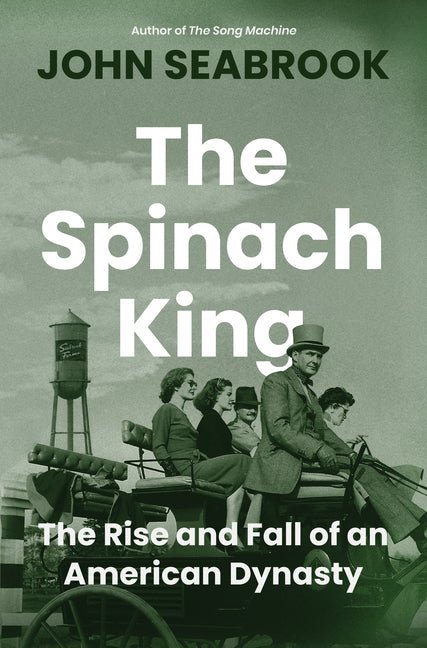
The Spinach King: The Rise and Fall of an American Dynasty
Couldn't load pickup availability
A New York Times Book Review Editor's Choice
One of The Christian Science Monitor's 10 best books of June 2025
The riveting saga of the Seabrook Family, by one of The New Yorker’s most acclaimed storytellers.
“Having left this material for his writer son, my father must have wanted the story told, even if he couldn’t bear to tell it himself.” So begins the story of a forgotten American dynasty, a farming family from the bean fields of southern New Jersey who became as wealthy and powerful as aristocrats—only to implode in a storm of lies.
The patriarch, C. F. Seabrook, was hailed as the “Henry Ford of Agriculture.” His son Jack, a keen businessman, was poised to take over what Life called “the biggest vegetable factory on earth.” But the carefully cultivated facade—glamorous outings by horse-drawn carriage, hidden wine cellars, and movie star girlfriends—hid dark secrets that led to the implosion of the family business.
At the heart of the narrative is a multi-generational succession battle. It’s a tale of family secrets and Swiss bank accounts, of half-truths, of hatred and passion—and lots and lots of liquor. The Seabrooks’ colorful legal and moral failings took place amid the trappings of extraordinary privilege. But the story of where that money came from is not so pretty
They say behind every great fortune there is a great crime. At Seabrook Farms, the troubling American histories of race, immigration, and exploitation arise like weeds from the soil. Great Migration Black laborers struck against the company for better wages in the 1930s, and Japanese Americans helped found a “global village” on the farm after World War II. Revealing both C. F. and Jack Seabrook’s corruption, The Spinach King undermines the “great man” theory of industrial progress. It also shows how American farms evolved from Jeffersonian smallholdings to gigantic agribusinesses, and what such enormous firms do to the families whose fate is bound up in the land.
A compulsively readable story of class and privilege, betrayal and revenge—three decades in the making—The Spinach King explores the author’s complicated family legacy and the dark corners of the American Dream.
Share
Book Details
- ISBN
- 1324003529
- Binding
- Hardcover
- Authors
- John Seabrook
- Publisher
- W. W. Norton & Company
- Published Date
- June 3, 2025
- Language
- English
- Pages
- 368
- Physical Info
- 1.09 in H x 9.21 in L x 6.38 in W (1.29 lb)
Great
A very interesting story, I enjoyed the period descriptions of the clothes and social interactions over several decades. They lived a decadent lifestyle and in the end, greed and jealousy took it all. The narration was superb.
Fascinating story
John Seabrook’s memoir is a story of family legacy with the weight of inheritance in all its forms: emotional, material, and generational.The Spinach King, refers to his eccentric father, who once built a frozen spinach empire, before mental illness and time unraveled his grip on both his business and his family. Seabrook sifts through old documents, letters, and memories to reconstruct not just his father's unraveling, but also the complex web of class, greed, ambition, and denial that shaped his family’s American dream.I found it interesting to read about Seabrook Farms because I grew up nearby and was familiar with the towns and the geography of South Jersey, along with the corrupt politicians people talked about. I even remember the packaging of the Seabrook Farms frozen creamed spinach we bought at the local grocery store.The narrative is introspective, balancing journalistic precision with raw emotional honesty. Seabrook, best known for his work in The New Yorker, brings a journalist’s curiosity to his own family’s past—treating it like a case study in privilege, dysfunction, and fading aristocracy. He captures the racist and class prejudices of his father, the quiet resilience of his mother, and his own place as a son caught between admiration and resentment.Also included are minute details about crops: the growth rates, planting dates, etc. which can be a little dry. However, the excellent narrator, Dion Graham, made it easy to listen to. He made it seem as if John Seabrook was talking directly to the reader / listener.The Spinach King succeeds as both a personal memoir and a subtle critique of the American elite’s contradictions: its love of order and appearances, its silence around mental health, and its unspoken rules of legacy. It’s a slow burn—but one that leaves a lasting impression.
Very interesting nonfiction book about the rise and fall of the Seabrook family from New Jersey that created a frozen vegetable empire.. The narrator did a great job as well.
- 5 stars: 6 (50%)
- 4 stars: 6 (50%)
- 3 stars: 0 (0%)
- 2 stars: 0 (0%)
- 1 star: 0 (0%)
Great
A very interesting story, I enjoyed the period descriptions of the clothes and social interactions over several decades. They lived a decadent lifestyle and in the end, greed and jealousy took it all. The narration was superb.
Fascinating story
John Seabrook’s memoir is a story of family legacy with the weight of inheritance in all its forms: emotional, material, and generational.The Spinach King, refers to his eccentric father, who once built a frozen spinach empire, before mental illness and time unraveled his grip on both his business and his family. Seabrook sifts through old documents, letters, and memories to reconstruct not just his father's unraveling, but also the complex web of class, greed, ambition, and denial that shaped his family’s American dream.I found it interesting to read about Seabrook Farms because I grew up nearby and was familiar with the towns and the geography of South Jersey, along with the corrupt politicians people talked about. I even remember the packaging of the Seabrook Farms frozen creamed spinach we bought at the local grocery store.The narrative is introspective, balancing journalistic precision with raw emotional honesty. Seabrook, best known for his work in The New Yorker, brings a journalist’s curiosity to his own family’s past—treating it like a case study in privilege, dysfunction, and fading aristocracy. He captures the racist and class prejudices of his father, the quiet resilience of his mother, and his own place as a son caught between admiration and resentment.Also included are minute details about crops: the growth rates, planting dates, etc. which can be a little dry. However, the excellent narrator, Dion Graham, made it easy to listen to. He made it seem as if John Seabrook was talking directly to the reader / listener.The Spinach King succeeds as both a personal memoir and a subtle critique of the American elite’s contradictions: its love of order and appearances, its silence around mental health, and its unspoken rules of legacy. It’s a slow burn—but one that leaves a lasting impression.
Very interesting nonfiction book about the rise and fall of the Seabrook family from New Jersey that created a frozen vegetable empire.. The narrator did a great job as well.
A riveting inside account of the arc of a major American corporation. For anyone with South Jersey associations, this book holds much additional interest.
This book was so well written and well researched. The author was a most enlightened person to be able to see his family history clearly, flaws and all. I was very interested in the description of the growth of the business across generations. The author's grandfather was pretty awful to his family. I really liked the style and way the author described his ancestors. It was a most absorbing book!
A very fine effort by author John Seabrook who documents a fascinating look in the family memoir about Seabrook Fams, one of the early food giants in America. Seabrook investigates his families known and hidden history, a history that began in England and with his great-great grandfather who was erased from history by the authors greart grandfather - not exactly sure as to why that occurred but is most likely due to the fact that his line of Seabrooks were serfs in England, and not related to the plutocratic Seabooks from South Carolina. We follow how AP and CF Seabrook built a small tract of land into a massive frozen food company and how CF was compared to Henry Ford thanks to his automation of the industry. Eventually AP is pushed out by CF, CF gives control to his sons (the authors dad and uncles) and then takes it back and sells the business. It is a story of power and pride, a story of blacks and Japanese Americans who worked on the farm for slave wages, so that the family could like like kings. The author details his fathers massive clothing closet, his coaching/carriage obsession, the huge wine collection, as well as how his dad was part of Grace Kelly's entourage at the wedding to the Prince of Monaco. And lets not forget about his dads affair with Eva Gabor! This is an eye-opening look at one families wealth and power, and some of the hidden secrets along the way.A definite 4.5**** for me!!
Fun read and very instructive. All families have issues, even the ones who appear to be very successful.A bit disappointed with a factual error in the book.The Queen did NOT give Princess Margaret the plot on Mustique where she built her home. It was given to her by her lady in waiting, and her husband, the Baron and Baroness of Glenconnor.
In his WOW ,gripping, binge worthy , and raw non fiction family history, John Seabrook tells all about the rise and fall of his family’s frozen food dynasty. Meet Eva Gabor, Grace Kelly, The duke of Windsor……..syncophants, four in hand coaching champs, all of them the pals, the money handlers, and business alliances of the Seabrook Spinach Dynasty in a nearly 500 page non fiction account you won’t want to put down or, to end.John Seabrook bravely and brazenly calls out his family’s historic racism, antisemitism, elitist and waspy southern New Jersey pedigree .After this read…….you’ll reach for all the New Yorker brilliant, and archived food essays by John Seabrook
What a terrific, in this case personal, American saga of family, industry, society and agriculture. For me, a mixture of "Giant" and "Mad Men" but also a real family story of greed and accomplishment. John Seabrook (Jr?) is a terrific writer of non-fiction and uses this book partially to set the record straight for a) the many descendants of those who made their living from growing and packaging nutrious foods for our country; and b) the complicated relationships among his family.What a gift of a read for those who once only knew Seabrook Farms from their freezers but also John's children who have a father who has come to terms with a complicated legacy. I really liked the descriptions of the clothes and lifestyle striving of a father from the Class of '39 (Princeton).
A great story, very well written.

