
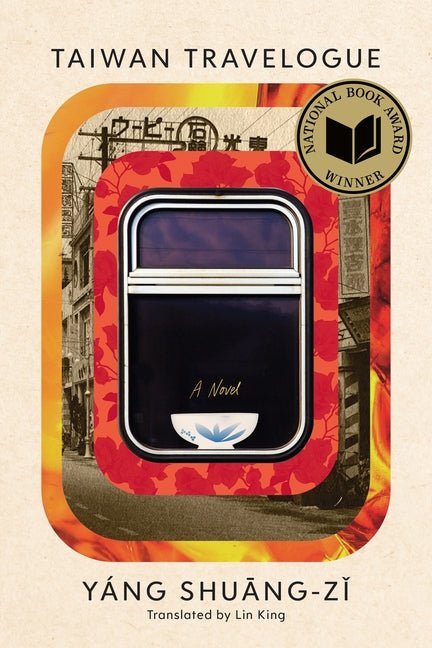
Taiwan Travelogue
Couldn't load pickup availability
WINNER OF THE 2024 NATIONAL BOOK AWARD FOR TRANSLATED LITERATURE
WINNER OF THE 2026 INTERNATIONAL BOOKER PRIZE
A bittersweet story of love between two women, nested in an artful exploration of language, history, and power
May 1938. The young novelist Aoyama Chizuko has sailed from her home in Nagasaki, Japan, and arrived in Taiwan. She's been invited there by the Japanese government ruling the island, though she has no interest in their official banquets or imperialist agenda. Instead, Chizuko longs to experience real island life and to taste as much of its authentic cuisine as her famously monstrous appetite can bear.
Soon a Taiwanese woman--who is younger even than she is, and who shares the characters of her name--is hired as her interpreter and makes her dreams come true. The charming, erudite, meticulous Chizuru arranges Chizuko's travels all over the Land of the South and also proves to be an exceptional cook. Over scenic train rides and braised pork rice, lively banter and winter melon tea, Chizuko grows infatuated with her companion and intent on drawing her closer. But something causes Chizuru to keep her distance. It's only after a heartbreaking separation that Chizuko begins to grasp what the "something" is.
Disguised as a translation of a rediscovered text by a Japanese writer, this novel was a sensation on its first publication in Mandarin Chinese in 2020 and won Taiwan's highest literary honor, the Golden Tripod Award. Taiwan Travelogue unburies lost colonial histories and deftly reveals how power dynamics inflect our most intimate relationships.
Share
Book Details
- ISBN
- 9781644453155
- Binding
- Paperback
- Authors
- Shuang-Zi Yang
- Publisher
- Graywolf Press
- Published Date
- November 12, 2024
- Language
- English
- Pages
- 320
- Physical Info
- 1 in H x 8.1 in L x 5.4 in W (0.9 lb)

With authors publishing so many thoroughly-appealing-to-me books that I would love to have time to read but the needed time is, unfortunately, not there, when “Taiwan Travelogue” by Yang Shang-Zi was to be my next read, I asked myself what there was about it that brought about my having ordered it.My memory from preliminary research on the book was that “Taiwan Travelogue” covered a Japanese author spending a year in Japanese-colonized Taiwan and she would greatly be into:(i) the island’s gourmet delights; and(ii) her Taiwanese interpreter (of appeal in so many ways), with the two young women’s desire for each other mutual, but they were shy about consummating their lingering love.The former (Taiwan’s food) would nowhere near make me want to buy “Taiwan Travelogue.” On the contrary, the latter (two women’s lengthy infatuation with each other but shy in consummating it) was compelling.The book basically, its totality, was continual conversations between (i) the Japanese intellectual (“Aoyama-san”) touring the island giving lectures, and (ii) her young interpreter she called Chi-chan. Aoyama-san took quite an interest in Taiwan’s culture, history, places… and particularly, very particularly: its food, its many kinds of food, and her young interpreter.When starting “Taiwan Travelogue,” right away the photo of the author (Yang), on the back cover, caught my eye and it was saying a lot. With her very short hair, her butch look, my perception was that she was eminently qualified to cover women’s love for each other.Yang and a scope of her “Taiwan Travelogue” was reminding me of Taiwanese Qiu Miaojin’s “Notes of a Crocodile” and “Last Words from Montmartre.” Qiu Miaojin’s books covered her love for women (back in the days when lesbians in Taiwan had better keep it secret). Qiu was the first to embrace her love of women in public.I mention this because would Yang’s book be similar to Qiu’s whereby the latter is continually covering her loves of women, you’re not getting to read of consummating that love, descriptions of sex, that is until: Qiu finally rewards the reader, and it is graphic!Would Yang’s “Taiwan Tavelogue” accomplish similar: Aoyama-san - after much trying (alcohol, continually trying to get Chi-chan to spend the night with her in her cottage…) - finally seducing Chi-chan?Gentle reader, you can read it to find out. - There will be no spoiler.
I loved this book. Dressed. As a travelogue, this novel deals with great sensitivity with colonialism and the complexity of social hierarchies around these constructions. Even without going deeper, the writing is beautiful and there are moments when you must simply stop to take it in. A wonderful, easy read.
This book won the Booker Prize this year, I read it in Chinese and I cannot wait to read it in English!!
Bought this book based on the award, and all the positive reviews. It shocks me that it is award winning and so many people liked it. So here is a little warning for the potential purchaser. This is a 2 note story. One is food obsession. If you are not at all familiar with the subtle differences of how different Asian cultures prepare obscure dishes, you will be bored. Then you also may find it distasteful that the author spends half the book taking about her appetite, what she is currently eating and what she wants to eat next. The 2nd note is the story of unrequited love. The author speaks of her female interpreter's physical beauty so often that you are not surprised when she after great struggle gets the interpreter to sleep one night in the same bed. No sex, just a one sided love affair that goes on and on and on. If the author was a man, he would have been condemned as a brute. In the final chapter the author shows a modicum of self awareness and calls herself a brute. It is too late, she has already indelibly imprinted herself in the reader's mind as incredibly selfish and obtuse. My final objection, is there is close to nothing about Taiwan's culture or history.
This is a novel depicting a Japanese novelist's cultural, gastronomic and historical travels on the island in the 30s , accompanied by her Taiwanese interpreter. It portrays, with great sensitivity, the developing relationship between the two women, which could not be divorced from history and the unequal position of Taiwan versus Japan.
)
)